
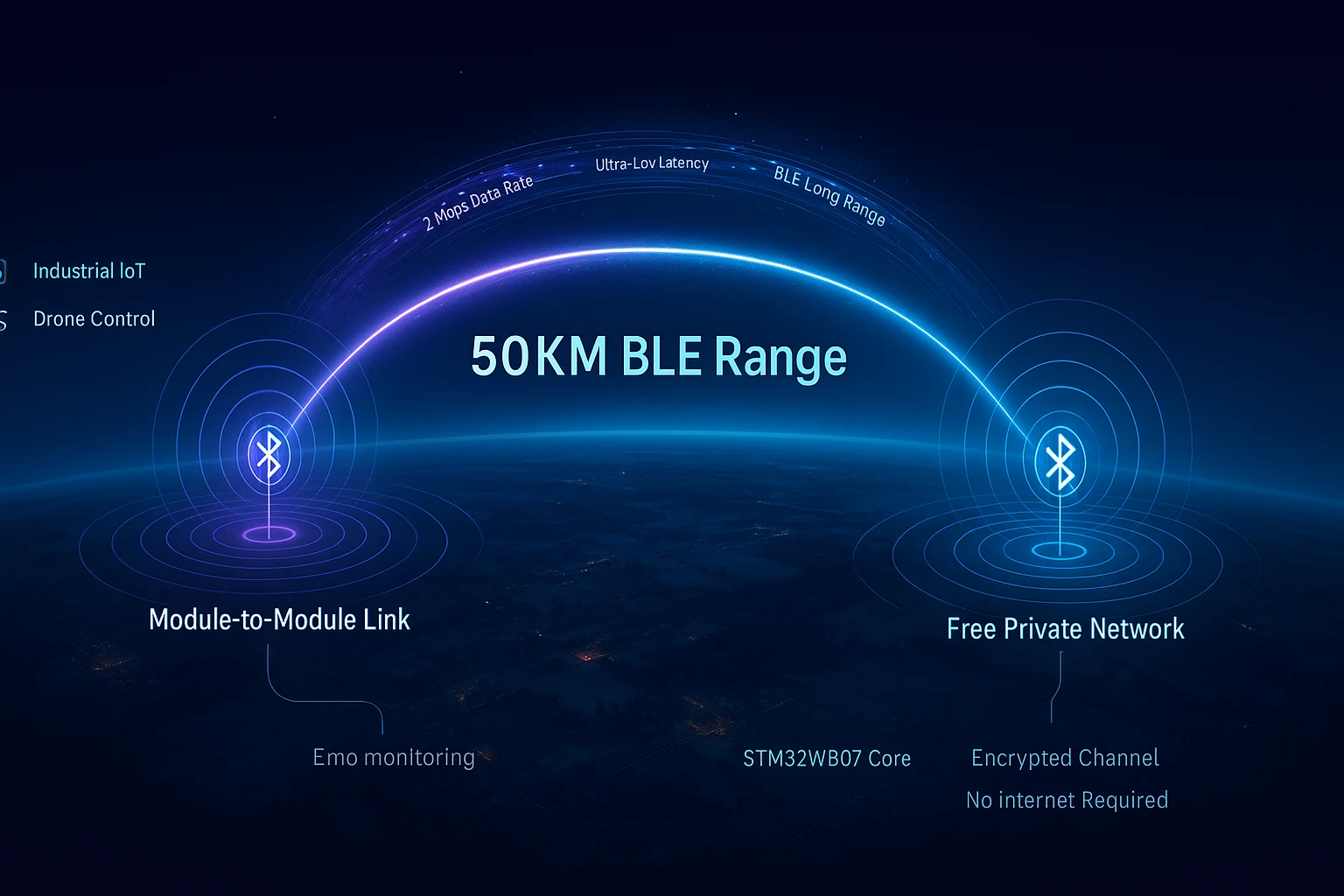
BLE Module Long Range: How the MultiNav Pro+ Achieves 50KM Over Bluetooth
RFOXiA Long Range Bluetooth Module
The BLE Module Long Range Revolution Starts Here
For years, Bluetooth meant short range. Commodity BLE modules shipped by the millions promise connectivity — but deliver somewhere between 10 and 100 meters under real-world conditions. That ceiling has frustrated drone builders, field researchers, robotics engineers, and IoT developers who need something more. Something that actually reaches.
The MultiNav Pro+ BLE module long range solution from RFOXiA breaks that ceiling entirely. Not by a little. By orders of magnitude.
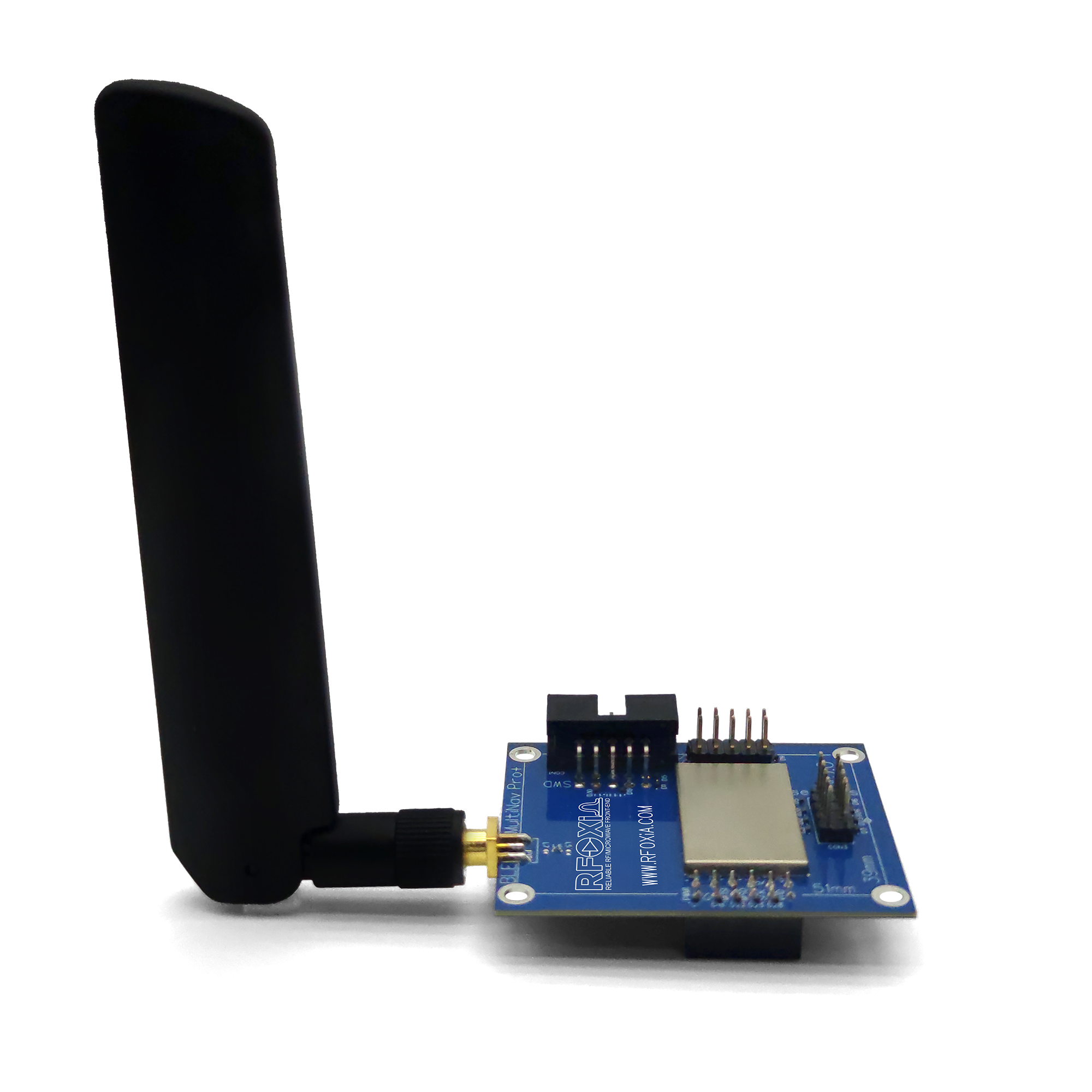
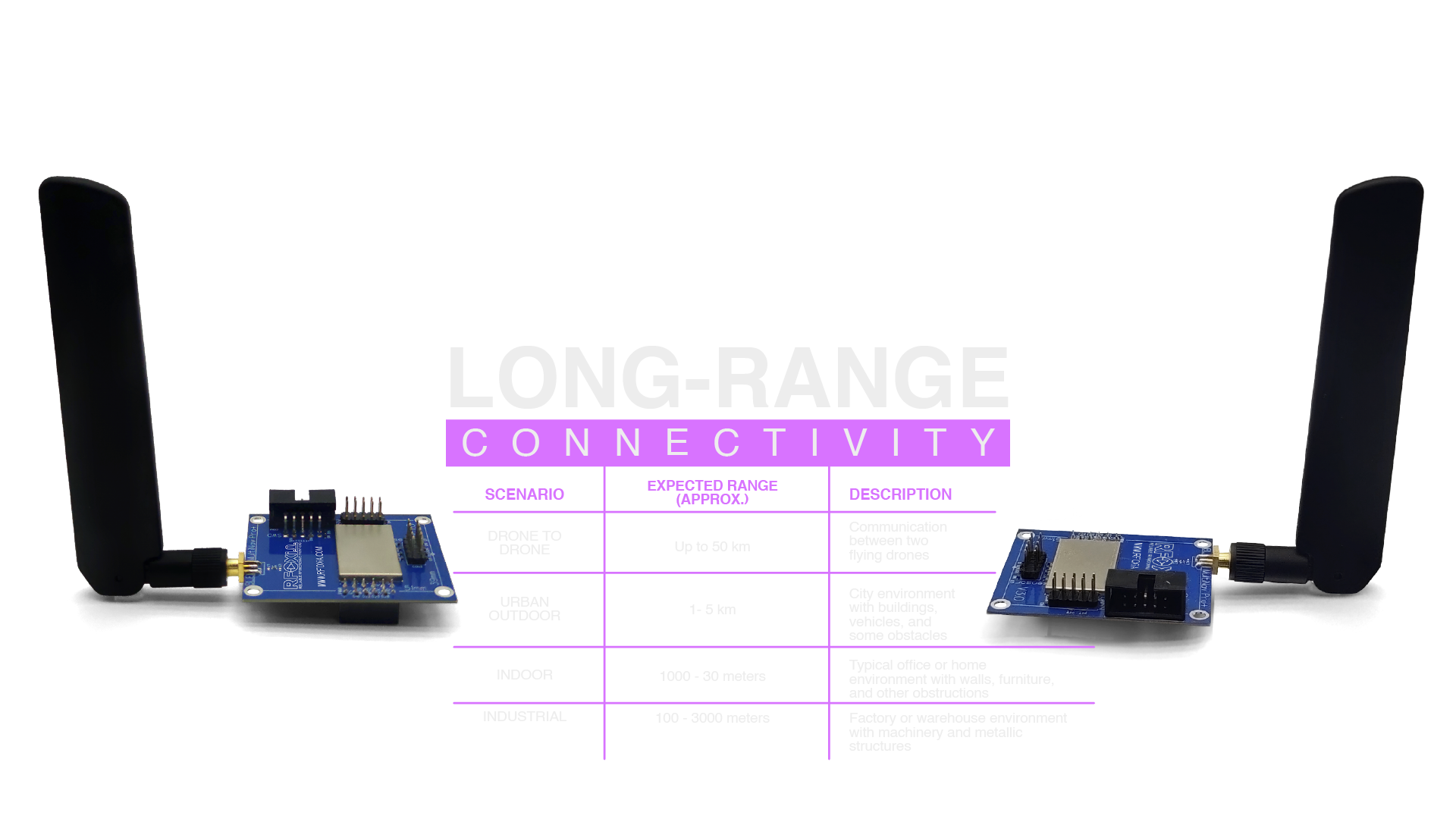
With a drone-to-drone range exceeding 50 kilometers, a man-to-drone range of 15 to 20 kilometers, and a ground-to-ground range of 5 kilometers when paired with a smartphone, the MultiNav Pro+ redefines what Bluetooth hardware can do — and it does it at a price point that every serious developer can reach.
This is not a incremental improvement. This is a category leap.
Why Long-Range BLE Has Been Impossible — Until Now
To understand why this achievement matters, you have to understand why standard BLE modules are so limited.
Off-the-shelf Bluetooth Low Energy chips are optimized for consumer electronics. Earbuds. Fitness trackers. Smart home devices. They are designed to be cheap, power-efficient, and to work within a room or across a house. Range is simply not a design priority.
When developers try to push commodity BLE modules beyond their rated range, they run into fundamental physics: signal attenuation, ground reflections, receiver sensitivity floors, and antenna gain limitations that no firmware tweak can fix.
The MultiNav Pro+ approaches the problem differently. RFOXiA's engineering team built a powerful RF front-end from the ground up — integrating external amplifiers, a high-gain chip antenna, and a precision RF path optimized for maximum receiver sensitivity. The result is a module that functions as a true long-range communication system while remaining fully Bluetooth-standard at the protocol level.
The 50KM drone-to-drone figure is achieved precisely because aerial deployment eliminates the ground reflections that limit terrestrial range. Two modules in the air, with clear line of sight, communicating over a link budget that commodity modules cannot come close to matching.
This is the BLE module long range performance that the professional developer community has been waiting for.
MultiNav Pro+ Specifications: The Numbers That Matter
Let's get into the hardware details that make this module exceptional.
Range Performance:
- Ground-to-ground (phone-to-phone via modules): 5KM
- Man-to-drone: 15–20KM
- Drone-to-drone: 50KM
Data Rate: 2 Mbps — fast enough for real-time control, sensor telemetry, live video metadata, and responsive bidirectional communication.
Processing Core: STM32WB07CCV6 — a dual-core architecture that simultaneously manages the BLE stack and your user application without performance compromise.
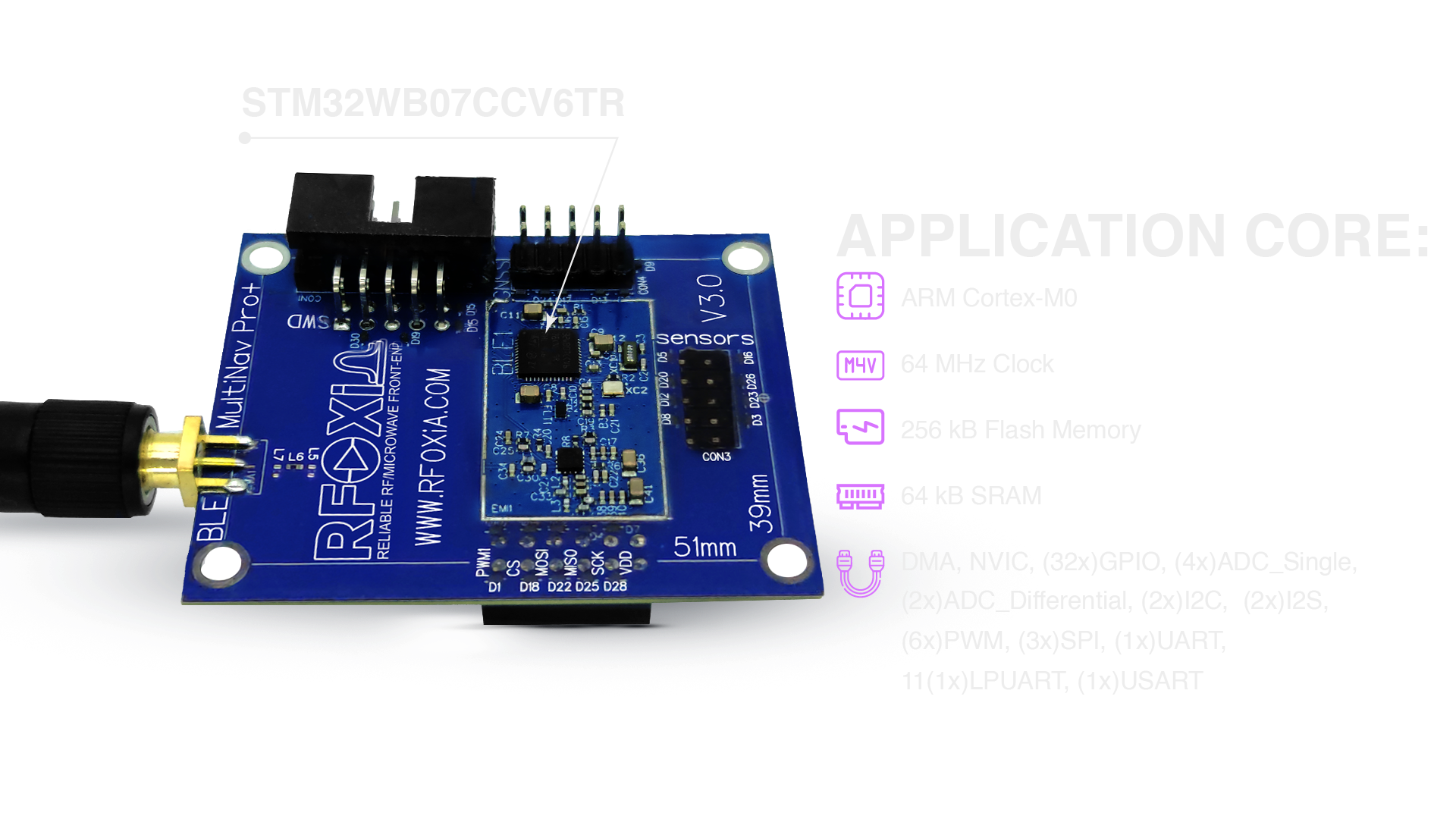
Form Factor: 57mm × 47mm module size, with a fixing frame of 54mm × 34mm featuring corner mounting holes. Antenna length of 140mm. Compact enough for tight airframes and constrained enclosures.
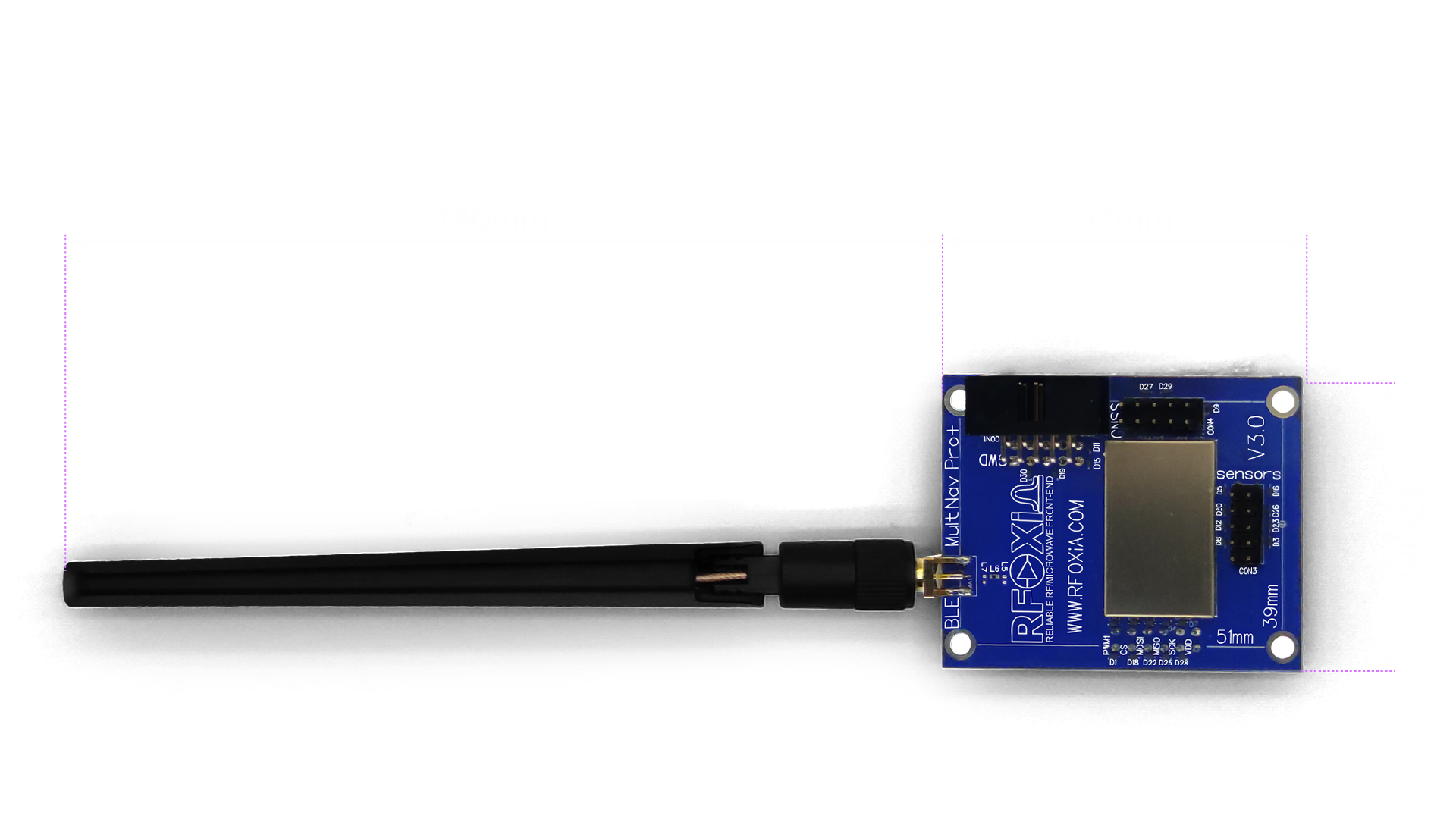
Antenna: Integrated high-gain chip antenna — no external antenna assembly required, no SMA connectors to break in the field.
RTC: Integrated RTC crystal for precise timing — critical for synchronized multi-node deployments, time-stamped sensor logs, and navigation applications.
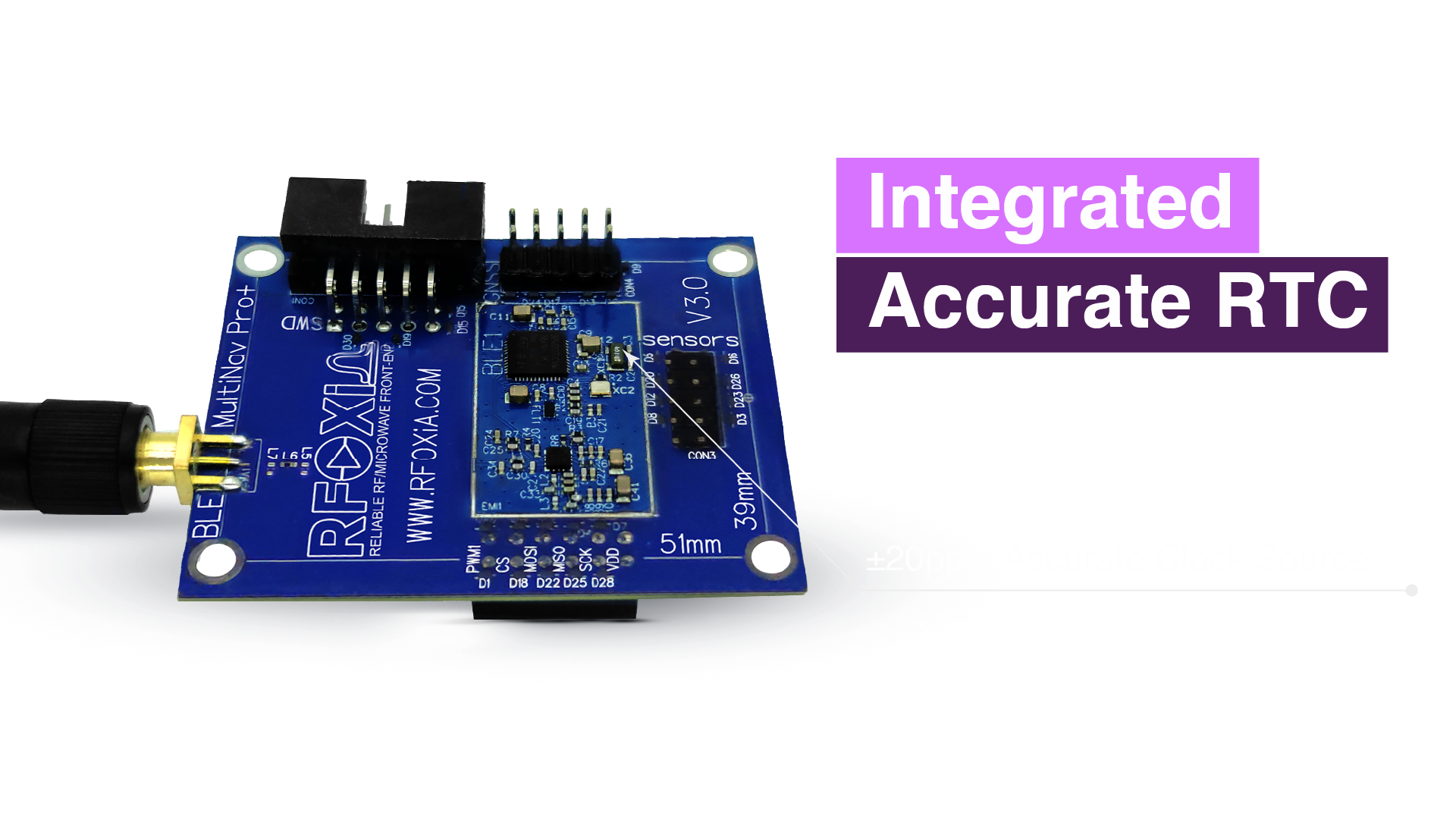
Certification: FCC certified — ready for commercial deployment, distribution through professional channels, and integration into products you sell.
Price: $59 for 2 units.
That last specification deserves to stand alone for a moment. Military-grade long-range wireless communication systems capable of these ranges cost $5,000 and up. Often significantly up. The MultiNav Pro+ delivers comparable range performance — for builders, by a builder — at a price that democratizes access to the technology entirely.
High-Speed Data Transmission at Long Range
Range is only half the story. A long-range link that delivers kilobits per second of usable throughput is not useful for modern applications.
The MultiNav Pro+ supports 2 Mbps data rate across its full operational range. This matters because real applications are data-hungry.
Drone telemetry streams flight controller data, GPS coordinates, battery status, and attitude information simultaneously. Robotic control systems need responsive, low-latency command delivery. Sensor networks push multiple data streams from multiple nodes. All of this demands bandwidth, not just range.
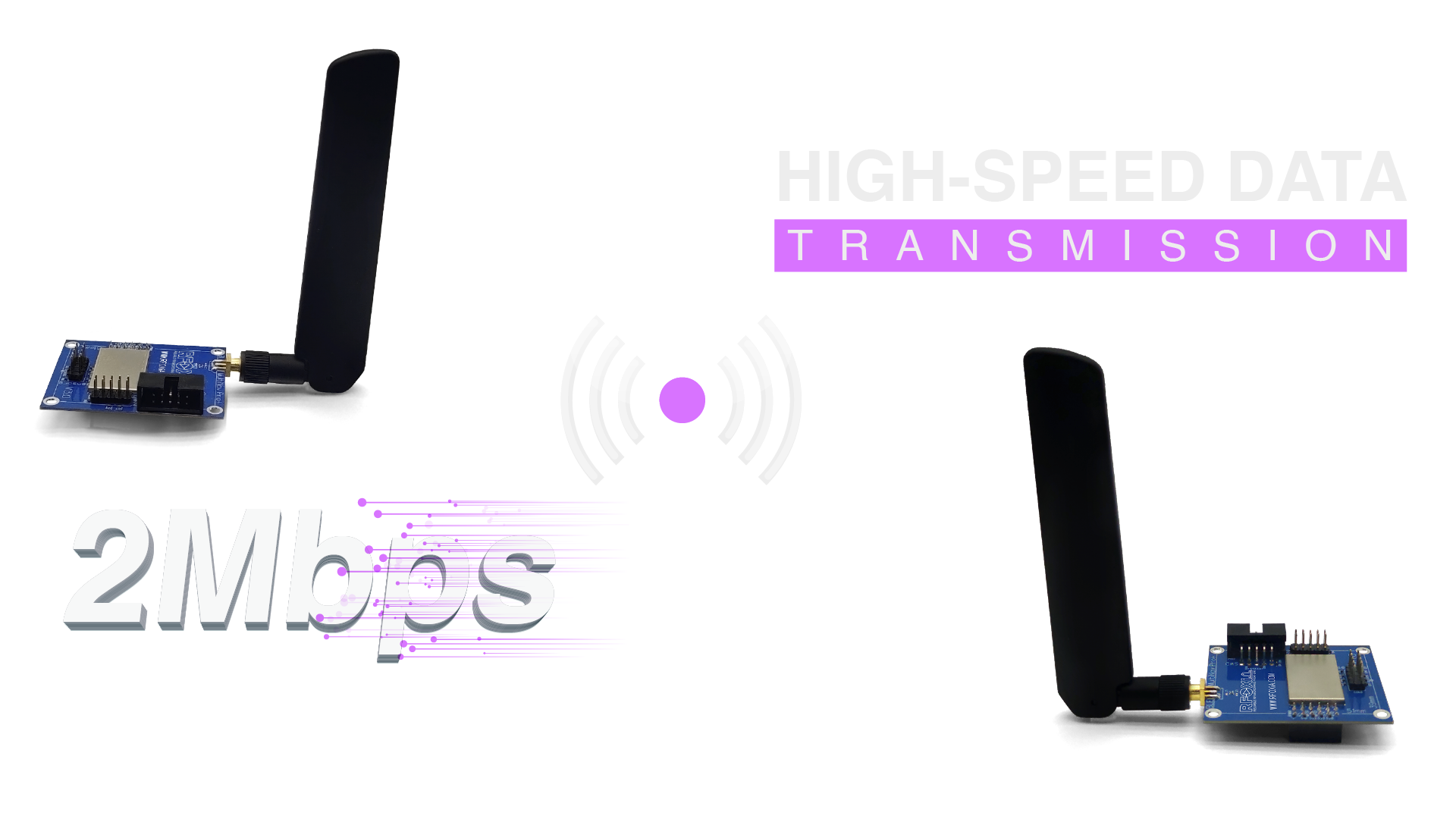
The 2 Mbps data rate combined with the module's range capability means you are not trading throughput for distance. You get both — a combination that simply does not exist elsewhere at this price point.
The RFOXiA Ecosystem: Built to Work Together
The MultiNav Pro+ BLE module is not a standalone component. It is the communication backbone of a complete, integrated hardware ecosystem designed for serious autonomous systems development.
The module features four distinct interface connectors:
- GNSS Interface — connects directly to the MultiNav Pro+ GNSS module for precise 1.5-meter accuracy at 18Hz fix rate
- Sensors Interface — connects to the Sensors module carrying temperature, humidity, pressure, air quality, accelerometer, gyroscope, and magnetometer
- Motor & Battery Management Interface — connects to motor controllers and battery management systems for full robotic and drone integration
- Programming Interface — integrated STLink-compatible SWD programming for firmware development and deployment
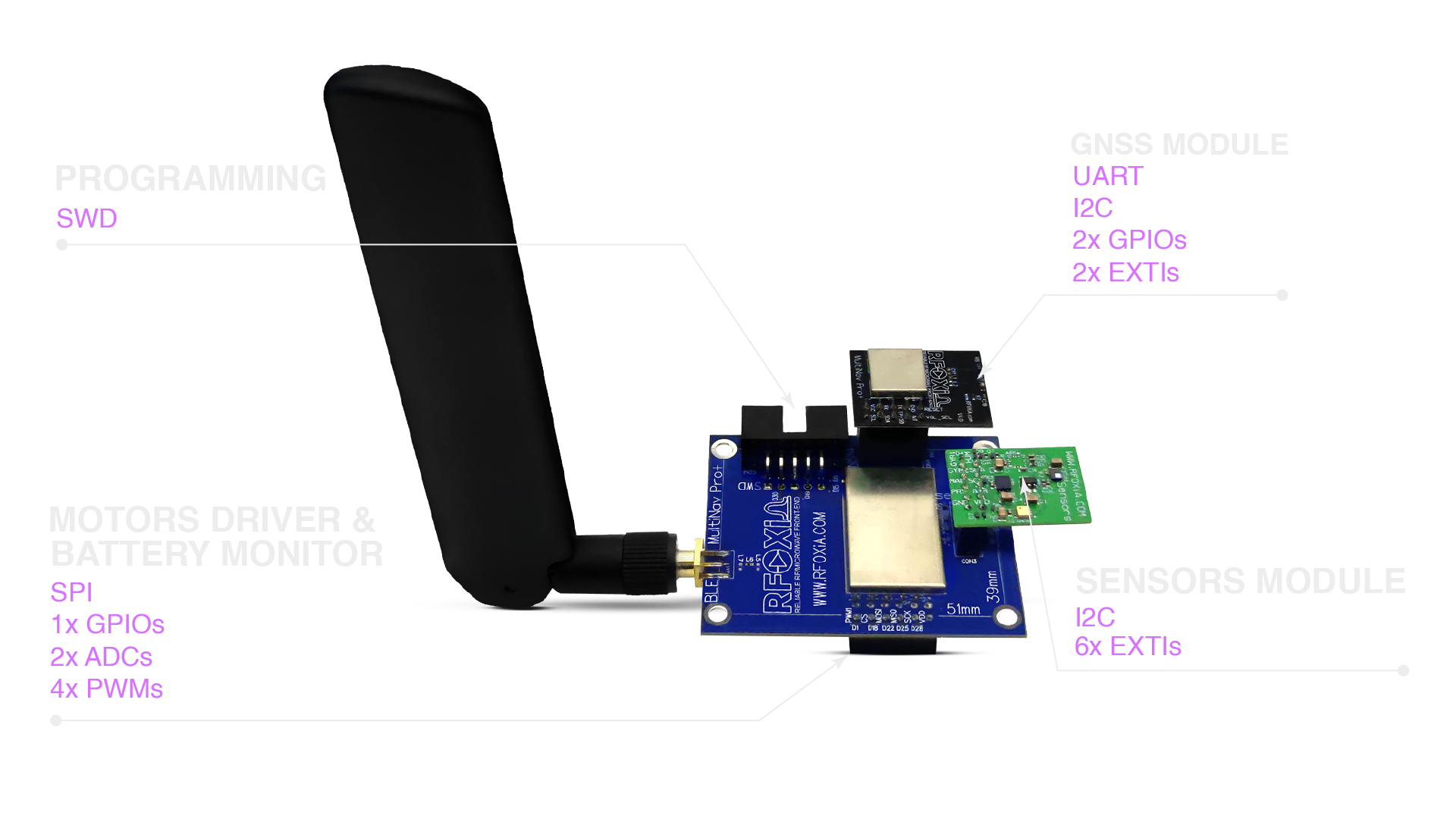
This modular architecture means you start with the BLE module long range capability as your core communication link, then expand your system with precision location, environmental sensing, and power management as your project demands. Everything snaps together. Everything was designed to work as a unified platform.
This is what makes RFOXiA unique: not one good module, but a coherent ecosystem where each component amplifies the value of the others.
RFOXiA Connect: The App That Brings It to Life
Hardware is only as useful as the interface that controls it. RFOXiA built the Connect app specifically for the MultiNav Pro+ ecosystem — and it shows.
The Control Screen features a PS5-style controller interface for drone and robot operation, a live map with real-time GPS tracking, and live sensor data display — all rendered from actual hardware data over the long-range BLE link. The entire control interface operates with zero internet dependency. No cloud. No subscriptions. No infrastructure. Just your phone and your module, communicating directly across kilometers of open air.
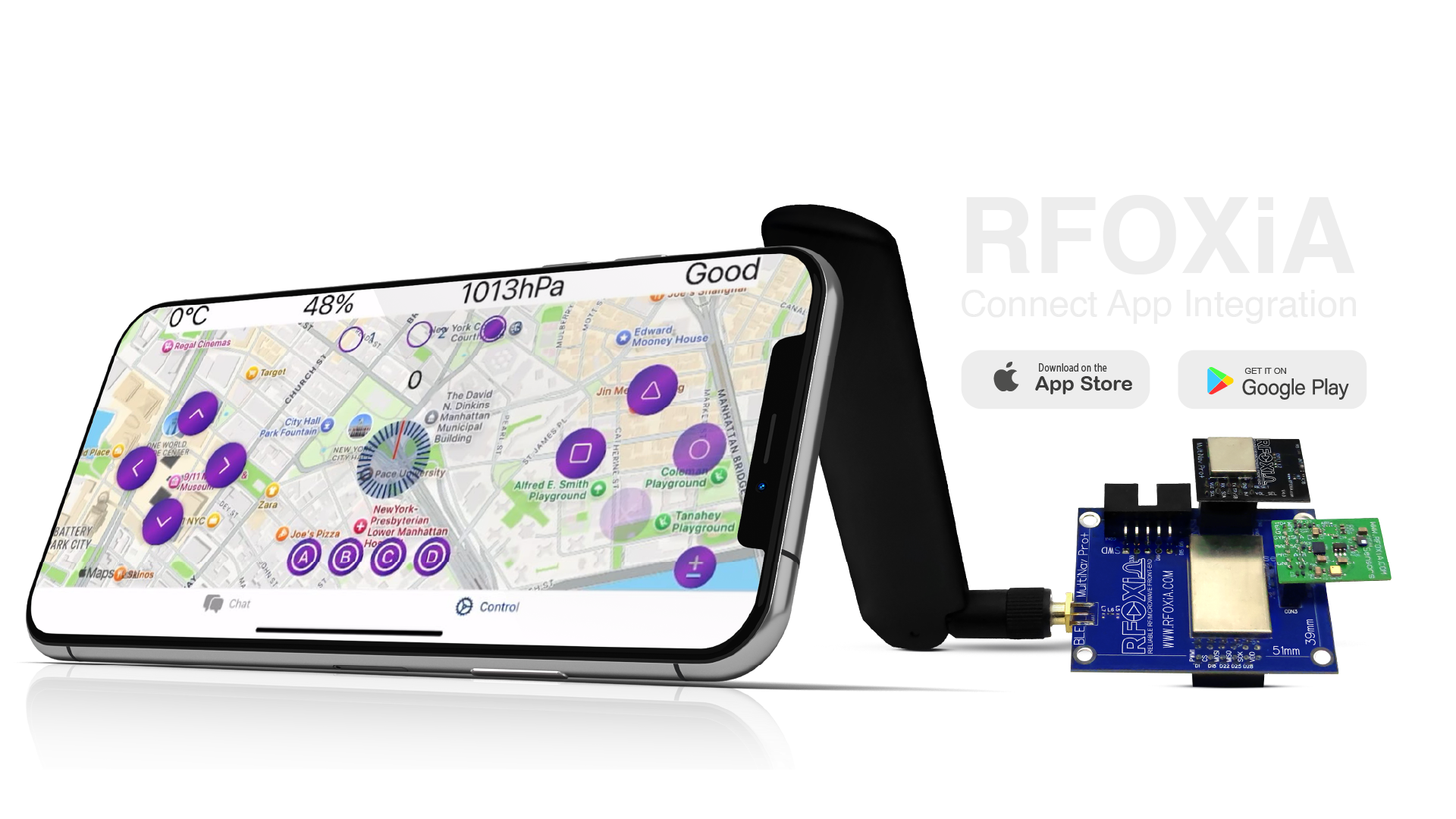
For team operations and field communication, the Chat Screen enables direct BLE Chat — internet-independent text communication between multiple MultiNav Pro+ users. Ideal for field research teams, disaster response operations, remote expeditions, and any scenario where cellular coverage cannot be assumed.
RFOXiA Connect is available for both Android and iOS — meaning your entire team can run the same interface regardless of device preference.
BLE Chat: Off-Grid Communication Infrastructure
One of the MultiNav Pro+'s most distinctive capabilities is what RFOXiA calls BLE Chat — a direct, internet-independent communication channel between module users.
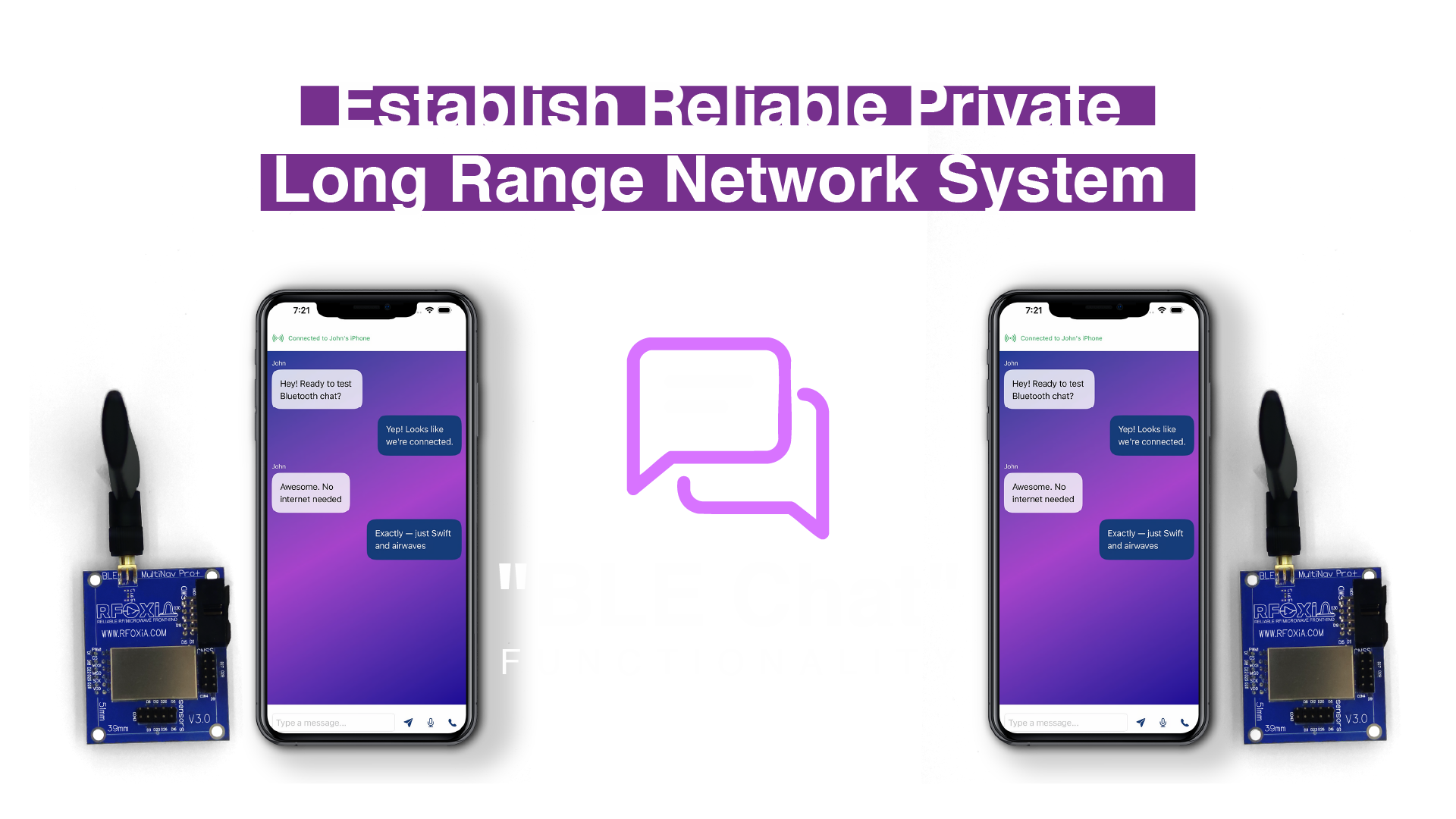
In scenarios where cellular networks are congested, unavailable, or deliberately avoided, BLE Chat creates a private peer-to-peer mesh communication layer. Field teams can coordinate across terrain that cellular towers do not reach. Drone pilots can relay information to ground crew beyond radio interference zones. Emergency response teams can maintain communication when infrastructure is compromised.
This functionality transforms the MultiNav Pro+ from a data link into a complete field communication platform — without adding complexity, cost, or dependency on external infrastructure.
Open Source and Fully Programmable
RFOXiA's philosophy is that the developer owns their hardware completely. The MultiNav Pro+ is fully open source and programmable via SWD, with complete source code available on GitHub.
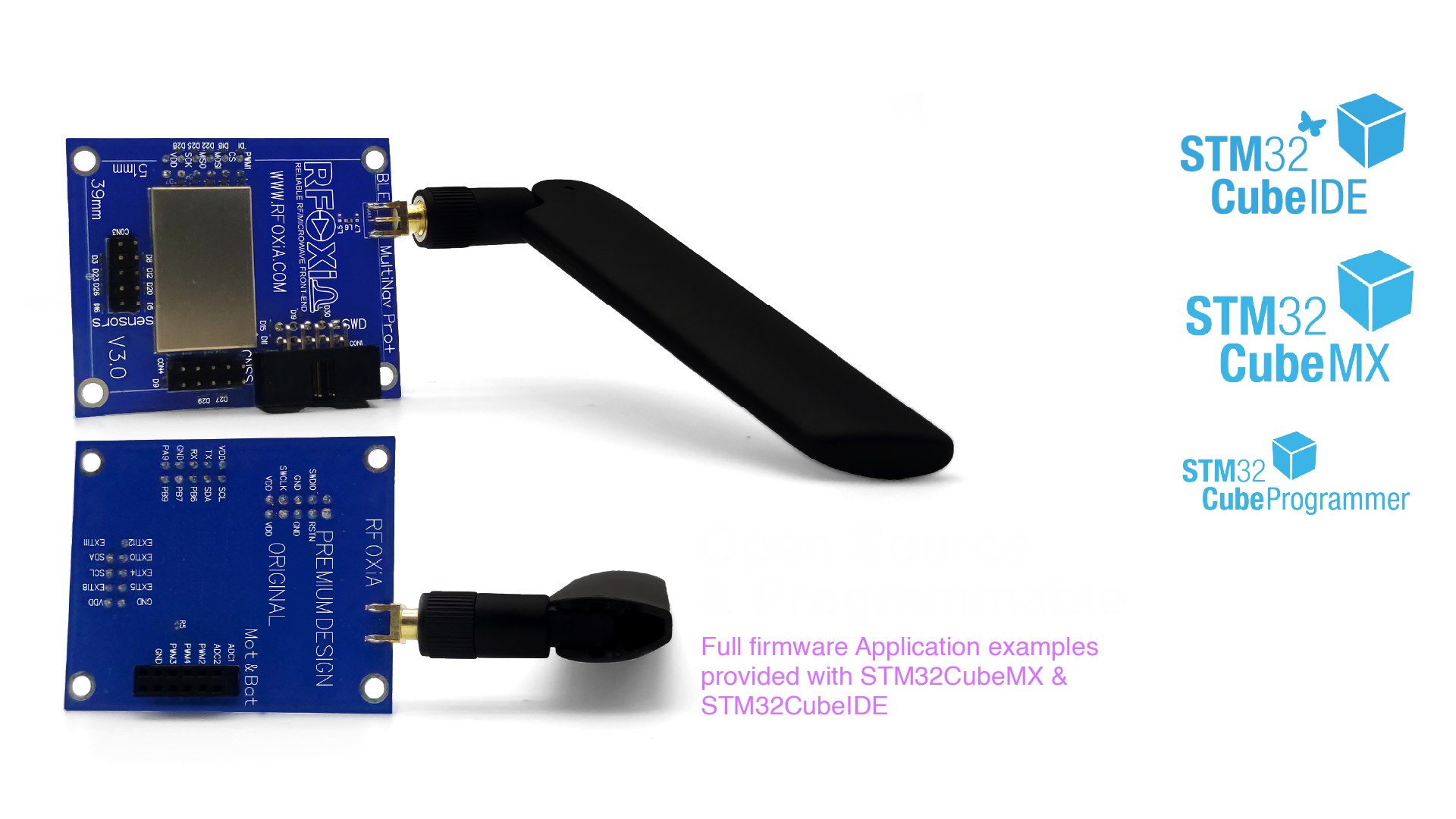
This means you can:
- Inspect and audit every line of firmware
- Customize the BLE stack behavior for your specific application
- Build entirely custom protocols on top of the hardware platform
- Contribute improvements back to the community
- Use the module as a learning platform for STM32WB development
The GitHub repository at github.com/RFOXiA/MultiNav-Pro-Long-Range-BLE-Module-Firmware-STM32WB07 contains the full firmware source, build instructions, and interface documentation.
For developers who want to build custom firmware quickly, RFOXiA Club's AI Firmware Builder allows you to describe your application in plain language and receive production-ready firmware with full source code — compressing months of development time into hours.
Who the MultiNav Pro+ BLE Module Long Range Is Built For
This module was designed with specific professional use cases in mind:
Drone Builders and FPV Pilots The 15–20KM man-to-drone range and 50KM drone-to-drone range exceed most drone communication systems available at any price. For long-range autonomous flight, relay drone setups, or professional inspection operations, the MultiNav Pro+ provides a communication backbone that keeps pace with modern aerial systems.
Robotics Engineers Ground robots operating in GPS-denied environments, warehouse automation systems, agricultural robots working across large field operations — all benefit from a high-speed, long-range communication link that does not depend on WiFi infrastructure.
IoT Developers Deploying sensor networks across large geographic areas — agricultural fields, construction sites, smart city environments — becomes viable when your communication link reaches 5KM between ground nodes without any additional infrastructure.
Field Researchers Scientific teams conducting environmental monitoring, wildlife tracking, geological surveys, or atmospheric research in remote locations need communication equipment that works where cellular does not. The MultiNav Pro+ delivers that capability at a price that research budgets can accommodate.
Embedded Systems Developers The open-source firmware, SWD programming interface, and AI Firmware Builder make the MultiNav Pro+ an exceptional development platform for engineers learning STM32WB or building commercial products on the platform.
Competitive Position: Nothing Else Exists Here
The BLE module long range market has a gap wide enough to drive a cargo drone through.
On one end: commodity BLE modules from Silicon Labs, Nordic, and Chinese manufacturers. Excellent products for their intended applications — smart home, wearables, consumer electronics. Range: 10 to 100 meters. Price: $5 to $15. Ecosystem: none.
On the other end: military and industrial long-range radio systems capable of 150KM and beyond. Range: exceptional. Price: $5,000 to $50,000. Accessibility: effectively zero for independent developers.
The MultiNav Pro+ occupies the empty space between these extremes — delivering professional-grade long-range performance with maker-accessible pricing, full ecosystem support, an AI development platform, a mobile control application, and an open-source firmware base.
There is no direct competitor at this price point with these specifications. That is not a marketing claim. It is a market reality.
RFOXiA Club: The Platform Behind the Hardware
Every MultiNav Pro+ purchase includes access to RFOXiA Club — the full developer platform built around the hardware ecosystem.
Club members get access to:
- AI Firmware Builder — generate production firmware from plain-language descriptions
- Dev Hub — community of developers sharing projects, asking questions, and collaborating
- Command Center — live device control and data streaming dashboard
- Resources — documentation, tutorials, SDK, and firmware examples
- Credit System — earn credits toward hardware purchases through platform engagement
New signups receive a $10 welcome credit — immediately applicable toward any hardware purchase. The credit system extends through the full funnel, with up to $50 in credits available before reaching the bundle purchase stage.
The platform is free to join. The hardware is what you are paying for. And the RFOXiA Long Range Bluetooth Module is the best place to start.
Technical Interfaces: Built for Integration
Professional hardware development requires hardware that integrates cleanly into existing systems. The MultiNav Pro+ was designed with this in mind.
The four-interface architecture (GNSS, Sensors, Motor/Battery Management, Programming) means the module slots into complex system designs without adapter boards, level shifters, or awkward workarounds. Each interface is documented in the open-source repository and supported by RFOXiA Club resources.
The SWD programming interface is compatible with standard STLink programmers, including the integrated programmer available in the RFOXiA Power/Program Kit — which pairs the supercapacitor power system with a dedicated programming interface for field deployment scenarios.
FCC Certification: Ready for Real Deployment
Every module in the RFOXiA lineup carries FCC certification — including the MultiNav Pro+ BLE.
For developers building commercial products, FCC certification on the module simplifies the path to market significantly. Module-level certification means your end product may qualify for reduced testing requirements under the FCC's modular approval rules.
For developers deploying equipment in the field, FCC certification means you are operating legally on certified hardware — not navigating the grey zone that uncertified modules create.
This certification is also the key credential that unlocks distribution through professional electronics channels including DigiKey, Mouser, and other major distributors — confirming that the MultiNav Pro+ meets the standards that professional buyers require.
Data Network: Your Hardware Earns While You Sleep
For developers who pair the BLE module with the Sensors module, the RFOXiA data network creates an entirely new category of hardware value.
Deploy your sensor stack outdoors with GPS validation active, stream verified environmental data to the RFOXiA network, and earn daily rewards — up to $0.40 per day for fully verified, high-frequency sensor data from locations where the network needs coverage.
The BLE module long range capability means your network node can relay data from sensor installations that are kilometers away from the nearest internet connection point — extending the reach of the data network into environments where conventional IoT infrastructure cannot go.
This converts a one-time hardware purchase into a long-term passive income asset. The hardware works. The data flows. The rewards accumulate.
Getting Started
The MultiNav Pro+ ships as a set of 2 modules for $59 — everything you need to establish your first long-range BLE link.
For developers who want the complete ecosystem, the Developer Bundle combines the BLE module, GNSS module, Sensors module, and Power/Program Kit into a single integrated package — the only product on the market combining long-range BLE, precision GNSS, multi-sensor environmental monitoring, and professional power management in one kit.
Join RFOXiA Club for free, claim your $10 welcome credit, and explore the AI Firmware Builder before your hardware even arrives.
The RFOXiA Long Range Bluetooth Module is in stock and shipping now.
Conclusion: The BLE Module Long Range Benchmark Has Changed
The MultiNav Pro+ does not ask you to accept the limitations that commodity Bluetooth modules have always imposed. It was built specifically to eliminate those limitations — through engineering, not compromise.
50KM drone-to-drone range. 2 Mbps data rate. FCC certified. Open source. $59 for two units.
This is what a BLE module long range solution looks like when it is designed by someone who actually needed one and had the RF engineering expertise to build it right.
If you are building anything wireless — drones, robots, sensor networks, field research equipment, commercial IoT products — the MultiNav Pro+ belongs in your toolkit.
Explore the MultiNav Pro+ BLE Module and start building without limits.
Written by: Moamen Mohamed LinkedIn