
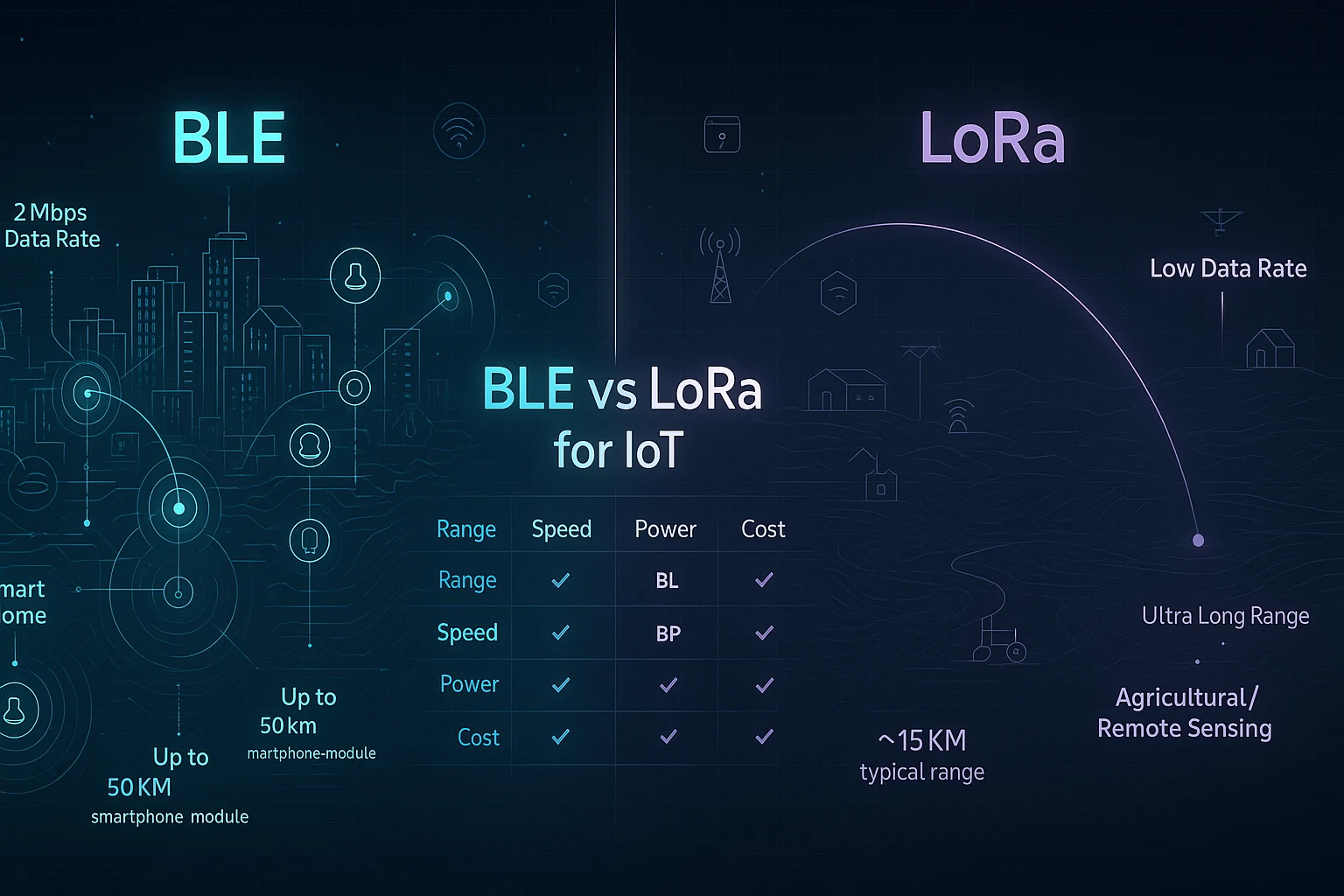
BLE vs LoRa for IoT: Which Long-Range Protocol Wins in 2025?
RFOXiA Long Range Bluetooth Module
BLE vs LoRa for IoT — The Complete Technical and Practical Breakdown
If you are building a wireless IoT system and trying to decide between Bluetooth Low Energy and LoRa, you are asking one of the most important questions in embedded development right now. The answer used to be simple: use BLE for short-range, low-power applications and use LoRa when you need distance. But that answer is no longer accurate — and the reason why is changing the way professional developers design their systems.
This guide covers everything you need to know about BLE vs LoRa for IoT: how each protocol actually works, where each one wins, where each one fails, and why a new generation of BLE hardware is closing the gap in ways that were not possible even two years ago.
What Is LoRa and Why Did It Dominate Long-Range IoT?
LoRa — short for Long Range — is a proprietary chirp spread spectrum modulation technique developed by Semtech. It operates in unlicensed sub-GHz bands (433 MHz, 868 MHz in Europe, 915 MHz in North America) and is designed specifically for low-power wide-area network (LPWAN) applications.
LoRa's defining characteristic is its ability to trade data rate for range. By using very low spreading factors and narrow bandwidth, a LoRa node can push a signal 10 to 15 kilometers in open terrain while consuming only microamp-level current in sleep mode. This made LoRa the default choice for agricultural sensors, smart city infrastructure, utility metering, and any application where you need to place a node far away and leave it running on a coin cell for years.
LoRa strengths:
- Exceptional range in open terrain (10–15km with standard hardware)
- Ultra-low power consumption in sleep mode
- Excellent penetration through walls and obstacles
- Large, mature ecosystem through LoRaWAN (The Things Network, Helium, etc.)
- Low module cost ($5–$20)
LoRa limitations:
- Extremely low data rate (0.3 kbps to 27 kbps depending on spreading factor)
- High latency — not suitable for real-time control
- Duty cycle restrictions in many regions (1% in EU)
- LoRaWAN network architecture adds complexity
- Not suitable for streaming, audio, video, or high-frequency sensor data
- No native smartphone integration — requires gateway infrastructure
For many IoT applications, those limitations are acceptable tradeoffs. If you are sending a temperature reading once per hour from a farm field, LoRa is excellent. But the moment your application requires real-time control, high-frequency data, smartphone connectivity, or anything approaching a stream rather than a packet — LoRa starts to break down.
What Is BLE and Why Was It Never Considered a Long-Range Protocol?
Bluetooth Low Energy is a wireless protocol operating in the 2.4 GHz ISM band, standardized by the Bluetooth Special Interest Group. BLE 5.0 introduced Long Range mode (Coded PHY) in 2016, which theoretically extended range to several hundred meters. In practice, commodity BLE modules using standard chip antennas and no external RF amplification achieve 80 to 150 meters in real-world outdoor conditions.
This is why BLE was always classified as a personal area network technology — wearables, headphones, smart home devices, health monitors. The standard advice in embedded development has always been: if you need range, do not use BLE.
Standard BLE strengths:
- Native smartphone integration — no gateway needed
- High data rate (1–2 Mbps)
- Low latency — suitable for real-time applications
- Simple pairing and connection model
- Massive ecosystem and tooling support
- Low power in sleep mode
Standard BLE limitations (commodity hardware):
- Range: 80–150 meters outdoors with standard modules
- 2.4 GHz susceptibility to interference in dense environments
- No LPWAN infrastructure equivalent to LoRaWAN
- Range limitation makes it unsuitable for most outdoor IoT deployments
So for most of the history of IoT development, the choice was clear: BLE for close range, LoRa for distance. That framework has now been broken.
How Next-Generation BLE Hardware Changes the BLE vs LoRa for IoT Equation
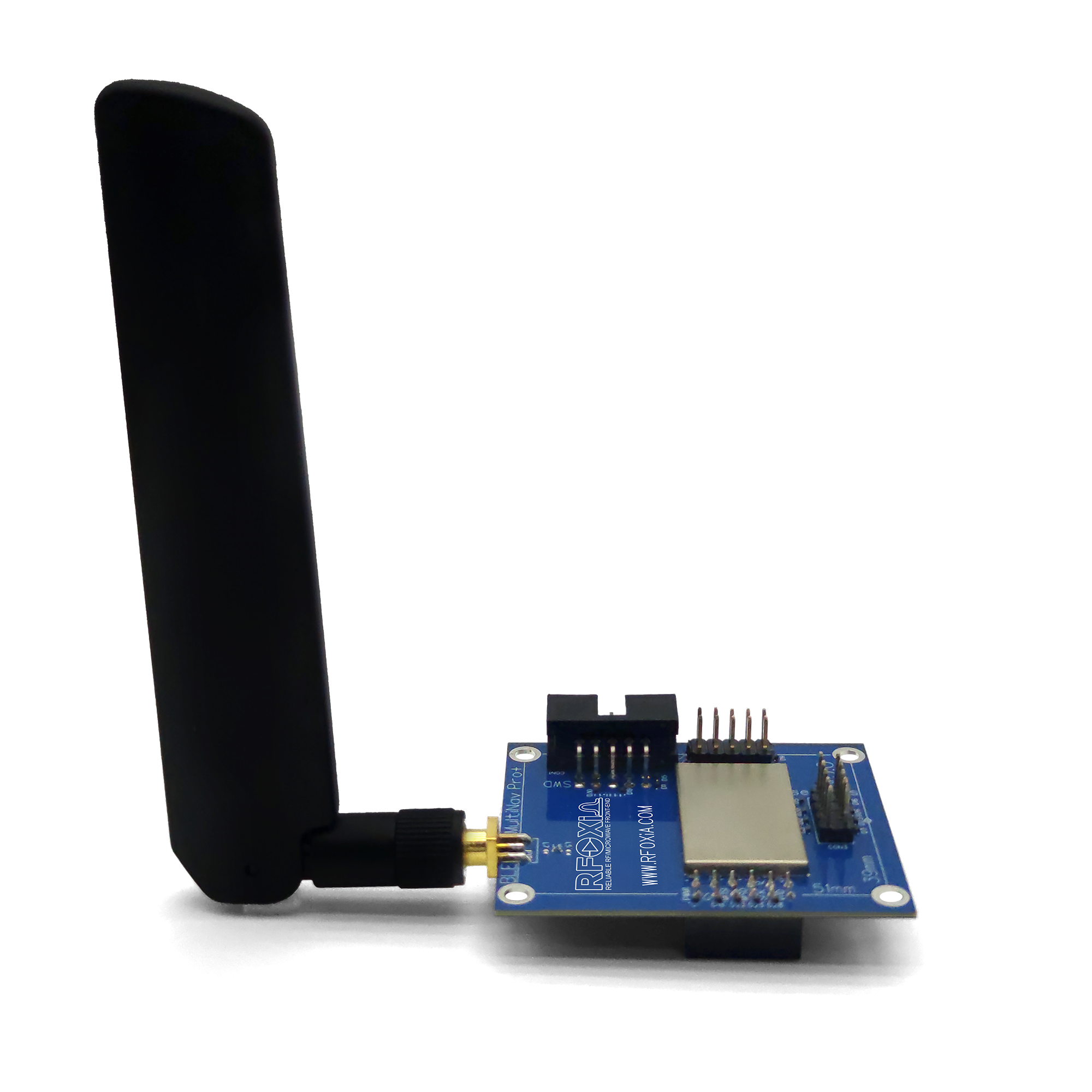
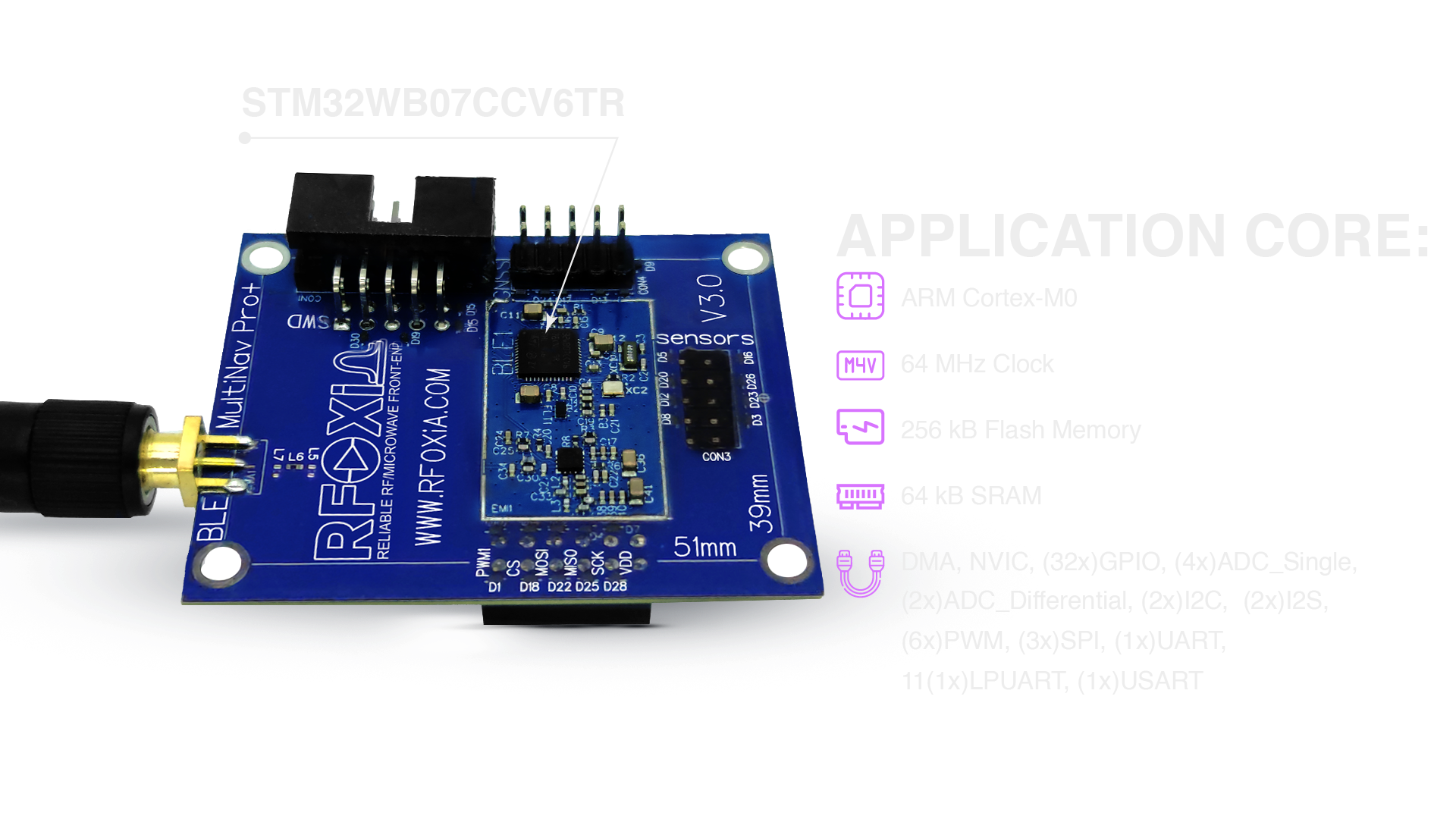
The MultiNav Pro+ BLE Module from RFOXiA represents what happens when professional RF engineering is applied to BLE at a price point accessible to developers. This is not a commodity module with a chip antenna. It uses a high-gain external antenna combined with a powerful RF front-end, external amplifiers, and advanced receiver sensitivity optimization built around the STM32WB07CCV6 processor.
The result is BLE performance that has never been available at this price point:
- Ground-to-ground: 5km (module paired with smartphone)
- Man-to-drone: 15–20km
- Drone-to-drone: 50km (both modules airborne, ground reflections eliminated)
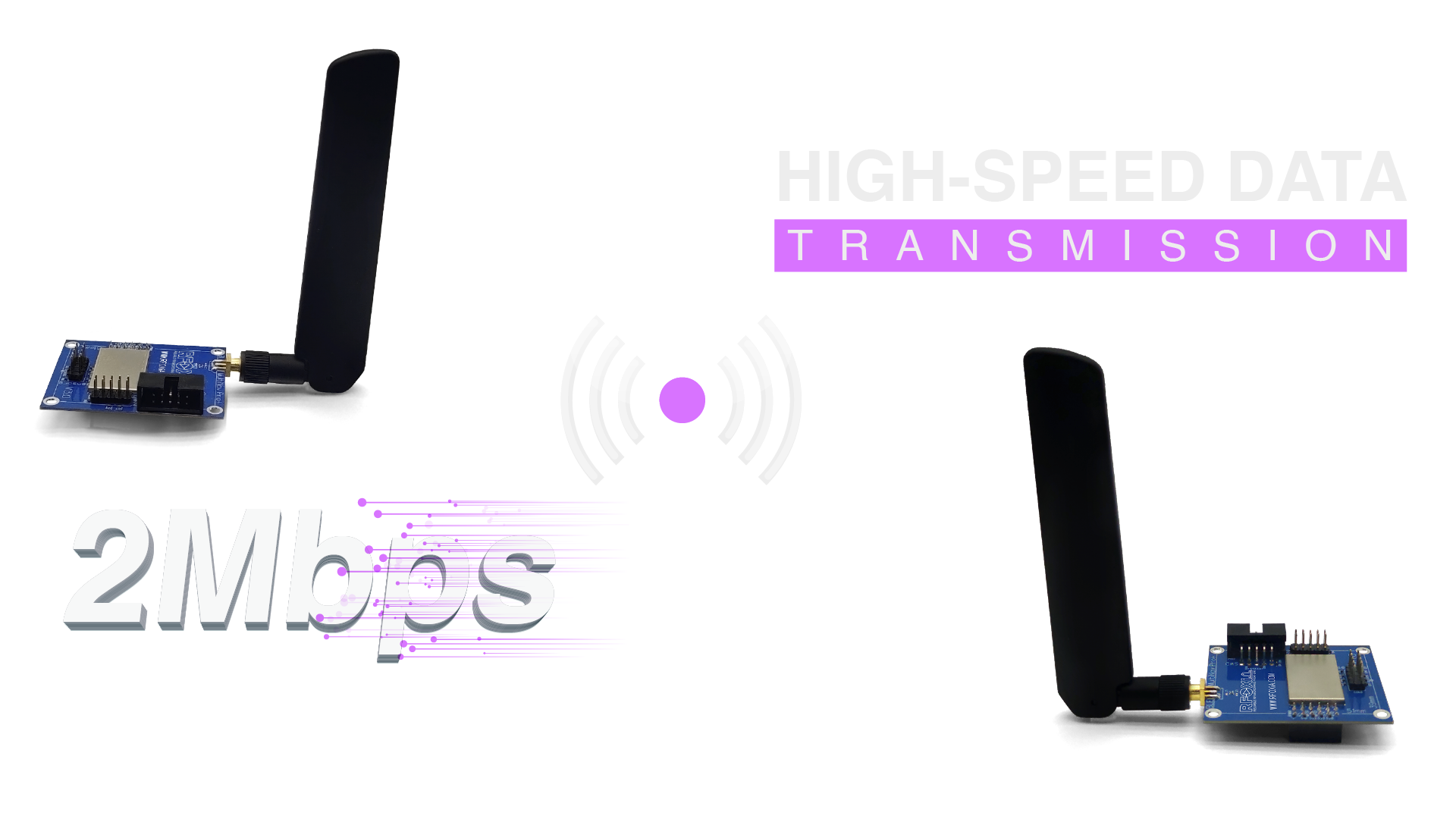
- Data rate: 2 Mbps
- Price: $59 for two units
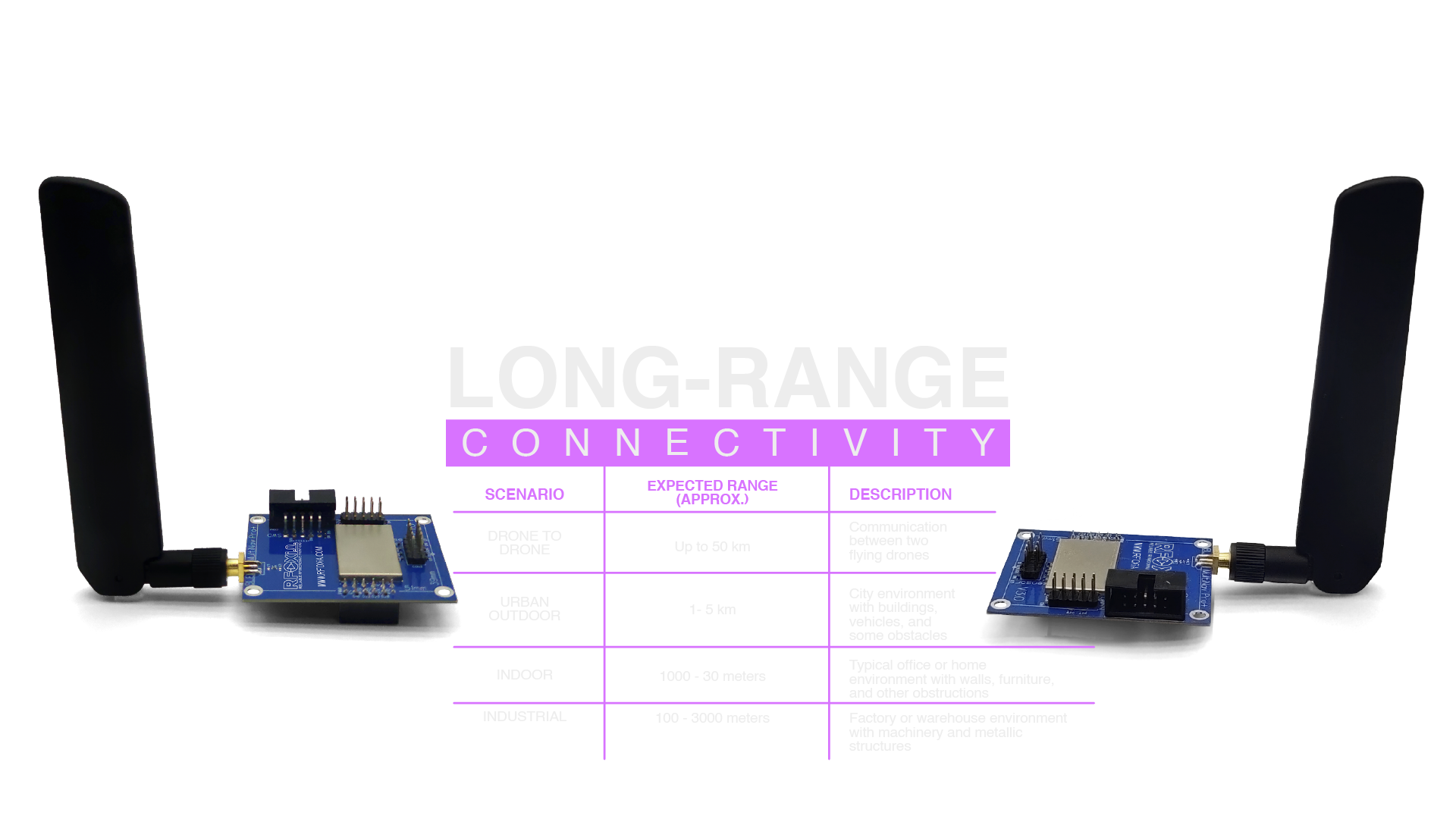
This is the core disruption in the BLE vs LoRa for IoT debate. A BLE module that reaches 50km drone-to-drone at 2 Mbps is not competing with commodity BLE modules anymore. It is competing directly with LoRa in the range category — while retaining every advantage BLE has always had over LoRa in data rate, latency, and smartphone integration.
BLE vs LoRa for IoT: Head-to-Head Comparison
Range
| Scenario | Standard BLE | LoRa | MultiNav Pro+ BLE |
|---|---|---|---|
| Indoor / Obstructed | 10–30m | 1–3km | 200–500m |
| Ground to Ground (open) | 80–150m | 10–15km | 5km |
| Man to Drone | ~100m | 5–8km | 15–20km |
| Drone to Drone | ~150m | 10–15km | 50km |
For traditional commodity BLE, LoRa wins range by an order of magnitude. For the MultiNav Pro+ BLE module, the gap closes dramatically — and in airborne applications, BLE matches or exceeds typical LoRa performance.
Data Rate
| Protocol | Maximum Data Rate |
|---|---|
| LoRa (SF7, BW500) | ~27 kbps |
| LoRa (SF12, BW125) | ~0.3 kbps |
| Standard BLE 5.0 | 2 Mbps |
| MultiNav Pro+ BLE | 2 Mbps |
BLE wins data rate by two to three orders of magnitude. This is not a close comparison. LoRa's data rate is a fundamental characteristic of its modulation — you cannot get LoRa to stream high-frequency sensor data, audio, real-time control packets, or video. BLE can handle all of these.
Latency
LoRa transmissions have inherent air time based on packet size and spreading factor. A typical LoRa packet at SF12 can take 1–2 seconds of air time. Combined with duty cycle restrictions, this makes LoRa completely unsuitable for real-time control of drones, robots, or any actuator-based system.
BLE operates with millisecond-level latency. The MultiNav Pro+ BLE module is specifically designed for drone and robot control — an application that requires sub-100ms response times. This is not possible with LoRa under any configuration.
Smartphone Integration
BLE connects natively to any modern smartphone without additional hardware. Every iPhone and Android device manufactured in the last eight years has BLE built in and apps can connect directly.
LoRa requires a gateway. To connect a LoRa node to the internet or to a smartphone, you need either a LoRaWAN gateway (typically $100–$500) or a dedicated receiver. This adds cost, complexity, and infrastructure dependency to every LoRa deployment.
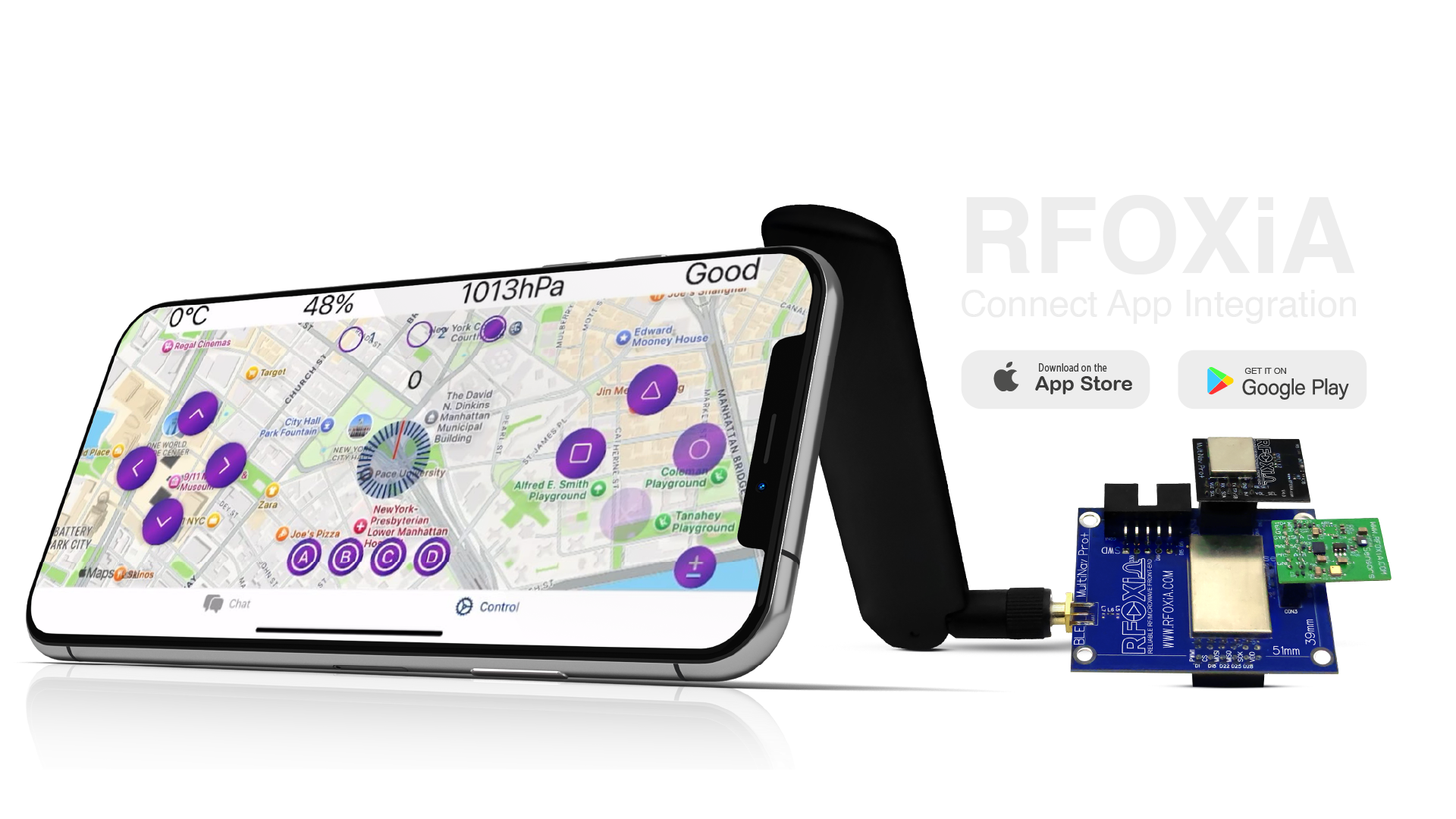
The RFOXiA Connect app demonstrates this advantage directly — a smartphone running the app connects directly to the MultiNav Pro+ BLE module, giving the user a live map view, real-time sensor data, and full control interface with no gateway, no network subscription, and no internet connection required.
Power Consumption
Both LoRa and BLE are designed for low power operation. In sleep mode, both can achieve microamp-level current draw. The difference appears during active transmission: LoRa's long air times can consume more total energy per transmission event than a fast BLE packet, particularly at high spreading factors.
For applications where nodes transmit infrequently (once per hour), LoRa's sleep power advantage gives it better long-term battery life on small cells. For applications that require frequent transmission or real-time streaming, BLE's faster transmission times can actually be more efficient on a per-bit basis.
Regulatory and Licensing
Both LoRa and BLE operate in unlicensed spectrum. LoRa uses sub-GHz bands with regional duty cycle restrictions (particularly strict in Europe). BLE operates at 2.4 GHz globally with no duty cycle restrictions, making it more flexible for high-frequency transmission applications.
The MultiNav Pro+ BLE module carries FCC certification, providing the regulatory clearance required for commercial deployment in the United States and simplifying international market entry.
When to Choose LoRa
Despite the advances in long-range BLE hardware, LoRa remains the right choice for specific applications:
Choose LoRa when:
- Your nodes transmit infrequently (once per hour or less)
- You need maximum penetration through dense urban structures
- You are deploying onto existing LoRaWAN network infrastructure (TTN, Helium)
- Battery life measured in years is the primary design constraint
- Data payload per transmission is very small (temperature, binary status)
- You do not need smartphone direct connection
- Range beyond 5km ground-to-ground is required without elevated antenna placement
Typical LoRa applications: Smart city parking sensors, utility metering, agricultural soil moisture monitoring at scale, asset tracking with infrequent updates, building environmental monitoring across large campuses.
When to Choose Long-Range BLE (MultiNav Pro+)
The MultiNav Pro+ BLE module wins decisively in any application where LoRa's data rate or latency limitations are a constraint — which is a much larger portion of professional IoT applications than most developers realize.
Choose long-range BLE when:
- You need real-time control of a drone, robot, or vehicle
- You require direct smartphone connectivity without gateway infrastructure
- Your application streams continuous data (sensor arrays, telemetry, audio)
- You need 2 Mbps throughput for any reason
- Deployment is airborne or elevated (drone-to-drone range of 50km exceeds most LoRa deployments)
- You want internet-independent mesh communication between operators
- You need a single module to handle control, telemetry, and communication simultaneously
The Ecosystem Advantage: Why BLE Wins Beyond the Spec Sheet
When evaluating BLE vs LoRa for IoT in a real project, protocol specs are only part of the decision. The ecosystem around the hardware matters equally.
The MultiNav Pro+ BLE module is not a standalone component. It is the core of a vertically integrated development platform:
Seamless Module Integration
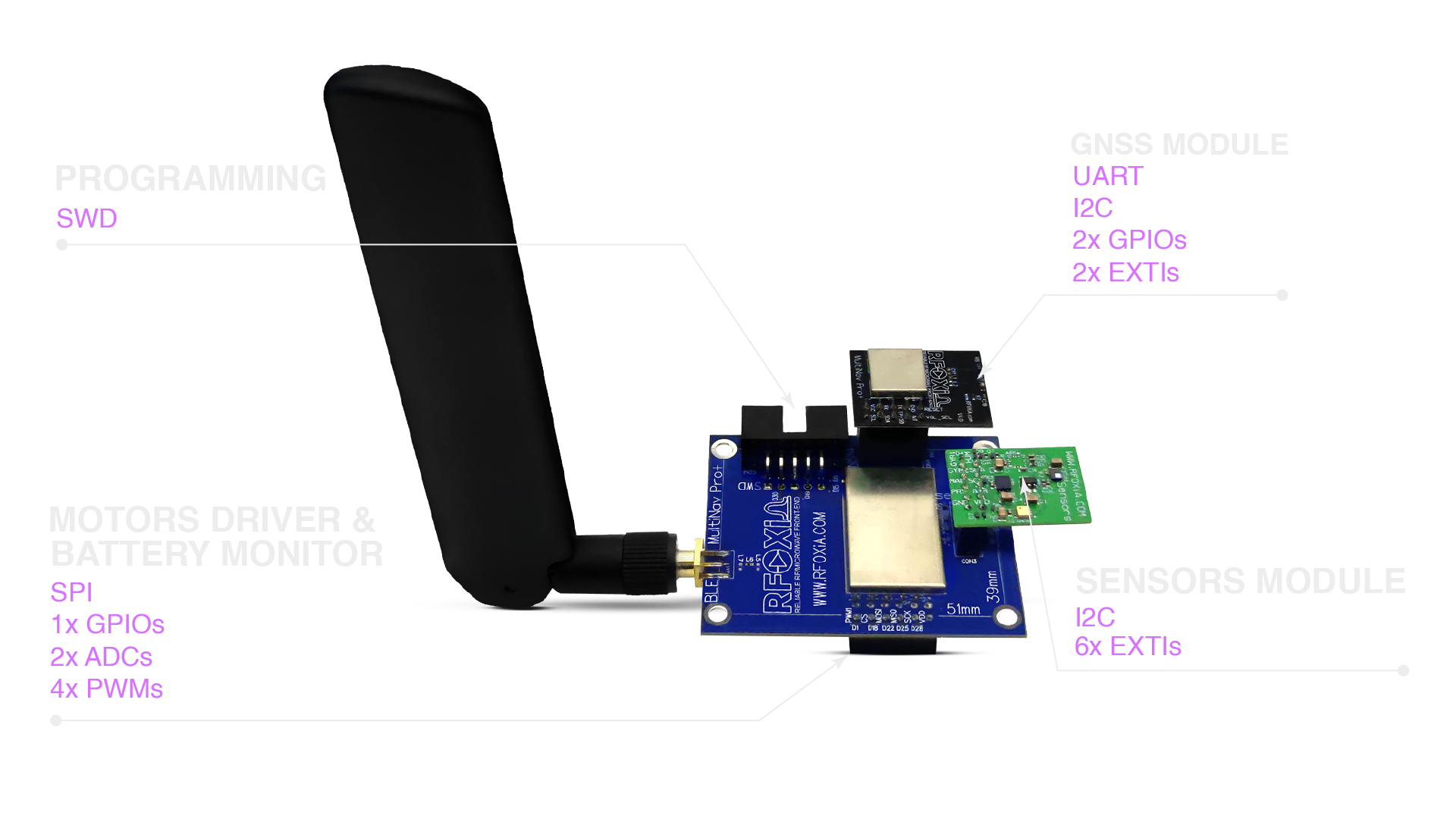
The BLE module connects directly with the MultiNav Pro+ GNSS module (1.5m accuracy, 18Hz fix rate), the Sensors module (temperature, humidity, pressure, air quality, accelerometer, gyroscope, magnetometer), and the Power/Program Kit. Together these form a complete autonomous system platform — communication, positioning, environmental sensing, and power management in one integrated stack.
Internet-Independent Mesh Communication
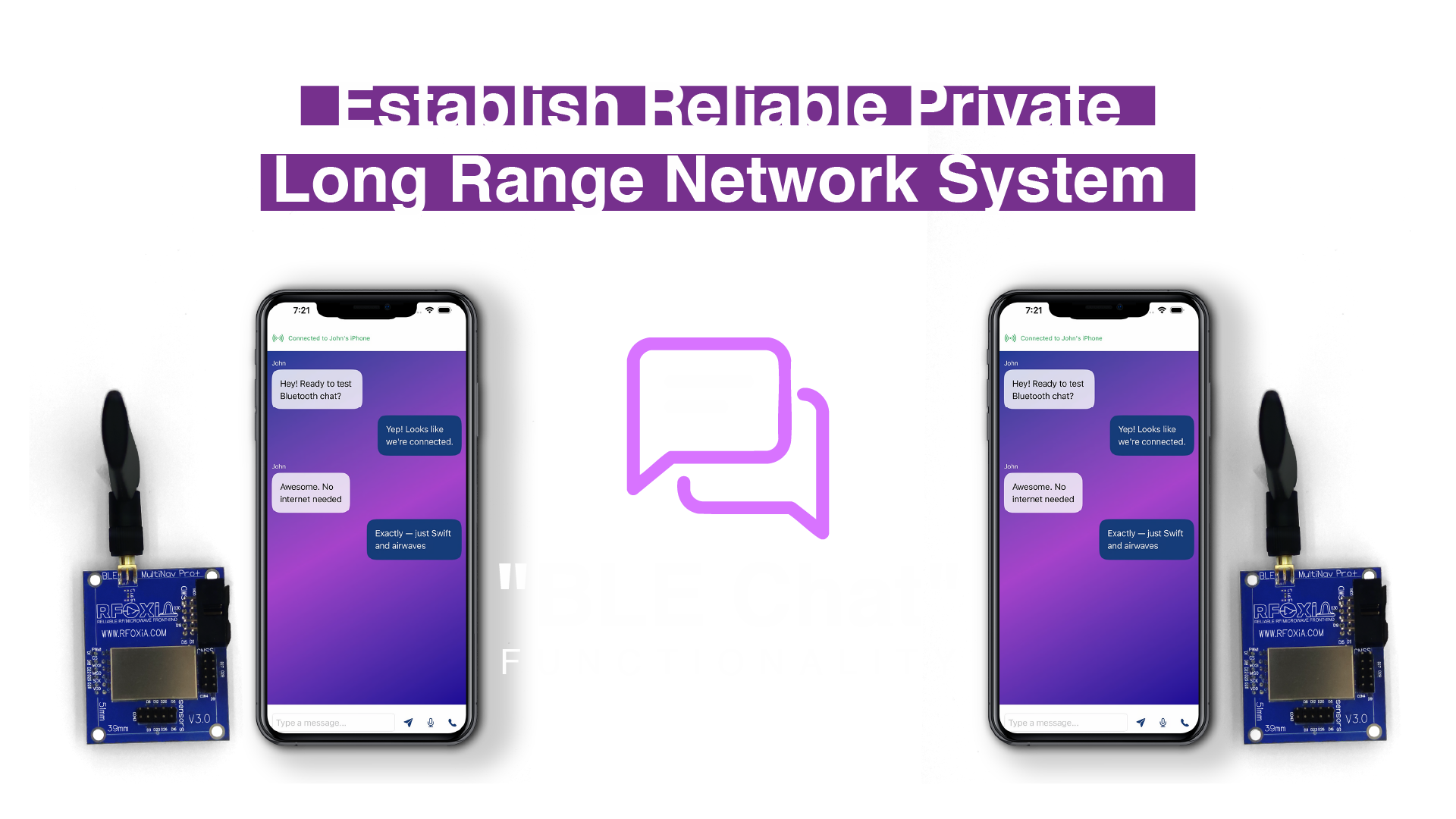
The BLE Chat functionality enables direct communication between MultiNav Pro+ users with no internet dependency. This is a capability that LoRa can approximate through LoRaWAN messaging but cannot match in terms of bandwidth or native smartphone experience. For field teams, disaster response operations, remote expeditions, and off-grid deployments, this represents a fundamentally different operational model.
Open Source and Fully Programmable
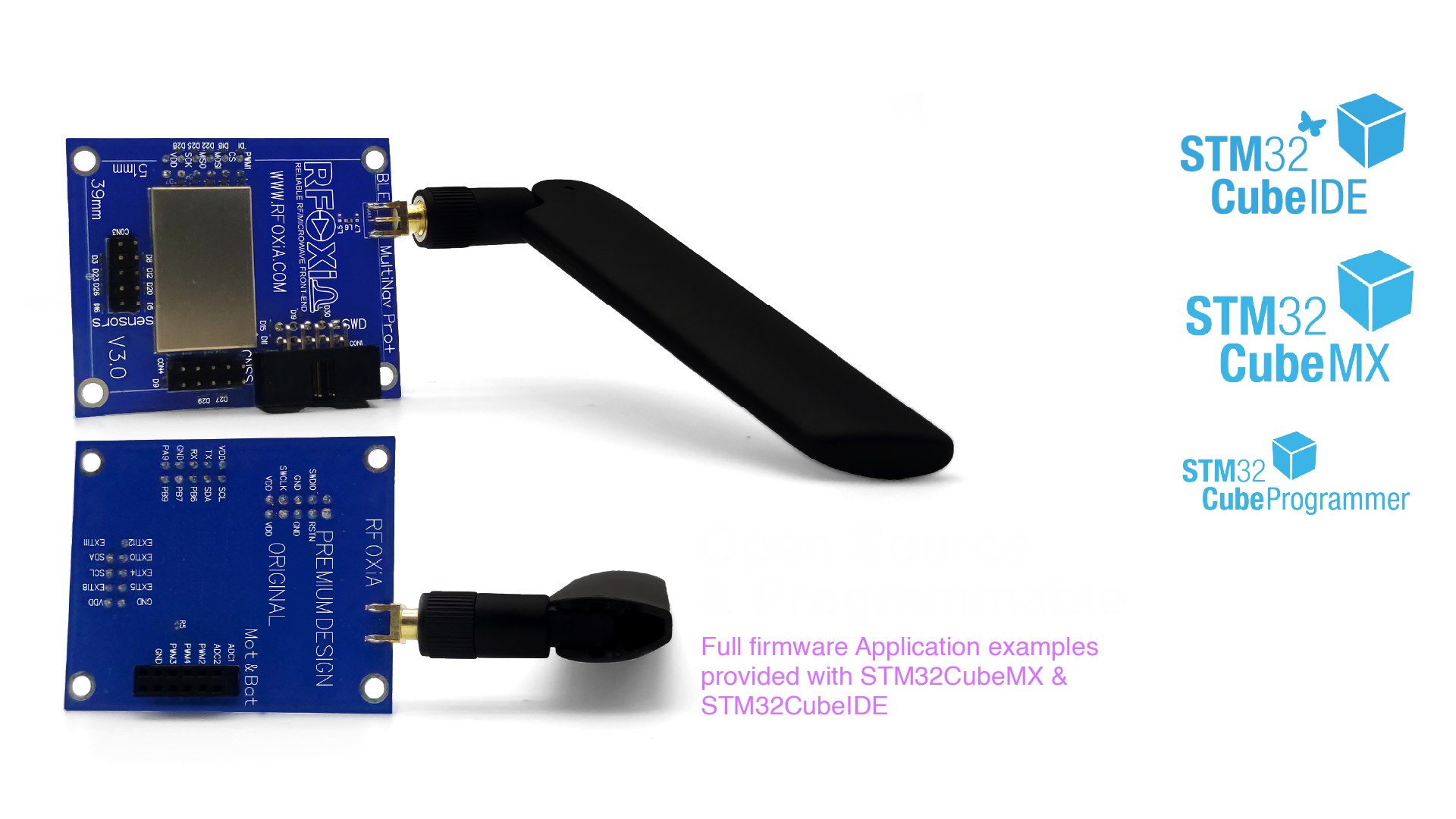
Full open-source access and SWD programmability means you are not locked into a proprietary stack. Developers can customize every aspect of the firmware. Combined with the AI Firmware Builder available in RFOXiA Club — which generates production-ready firmware from plain-language descriptions — the development time from concept to working prototype is dramatically compressed.
LoRa modules similarly offer open firmware access, but the ecosystem tooling and AI-assisted development platform available on the BLE side through RFOXiA Club has no equivalent in the LoRa space at this price point.
Compact Professional Form Factor
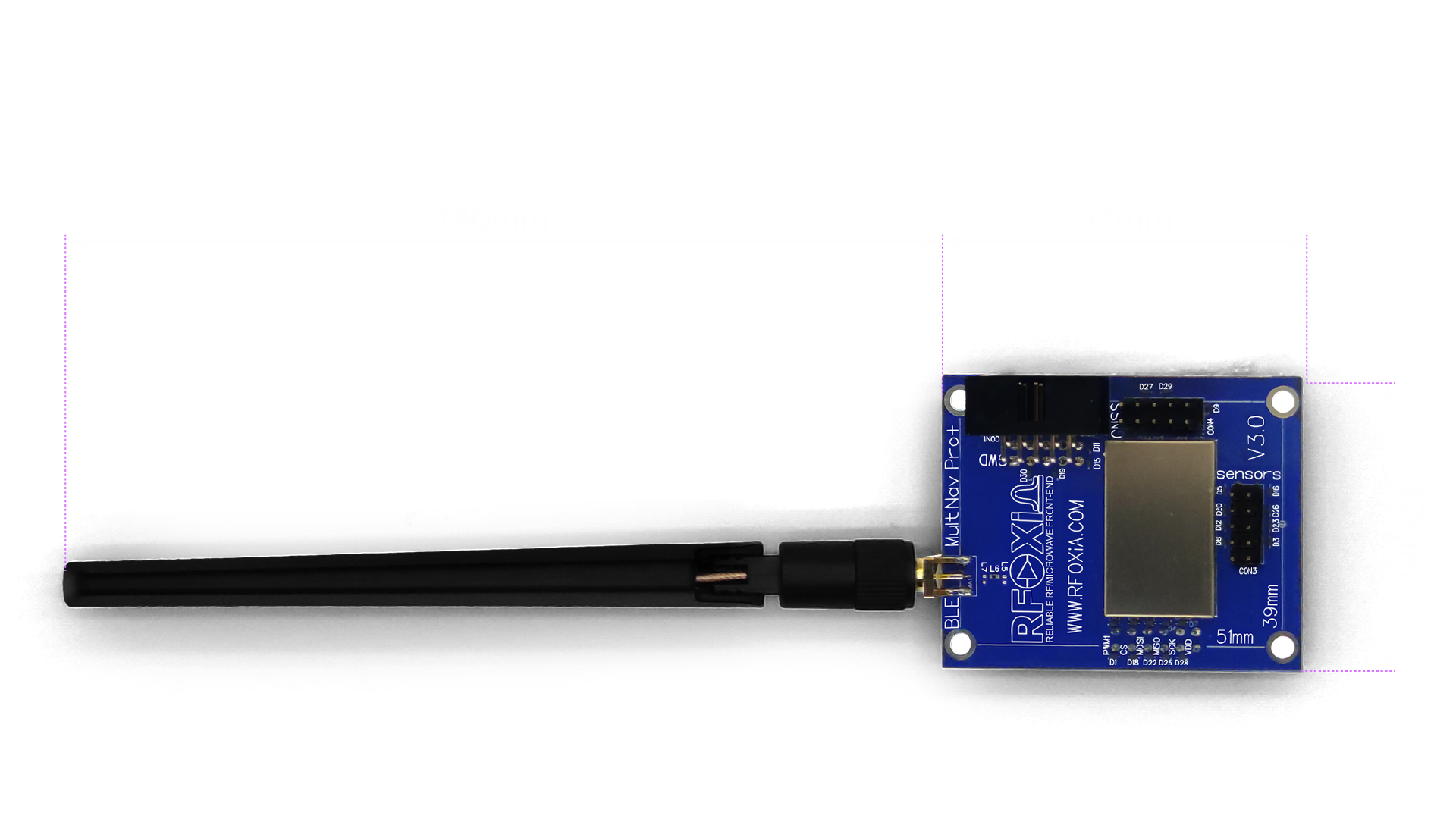
At 57mm × 47mm with corner mounting holes on a 51mm × 39mm fixing frame, the MultiNav Pro+ BLE module is designed for integration into constrained physical designs — drone frames, enclosures, research instruments, and field equipment where space is a real engineering constraint.
Precision Timing for Synchronization
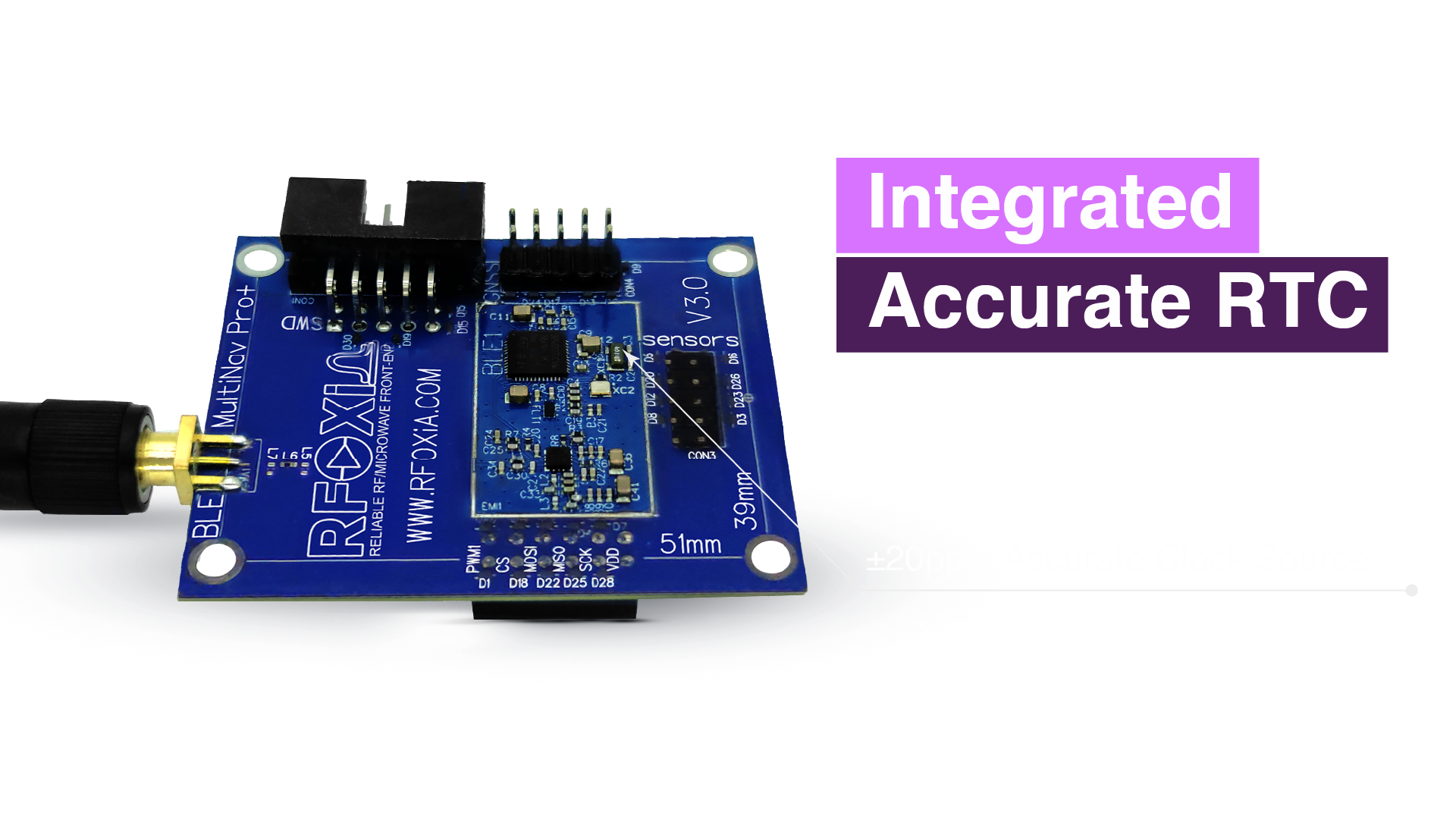
The integrated RTC crystal provides precise timing that matters in multi-node deployments where data needs to be synchronized across devices. This is particularly relevant in research and industrial monitoring applications where temporal accuracy of sensor data is critical.
Real-World Application Decision Guide
| Application | Recommended Protocol | Reason |
|---|---|---|
| Drone telemetry and control | Long-range BLE | Real-time control, 15–50km range, 2 Mbps data |
| Agricultural soil sensors (10-year battery) | LoRa | Infrequent transmission, battery life priority |
| FPV racing and freestyle | Long-range BLE | Latency critical, smartphone integration |
| Smart city parking meters | LoRa | Low data, urban penetration, infrastructure |
| Field research with sensor streaming | Long-range BLE | High data rate, multi-sensor integration |
| Remote industrial asset monitoring | LoRa | Infrequent updates, no latency requirement |
| Disaster response communication | Long-range BLE | Mesh chat, smartphone integration, no infrastructure |
| Utility metering at scale | LoRa | LoRaWAN infrastructure, long battery life |
| Environmental data networks | Long-range BLE | GPS-verified, high-frequency, smartphone connected |
The Price Point Reality
One argument historically made in favor of LoRa was cost. Basic LoRa modules are available for $5 to $15. Standard BLE modules are similarly priced. Long-range BLE has historically required expensive professional hardware.
The MultiNav Pro+ BLE module changes this. At $59 for two units — $29.50 per module — you get 5km ground-to-ground range with smartphone connectivity, 2 Mbps data rate, real-time control capability, and a full ecosystem integration platform. To achieve comparable range with LoRa and add smartphone connectivity, you would need the LoRa nodes plus gateway hardware plus application infrastructure — easily $150 to $300 or more for a comparable deployment.
For serious IoT developers evaluating BLE vs LoRa for IoT on a total system cost basis, not just module cost, long-range BLE is now highly competitive.
If this level of range and performance at this price point interests you, the RFOXiA Long Range Bluetooth Module is available now, FCC certified and ready to ship.
Frequently Asked Questions: BLE vs LoRa for IoT
Can BLE really reach 50km? With commodity hardware, no. With the MultiNav Pro+ BLE module using external amplifiers, optimized RF front-end design, and high-gain antenna — yes, in drone-to-drone deployments where both units are airborne and ground reflections are eliminated. Ground-to-ground range with smartphone pairing is 5km.
Does long-range BLE consume more power than LoRa? At comparable transmission frequencies, the power difference is application-dependent. LoRa's advantage is in very infrequent transmission scenarios with multi-year battery requirements. For applications requiring real-time streaming, BLE's faster transmission efficiency can be competitive.
Can I use both BLE and LoRa in the same system? Yes, and some professional deployments do exactly this — LoRa for low-frequency sensor reporting across long distances, BLE for local high-bandwidth control and monitoring. The RFOXiA ecosystem does not preclude this architecture.
Is LoRa going away? No. LoRa remains excellent for its core use case: low-power, infrequent-transmission nodes across wide areas using existing LoRaWAN infrastructure. The advancement of long-range BLE hardware does not eliminate LoRa — it gives developers a competitive alternative for applications that LoRa's data rate and latency limitations cannot serve.
What makes the MultiNav Pro+ BLE module different from other BLE modules? The RF front-end design. Standard BLE modules use integrated chip antennas with no external amplification. The MultiNav Pro+ uses external amplifiers and a high-gain antenna combined with advanced receiver sensitivity design to achieve ranges that are simply not possible with commodity BLE silicon alone.
Conclusion: BLE vs LoRa for IoT in 2025
The BLE vs LoRa for IoT decision in 2025 is no longer a simple range versus speed tradeoff. It is a nuanced engineering decision that depends on your specific application requirements.
LoRa remains the right choice for ultra-low-power, infrequent-transmission applications where long-range penetration through obstacles is essential and gateway infrastructure is acceptable.
Long-range BLE — specifically the MultiNav Pro+ BLE module — wins decisively in any application requiring real-time control, high-bandwidth data streaming, direct smartphone connectivity, or airborne deployment where its 50km drone-to-drone range matches or exceeds typical LoRa performance while delivering 2 Mbps throughput and millisecond latency that LoRa cannot approach.
For drone builders, FPV pilots, field researchers, robotics engineers, and IoT developers who need professional-grade range without professional-grade budgets, the choice is clear. The RFOXiA Long Range Bluetooth Module delivers 50km BLE range, 2 Mbps data rate, full smartphone integration, FCC certification, and a complete development ecosystem at $59 for two units.
That is a market position that did not exist two years ago. It exists now.
Explore the full MultiNav Pro+ BLE module specifications, application examples, and developer resources at the RFOXiA Long Range Bluetooth Module product page and join RFOXiA Club for $10 in welcome credits toward your first order.
Written by: Moamen Mohamed LinkedIn