
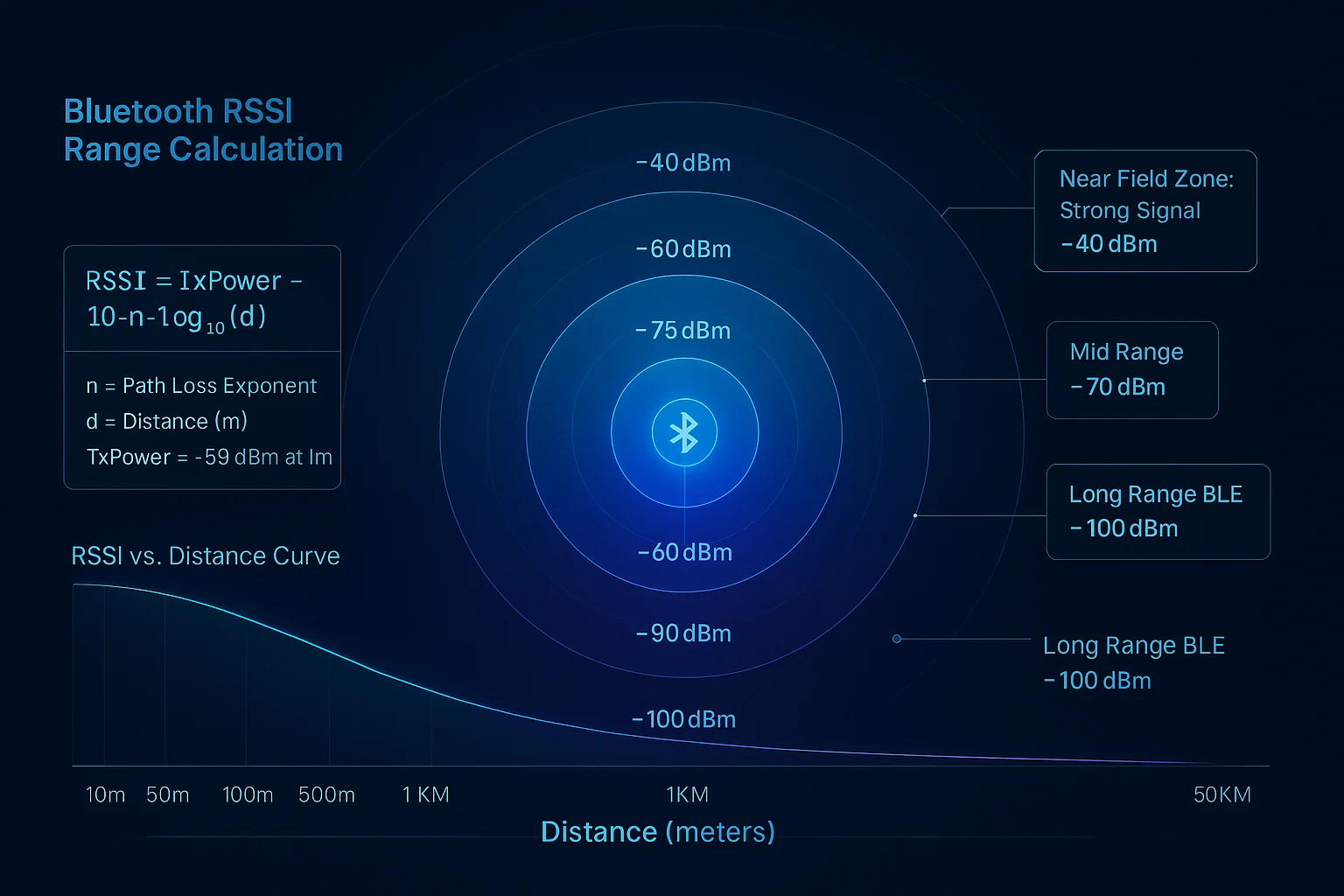
Bluetooth RSSI Range Calculation: The Complete Engineer's Guide
RFOXiA Long Range Bluetooth Module
How to Accurately Predict BLE Range — And Why Most Modules Fall Short
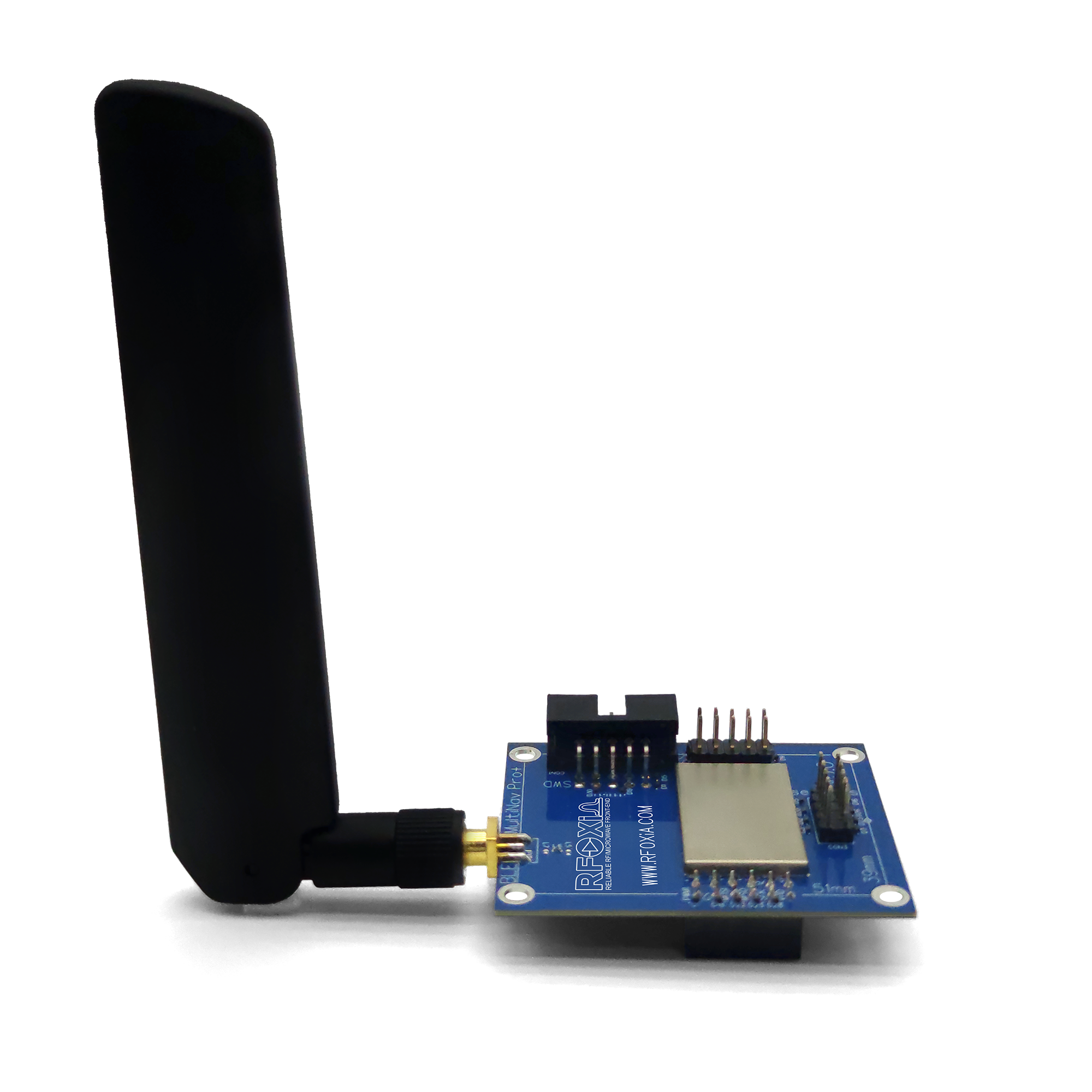
If you have ever deployed a Bluetooth Low Energy module and watched your connection drop at 50 meters when the datasheet promised 100, you already know the problem. Bluetooth RSSI range calculation is one of the most misunderstood topics in wireless engineering — and most developers only discover this after a failed field deployment.
This guide breaks down the physics and math behind RSSI-based range estimation, explains why commodity BLE modules fail at distance, and shows you what hardware design decisions actually determine how far your signal travels. By the end, you will understand not just the formulas but the engineering trade-offs that separate a 100-meter module from one that reaches 50 kilometers.
What Is RSSI and Why Does It Matter?
RSSI stands for Received Signal Strength Indicator. It is a relative measurement of the power level detected at a receiver's antenna, expressed in decibel-milliwatts (dBm). A value of -40 dBm indicates a strong signal close to the transmitter. A value of -90 dBm indicates a very weak signal near the noise floor.
RSSI matters for three core reasons:
- Range estimation — RSSI decays predictably with distance according to known propagation models, making it useful for estimating how far a device is from a receiver.
- Link quality monitoring — dropping RSSI over time warns you of an impending connection loss before it happens.
- Indoor positioning and proximity detection — RSSI triangulation from multiple anchors enables room-level or sub-meter positioning in some configurations.
For this guide, we focus on Bluetooth RSSI range calculation in outdoor and semi-open environments — the scenario most relevant to drone operators, IoT field deployments, and robotics applications.
The Free Space Path Loss Formula
The foundational model for Bluetooth RSSI range calculation is the Free Space Path Loss (FSPL) equation:
FSPL (dB) = 20 × log₁₀(d) + 20 × log₁₀(f) + 20 × log₁₀(4π/c)
Simplified for practical use at 2.4 GHz:
FSPL (dB) ≈ 40 + 20 × log₁₀(d)
Where d is the distance in meters.
To calculate the maximum range from known transmit power and receiver sensitivity:
Maximum Range (m) = 10^((TxPower - RxSensitivity - FSPL_constant) / 20)
Let's plug in real numbers for a commodity BLE module:
- Transmit power: +0 dBm (typical for basic modules)
- Receiver sensitivity: -90 dBm (typical for commodity chips)
- Link budget: 90 dB
- Free space range: approximately 100–150 meters under ideal conditions
Now let's look at what changes when you engineer for range:
- Transmit power: +10 dBm (with RF front-end amplifier)
- Receiver sensitivity: -100 dBm (optimized RF design)
- Antenna gain: +3 dBi (high-gain chip antenna)
- Link budget: 113+ dB
- Free space range: several kilometers to tens of kilometers depending on elevation
This is not magic. It is physics and engineering.
Why the Log-Distance Path Loss Model Is More Realistic
Free space assumes a perfect vacuum with no obstructions. Real-world environments introduce multipath reflections, absorption, and diffraction. The Log-Distance Path Loss model accounts for this:
PL(d) = PL(d₀) + 10n × log₁₀(d/d₀) + Xσ
Where:
- PL(d₀) = path loss at a reference distance (usually 1 meter)
- n = path loss exponent (2.0 in free space, 2.5–4.0 in urban/indoor)
- Xσ = shadowing factor (zero-mean Gaussian random variable representing environmental variation)
For Bluetooth RSSI range calculation in outdoor open-air scenarios (drone-to-drone, for example), n approaches 2.0, which is close to free space behavior. This is why elevation dramatically increases effective range — ground reflections and obstructions are eliminated, and the path loss exponent drops toward its theoretical minimum.
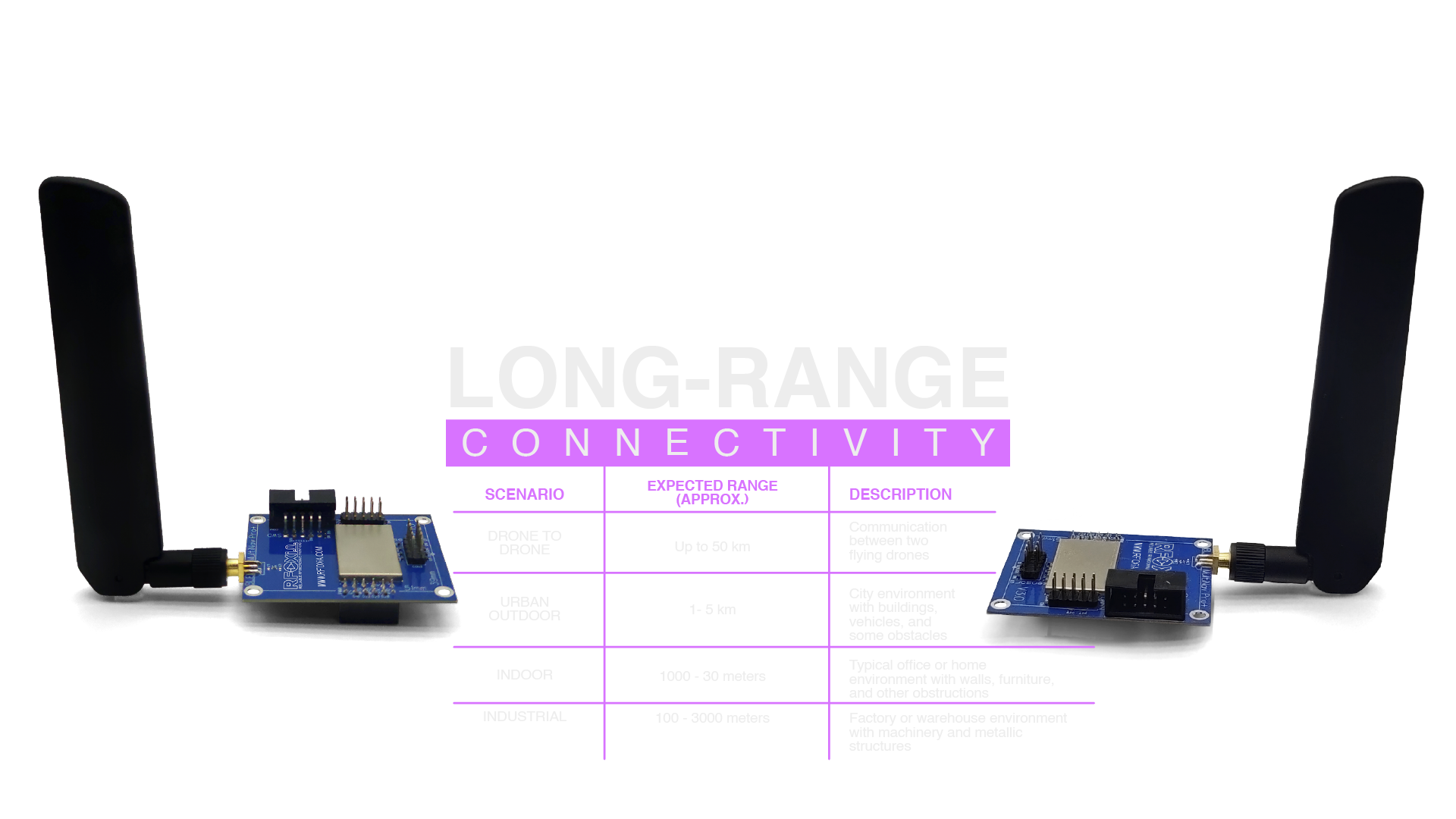
This is the engineering reason why the MultiNav Pro+ BLE module achieves 5KM ground-to-ground, 15–20KM man-to-drone, and up to 50KM drone-to-drone. As altitude increases, the path loss exponent decreases toward free space behavior, and the full link budget of the module is utilized without environmental degradation.
The Four Variables That Actually Determine BLE Range
Every Bluetooth RSSI range calculation ultimately comes back to four hardware variables. Understanding these is the difference between engineering for range and hoping for it.
1. Transmit Power (TxPower)
Most commodity BLE chips transmit at 0 dBm. Some reach +4 dBm or +8 dBm. Every 6 dB of additional transmit power roughly doubles the effective range under free space conditions. Modules with an RF front-end power amplifier can push +20 dBm or higher, subject to regulatory limits.
FCC Part 15 limits conducted output power for BLE in the 2.4 GHz ISM band. Compliance with these limits — evidenced by FCC certification — ensures your module can legally transmit at its rated power in the United States and most international markets.
2. Receiver Sensitivity
Receiver sensitivity defines the weakest signal the radio can successfully decode. It is measured in dBm and is a negative number — the more negative, the better. A module with -100 dBm sensitivity can detect signals 10 dB weaker than one rated at -90 dBm. That 10 dB difference translates to roughly 3× the range in free space.
Receiver sensitivity is determined by the chip design, LNA (low-noise amplifier) quality, RF front-end filtering, and PCB layout — areas where commodity modules consistently underperform against purpose-engineered hardware.
3. Antenna Gain
Antenna gain is expressed in dBi (decibels relative to an isotropic radiator). A standard PCB trace antenna might provide 0–2 dBi. A high-gain chip antenna or external antenna can provide 3–6 dBi or more. Every 3 dBi of antenna gain provides approximately 1.4× range improvement.
The antenna is often the most overlooked element in Bluetooth RSSI range calculation. Developers focus on the chip spec sheet and ignore antenna design — then wonder why their 100-meter module stops working at 40 meters.
4. Link Budget
Link budget is the complete accounting of all gains and losses in the RF chain:
Link Budget (dB) = TxPower + TxAntenna - FSPL - Losses + RxAntenna - RxNoiseFigure
Maximum range is achieved when received signal power equals receiver sensitivity. A higher link budget directly means longer range. Professional RF engineers design for specific link budgets depending on the target application. Commodity BLE modules are designed for cost — not link budget.
How to Use RSSI for Range Estimation in Code
For developers implementing Bluetooth RSSI range calculation in firmware or application code, the standard approach uses the path loss model inverted:
Estimated Distance (m) = 10^((TxPower_at_1m - RSSI) / (10 × n))
Where:
- TxPower_at_1m = the known RSSI value at exactly 1 meter from the transmitter (measured during calibration)
- RSSI = current measured RSSI
- n = path loss exponent (use 2.0 for open outdoor, 2.7–3.5 for indoor with obstacles)
Example: If TxPower at 1m = -59 dBm, current RSSI = -80 dBm, n = 2.0:
Distance = 10^((-59 - (-80)) / (10 × 2.0)) = 10^(21/20) = 10^1.05 ≈ 11.2 meters
This calculation works well for proximity detection and rough ranging. For precision location, RSSI-based estimation should be fused with GNSS data — which is exactly the architecture the MultiNav Pro+ ecosystem supports.
RSSI Filtering: Kalman and Moving Average
Raw RSSI readings are noisy. A single reading can vary by 5–10 dBm from one measurement to the next due to multipath fading, body absorption, and random noise. Any production Bluetooth RSSI range calculation system must filter the RSSI stream before computing distance.
Simple Moving Average (SMA): Average the last N RSSI readings. Easy to implement, introduces lag.
Exponential Moving Average (EMA): Weighted average that gives more weight to recent readings. Faster response than SMA with less noise.
Kalman Filter: Optimal linear estimator. Tracks both the estimated state (RSSI) and uncertainty. Excellent for tracking moving objects where both RSSI and its rate of change matter. Computationally heavier but dramatically more accurate for dynamic scenarios.
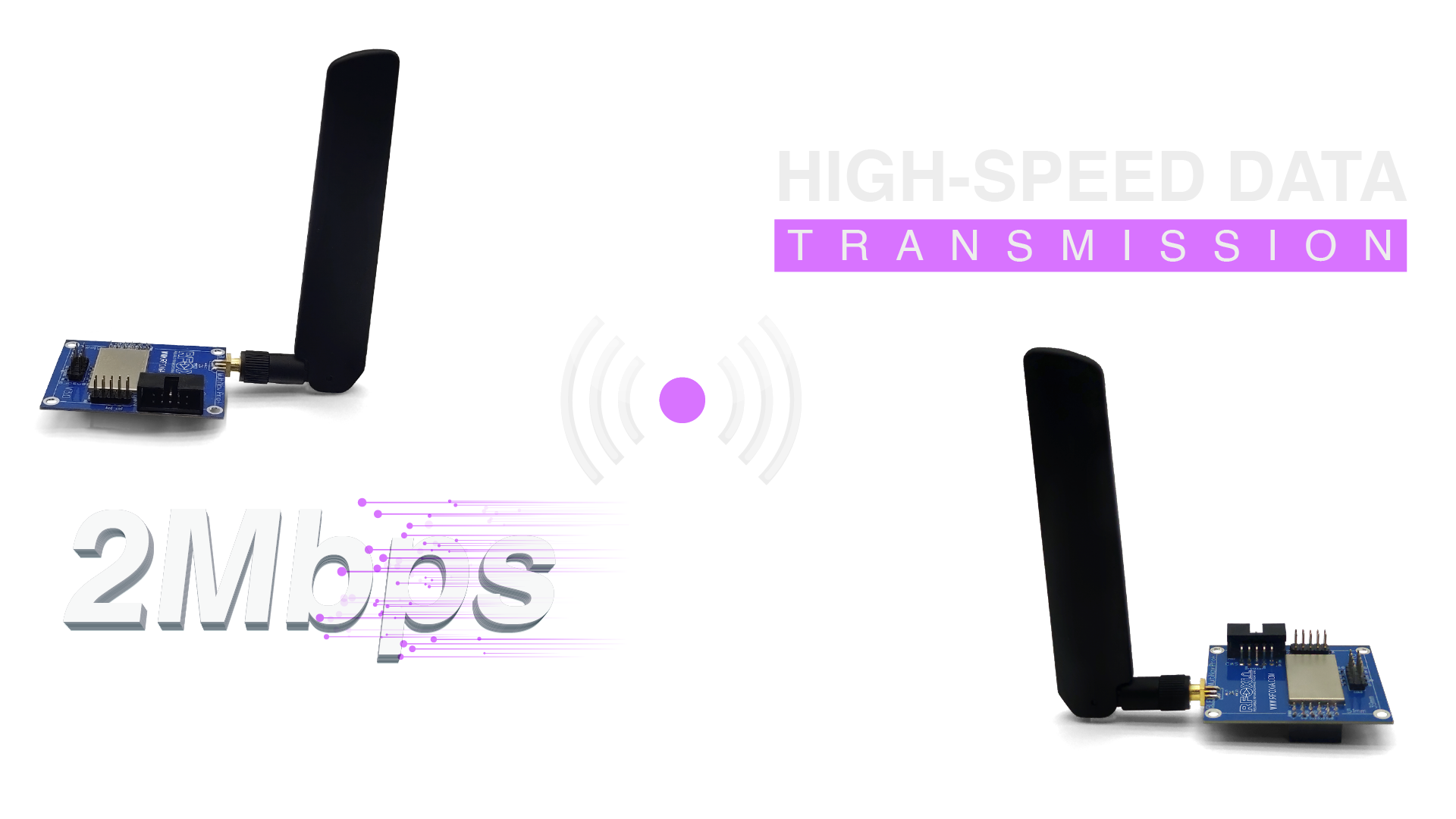
For drone and robotics applications — where the platform is moving quickly and link quality decisions happen in milliseconds — a Kalman filter on RSSI is worth the computational overhead. At 2 Mbps data rate, the MultiNav Pro+ BLE module can stream RSSI samples at high frequency, giving the filter enough data to converge quickly.
Why Commodity BLE Modules Fail at Range
The gap between a commodity BLE module and a purpose-engineered long-range module is not marketing — it is engineering. Here is where commodity modules consistently fall short:
1. No RF Front-End Amplifier: Commodity modules skip the PA (power amplifier) and LNA (low-noise amplifier) to save $1–2 in BOM cost. This single omission eliminates 10–15 dB of link budget — the difference between 100 meters and 5 kilometers.
2. Generic PCB Layout: RF performance is extremely sensitive to PCB layout. Impedance mismatches, ground plane gaps, and poor component placement all degrade performance in ways that never appear in a datasheet but always appear in field testing.
3. Cheap Antenna or No Antenna: PCB trace antennas on commodity modules are designed for miniaturization, not performance. A well-designed high-gain chip antenna adds real-world range that no software optimization can replicate.
4. No Receiver Sensitivity Optimization: The STM32WB07CCV6 at the core of the MultiNav Pro+ BLE module is a capable radio processor — but its performance in a system is determined by the RF front-end design around it, not just the chip itself.
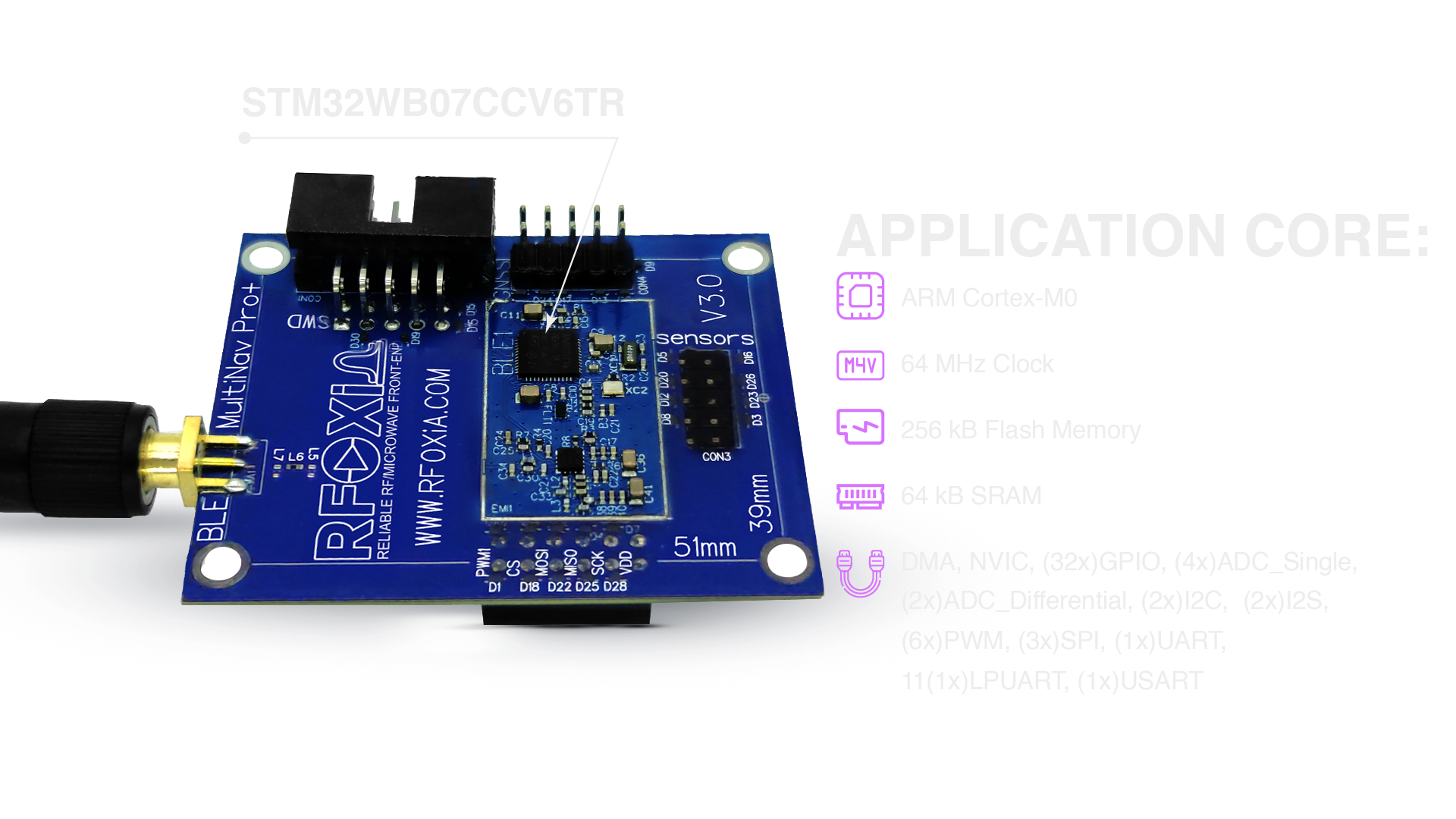
This is the engineering reality that separates the MultiNav Pro+ from every commodity BLE module on the market. The same 2.4 GHz Bluetooth standard. Dramatically different hardware engineering. Dramatically different results.
The MultiNav Pro+ BLE Module: Engineered for Real Range
The RFOXiA Long Range Bluetooth Module is purpose-built to achieve the range numbers that the Friis and FSPL equations predict are possible — not the compromised numbers that result from cost-cutting in commodity hardware.
Verified Range Performance
- Ground-to-ground (smartphone paired): 5KM
- Man-to-drone: 15–20KM
- Drone-to-drone (both elevated, ground reflections eliminated): 50KM
These numbers align directly with what physics predicts when you engineer for maximum link budget: high transmit power, optimized receiver sensitivity, high-gain integrated antenna, and clean RF PCB design.
2 Mbps Data Rate
Range is only useful if the link carries meaningful data. The MultiNav Pro+ operates at 2 Mbps — fast enough to stream real-time sensor data, GPS telemetry, control commands, and video metadata simultaneously across its operating range.
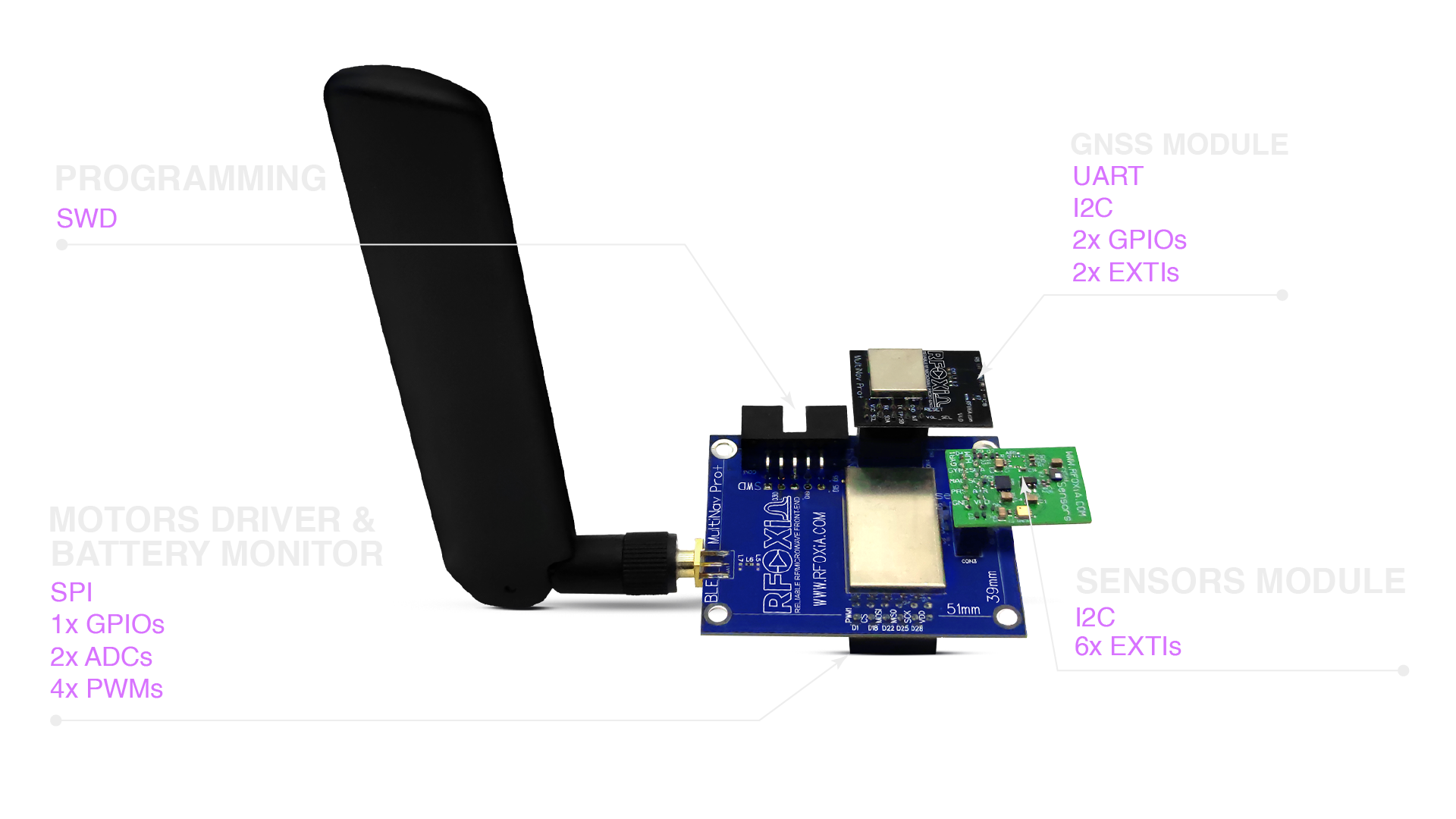
Compact Form Factor
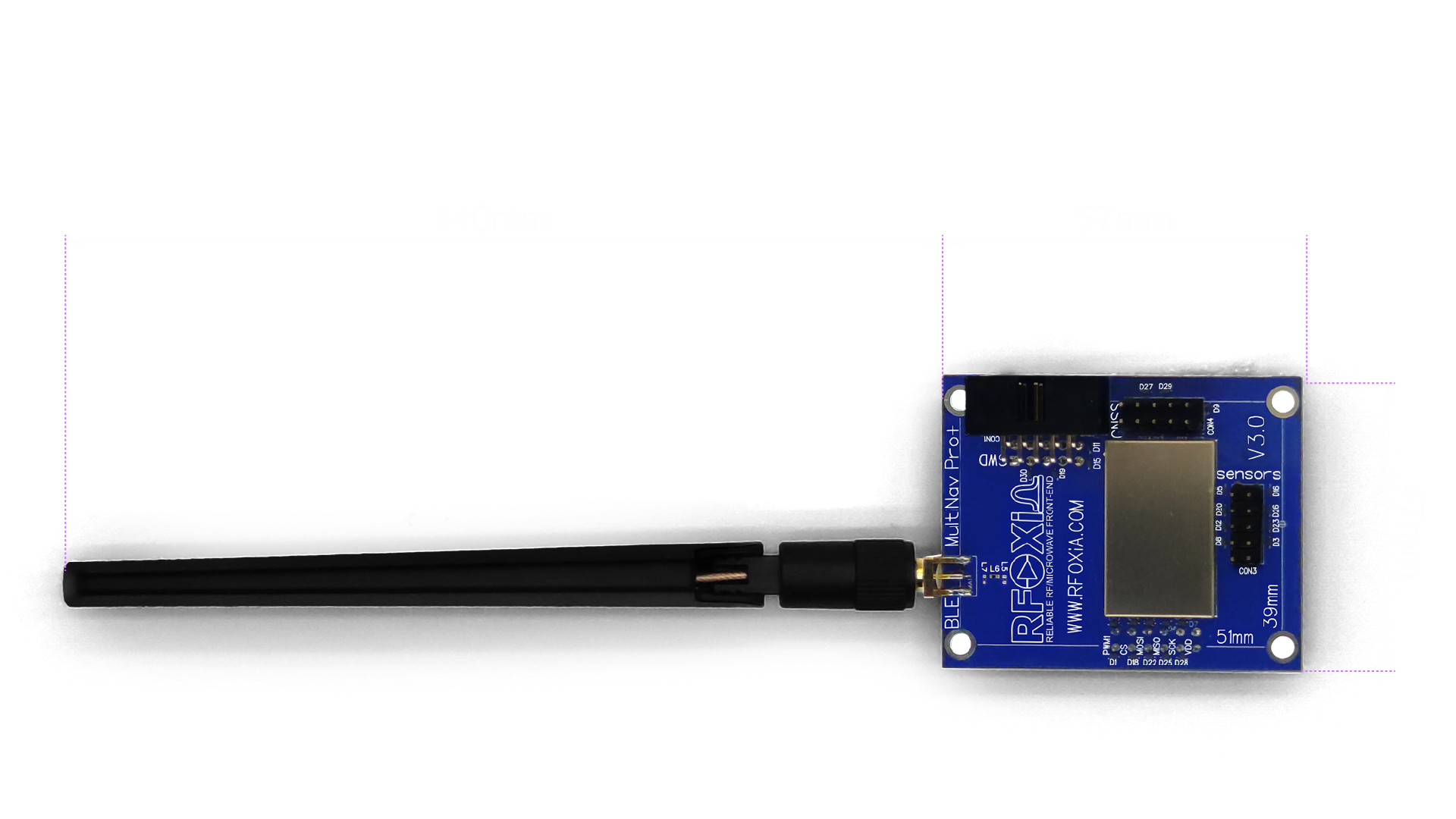
At 57mm × 47mm with a 140mm antenna, the module fits into space-constrained designs — including inside drone frames where every millimeter matters. The fixing frame size of 51mm × 39mm with corner mounting holes makes mechanical integration straightforward.
FCC Certified
FCC certification means the module has been independently tested and verified to meet US radio frequency regulations. This is not a paperwork checkbox — it is evidence that the module operates at its rated transmit power legally, that it does not cause harmful interference, and that it meets conducted emission standards that protect the link budget from self-interference.
For commercial deployment, distributor qualification, or integration into a product you intend to sell, FCC certification on your wireless module is non-negotiable.
BLE Chat: Internet-Independent Long-Range Communication
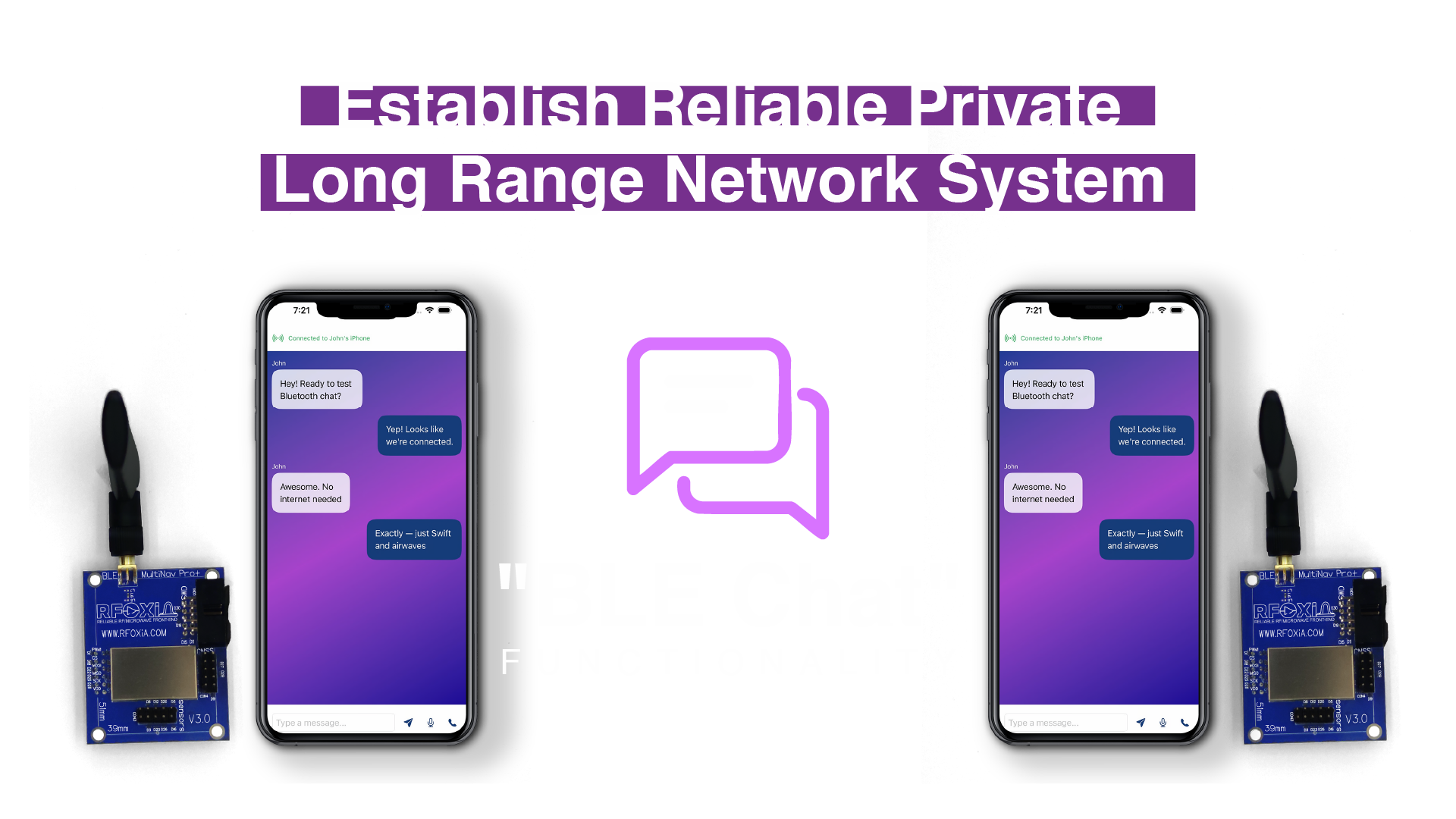
One of the most compelling applications of accurate Bluetooth RSSI range calculation is mesh communication — knowing the quality of each link in a multi-hop network so the routing algorithm can make intelligent path decisions. The MultiNav Pro+ BLE module's Chat functionality enables direct, internet-independent text and data communication between users at ranges up to 5KM ground-to-ground.
For disaster response teams, remote field expeditions, or any scenario where cellular infrastructure is unavailable or compromised, this is a capability that commodity BLE simply cannot provide.
RFOXiA Connect App: RSSI and Range in Your Pocket
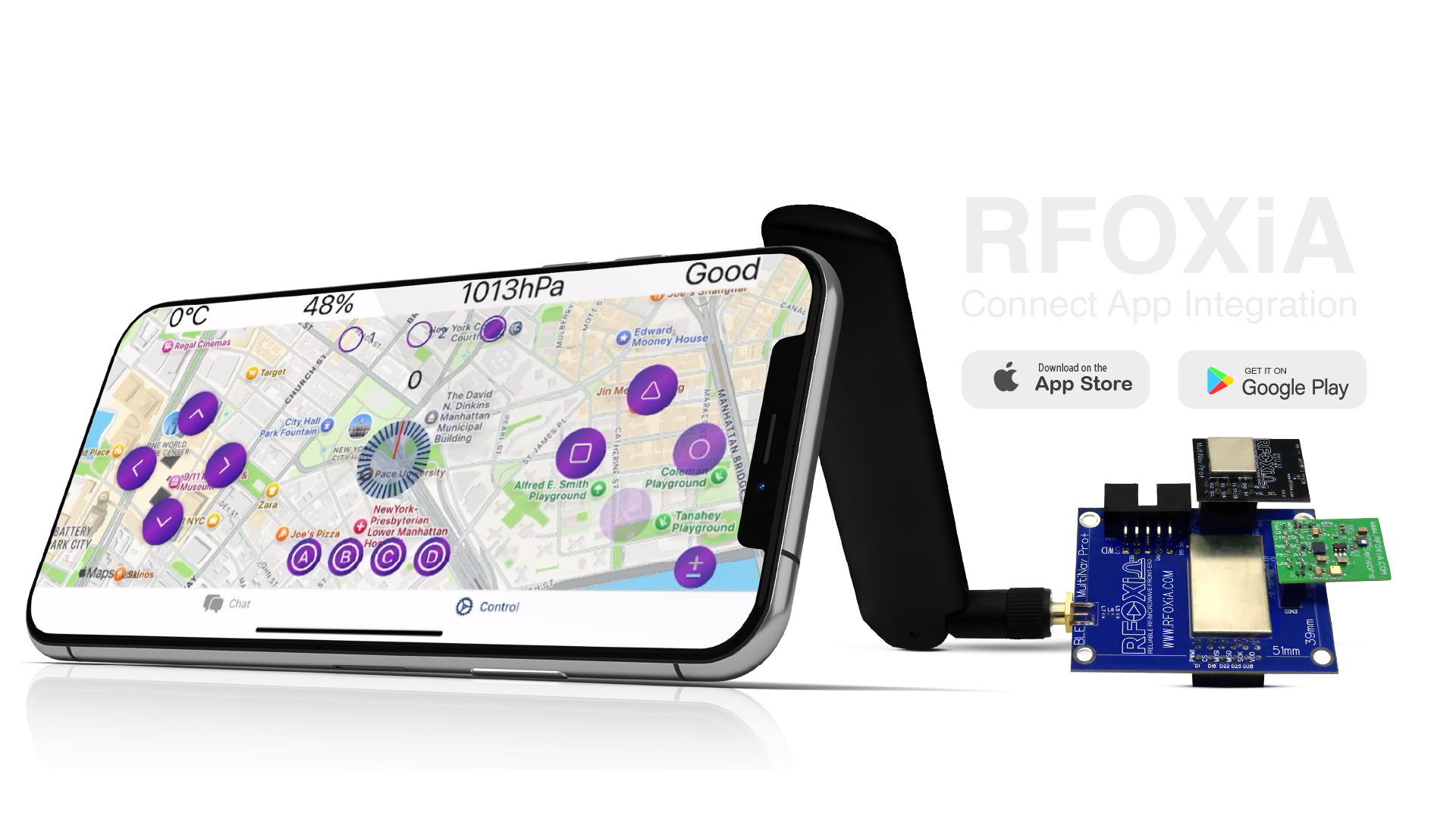
The RFOXiA Connect app brings real-time link monitoring, GPS tracking, and sensor data visualization to iOS and Android. The PS5-style controller interface gives drone and robot operators intuitive control at the full range of the BLE module — up to 20KM for man-to-drone applications.
All control and monitoring functions work completely without internet connectivity. The communication happens directly between your smartphone and the BLE module. Understanding Bluetooth RSSI range calculation becomes actionable when you can see live RSSI values and GPS position simultaneously on a map interface.
Open Source Firmware and the AI Firmware Builder
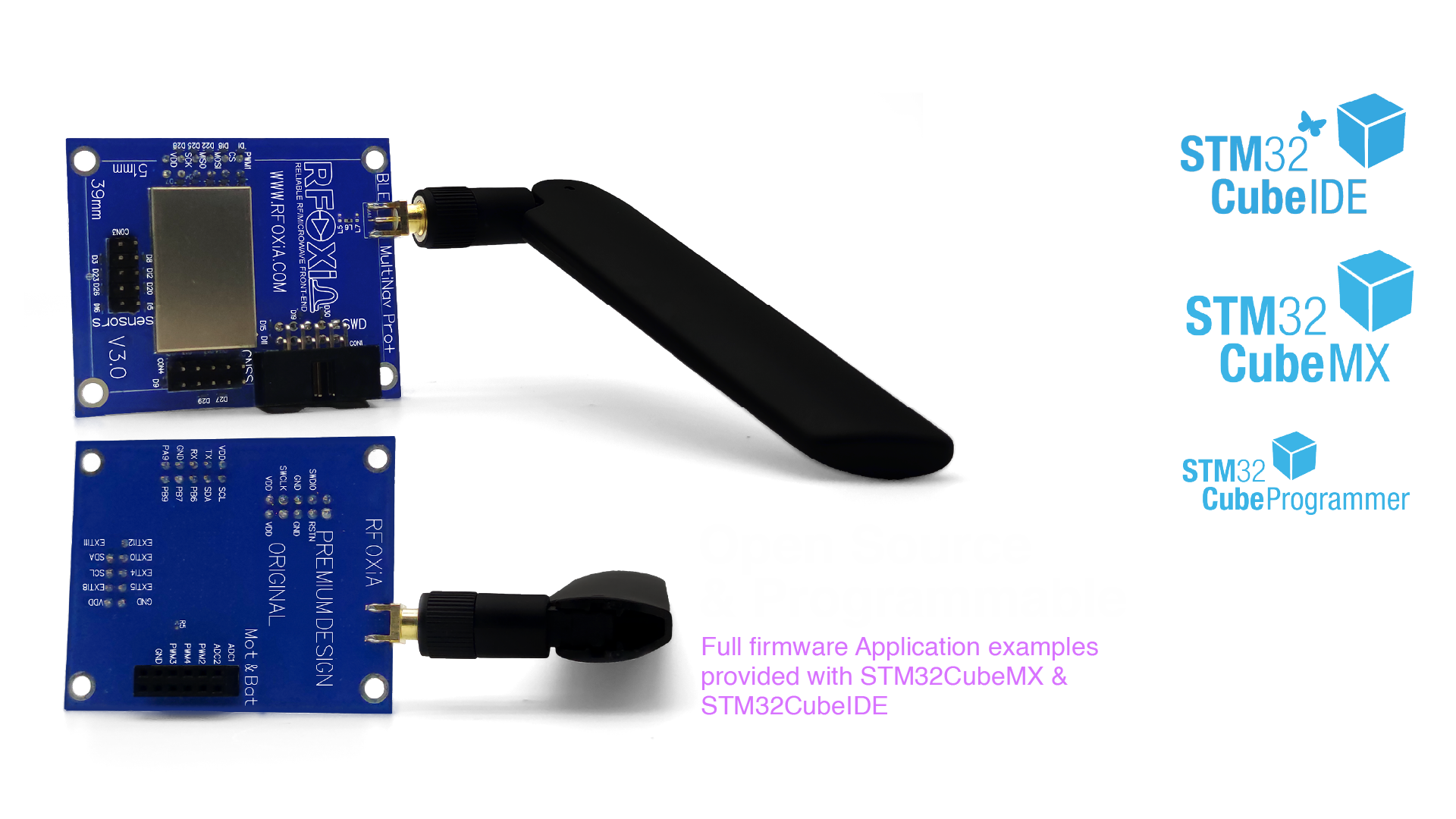
The MultiNav Pro+ BLE module firmware is fully open source, available on GitHub at github.com/RFOXiA/MultiNav-Pro-Long-Range-BLE-Module-Firmware-STM32WB07. Developers can implement custom Bluetooth RSSI range calculation algorithms, custom filtering, custom control protocols — anything the STM32WB07CCV6 can execute.
For developers who want to build custom applications without starting from scratch in C, the RFOXiA Club AI Firmware Builder lets you describe your application in plain language and generates production-ready firmware with full source code. This reduces firmware development time from months to hours.
Programming access is via SWD through the integrated STLink interface on the Power/Program Kit.
Precision Timing with Integrated RTC
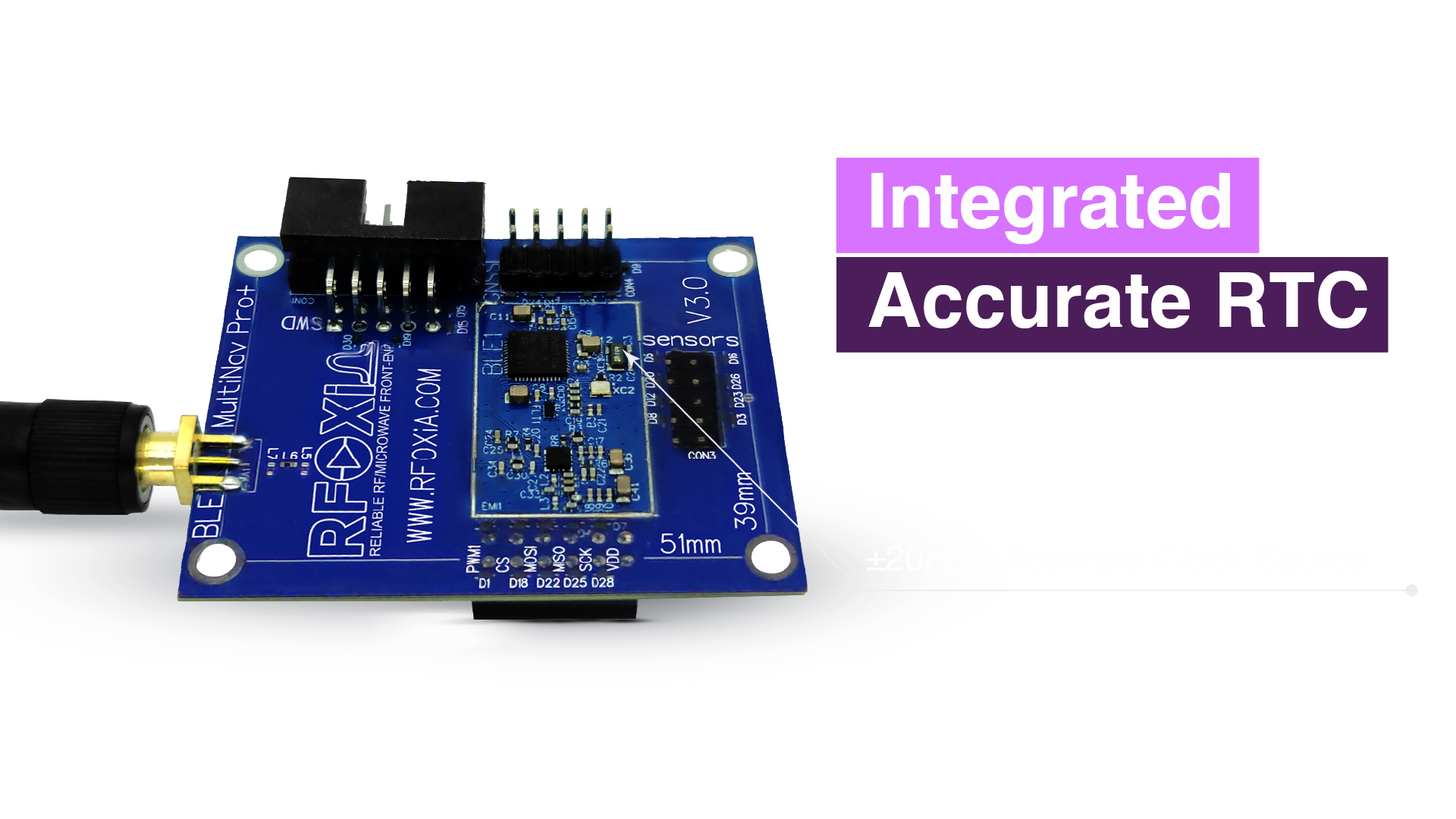
For synchronized multi-node deployments — where Bluetooth RSSI range calculation feeds into time-difference-of-arrival (TDOA) positioning systems — accurate timing is critical. The MultiNav Pro+ BLE module integrates an RTC crystal that ensures precise timing across distributed nodes, enabling synchronization accuracy that commodity modules cannot achieve.
Practical Bluetooth RSSI Range Calculation: A Developer Checklist
Before you deploy any BLE system in the field, run through this checklist to validate your range predictions against physics:
1. Establish your link budget. TxPower (dBm) + TxAntenna (dBi) + RxAntenna (dBi) - RxSensitivity (dBm) = total link budget (dB).
2. Choose the right path loss model. Outdoor open air: n = 2.0. Dense urban: n = 3.0–3.5. Indoor with walls: n = 3.5–4.5.
3. Calculate theoretical maximum range. Max range (m) = 10^((link budget - FSPL_constant) / (10 × n)).
4. Apply a fade margin. Subtract 10–20 dB from your link budget to account for real-world degradation, multipath, and environmental variation.
5. Validate with field testing. Walk or fly the system to the predicted range limit. Log RSSI vs. distance. Compare to model. Adjust n until the model fits observed data.
6. Implement RSSI filtering in production firmware. EMA or Kalman filter on RSSI before computing distance or triggering link quality alerts.
7. Consider elevation for maximum range. For drone-to-drone applications, elevation removes ground reflections and drops path loss exponent toward 2.0 — the scenario where 50KM range becomes achievable.
Who Needs This Level of Range?
The answer is: more developers than you might think. Most BLE deployments use commodity modules not because 100 meters is enough, but because developers do not know that professional-grade long-range BLE exists at maker-accessible prices.
- FPV and drone builders who want to control their aircraft beyond visual line of sight with a private, encrypted link — not a shared protocol.
- Robotics engineers deploying autonomous systems in open environments where 100-meter radio range is a liability.
- IoT field researchers who need to push sensor data from remote installations without cellular infrastructure.
- Search and rescue teams who need reliable communication independent of towers and satellites.
- Amateur radio operators and makers who want to explore the limits of what BLE hardware can actually do.
For all of these applications, accurate Bluetooth RSSI range calculation is not just an academic exercise — it is the design foundation for a system that either works in the field or fails there.
The RFOXiA Long Range Bluetooth Module is available for $59 for two units — a price point that puts professional-grade long-range BLE hardware in reach of any developer, researcher, or builder who needs it.
The Complete Ecosystem
The MultiNav Pro+ BLE module does not exist in isolation. It is the wireless backbone of a complete development ecosystem:
- MultiNav Pro+ GNSS Module — 1.5-meter accuracy, 18Hz fix rate, for precise location on fast-moving platforms.
- Sensors Module — 7 integrated sensors (temperature, humidity, pressure, air quality, accelerometer, gyroscope, magnetometer) for complete environmental awareness.
- Power/Program Kit — supercapacitor-based power with 5-minute charge time and 24-hour runtime for field deployments.
- RFOXiA Club — the developer platform where AI firmware generation, community, data monetization, and hardware management converge.
The Developer Bundle combines all four modules for $199 — the only product on the market integrating long-range BLE, precision GNSS, multi-sensor monitoring, and professional power management in one unified kit.
Conclusion
Bluetooth RSSI range calculation is grounded in well-understood physics. The Friis transmission equation, free space path loss, and the log-distance model are not approximations — they are the engineering foundation for every wireless system ever built. The gap between a 100-meter commodity module and a 50-kilometer professional module is not a mystery. It is link budget: transmit power, receiver sensitivity, antenna gain, and RF design quality.
Most BLE modules sacrifice link budget for cost. The MultiNav Pro+ BLE module was designed to achieve the range that the physics actually allows — and then engineered, FCC certified, and field tested to prove it.
If your next project demands real range, real data rates, and a complete development ecosystem to build on, explore the RFOXiA Long Range Bluetooth Module and join the RFOXiA Club for free access, AI firmware tools, and a $10 welcome credit toward your first order.
Written by: Moamen Mohamed LinkedIn