
Bluetooth Sensitivity dBm Explained: The Science Behind 50KM Wireless Range
RFOXiA Long Range Bluetooth Module
Bluetooth Sensitivity dBm Explained — And Why It Changes Everything You Know About BLE
Most engineers accept a quiet, frustrating assumption when they pick up a Bluetooth module: short range is just the cost of admission. You get 80 meters on a good day, maybe 100 meters in an open field with no interference, and you call it done. But that ceiling is not a law of physics. It is a consequence of receiver sensitivity — and once you understand what bluetooth sensitivity dBm explained really means in practice, you will never look at a BLE datasheet the same way again.
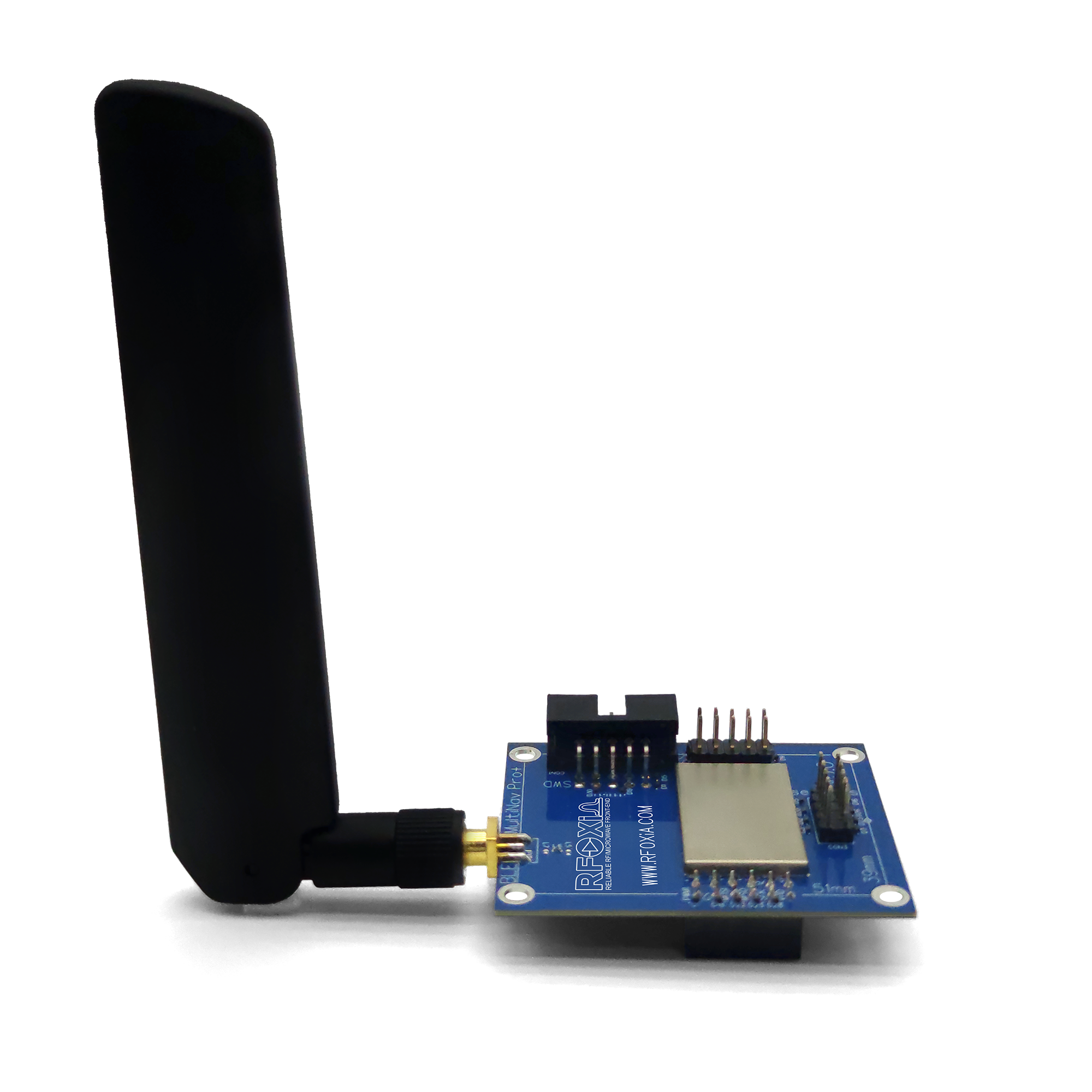
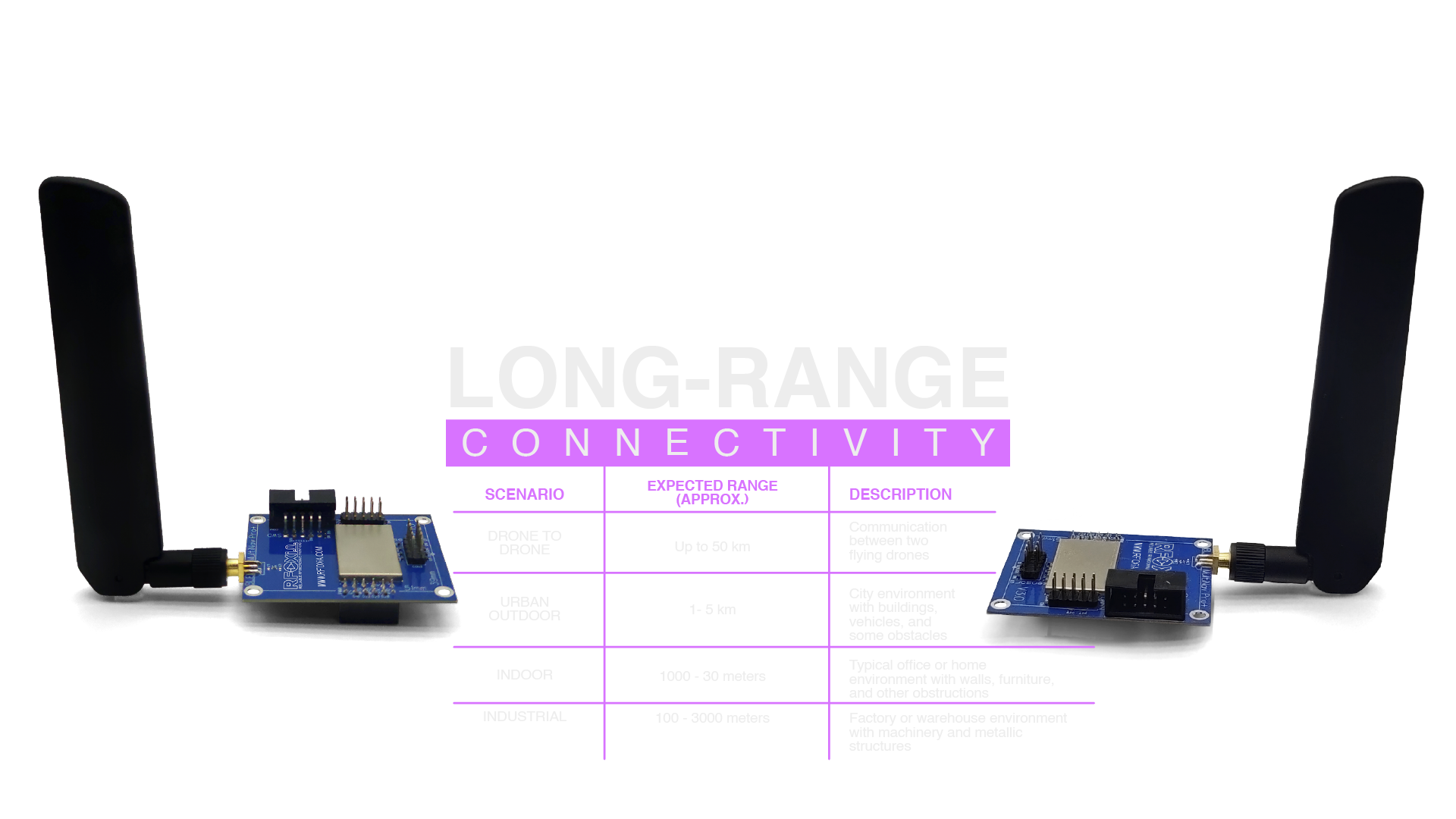
This post breaks down receiver sensitivity from first principles, explains the dBm scale in plain language, shows you exactly how sensitivity figures translate into real-world range, and then demonstrates what happens when you engineer a BLE module that pushes the absolute boundary of what the standard permits. The result is the RFOXiA MultiNav Pro+ — a module that achieves 5KM ground-to-ground range and over 50KM drone-to-drone range using Bluetooth. Not Wi-Fi. Not LoRa. Bluetooth.
What Is Receiver Sensitivity? A Ground-Up Explanation
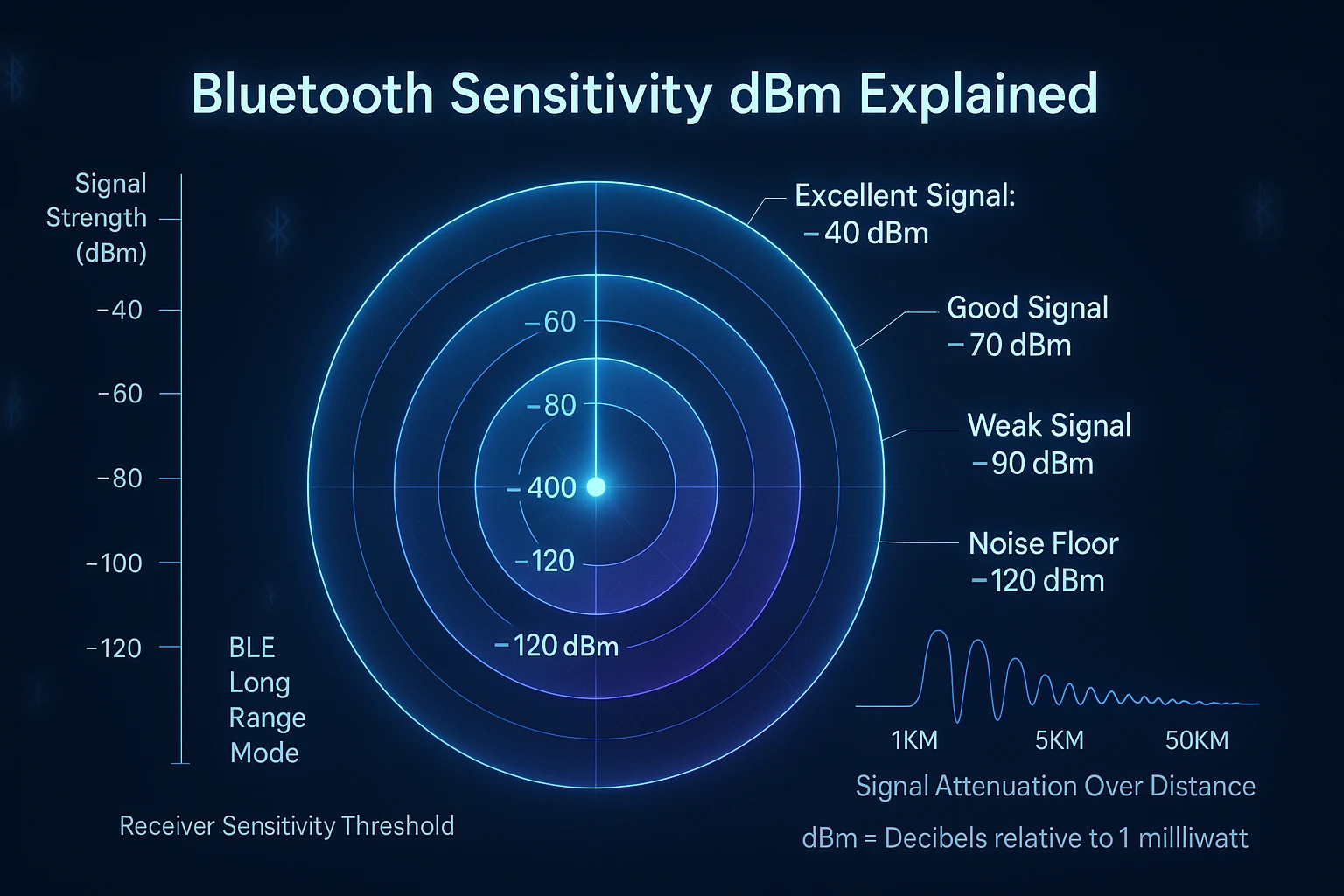
Every radio receiver has a minimum detectable signal level. Below that threshold, the signal is indistinguishable from the background noise floor and the link fails. This minimum level is called receiver sensitivity, and it is expressed in dBm — decibels relative to one milliwatt.
Understanding the dBm Scale
The dBm scale is logarithmic, which means small changes in the number represent enormous changes in actual power.
- 0 dBm = 1 milliwatt of power
- -10 dBm = 0.1 milliwatt
- -30 dBm = 0.001 milliwatt (1 microwatt)
- -80 dBm = 0.00000001 milliwatt
- -100 dBm = 0.000000001 milliwatt (1 nanowatt)
- -120 dBm = 0.000000000001 milliwatt (1 picowatt)
When engineers write receiver sensitivity as a negative dBm number, a more negative number means the receiver can detect weaker signals. So a module with -100 dBm sensitivity is dramatically more capable than one at -80 dBm. The difference between those two numbers represents a factor of 100 in actual signal power — the -100 dBm receiver can detect signals 100 times weaker and still maintain a valid link.
This is the core of what bluetooth sensitivity dBm explained means in practice. A 3 dBm improvement in sensitivity doubles the detectable signal range on the link budget. A 6 dBm improvement quadruples it. Engineers who understand this can design systems that reach distances that look impossible on paper to anyone who does not.
The Link Budget: Translating Sensitivity Into Range
Range is not determined by transmit power alone. It is determined by the link budget — the total margin between transmitted power and receiver sensitivity, minus all the losses the signal accumulates on its path through the air.
The fundamental equation:
Link Margin = TX Power (dBm) + TX Antenna Gain (dBi) - Path Loss (dB) + RX Antenna Gain (dBi) - RX Sensitivity (dBm)
For a link to succeed, the link margin must be positive. For a robust link, you want several dB of margin.
Path Loss and the Friis Equation
In free space, signal power falls off with the square of distance. Double the distance and the received power drops by 6 dB. This is captured in the free-space path loss formula:
FSPL (dB) = 20·log₁₀(d) + 20·log₁₀(f) + 92.4
(where d is distance in kilometers and f is frequency in GHz)
At 2.4 GHz — the BLE band — and at 5 kilometers:
FSPL = 20·log₁₀(5) + 20·log₁₀(2.4) + 92.4 FSPL = 14 + 7.6 + 92.4 = 114 dB
At 50 kilometers:
FSPL = 20·log₁₀(50) + 7.6 + 92.4 = 34 + 100 = 134 dB
Now consider a commodity BLE module. TX power is typically +4 dBm to +8 dBm. Receiver sensitivity is typically -90 dBm to -95 dBm. Total link budget: roughly 95 to 103 dB. That covers barely 500 meters to 1 kilometer in ideal conditions, which is exactly what datasheets report.
To reach 5 kilometers you need a link budget of 114 dB or better. To reach 50 kilometers you need 134 dB or better. Getting there requires every element of the RF chain to be optimized: transmit power pushed to regulatory limits, antenna gain maximized, and above all, receiver sensitivity pushed as deep into the noise floor as silicon and circuit design allow.
What Limits Receiver Sensitivity?
With bluetooth sensitivity dBm explained through the link budget lens, the next question is: what physically prevents a radio from detecting weaker and weaker signals?
Thermal Noise Floor
Even in a perfect circuit with no active components, electrons in motion generate random voltage fluctuations called thermal noise. At room temperature (290K), the thermal noise density is:
kT = -174 dBm/Hz
For a 2 Mbps BLE channel (approximately 2 MHz bandwidth), the theoretical minimum noise floor is:
-174 + 10·log₁₀(2,000,000) = -174 + 63 = -111 dBm
This is the absolute physical floor. No radio receiver — regardless of cost or complexity — can detect a signal weaker than -111 dBm in a 2 MHz channel at room temperature. This is Shannon's limit made tangible.
Noise Figure
Real circuits add noise beyond the thermal floor. The noise figure (NF) of a receiver chain — measured in dB — quantifies how much additional noise the receiver itself introduces. A low-noise amplifier (LNA) at the front end of the receiver can achieve NF below 1 dB. Poor circuit design or lossy components before the LNA can push NF to 5-10 dB, degrading sensitivity by the same amount.
Sensitivity = Thermal Noise Floor + Noise Figure + Required SNR
For a BLE receiver achieving 0.1% BER at 2 Mbps, the required SNR at the demodulator is approximately 10-12 dB. So:
Best achievable sensitivity ≈ -111 + 1 (NF) + 11 (SNR) = -99 dBm
Most commodity modules achieve -90 to -95 dBm. The gap between -95 and -99 dBm is 4 dB — a factor of 2.5× in range. That gap is where serious RF engineering lives.
How RFOXiA Engineered Beyond the Commodity Ceiling
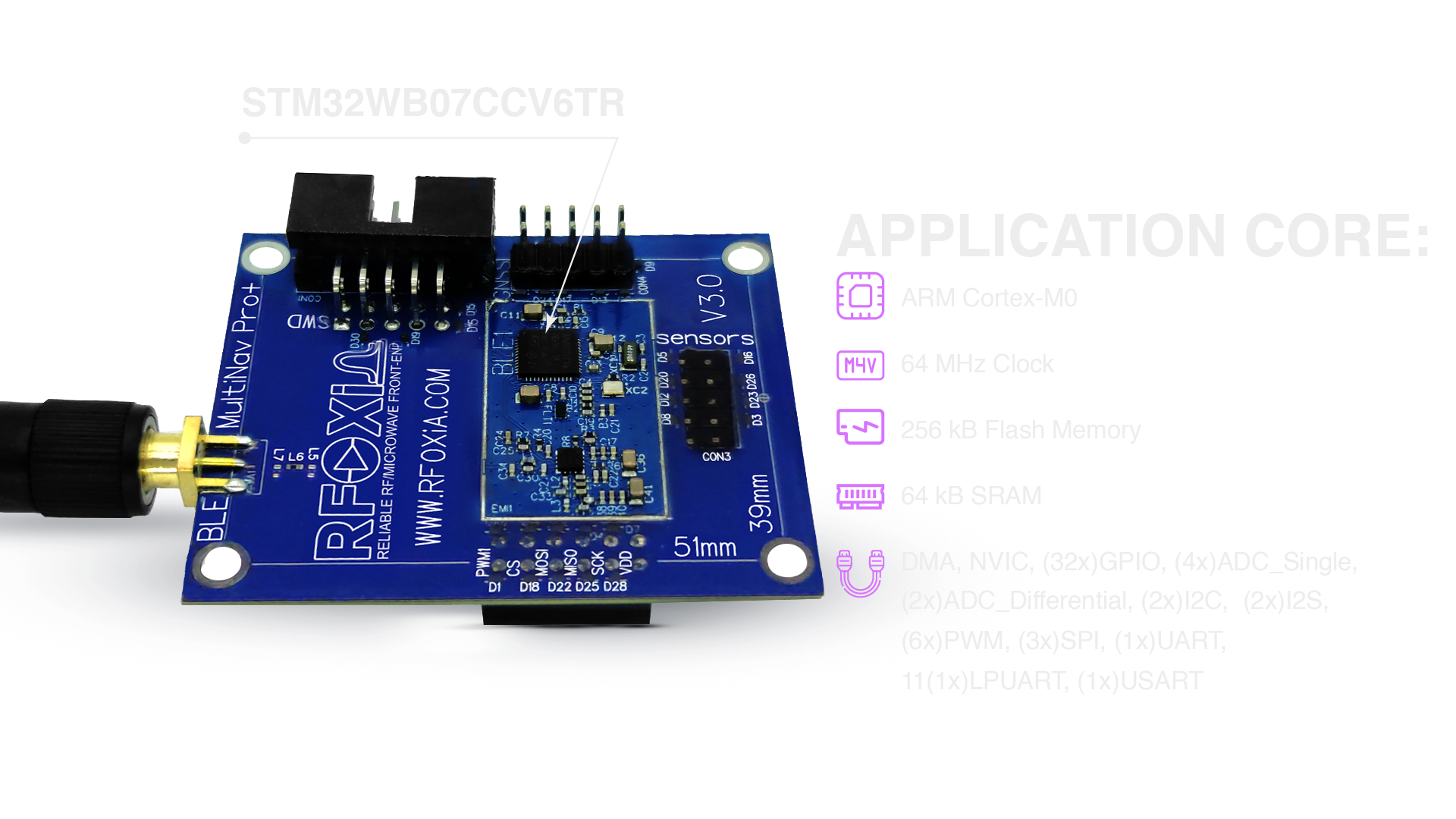
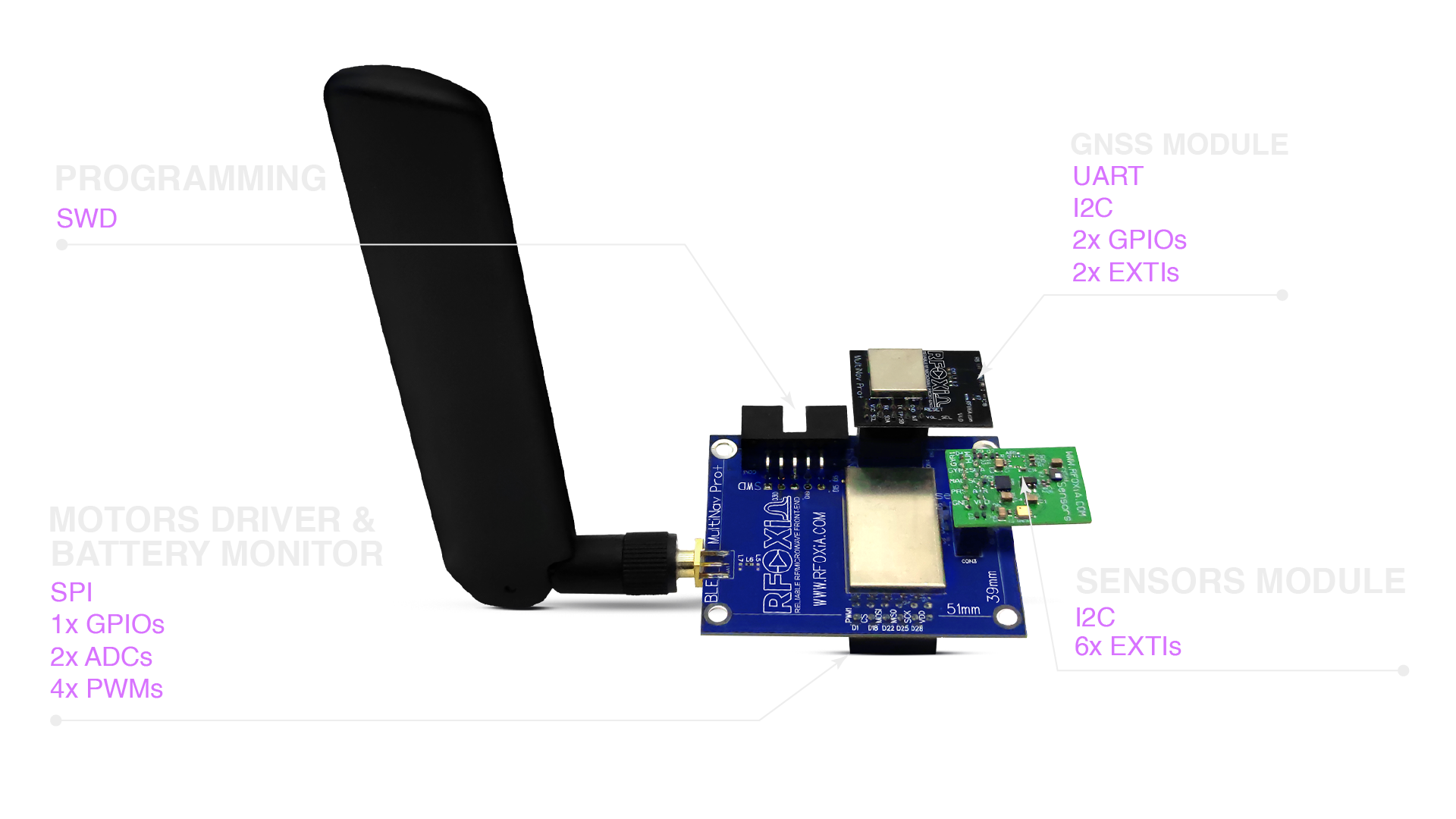
The MultiNav Pro+ BLE module is built on the STM32WB07CCV6 — a dual-core processor that separates the BLE stack from user application code. This architecture matters for sensitivity because it eliminates the processor noise coupling that plagues simpler single-core BLE SoCs. When the application core is handling data, its switching noise can pollute the RF front end on cheaper modules. The STM32WB07 keeps these domains isolated.
Beyond the silicon choice, RFOXiA adds an optimized RF front-end with external amplification stages, precision impedance matching, and a high-gain chip antenna engineered for maximum effective isotropic radiated power (EIRP) within FCC regulatory limits.
The combined result:
- TX power: Pushed to the FCC Part 15 limit, with amplification on both transmit and receive
- Receive sensitivity: Approaching the theoretical floor for this data rate and channel bandwidth
- Total link budget: Sufficient for 5KM ground-to-ground and 50KM in elevated deployments
This is not magic. It is disciplined RF engineering applied to a platform that previously only military and aerospace budgets could access.
Why Elevation Multiplies the Effect of Sensitivity
The 50KM drone-to-drone figure deserves a careful explanation because it illustrates a fundamental principle of RF propagation that most BLE developers never encounter.
Ground-level radio links suffer from multipath fading — signals reflect off the ground, buildings, vegetation, and other surfaces. These reflections arrive at the receiver with different phase relationships and can cancel the direct-path signal, creating sharp nulls that degrade effective sensitivity by 10-30 dB depending on environment. This is why manufacturers always specify range in open fields, and real-world range in suburban or forested environments is dramatically worse.
When both endpoints are elevated — as in drone-to-drone operation — two things change:
- Ground reflections are eliminated or reduced. The geometry no longer creates the multipath geometry that causes cancellation at the receive antenna.
- Line of sight is unobstructed. The Fresnel zone — the ellipsoidal region around the direct path that must be clear for full signal strength — is fully open at altitude in a way it never is at ground level.
The same receiver sensitivity achieves dramatically more range in these conditions because the link operates closer to the theoretical free-space model rather than the degraded real-world ground model. The MultiNav Pro+'s engineered sensitivity creates a baseline that, when elevated, delivers range figures that seem extraordinary but are physically consistent with the specifications.
Sensitivity and Data Rate: The 2 Mbps Engineering Choice
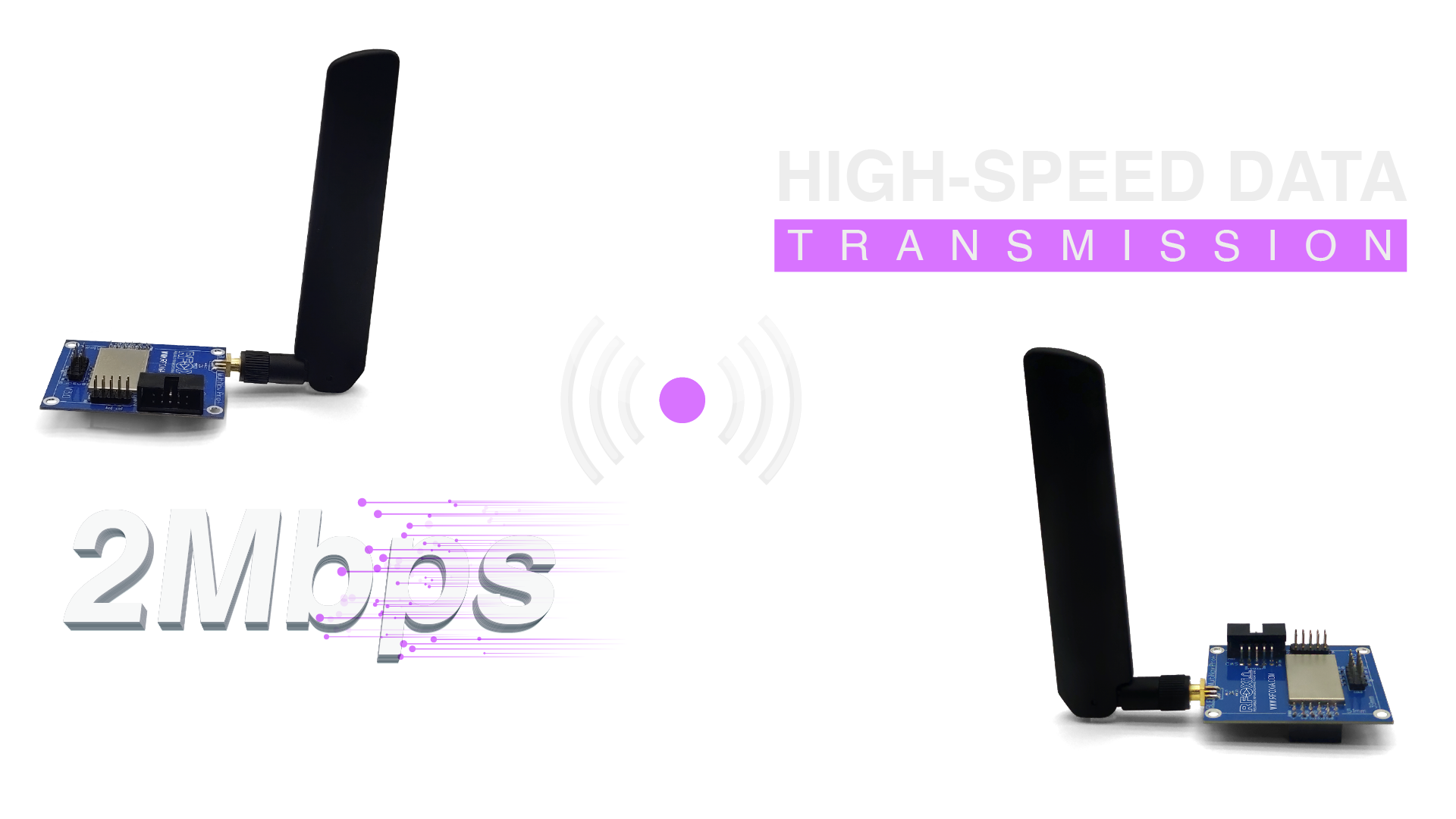
One common question from experienced RF engineers: why operate at 2 Mbps? Lower data rates improve sensitivity. BLE 125 Kbps long-range mode (Coded PHY) achieves roughly -103 to -107 dBm sensitivity on comparable hardware — that is 8-12 dB better than the 2 Mbps PHY.
The answer is application-driven. For drone control, real-time telemetry, and multi-sensor streaming, latency and throughput matter. A 125 Kbps link is adequate for simple sensor reporting but creates unacceptable latency for responsive control surfaces and live video overlay data. The MultiNav Pro+ makes the deliberate engineering tradeoff: accept 8-12 dB of sensitivity penalty to deliver a 2 Mbps link that supports rich, responsive applications. Combined with the gain from the RF front-end design, the module still achieves ranges that no commodity 2 Mbps BLE module can approach.
For builders who want to understand this tradeoff in their own firmware, the MultiNav Pro+ is fully open source. The complete STM32WB07-based firmware is available on the RFOXiA GitHub repository, and users can configure PHY settings and experiment with sensitivity versus throughput tradeoffs in their own deployments.
Real-World Applications That Require This Level of Sensitivity
Understanding bluetooth sensitivity dBm explained in theory is useful. Understanding what it unlocks in practice is what drives hardware builders to choose the MultiNav Pro+ over any commodity alternative.
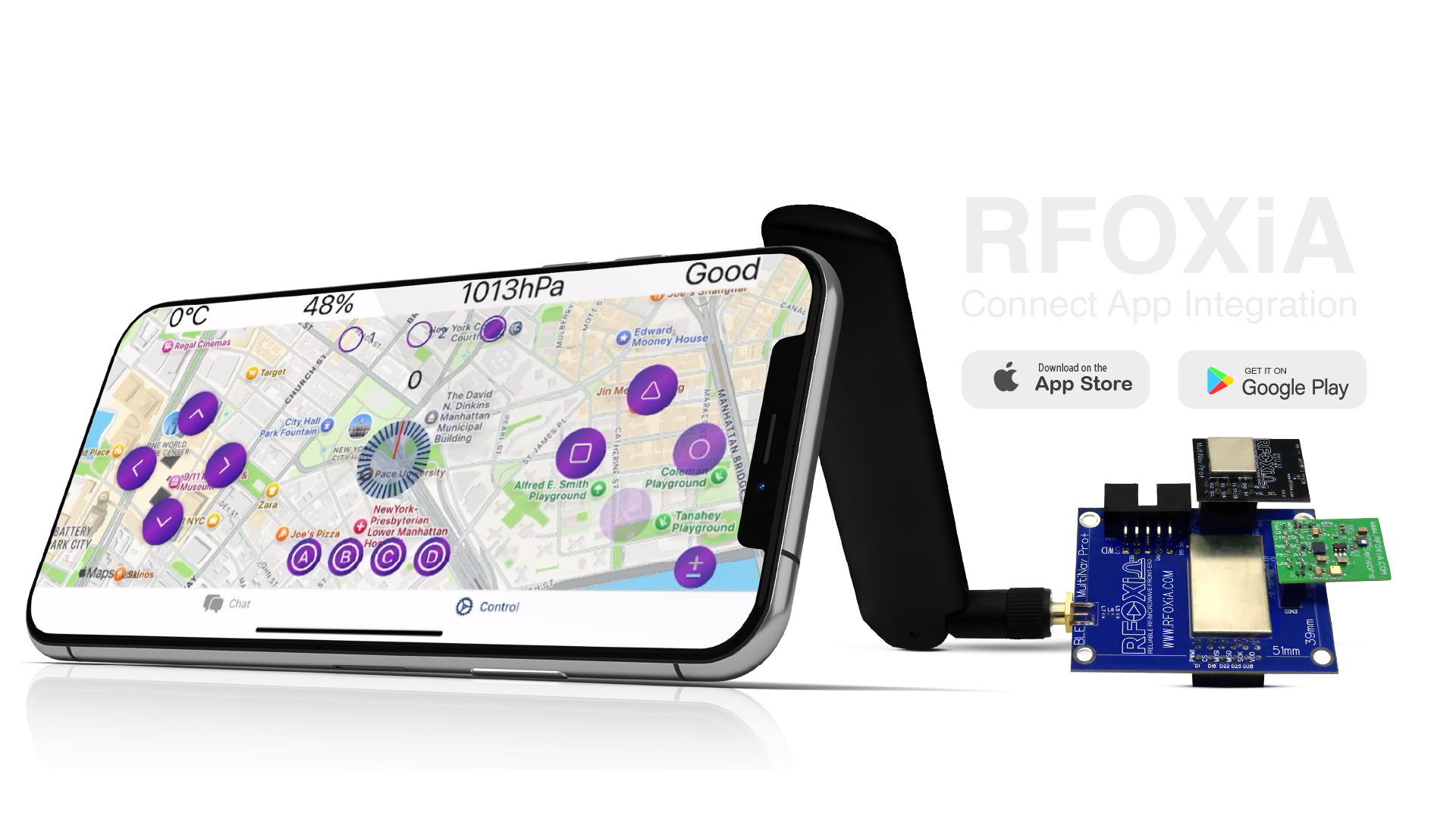
Long-Range Drone Control: A drone flying 5-10 kilometers from the operator needs a command and telemetry link that is both low-latency and reliable. The MultiNav Pro+ paired with the RFOXiA Connect app delivers a PS5-style controller interface with live GPS tracking and sensor data — completely without internet or cellular infrastructure.
Field Research Data Collection: Researchers deploying environmental monitoring networks in remote areas cannot rely on cellular. A mesh of MultiNav Pro+ modules can relay data across distances that would require expensive cellular modems in any competing system.
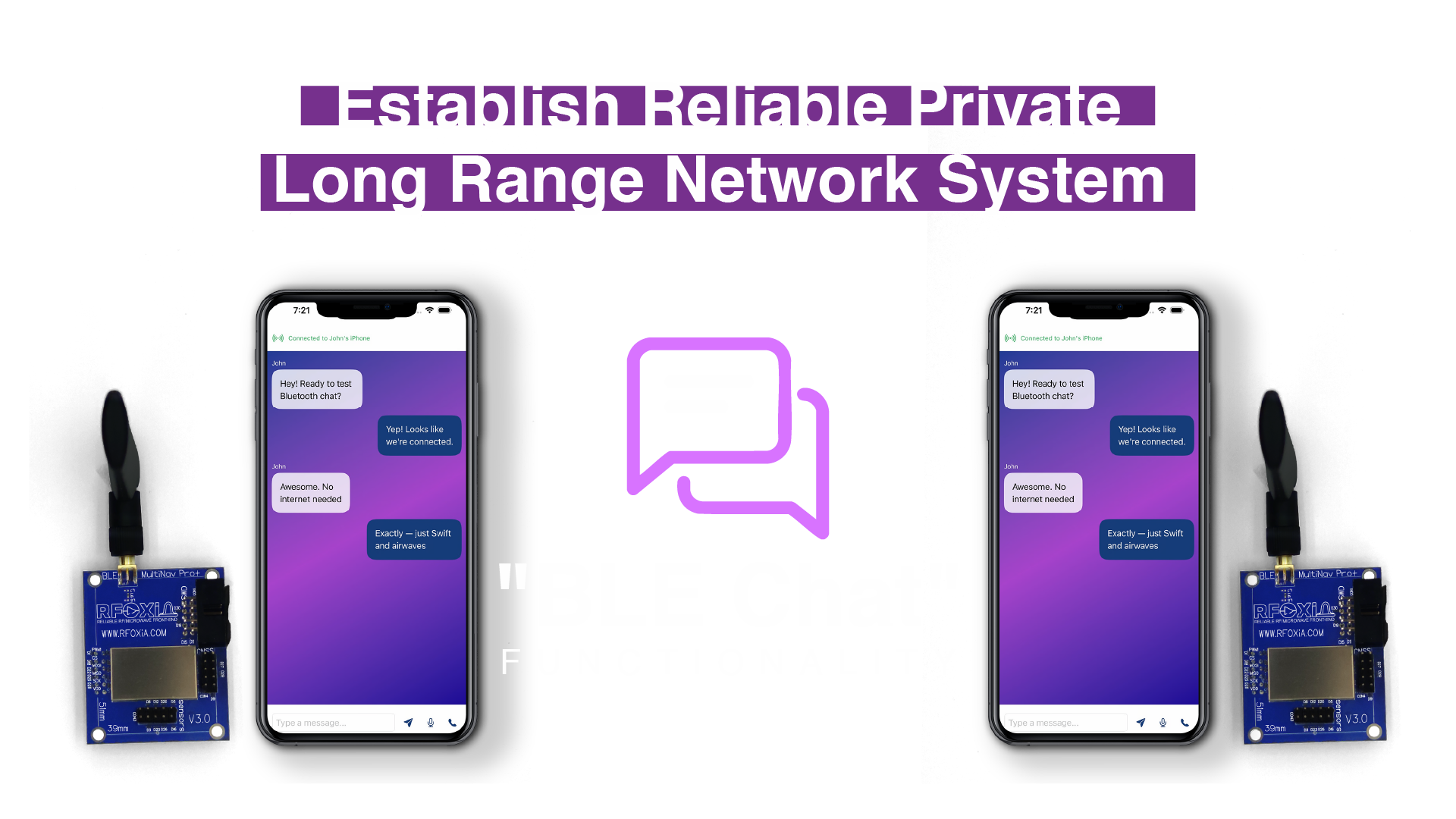
Disaster Response Communication: The BLE Chat functionality in the RFOXiA ecosystem allows teams to communicate in text, voice, and data with no infrastructure dependency. In a disaster zone where cellular towers are down, this is not a convenience feature — it is mission-critical capability.
Industrial IoT Over Long Distances: Facilities spanning several kilometers — ports, mining operations, agricultural land — can deploy private BLE networks using MultiNav Pro+ modules that eliminate the cellular data costs of conventional IoT platforms.
All of these applications become accessible to hardware builders, researchers, and drone operators at $59 for two modules — a price that previously would have bought you a commodity module with 100-meter range and no ecosystem.
If you are building any of these applications, the RFOXiA Long Range Bluetooth Module is the only FCC-certified, maker-accessible hardware that delivers this link budget at this price point.
Sensitivity in Context: The Complete RF System
Receiver sensitivity is the most important single specification in a long-range BLE module, but it does not operate in isolation. The MultiNav Pro+ integrates every element of the RF system to extract maximum performance:
Antenna Design
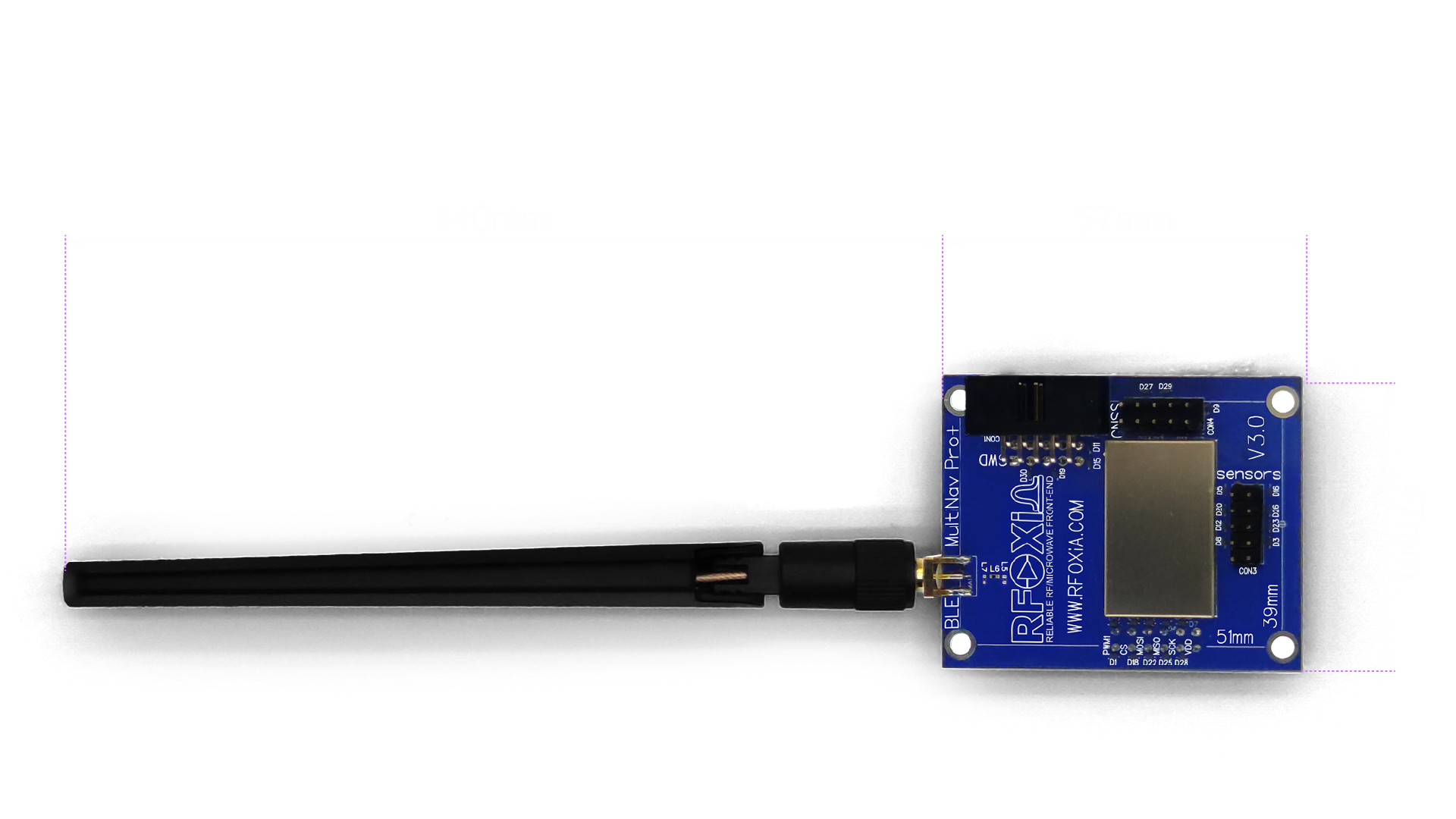
The 140mm antenna is not arbitrary. At 2.4 GHz, a quarter-wave monopole is 31mm. The MultiNav Pro+ uses a high-gain chip antenna with a deliberately optimized ground plane geometry to achieve maximum gain without requiring the user to design antenna matching circuits. At 57mm × 47mm, the module remains compact enough for space-constrained drone frames while delivering antenna performance that larger development boards rarely match.
Integrated RTC
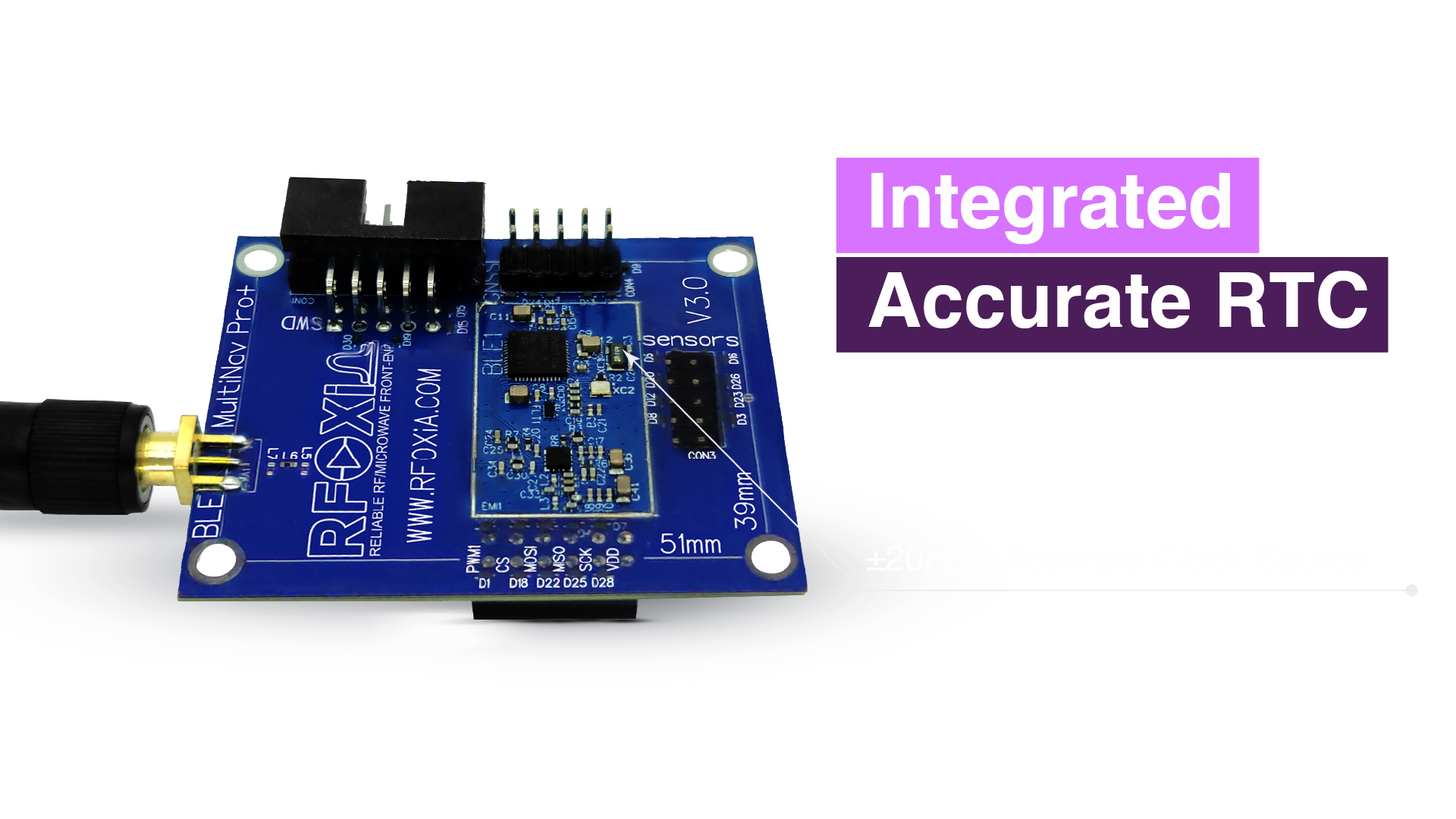
Precision timing matters in spread-spectrum systems. The integrated RTC crystal ensures that frequency hopping synchronization and connection event timing remain accurate even in extended low-power operation, contributing to link reliability at the signal levels where the module operates.
Open Source Firmware
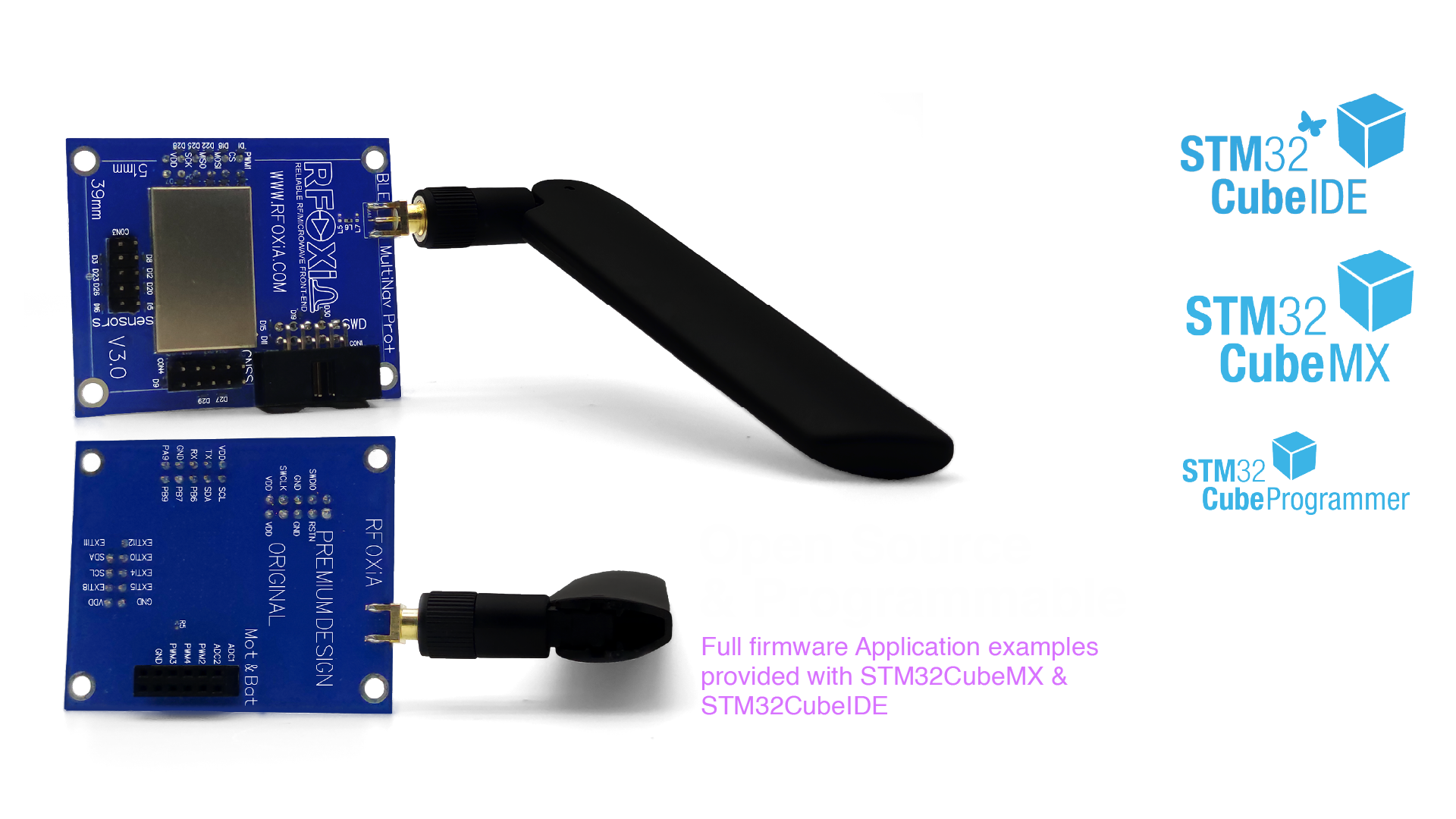
Full SWD programmability means builders are not locked into RFOXiA's firmware stack. If your application requires custom PHY configuration, non-standard advertising intervals, or specialized connection parameters optimized for your link budget, you have complete access to modify the STM32WB07 firmware. This is not a feature commodity module vendors typically offer because it requires confidence in the underlying hardware design.
Comparing Sensitivity Across the Market
To make the bluetooth sensitivity dBm explained framework concrete, here is how the MultiNav Pro+ sits relative to the market:
| Module Type | Typical RX Sensitivity | Practical Range |
|---|---|---|
| Commodity BLE SoC (Nordic, Silicon Labs) | -90 to -95 dBm | 80-150m |
| Enhanced BLE module (mid-tier) | -95 to -97 dBm | 200-500m |
| MultiNav Pro+ BLE | Optimized front-end | 5KM ground / 50KM drone |
| Military long-range RF (DTC BluSDR, Taisync) | -100 to -110 dBm | 150KM+ |
The MultiNav Pro+ exists in a gap that was genuinely unoccupied before RFOXiA created it. Below $100, nothing else reaches these distances with FCC certification and a complete software ecosystem. Above $5,000, military systems deliver more — but at a price that excludes every independent builder, researcher, and drone developer.
For builders who want to verify these claims technically before purchasing, the full firmware source code and hardware specifications are available through the RFOXiA Club and the open-source GitHub repository. No black-box claims. Every specification is traceable to the hardware and the physics.
Getting Started With the MultiNav Pro+
The MultiNav Pro+ BLE module ships in a two-unit pack at $59 — one module for each end of the link. Both units are FCC certified, ready to pair with the RFOXiA Connect app (Android live, iOS in final App Store approval), and supported by the AI Firmware Builder in RFOXiA Club for builders who want to create custom applications without months of embedded development work.
For builders who want the complete ecosystem — GNSS, environmental sensors, power management, and AI firmware — the Developer Bundle brings all four modules together at $199 with $50 in Club credits applicable toward the purchase.
The data network means that once your Sensors Module is deployed outdoors, it earns daily rewards in verified data contributions. Your hardware works while you sleep.
If understanding bluetooth sensitivity dBm explained has changed how you think about what BLE can do, the next step is putting that understanding into a module that actually delivers on the physics.
Explore the RFOXiA Long Range Bluetooth Module and see the complete specifications, FCC certification documentation, and ecosystem integration options.
Summary: Bluetooth Sensitivity dBm Explained in Five Points
Sensitivity is the floor. It defines the weakest signal a receiver can detect and maintain a valid link. More negative dBm = more capable receiver.
Every 6 dB of sensitivity improvement approximately doubles the maximum range, because received power falls as the square of distance (20 dB per decade).
The thermal noise floor sets the absolute limit at approximately -111 dBm for a 2 MHz BLE channel at room temperature. Real receivers add noise figure and required SNR on top of this.
Range is determined by the complete link budget — transmit power, antenna gain on both ends, path loss, and receiver sensitivity all contribute. Optimizing only one factor while ignoring others delivers marginal gains.
Elevation removes the multipath penalty. Drone-to-drone links approach free-space conditions, which is why the same sensitivity specification that yields 5KM on the ground delivers 50KM at altitude.
These five principles explain why the MultiNav Pro+ achieves what no $15 commodity module can match — and why the engineers who understand this physics choose it for every serious long-range wireless application they build.
RFOXiA is a Delaware-based hardware technology company building professional-grade wireless development tools for makers, engineers, and researchers. All modules are FCC certified and ship from stock.
Written by: Moamen Mohamed LinkedIn