
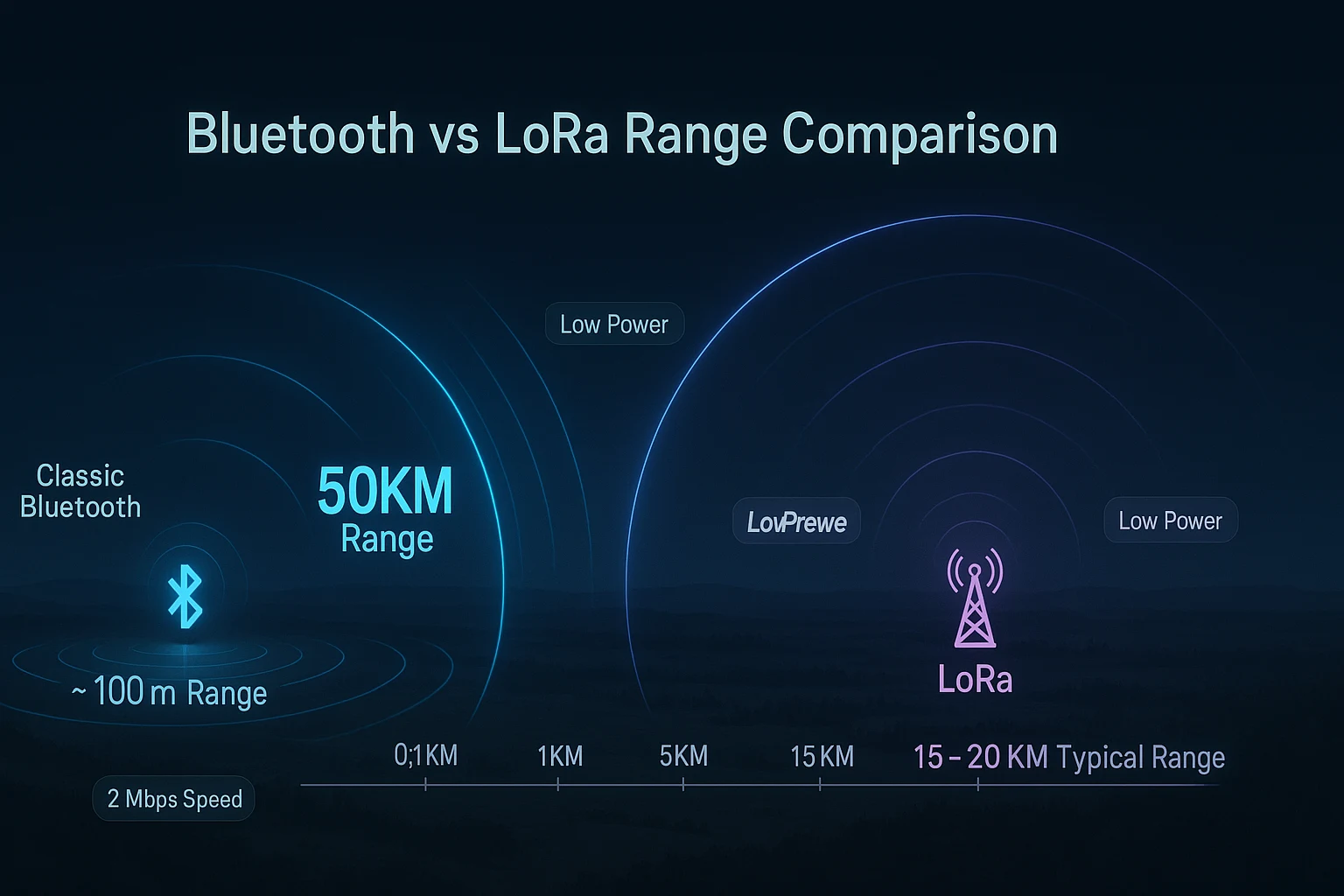
Bluetooth vs LoRa Range Comparison: Why BLE Now Wins at 50KM
RFOXiA Long Range Bluetooth Module
Bluetooth vs LoRa Range Comparison — The Definitive Guide for Builders and Engineers
For years, the answer to "which wireless technology reaches farthest?" was simple: LoRa. Bluetooth was the short-range champion of personal devices, and LoRa was the undisputed king of low-power wide-area networks. If you needed to push data beyond a few hundred meters, you reached for a LoRa module without a second thought.
That assumption is now outdated.
A new generation of advanced BLE hardware has shattered the range ceiling that defined Bluetooth for decades. The bluetooth vs lora range comparison has become genuinely competitive — and in several real-world scenarios, Bluetooth has not just matched LoRa but exceeded it. This guide breaks down how both technologies actually perform, what drives the difference, and when you should choose one over the other for your next project.
The Traditional Bluetooth vs LoRa Range Comparison
Before diving into modern hardware, it's worth understanding why LoRa dominated for so long.
Standard Bluetooth (BLE 4.x / 5.0):
- Typical range: 10–100 meters indoors
- Line-of-sight maximum: ~200–400 meters
- Frequency: 2.4 GHz ISM band
- Data rate: up to 2 Mbps
- Power consumption: very low
- Primary use: personal devices, wearables, smart home sensors
LoRa (Long Range):
- Typical range: 2–15 km in open terrain
- Maximum documented: 700+ km in optimized balloon/altitude tests
- Frequency: 433/868/915 MHz sub-GHz bands
- Data rate: 0.3–50 kbps (slow)
- Power consumption: very low to low
- Primary use: IoT sensor networks, agriculture, smart city infrastructure
On paper, LoRa had the range argument won. Sub-GHz frequencies propagate farther, diffract around obstacles better, and suffer less free-space path loss than 2.4 GHz signals. LoRa's chirp spread spectrum modulation also gives it exceptional receiver sensitivity — sometimes reaching –148 dBm — which means it can decode incredibly weak signals.
Bluetooth, operating at 2.4 GHz, theoretically suffers 20 dB more free-space path loss than a 433 MHz LoRa signal over the same distance. That's a massive physics disadvantage.
So how has BLE closed — and in some cases reversed — this gap?
What Changed: The RF Engineering Behind Modern Long-Range BLE
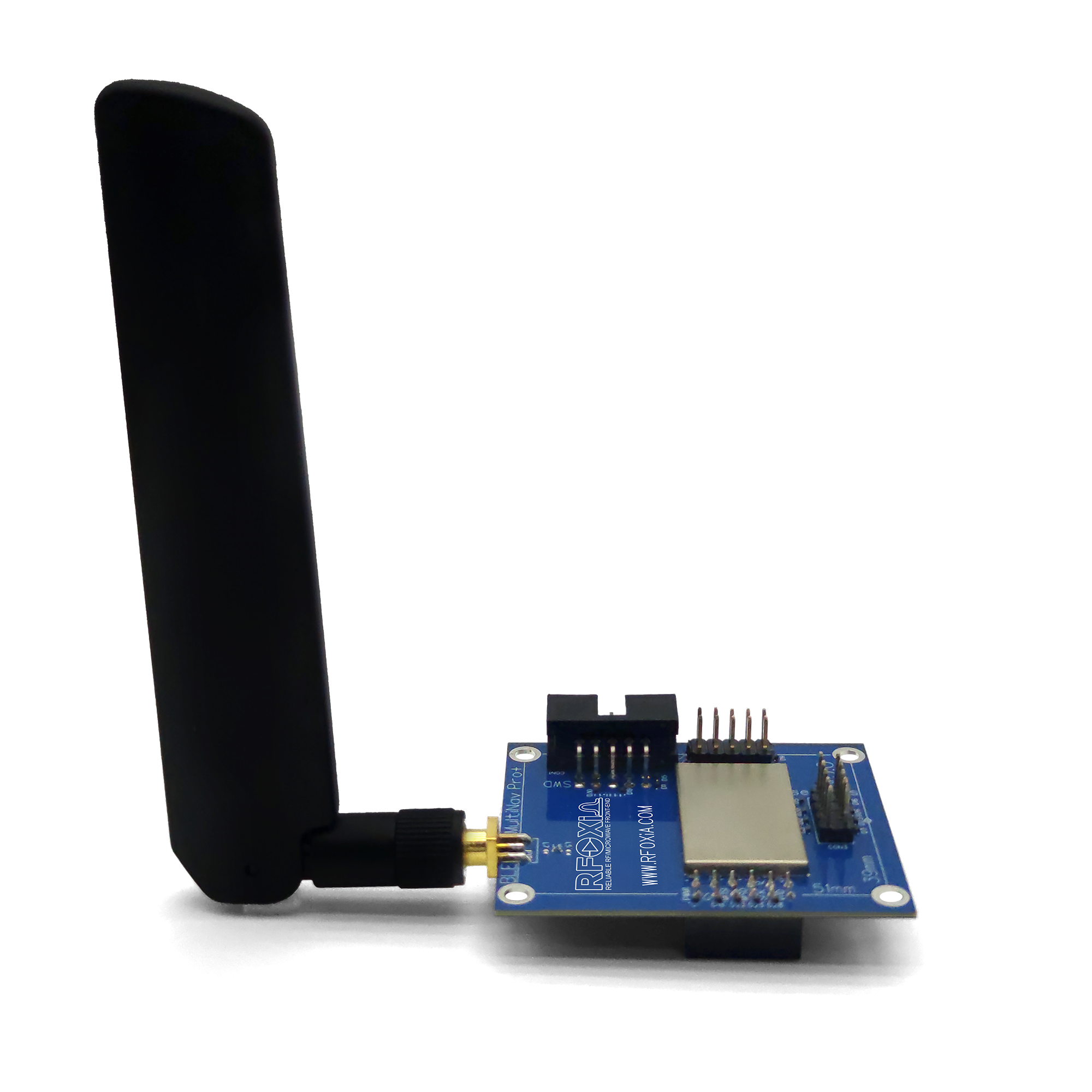
The answer lies in aggressive RF front-end engineering. Consumer BLE modules use a bare chip with a simple PCB trace antenna, minimal output power (0 dBm typical), and basic receiver circuitry. That's why they cap out at 100 meters.
Advanced long-range BLE modules like the MultiNav Pro+ approach the problem differently:
- External Power Amplifiers — boosting transmit power dramatically beyond standard BLE chip limits
- Low Noise Amplifiers (LNA) on the receive path — pulling signals out of the noise floor that standard modules would never decode
- Optimized antenna design — high-gain directional or phased designs that concentrate energy where it's needed
- Advanced receiver sensitivity tuning — pushing sensitivity to levels that compete directly with LoRa hardware
- BLE Long Range mode (Coded PHY) — a BLE 5.0 feature that trades data rate for range through forward error correction
The result? The MultiNav Pro+ BLE module achieves:
- 5 km ground-to-ground (module paired to smartphone on both ends)
- 15–20 km man-to-drone (module on drone, paired phone on ground)
- 50 km drone-to-drone (both modules airborne, eliminating ground reflections and multipath)
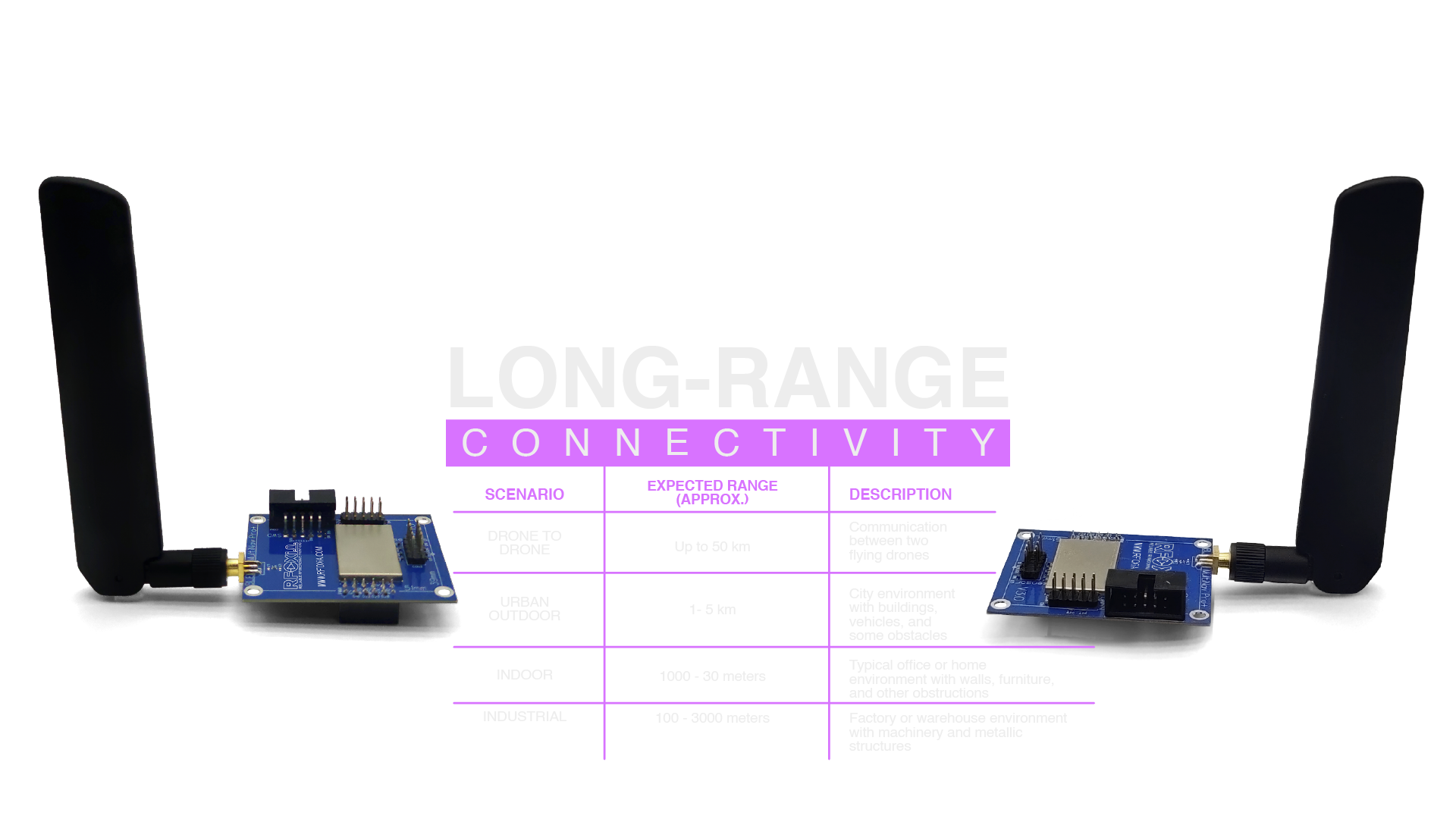
That 50 km figure isn't theoretical. It's the drone-to-drone configuration, where both endpoints are elevated and line-of-sight geometry is maximized. No towers. No infrastructure. No internet connection. Just two BLE modules communicating across 50 kilometers of open sky.
Suddenly, the bluetooth vs lora range comparison looks very different.
Head-to-Head: Bluetooth vs LoRa Range Comparison by Use Case
Ground-Level IoT Sensor Networks
LoRa advantage: Sub-GHz propagation is superior for cluttered urban environments and over-the-horizon links. LoRaWAN infrastructure (The Things Network, Helium) can extend range further by routing through gateways. For fixed sensor nodes reporting once per hour, LoRa is extremely hard to beat.
BLE advantage: No gateway infrastructure required. Direct device-to-device communication. 5 km ground range without any network subscription or gateway deployment.
Verdict: LoRa wins for city-scale sensor deployments relying on existing infrastructure. BLE wins for private self-contained networks.
Drone Control and Telemetry
LoRa: Some builders use LoRa for telemetry links. Data rates are low (typically under 50 kbps), which limits sensor streaming. Range is decent but antenna size at 433/868 MHz is physically larger.
BLE: At 15–20 km man-to-drone and 50 km drone-to-drone, the MultiNav Pro+ exceeds typical LoRa performance in this configuration while delivering 2 Mbps data throughput — enough for real-time sensor streaming, GPS telemetry, and control commands simultaneously.
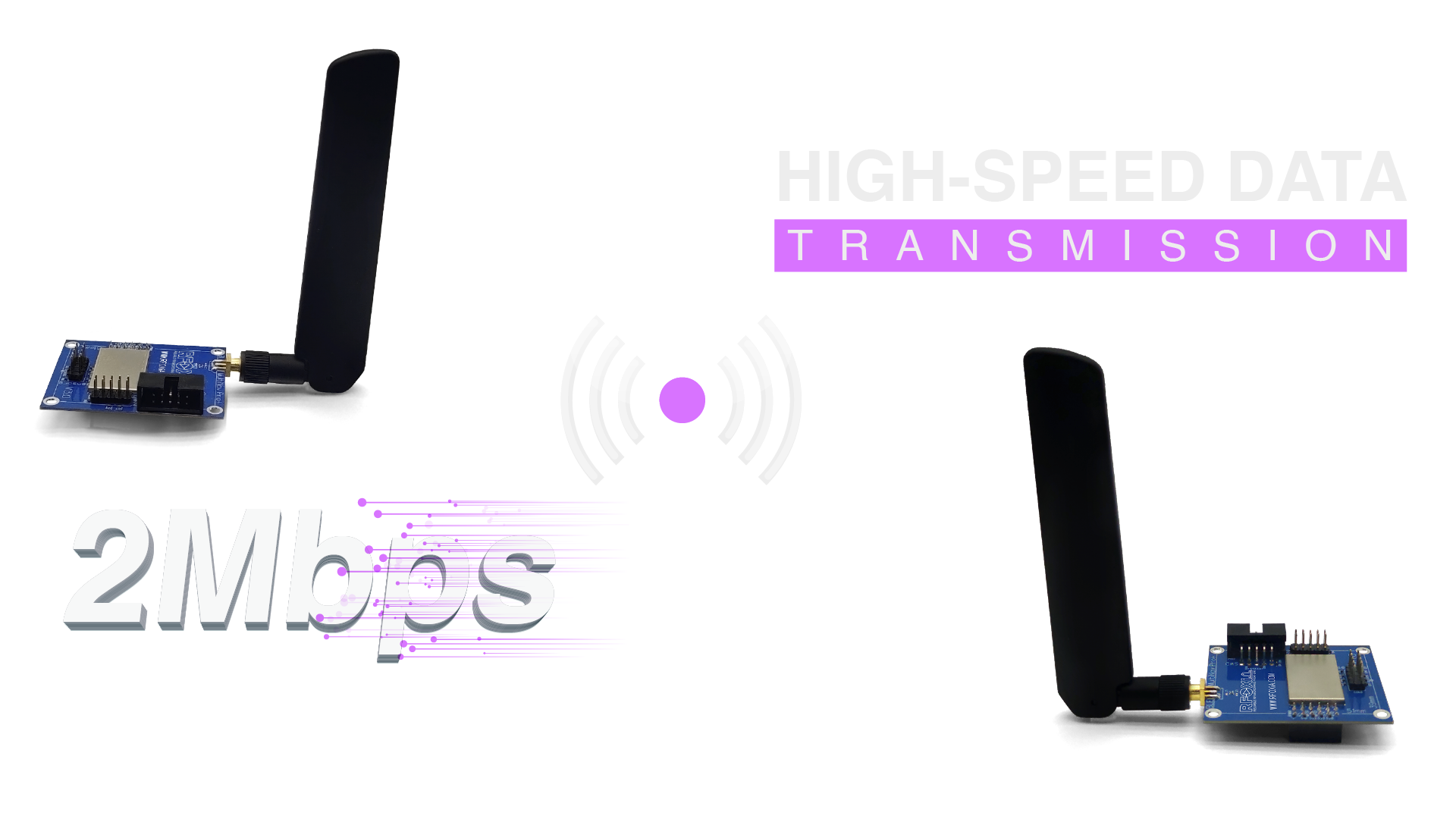
Verdict: Advanced BLE wins for drone applications requiring high data rates and long range together. This combination is simply not achievable with LoRa.
Off-Grid Communication
LoRa: LoRa mesh networks (Meshtastic) have become popular for off-grid text messaging. Great community, open source, 5–15 km per hop, works on phones via Bluetooth bridge (ironically).
BLE: The MultiNav Pro+'s built-in BLE Chat functionality delivers direct internet-independent communication between users — text, data, and voice — with no bridge device needed. The module connects directly to your smartphone.
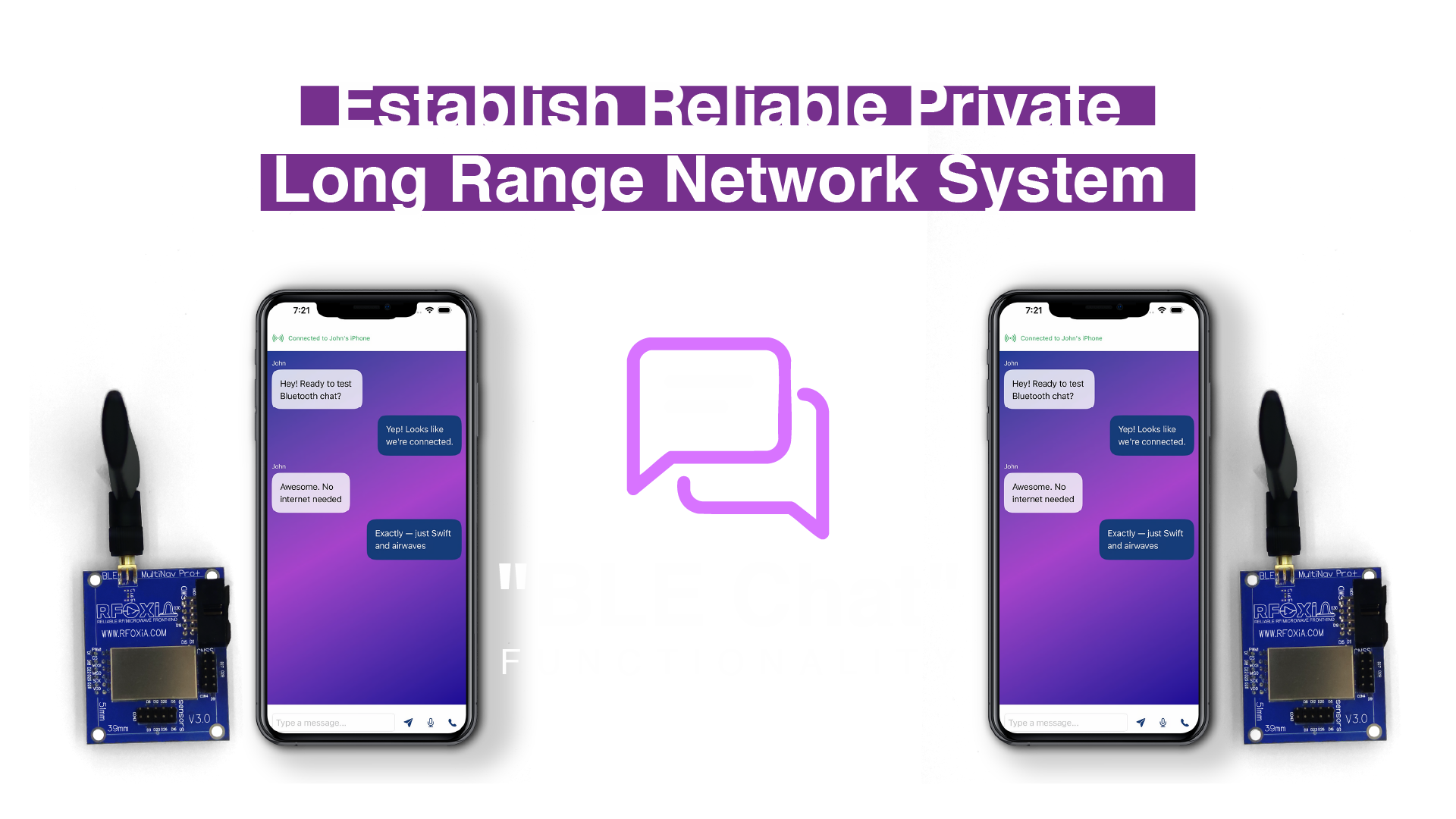
Verdict: Comparable capability; BLE Chat has an edge in simplicity of deployment since it connects natively to the phone without a separate gateway.
Precision Robotics and Real-Time Control
LoRa: Not suitable. Latency is too high and data rates too low for real-time control loops.
BLE: 2 Mbps with minimal latency. Purpose-built for control applications. The RFOXiA Connect app provides a PS5-style controller interface with live map and sensor overlay for real-time robotic and drone control.
Verdict: BLE wins decisively for control applications.
The Data Rate Divide: Why This Matters More Than Range Alone
The bluetooth vs lora range comparison isn't just about kilometers — it's about what you can actually do at that range.
LoRa at maximum range achieves approximately 300 bps. Even at moderate range with decent settings, you're looking at 5–50 kbps. That's enough for sensor readings and GPS coordinates transmitted every few seconds. It is absolutely not enough for:
- Streaming continuous sensor data
- Video metadata or control overlays
- Voice communication
- Real-time high-frequency telemetry
- Actuator control with fast feedback loops
BLE at 2 Mbps changes everything. That's the difference between a telegraph and a telephone. At 20 km man-to-drone range, you can stream full environmental sensor data, GPS location at 18 Hz, and receive control inputs simultaneously without queue buildup.
For drone builders, FPV pilots, and robotics engineers, this is the specification that actually matters for real-world deployment.
The Ecosystem Argument: BLE as a Platform, Not Just a Radio
One dimension the standard bluetooth vs lora range comparison misses entirely is ecosystem depth. A LoRa module is a radio. A modern long-range BLE platform is an entire development environment.
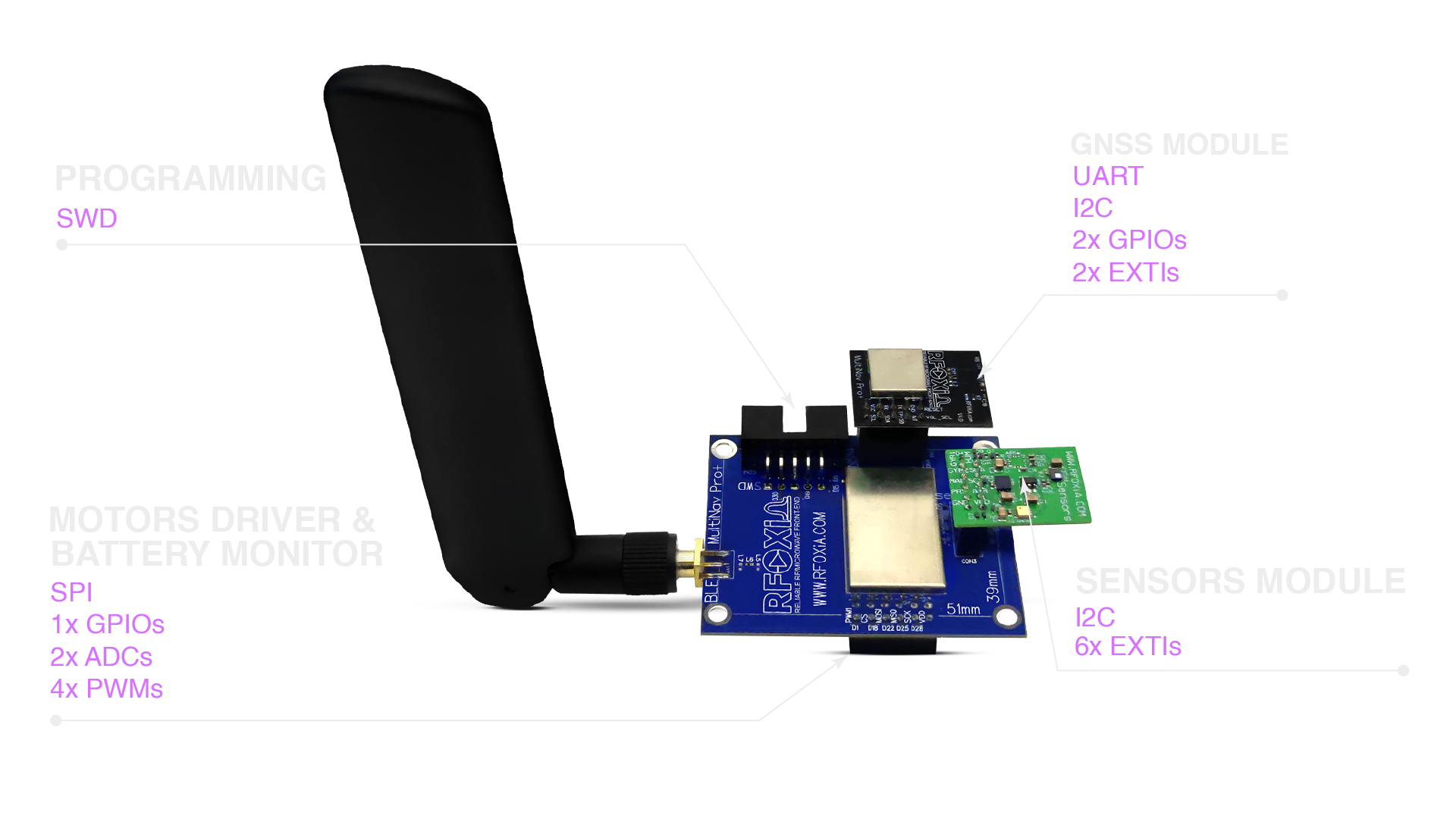
The MultiNav Pro+ BLE module is designed to integrate seamlessly with:
- GNSS Module — 1.5m accuracy, 18 Hz fix rate for tracking fast-moving platforms
- Sensors Module — 7 sensors (temperature, humidity, pressure, air quality, accelerometer, gyroscope, magnetometer) in one board
- Power/Program Kit — supercapacitor-based power with 5-minute charge and 24-hour runtime
This creates a unified autonomous system platform. Your drone or robot carries long-range BLE communication, precision GPS tracking, comprehensive environmental sensing, and professional power management — all in one integrated, FCC-certified ecosystem.
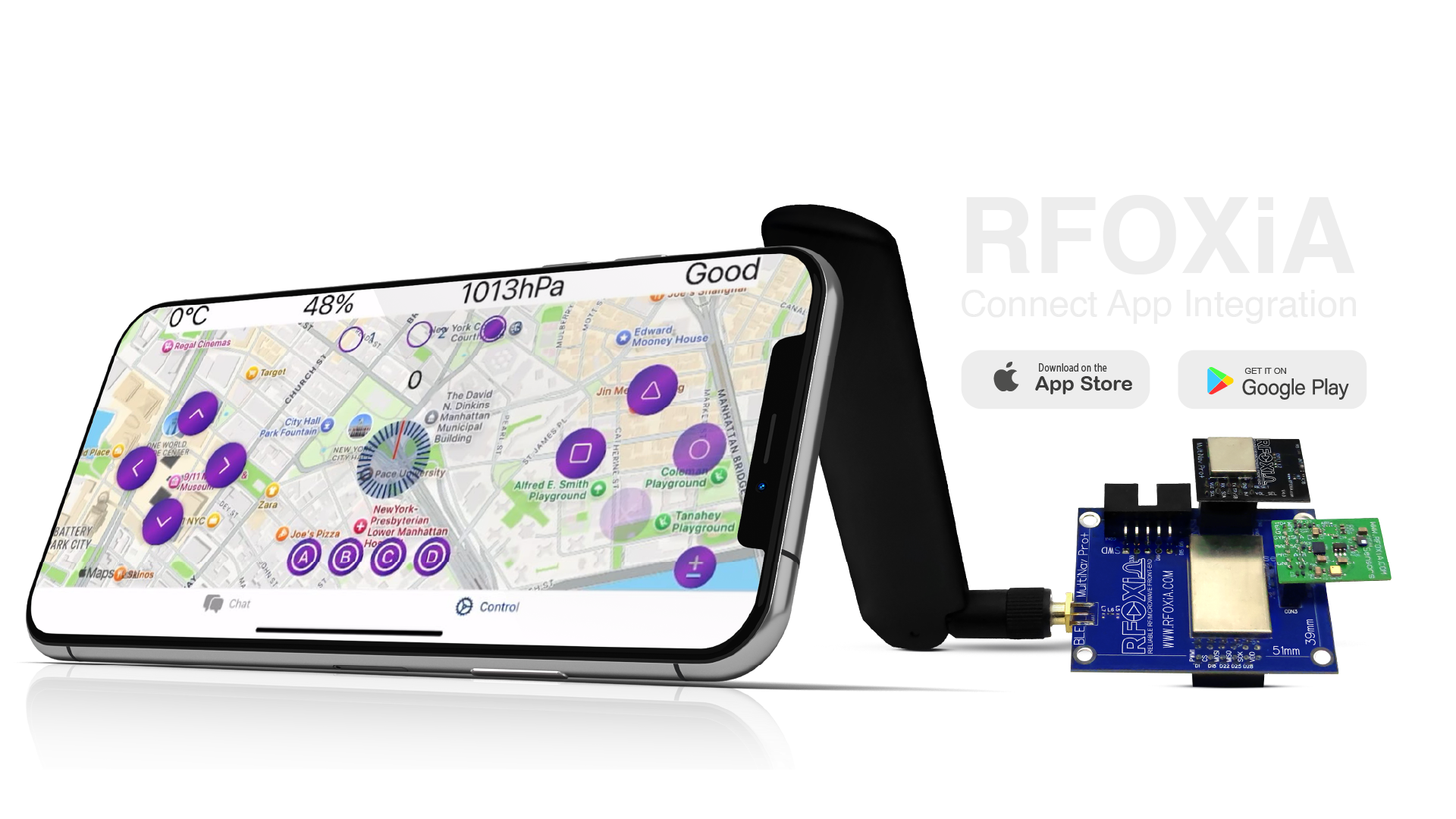
The RFOXiA Long Range Bluetooth Module connects directly to the RFOXiA Connect app on iOS and Android — giving you a live map view, sensor data dashboard, and controller interface without writing a single line of code. When you're ready to go deeper, the platform's AI Firmware Builder generates production-ready firmware from plain-language descriptions.
LoRa doesn't have any of this. You get a radio. The rest is up to you.
Processing Power and Programmability
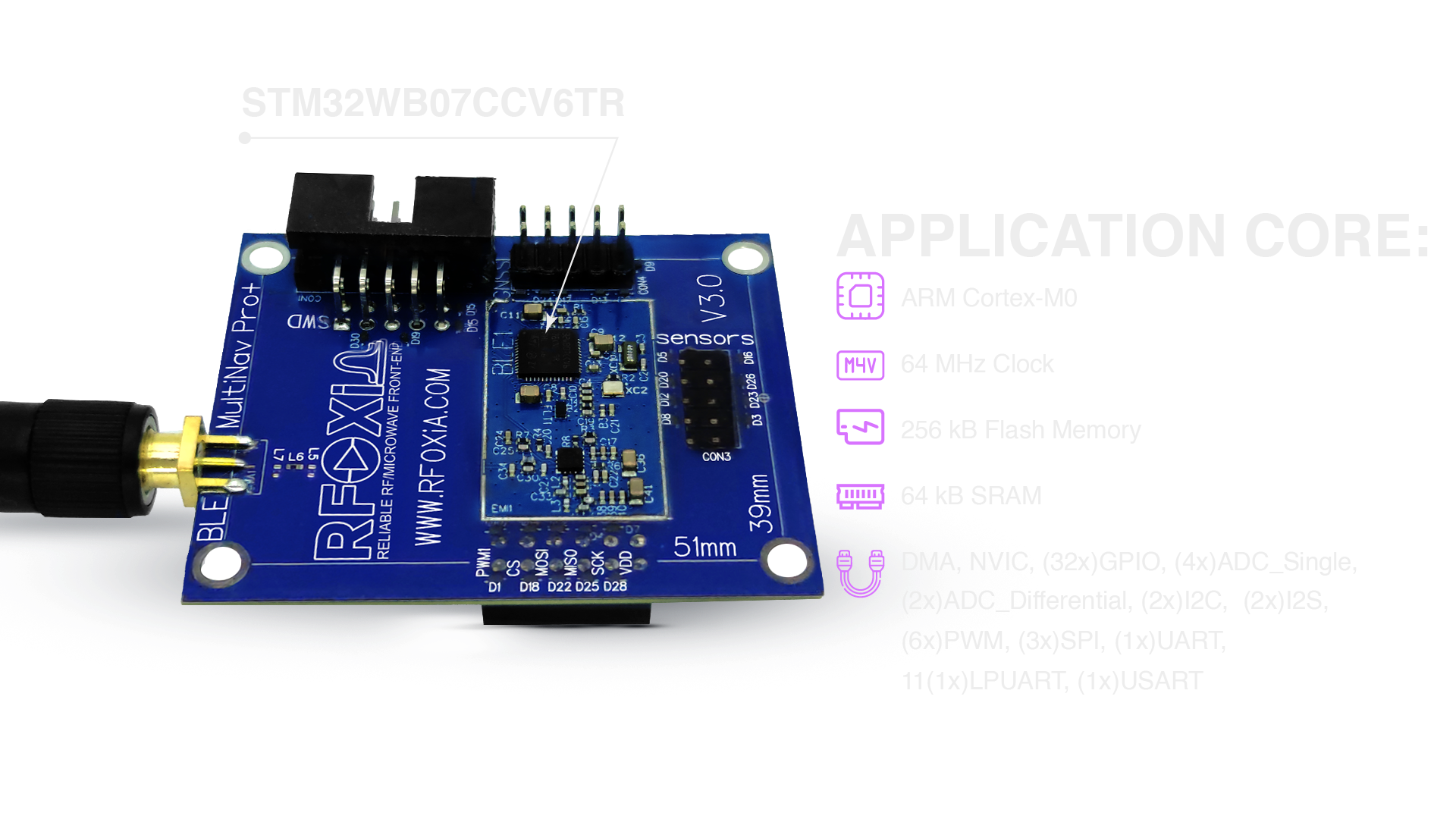
The MultiNav Pro+ BLE module is built around the STM32WB07CCV6 — a dual-core wireless microcontroller from STMicroelectronics that handles the BLE stack on one core while running your application on the other. This architecture means the radio and your firmware never compete for processor time, eliminating the latency spikes that plague simpler single-core BLE implementations.
For engineers building custom applications, this matters enormously. You get a powerful, deterministic compute environment alongside the radio — not just a transparent serial pipe.
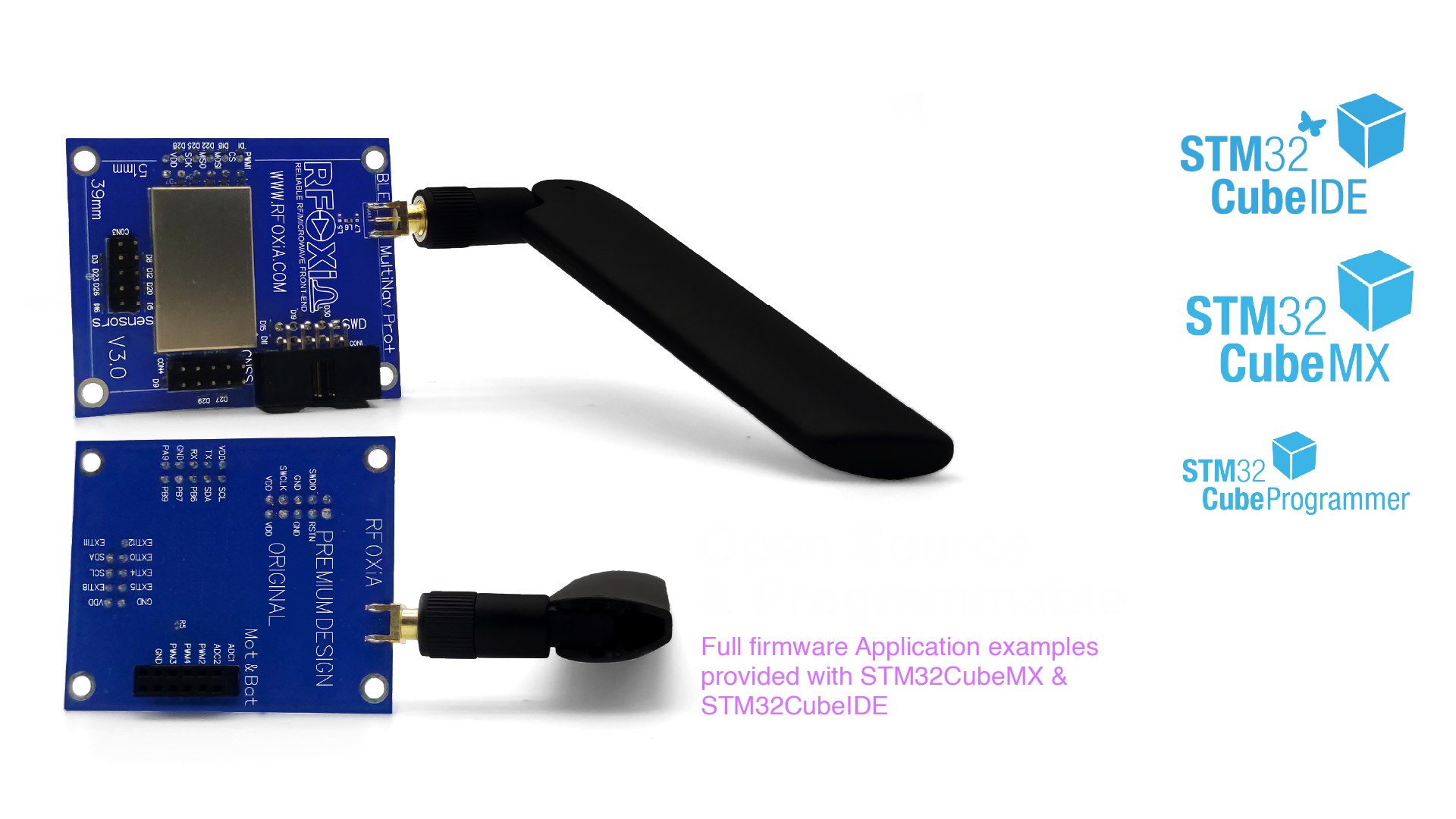
Full open-source access and SWD programmability mean you're never locked into factory firmware. The module is yours to customize completely. Combined with the AI Firmware Builder on RFOXiA Club, builders can go from concept to running firmware in hours rather than weeks.
Physical Design and Deployment Practicalities
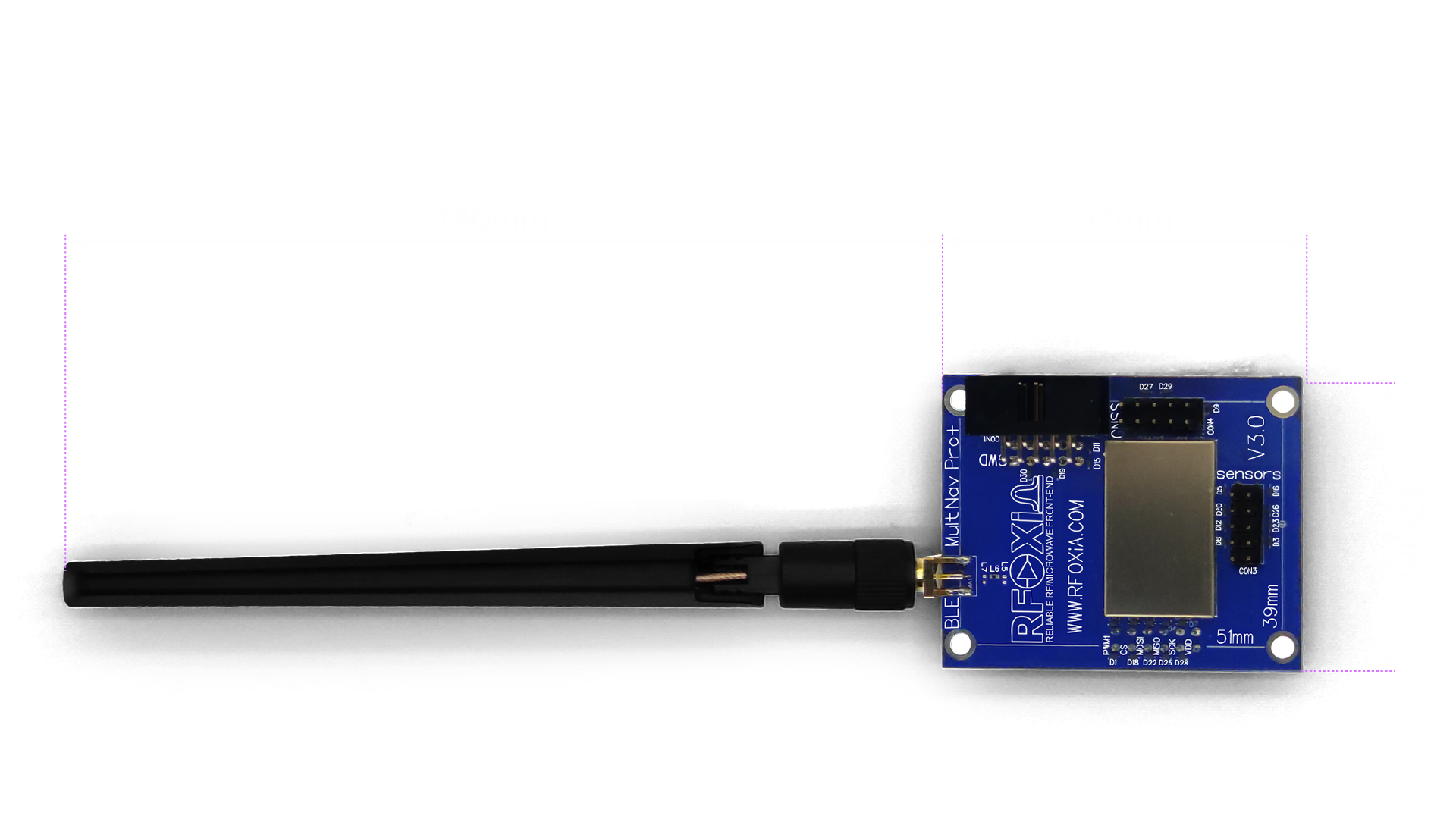
At 57mm × 47mm with a fixing frame of 54mm × 34mm and corner mounting holes, the MultiNav Pro+ BLE is designed for real engineering integration. It fits into space-constrained UAV frames, enclosures, and custom robot chassis. The high-gain integrated chip antenna eliminates the need for external antenna management in most deployment configurations.
For field deployment timing, the integrated RTC is a detail that matters more than it appears.
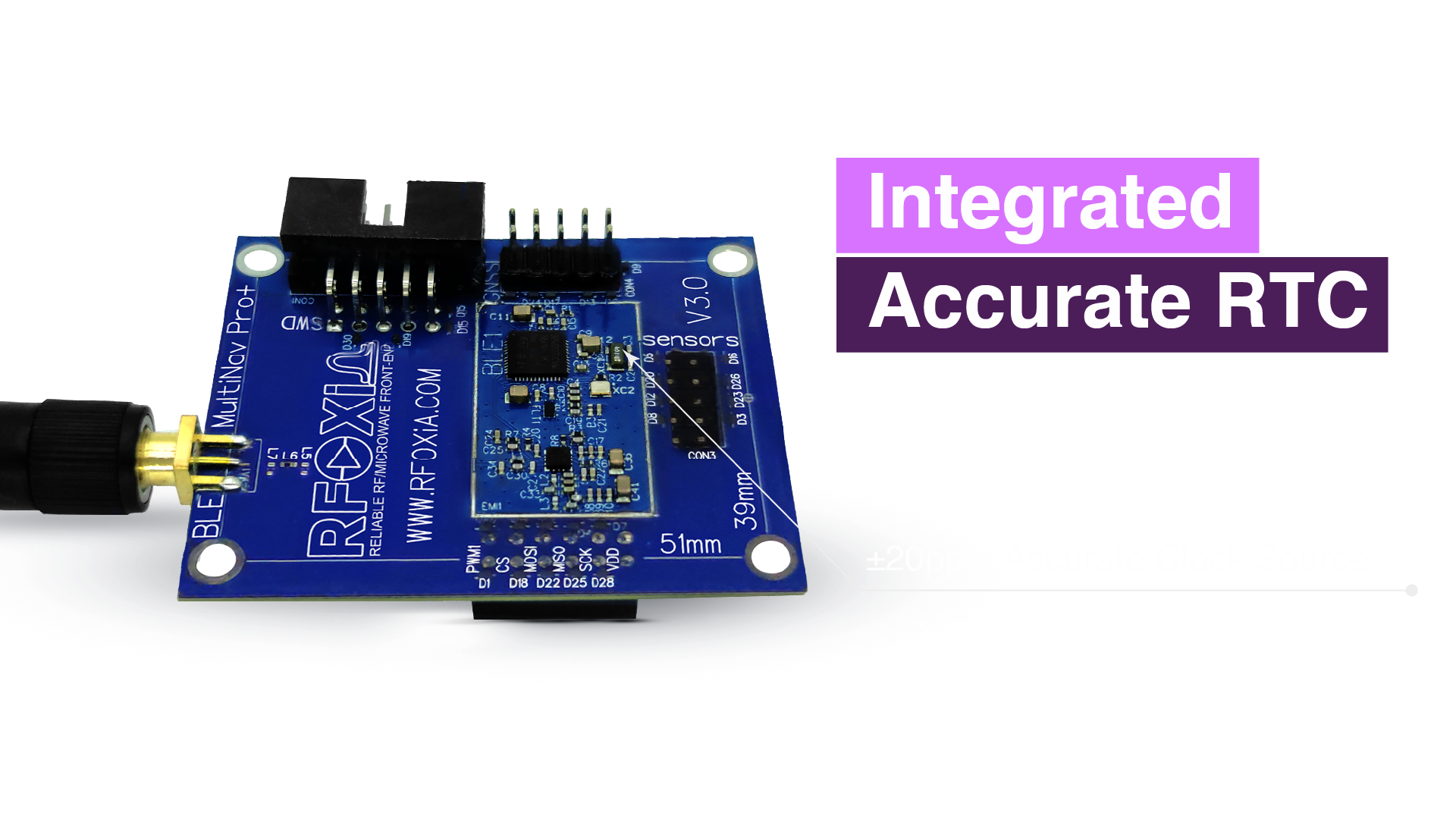
When you're correlating sensor data streams from multiple nodes, synchronizing control commands with flight paths, or timestamping environmental readings for scientific logging, an accurate onboard RTC eliminates drift and keeps your data integrity intact — even without network time sync.
Price, Certification, and Availability
Here's where the bluetooth vs lora range comparison has a clear winner in practical terms for most builders.
Long-range LoRa options:
- Basic LoRa modules: $10–30
- Professional LoRa radios with amplification: $100–300
- Complete certified LoRa development platforms: $200–800
- Industrial LoRa systems with this range: $1,000+
MultiNav Pro+ BLE Module:
- $59 for 2 units — both ends of your link included
- FCC certified
- Ready to ship
- Ecosystem-compatible
- App-ready out of the box
Two BLE modules at $59. Five kilometers of ground range. Twenty kilometers to your drone. Fifty kilometers drone to drone. FCC certified. App included.
There is no comparable product in this price band. Commodity BLE modules cap at 100 meters. Military-grade long-range systems start at $5,000. The RFOXiA Long Range Bluetooth Module occupies a gap in the market that previously didn't exist — professional-grade long-range wireless at maker-accessible prices.
When to Choose LoRa (Honestly)
This guide isn't here to declare LoRa dead — that would be inaccurate. There are still scenarios where LoRa is the right choice:
- Existing LoRaWAN infrastructure: If you're deploying sensors in a city with active TTN or Helium gateways, LoRa gives you network connectivity without any hardware on the receiving end
- Ultra-low power, infrequent reporting: For sensors sending one packet per hour that must run on a coin cell for years, LoRa's power profile and sub-GHz propagation are hard to beat
- Heavily obstructed environments: Dense urban areas with no line-of-sight between nodes still favor sub-GHz propagation
- Extremely long hops over flat terrain: For 20–50+ km ground-to-ground through existing infrastructure, LoRa remains strong
For everything else — especially anything involving real-time control, high data rates, drone operations, direct smartphone connectivity, or ecosystem integration — advanced long-range BLE is the better engineering choice.
Summary: The Bluetooth vs LoRa Range Comparison Has Fundamentally Changed
| Specification | Standard BLE | LoRa | MultiNav Pro+ BLE |
|---|---|---|---|
| Ground range | 100m | 2–15 km | 5 km |
| Drone range | N/A | 5–20 km | 15–20 km |
| Air-to-air range | N/A | 20–50 km | 50 km |
| Data rate | 2 Mbps | 0.3–50 kbps | 2 Mbps |
| Infrastructure needed | No | Optional/Yes | No |
| Smartphone native | Yes | No (bridge needed) | Yes |
| Price for full link | $5–15 | $20–100 | $59 |
| FCC certified | Varies | Varies | Yes |
| Ecosystem | None | Limited | Full platform |
The bluetooth vs lora range comparison is no longer a simple win for either technology. It's a nuanced decision that depends entirely on your application requirements. What is certain is that the old assumption — "need range? use LoRa" — no longer holds for builders who need range AND data rate AND smartphone connectivity AND ecosystem support.
The MultiNav Pro+ has rewritten that assumption at $59 for a complete two-unit link.
Get the MultiNav Pro+ BLE Module
Ready to build beyond the limits of standard wireless? The RFOXiA Long Range Bluetooth Module is FCC certified, in stock, and ships with full ecosystem compatibility — including the RFOXiA Connect app, AI Firmware Builder access, and integration with the complete MultiNav Pro+ module family.
$59 for 2 units. 50 km drone-to-drone range. 2 Mbps data rate. No infrastructure required.
Visit rfoxia.com to explore the full Developer Bundle and start building wireless systems that go further than anything in your price range ever has before.
Written by: Moamen Mohamed LinkedIn