
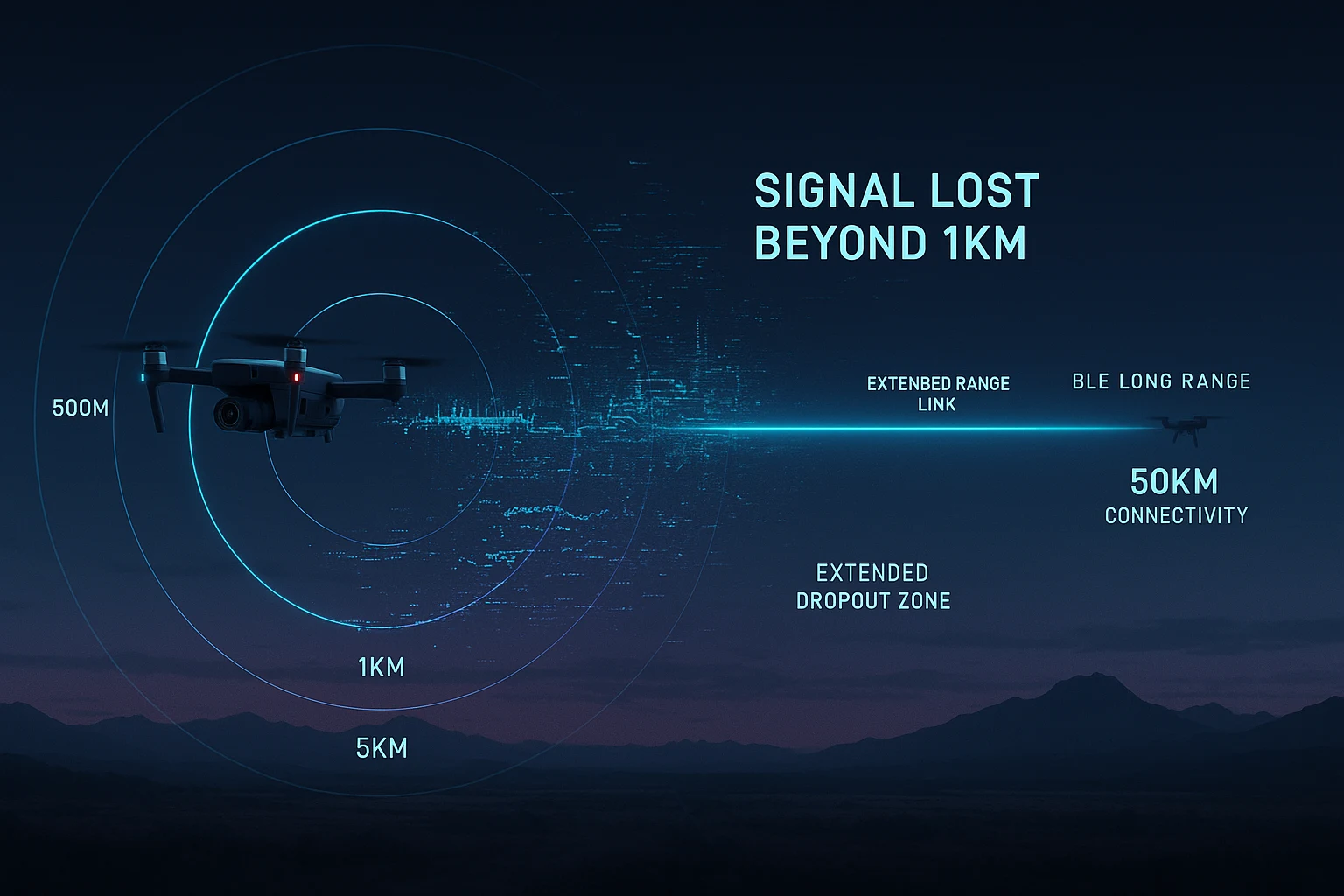
Drone Signal Loss Beyond 1km Is a Solved Problem — If You Have the Right Hardware
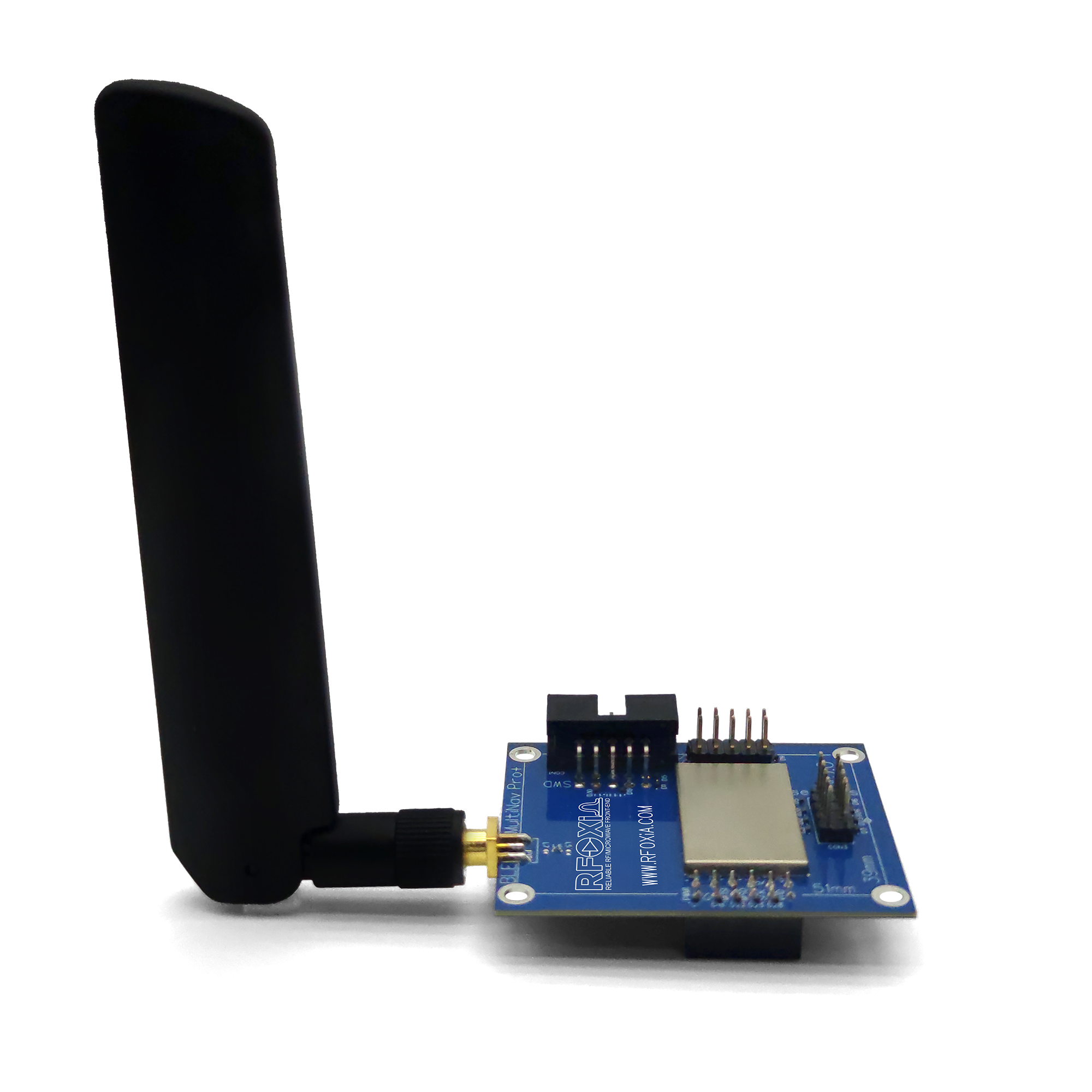
RFOXiA Long Range Bluetooth Module
Why Drone Signal Loss Beyond 1km Destroys Missions and How to End It Forever
You're in the field. Your drone is climbing, everything looks perfect, and then it happens — the feed stutters, the controls lag, and somewhere past that invisible 800-meter wall your signal disappears entirely. If you've experienced drone signal loss beyond 1km, you already know the sinking feeling of watching an expensive aircraft drift out of reliable control range while you desperately hope the return-to-home sequence kicks in on time.
This isn't a pilot skill problem. This isn't a settings problem. This is a hardware problem — and for years, the only solutions were either woefully inadequate commodity Bluetooth modules topping out at 80–100 meters, or military-grade communication systems priced at $5,000 and above that belong in a defense budget, not a maker's workshop.
That gap — between "not nearly enough" and "completely unaffordable" — is exactly the problem the MultiNav Pro+ BLE Module by RFOXiA was engineered to destroy.
The Real Reason Most Bluetooth Modules Fail at Range
Before we talk about the solution, it's worth understanding why drone signal loss beyond 1km is so common with standard wireless hardware.
Most Bluetooth Low Energy (BLE) modules available to makers and developers are designed for short-range personal area networking — think wireless earbuds, fitness trackers, and smart home sensors. Their RF front-ends are optimized for low power consumption over short distances, typically 10–100 meters in open air. When you take one of these modules and try to use it to control a drone at 500 meters, you're asking a bicycle to win a highway race.
The root causes of early drone signal loss with commodity hardware include:
- Weak transmit power: Most modules cap at +6 to +10 dBm
- Poor receiver sensitivity: Inability to decode weak incoming signals
- No external RF amplification: The signal degrades rapidly without a powered amplifier stage
- Ground-level reflections and interference: At low altitudes, multipath interference destroys signal integrity
- No optimized antenna design: Omnidirectional chip antennas work for close range; they bleed efficiency at distance
The result is predictable: reliable control out to maybe 300–500 meters in ideal conditions, and phantom disconnections that get worse as terrain, interference, and altitude all compound against you.
What 50km Range Actually Means for Drone Operators
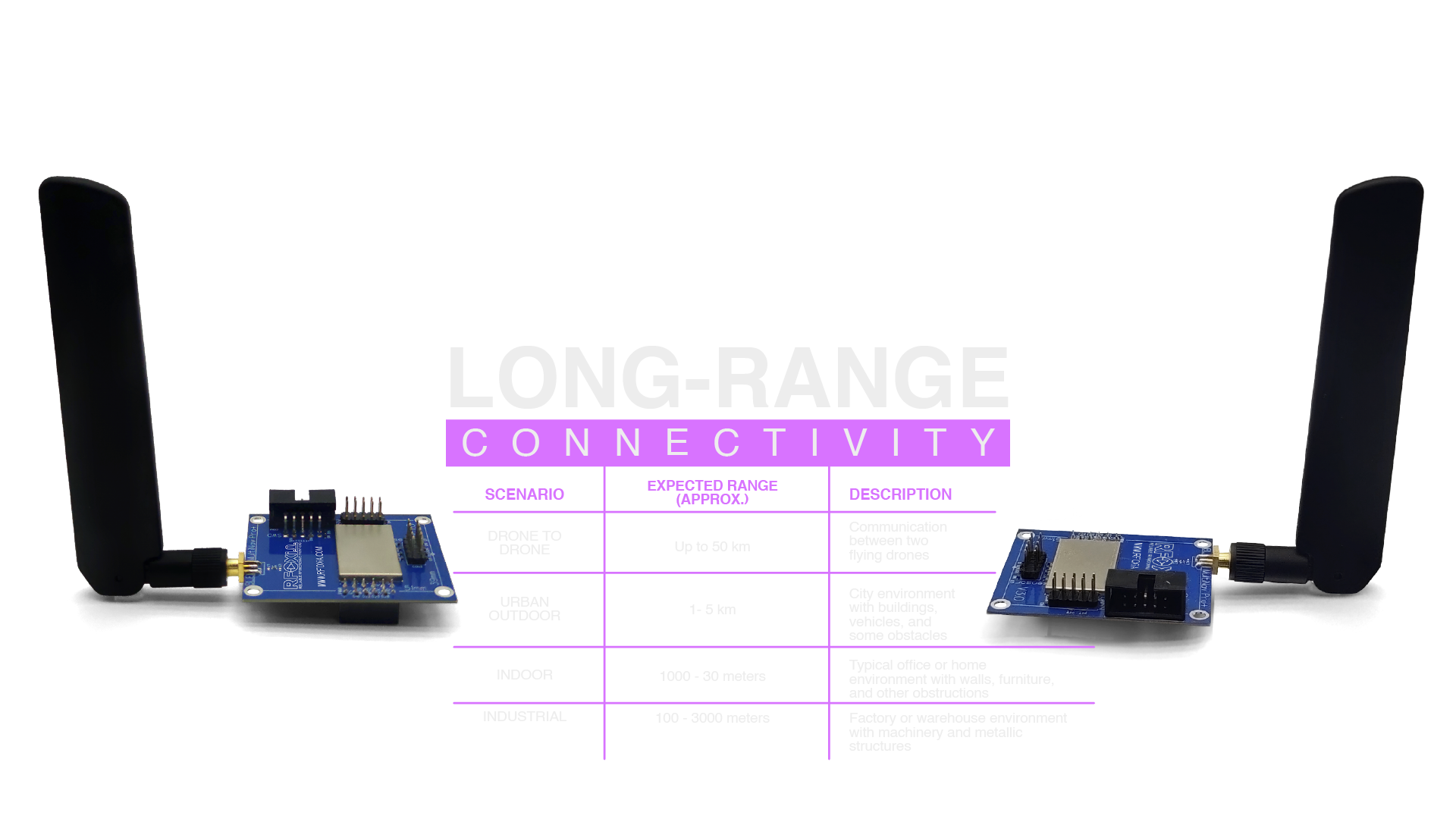
When RFOXiA states that the MultiNav Pro+ BLE Module achieves ranges up to 50km, that number deserves a precise breakdown because it directly determines the right use case for each scenario:
Ground-to-ground (phone-to-phone): 5km. Two users each paired with a MultiNav Pro+ BLE module via their smartphones can communicate with full data fidelity across 5 kilometers — no cell towers, no Wi-Fi, no internet infrastructure required.
Man-to-drone (phone-to-module on aircraft): 15–20km. A pilot on the ground controlling a drone equipped with the MultiNav Pro+ BLE module can maintain clean, reliable communication out to 15–20 kilometers. This is the operational range that eliminates drone signal loss beyond 1km as a concern — permanently.
Drone-to-drone (module-to-module in the air): 50km. When two MultiNav Pro+ BLE modules are both airborne, ground-level reflections and multipath interference are eliminated, and the air-to-air link reaches the full 50km specification. This is the figure that fundamentally redefines what BLE is capable of.
For the vast majority of FPV pilots, drone builders, and field researchers, the 15–20km man-to-drone range is the number that matters most. It represents a 30–40x improvement over what commodity BLE hardware delivers, and it's achieved at a price point — $59 for two modules — that is accessible to any serious builder.
How MultiNav Pro+ BLE Achieves This Range
The range figures aren't marketing. They're the product of deliberate, professional RF engineering applied at every layer of the hardware stack.
Optimized RF Front-End with External Amplifiers
Unlike commodity BLE modules that route signal directly from the chip to a minimal antenna, the MultiNav Pro+ BLE features a sophisticated RF front-end with external amplification stages. The transmit power is boosted well beyond what the base SoC can deliver alone, and the receive path is similarly enhanced to pull in weak signals that a standard module would discard as noise.
STM32WB07CCV6 Processing Core
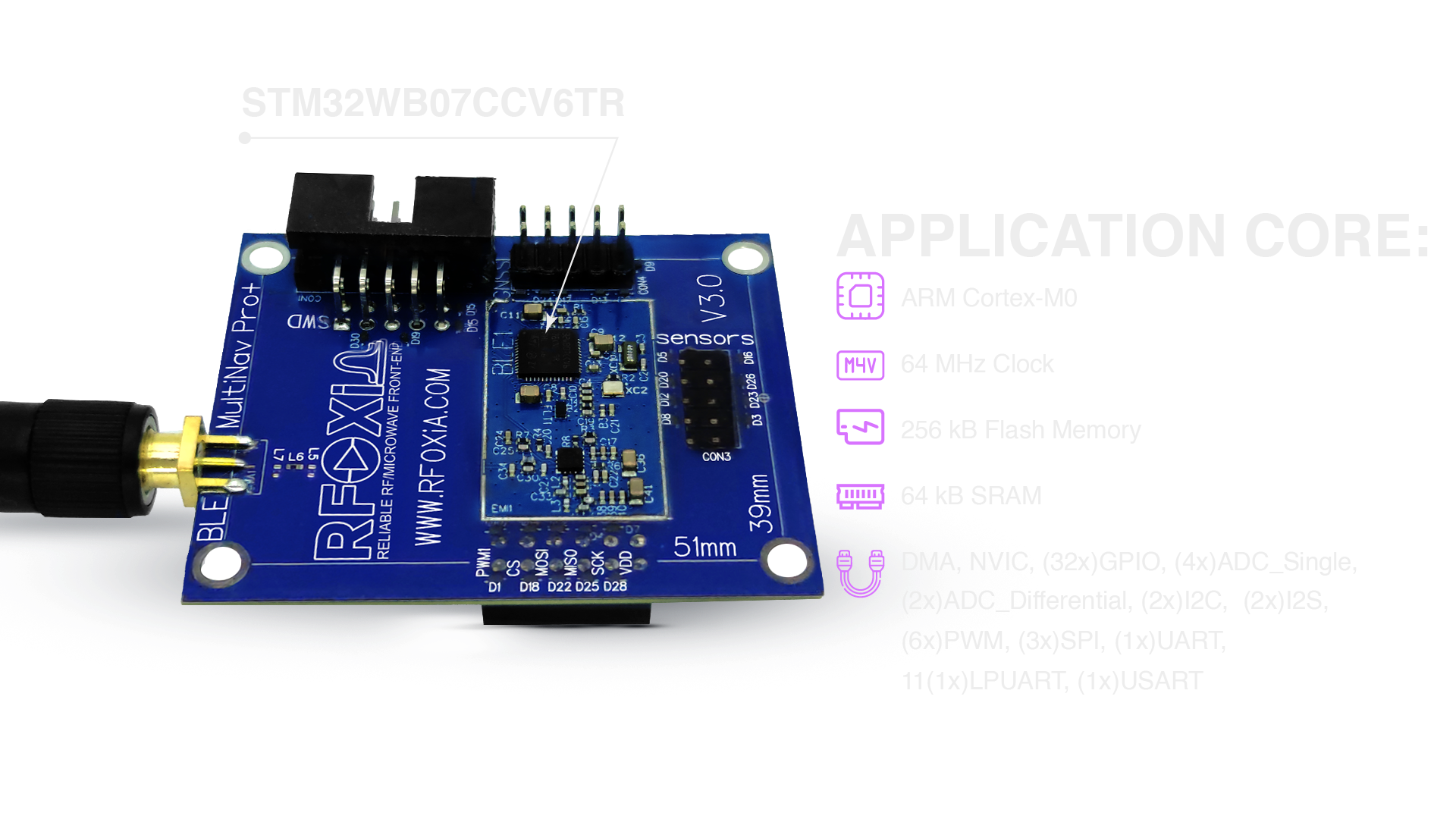
At the heart of the MultiNav Pro+ BLE is the STM32WB07CCV6, a dual-core wireless microcontroller from ST Microelectronics. This chip manages both the BLE protocol stack and user application logic simultaneously, without the compromises that come from running communications and application code on a single resource-constrained core. The result is optimal performance and responsiveness even under heavy data loads — exactly what drone control demands.
2 Mbps Data Rate
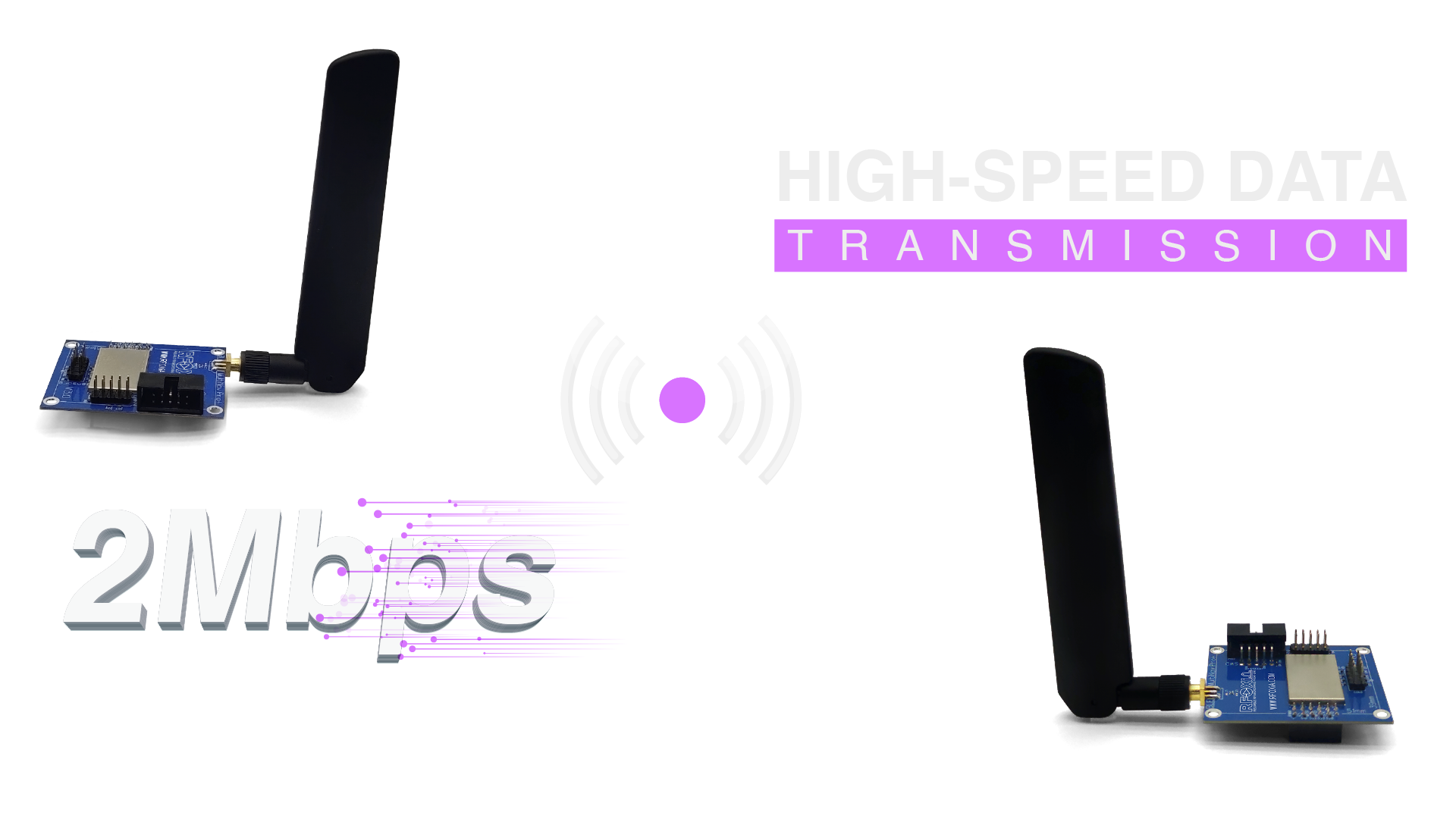
The module supports 2 Mbps BLE data rate — the highest available in the BLE specification. This matters for drone control because you're not just sending joystick commands. You're potentially streaming telemetry data, GPS coordinates, sensor readings, and control signals simultaneously. At 2 Mbps, this data throughput is handled with minimal latency, keeping your control loop tight and your telemetry current even at the extreme ranges the module supports.
High-Gain Integrated Chip Antenna
The module incorporates a high-gain chip antenna with a 140mm antenna element, engineered to maximize effective radiated power in the directions that matter. This isn't an afterthought component — the antenna design is a core part of why the module achieves its range specifications without requiring external directional antennas or ground plane modifications.
FCC Certification
The MultiNav Pro+ BLE is FCC certified. This isn't just a regulatory checkbox — it's evidence that the module's RF performance has been independently measured, documented, and validated by an accredited testing laboratory. When a module is FCC certified at these power levels, the range claims are backed by real-world RF measurement, not optimistic bench testing.
Drone Signal Loss Beyond 1km: Solved with the Right Ecosystem
Range alone is only part of the story. The reason drone signal loss beyond 1km has been so persistent for makers and builders isn't just hardware performance — it's the complete absence of an integrated control ecosystem that works at those ranges.
Most long-range solutions require custom firmware, separate ground control software, proprietary telemetry radios, and significant integration work before you can even begin a flight. The MultiNav Pro+ BLE is built as the wireless backbone of a complete developer ecosystem.
RFOXiA Connect App
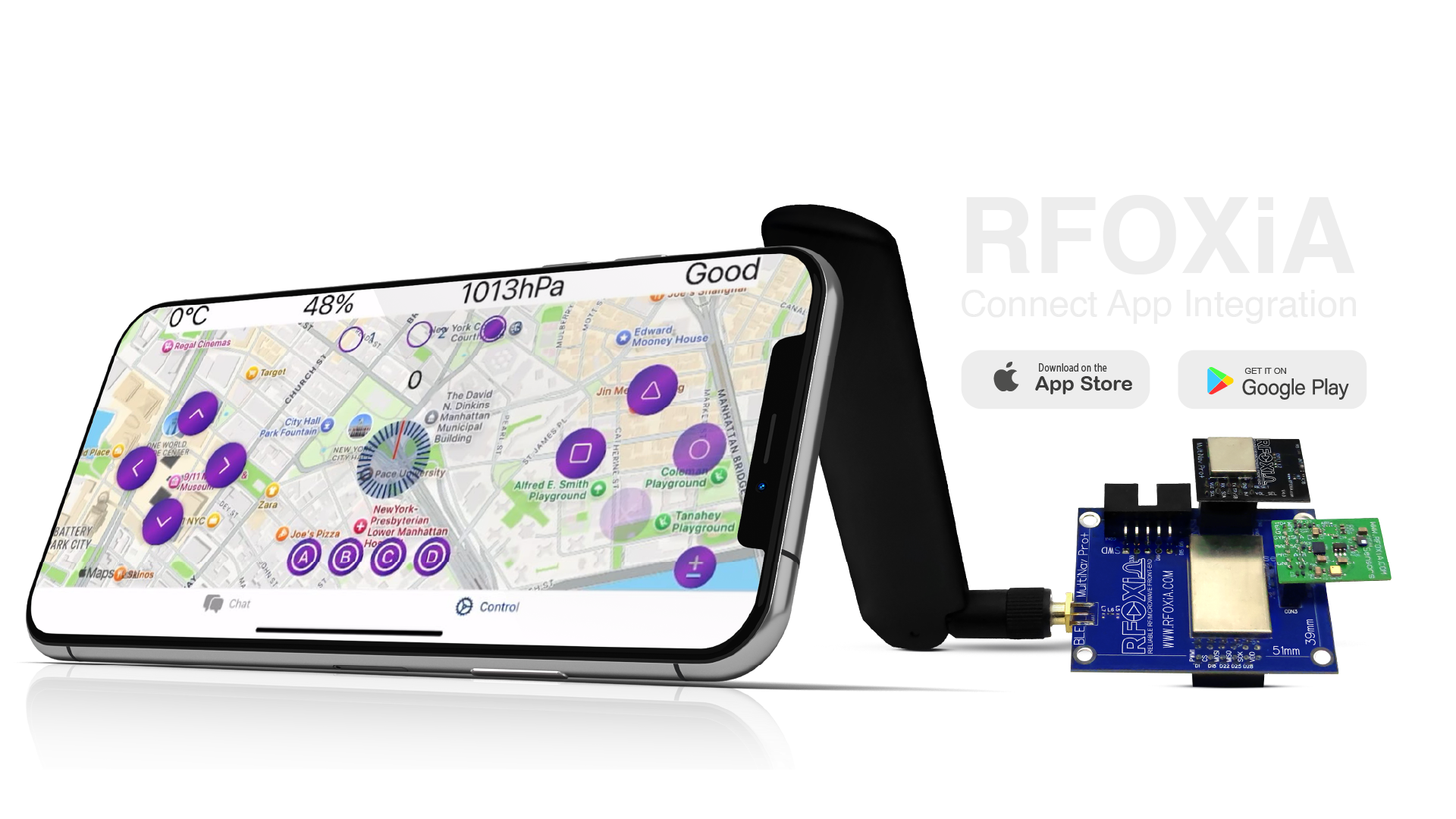
The RFOXiA Connect app (available on Android now, iOS pending approval) transforms your smartphone into a full-featured drone and robot ground station. The app pairs with the MultiNav Pro+ BLE module and delivers:
- PS5-style controller interface for intuitive drone and robot control
- Live map view with real-time GPS position tracking
- Live sensor data display showing telemetry in real time
- Automation center for scripted mission control
- Completely internet-independent operation — if you're flying in a canyon, a forest, or anywhere without cell service, your control link is unaffected
This is the critical distinction: the RFOXiA Connect app doesn't use the internet to communicate with your drone. It communicates directly, over the BLE link, through the MultiNav Pro+ BLE modules. Signal quality depends on your RF link — and at 15–20km man-to-drone range, that link is vastly more robust than any consumer drone system built on Wi-Fi or standard BLE.
If you're ready to stop accepting drone signal loss beyond 1km as an unavoidable reality, the RFOXiA Long Range Bluetooth Module is the hardware upgrade your build has been waiting for.
Seamless Module Ecosystem
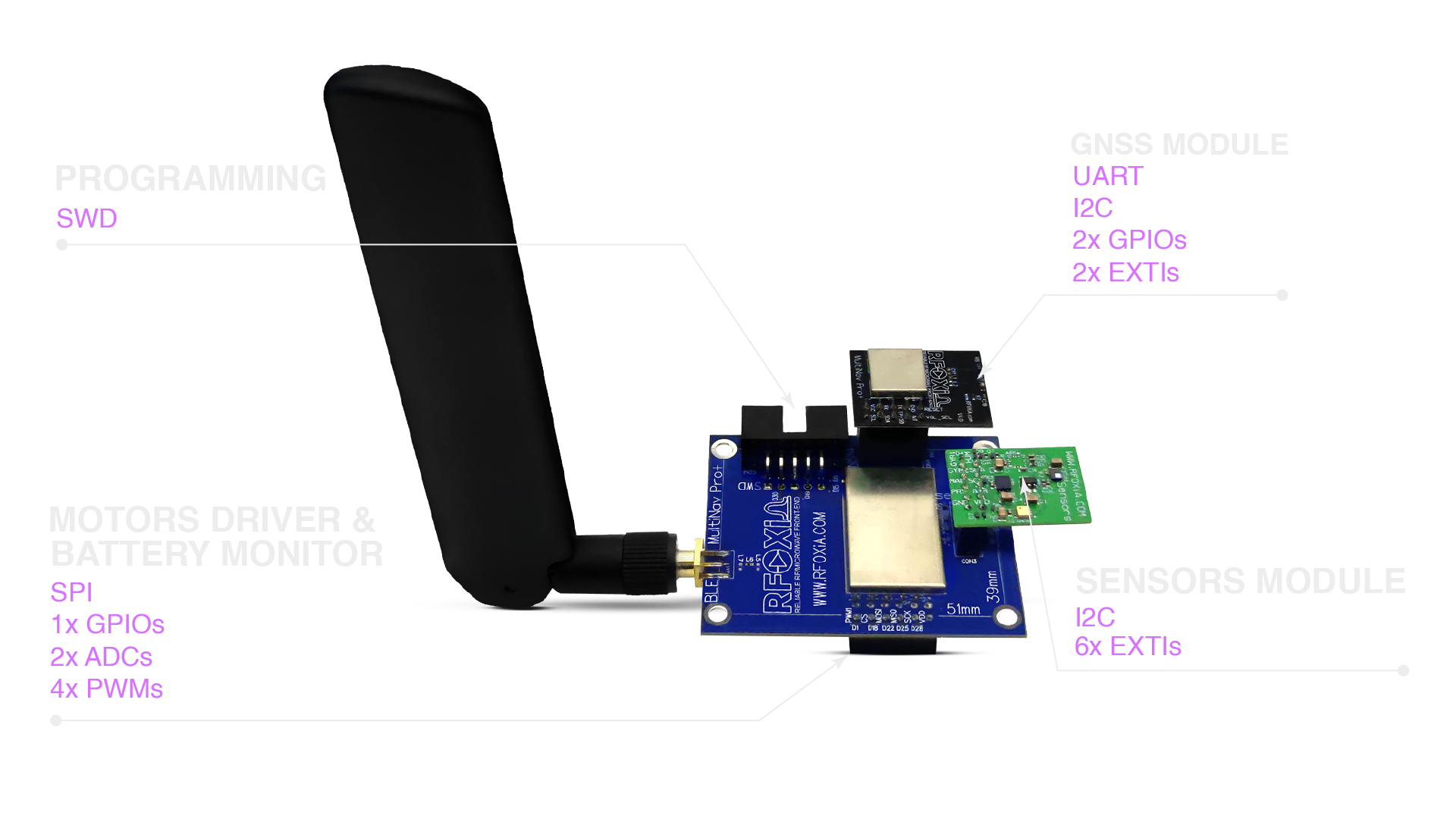
The MultiNav Pro+ BLE doesn't operate in isolation. It's designed to integrate directly with the rest of the MultiNav Pro+ ecosystem:
- GNSS Module (1.5m accuracy, 18Hz fix rate) — for precise real-time positioning even on fast-moving platforms
- Sensors Module (temperature, humidity, pressure, air quality, accelerometer, gyroscope, magnetometer) — seven sensors on one board for complete environmental awareness
- Power/Program Kit — supercapacitor-based power system with 5-minute charge time and 24-hour runtime
Four distinct interfaces on the BLE module — GNSS, Sensors, Motors & Battery Management, and Programming — allow you to connect the full ecosystem cleanly without custom wiring harnesses or adapter boards.
BLE Chat: Communication Without Infrastructure
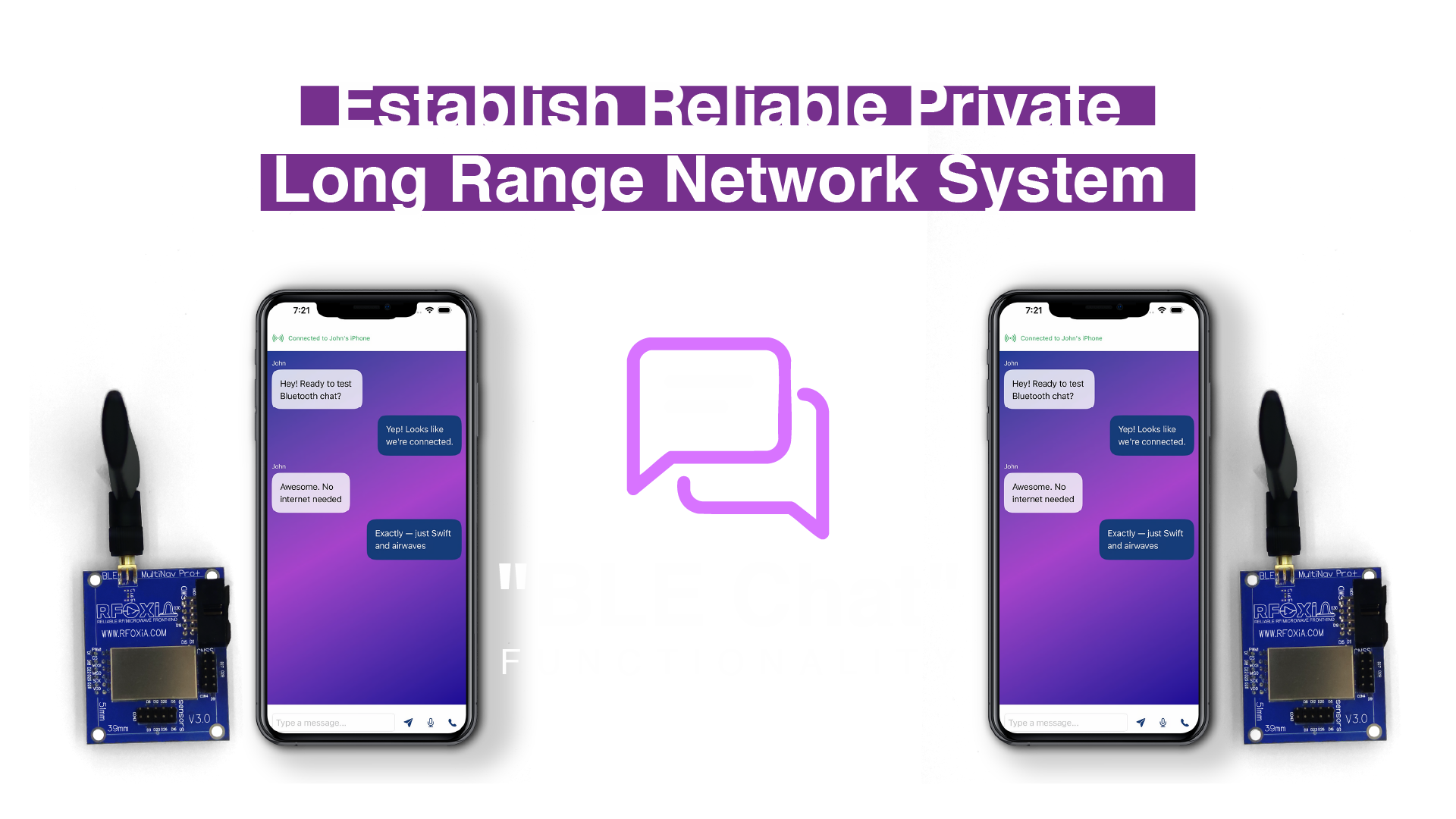
For field teams, researchers, and anyone working in remote environments, the MultiNav Pro+ BLE includes a BLE Chat functionality that establishes direct, internet-independent communication between users. Text, data, and voice communication across up to 5km ground-to-ground, completely off-grid. For search and rescue coordination, agricultural field teams, survey crews, or disaster response — this capability is not available in any commodity BLE product at any price.
Compact, Durable, Ready to Deploy
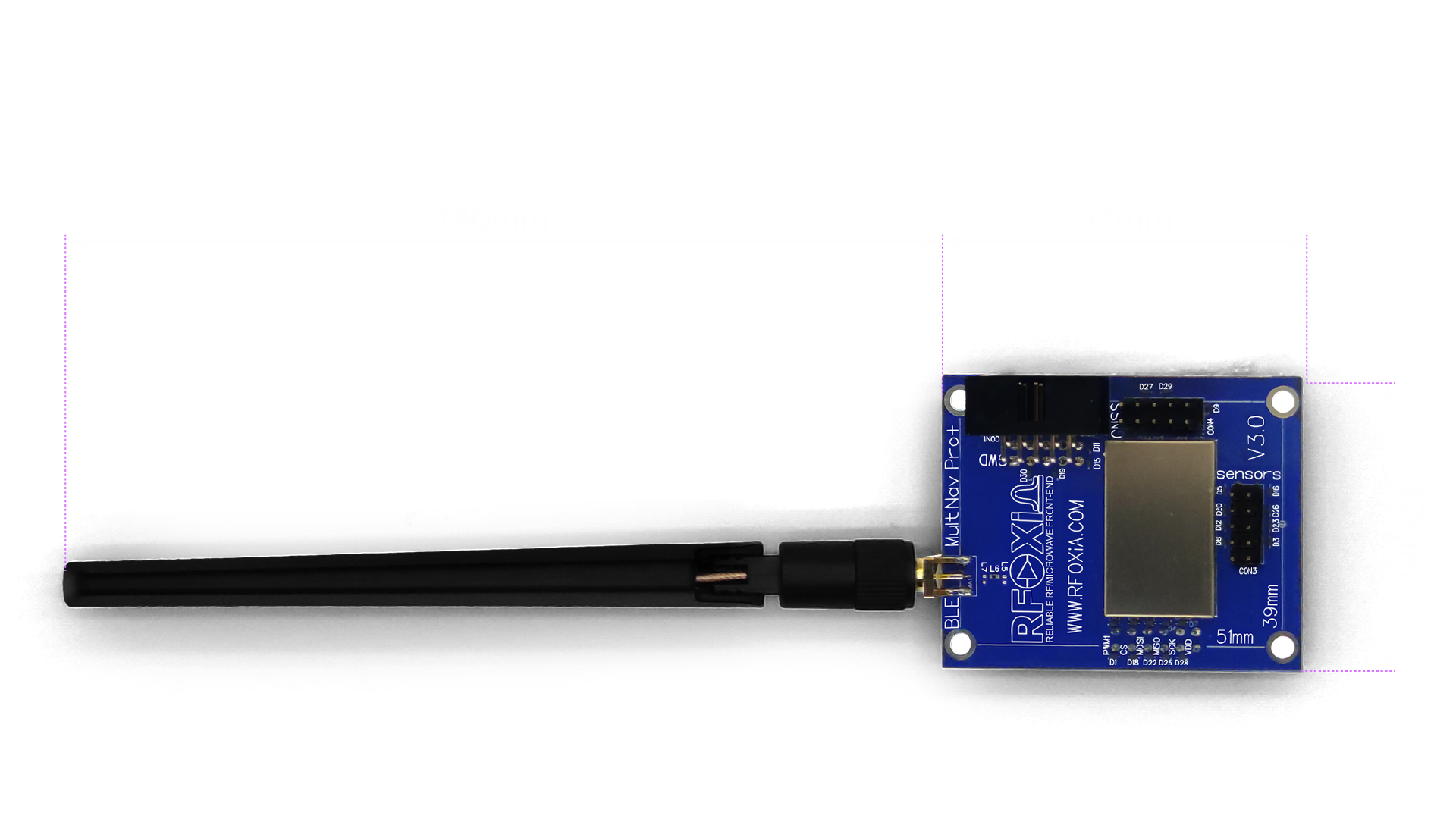
At 57mm × 47mm with a fixing frame size of 54mm × 34mm and corner mounting holes, the MultiNav Pro+ BLE is engineered for integration into space-constrained drone frames and enclosures. The fixing frame design makes secure mechanical mounting straightforward, and the module's robust construction handles the vibration and environmental exposure of real-world field operation.
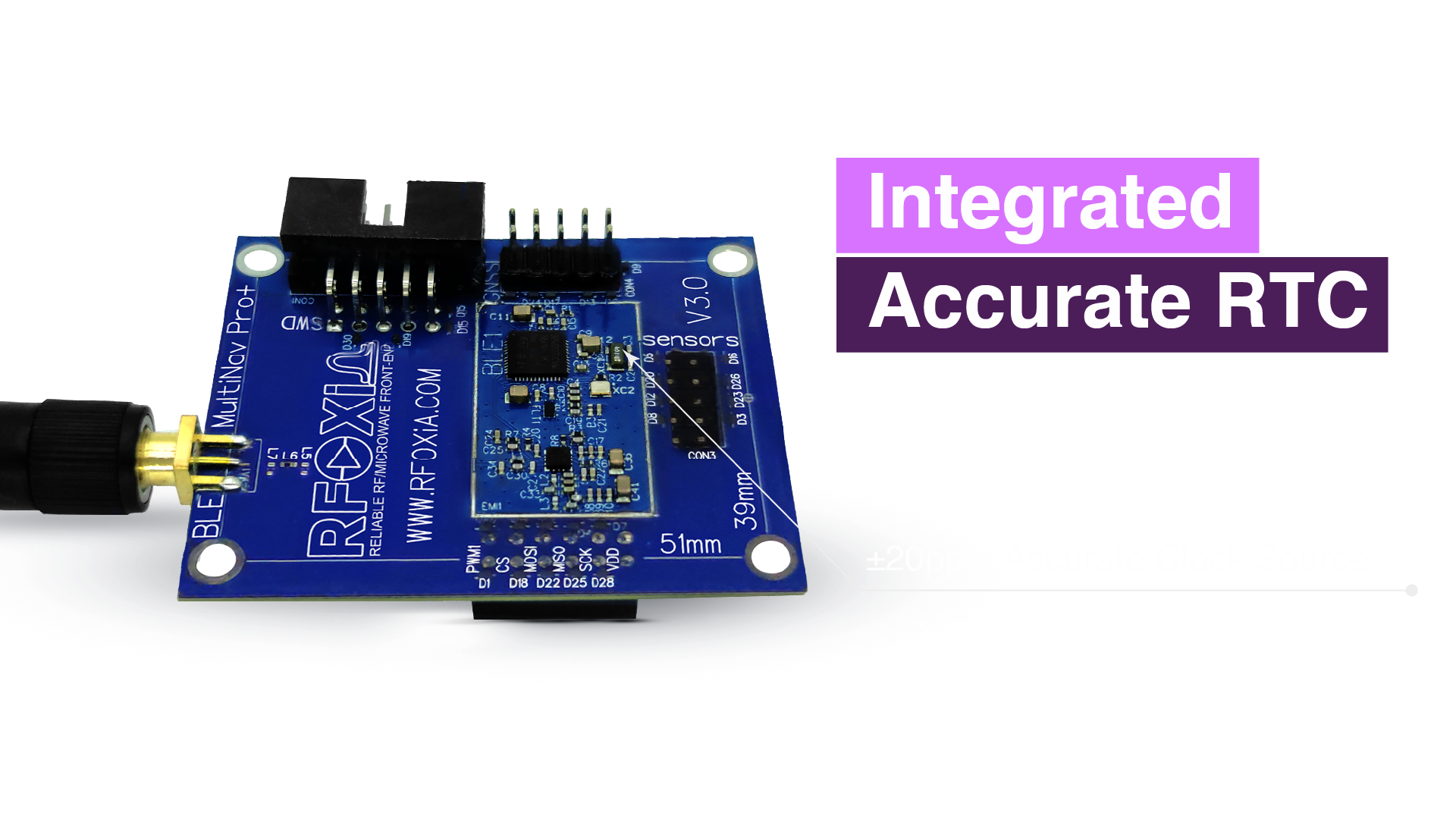
The integrated RTC crystal provides precise timing for synchronization in navigation and time-sensitive applications — an important detail for any autonomous system where timing accuracy affects mission performance.
Open Source and Fully Programmable
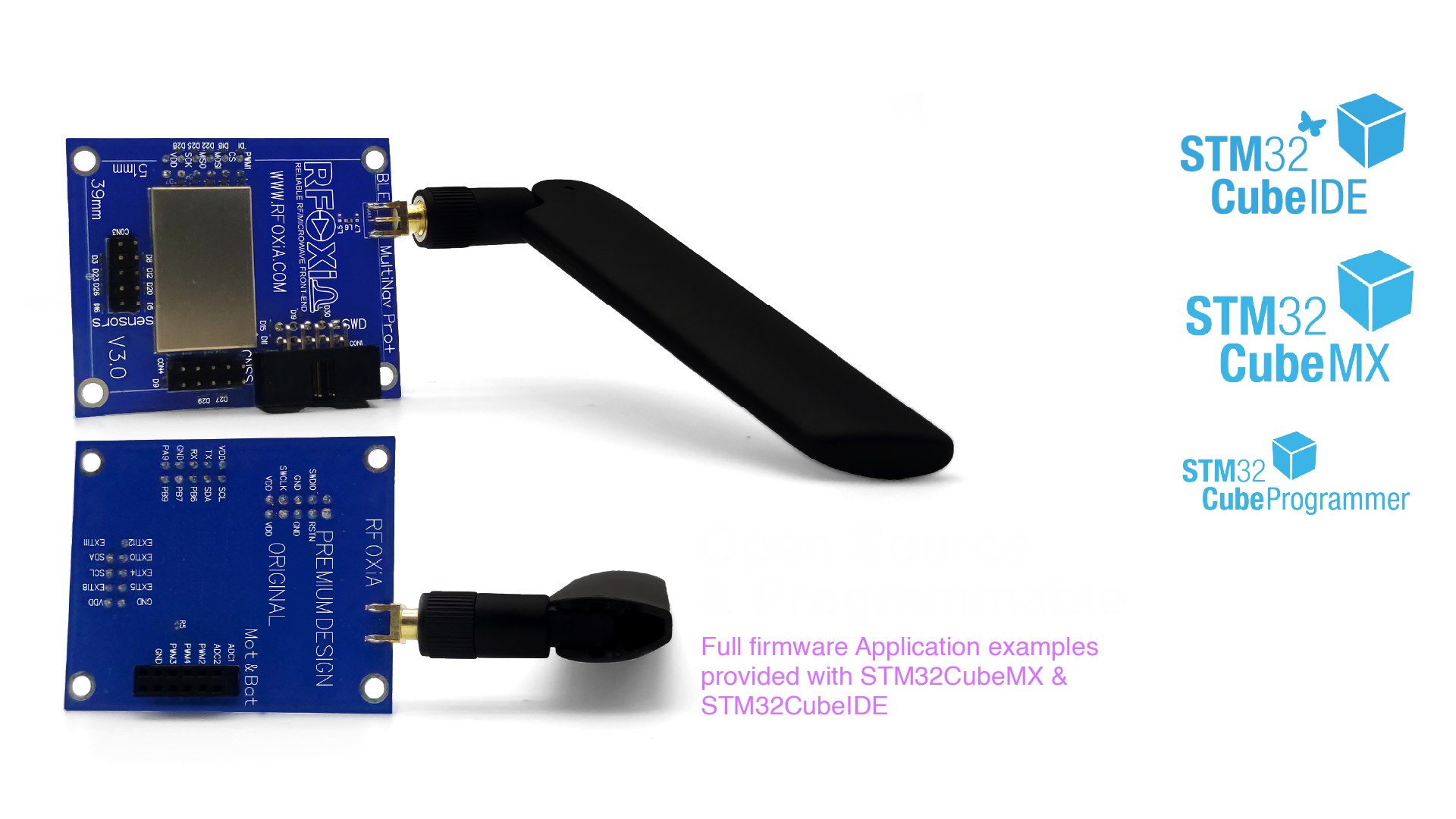
The MultiNav Pro+ BLE is fully open source, with complete firmware access available on GitHub (github.com/RFOXiA/MultiNav-Pro-Long-Range-BLE-Module-Firmware-STM32WB07). Programming is done via SWD using the integrated STLink interface in the Power/Program Kit, giving you full control over the module's behavior at every level of the stack.
For builders who want to customize firmware without spending weeks on low-level BLE stack development, RFOXiA Club includes an AI Firmware Builder — describe your application in plain language and receive complete, production-ready firmware generated for your specific use case. What used to take months of embedded development can now be completed in hours.
The Price That Changes Everything
Here's where the MultiNav Pro+ BLE becomes genuinely disruptive to the market.
The technology to achieve 20km drone control range has existed for years — inside military systems priced at $5,000 to $50,000+. Standard BLE modules deliver 80–100 meters and cost $5–15. Between those two extremes, there was effectively nothing for the professional maker, drone builder, or IoT engineer.
Two MultiNav Pro+ BLE modules — a complete point-to-point long-range link — ship for $59.
For teams building fleet management systems for agricultural drones, researchers deploying environmental monitoring networks across kilometers of terrain, FPV pilots who refuse to accept arbitrary range limitations, or robotics engineers building autonomous systems for real-world outdoor deployment — this price point fundamentally changes what's buildable on a realistic budget.
Drone signal loss beyond 1km is not a physical inevitability. It's a hardware limitation — and the RFOXiA Long Range Bluetooth Module is the hardware that removes that limitation at a price that doesn't require a defense contract.
Who the MultiNav Pro+ BLE Is Built For
This module is engineered specifically for:
- FPV pilots and drone builders who need reliable control and telemetry well beyond the range limits of standard RC systems
- Robotics engineers building autonomous outdoor platforms that must maintain communication with base stations across terrain
- IoT developers deploying sensor networks across farms, industrial sites, or remote locations where cellular coverage is unreliable or nonexistent
- Field researchers who need both data communication and off-grid voice/text capability
- Search and rescue and disaster response teams who need infrastructure-independent communication
- Agricultural operators managing drone fleets across large land areas
If your work takes you past the invisible range wall where every commodity Bluetooth module gives up, the MultiNav Pro+ BLE is your solution.
Specifications Summary
| Parameter | Specification |
|---|---|
| Ground-to-ground range | 5km |
| Man-to-drone range | 15–20km |
| Drone-to-drone range | 50km |
| Data rate | 2 Mbps |
| Processing core | STM32WB07CCV6 |
| Module dimensions | 57mm × 47mm |
| Antenna length | 140mm |
| Fixing frame | 54mm × 34mm (corner mounting holes) |
| Certification | FCC certified |
| Programming interface | SWD via STLink |
| App compatibility | iOS and Android (RFOXiA Connect) |
| Firmware | Open source (GitHub) |
| Price | $59 for 2 units |
Stop Accepting Drone Signal Loss Beyond 1km as Normal
Drone signal loss beyond 1km has been treated as an inconvenient reality of working with commodity wireless hardware. It isn't inevitable. It's a solvable engineering problem — and the MultiNav Pro+ BLE is the solution that makers, builders, and researchers have needed for years.
FCC certified. Professionally engineered. Open source. Ecosystem-ready. And priced at $59 for a complete two-module link.
The complete wireless developer ecosystem — BLE module, GNSS, sensors, power management, AI firmware builder, mobile control app, and data monetization network — is available through RFOXiA Club at rfoxia.com.
If you're ready to build without range limits, the RFOXiA Long Range Bluetooth Module is ready to ship.
Written by: Moamen Mohamed LinkedIn