
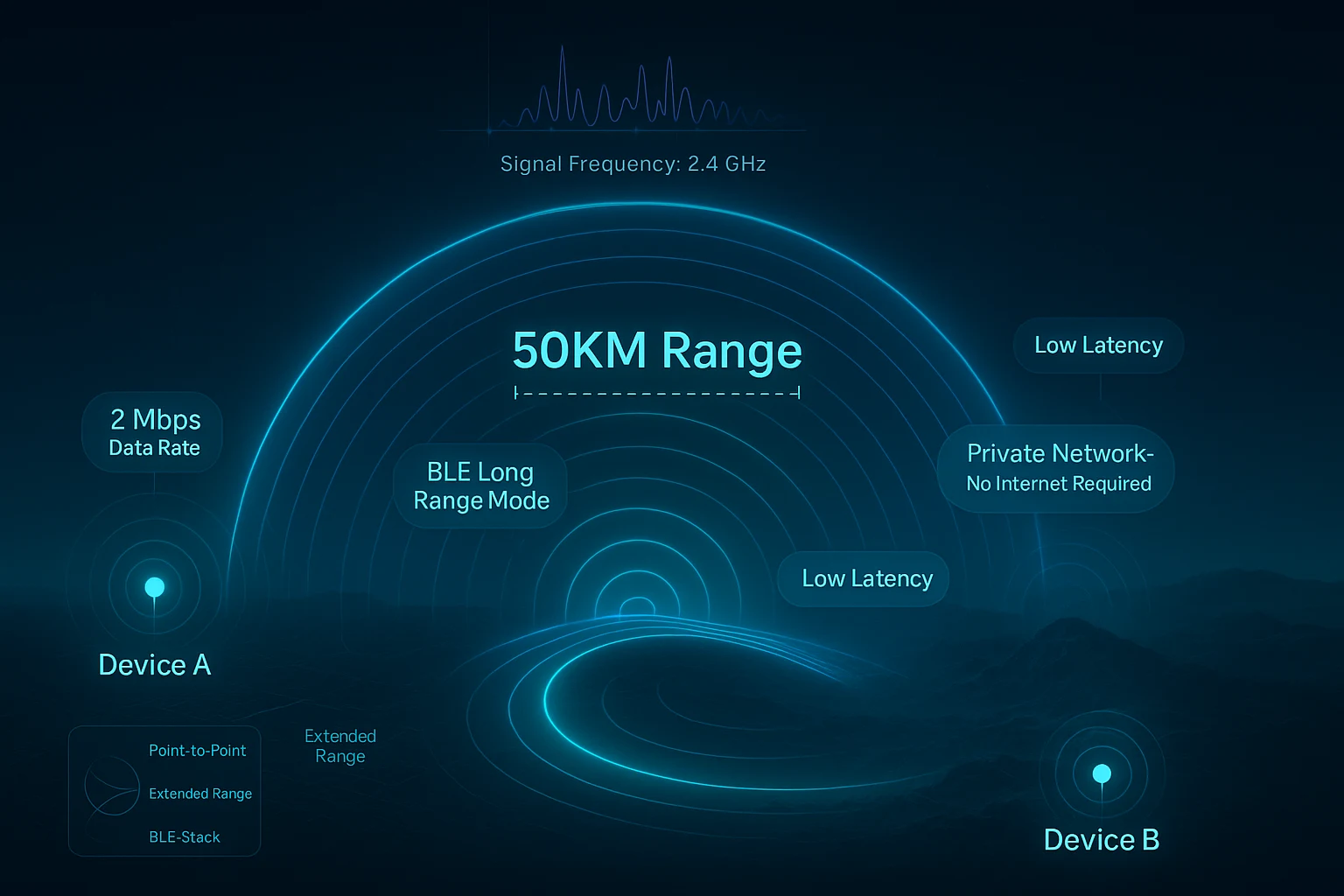
How Does Long Range Bluetooth Work?
RFOXiA Long Range Bluetooth Module
Understanding the Technology That Pushes Bluetooth Beyond Its Limits
How does long range Bluetooth work — and why does it matter that the answer has completely changed in the last few years? Most people assume Bluetooth is a short-range technology. Your headphones connect at 10 meters. Your phone pairs with a speaker across the room. That's the Bluetooth most people know.
But that version of Bluetooth barely scratches the surface of what the protocol is capable of — and what modern hardware engineers have achieved by pushing it far beyond its default operating parameters.
This guide breaks down the real engineering behind long-range Bluetooth: the physics, the protocol features, the hardware amplification techniques, and why a new generation of modules is now delivering ranges measured in kilometers — not meters — at prices accessible to any serious developer.
The Physics of Bluetooth Signal Propagation
Before understanding how long range Bluetooth works, you need to understand what limits it in the first place.
Bluetooth operates in the 2.4 GHz ISM band — the same crowded band as Wi-Fi, microwave ovens, and dozens of other wireless technologies. At this frequency, signals experience significant free-space path loss. The Friis transmission equation tells us that signal power decreases with the square of distance: double the distance, and you lose 6 dB of signal power. This is the fundamental physical constraint that every wireless engineer works within.
Standard commodity BLE modules — the kind you find in off-the-shelf development boards — are designed for low cost and low power consumption. They use minimal transmit power (typically +0 to +4 dBm) and modest receiver sensitivity (around -90 to -95 dBm). At these parameters, you get a link budget that supports ranges of 80 to 100 meters under ideal conditions, and far less in real-world environments with obstacles and interference.
So how does long range Bluetooth work when you need to go orders of magnitude further?
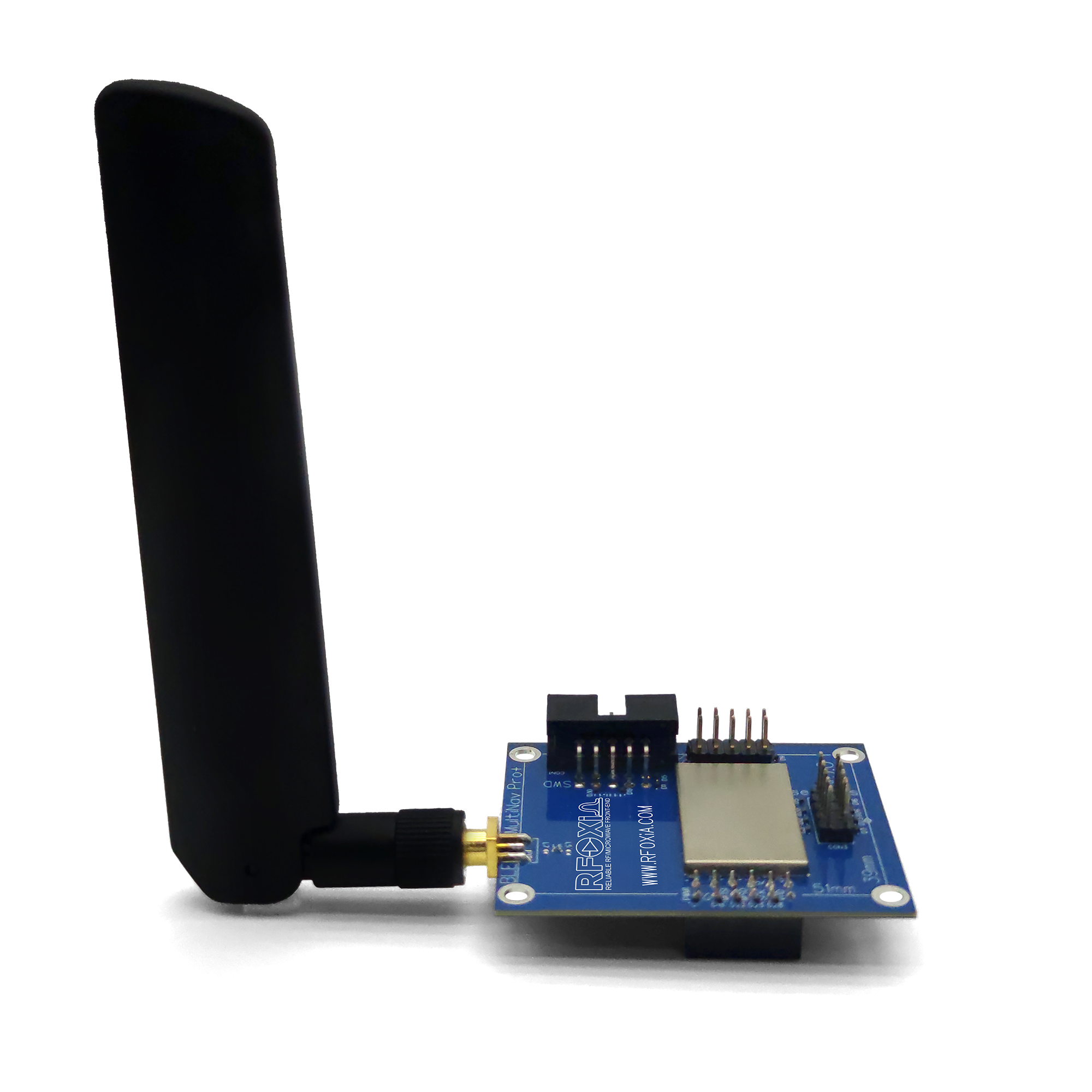
The answer involves three distinct layers of engineering working together: the Bluetooth protocol itself, RF front-end amplification hardware, and antenna design.
Layer 1: Bluetooth 5 Long Range Mode (Coded PHY)
Bluetooth 5 introduced a feature called Coded PHY — a physical layer mode specifically designed to extend range at the cost of data rate. Here's how it works:
Forward Error Correction (FEC): In Coded PHY mode, the radio transmits each bit of data multiple times using error correction encoding. The S=2 mode sends each bit twice (2x redundancy), and S=8 mode sends each bit eight times. The receiver can reconstruct the original data even when individual bit errors occur — effectively improving receiver sensitivity without increasing transmit power.
Sensitivity Improvement: Coded PHY S=8 mode provides approximately 12 dB of sensitivity improvement over standard BLE. In link budget terms, that 12 dB translates directly to roughly 4x the range under free-space conditions. This is meaningful, but it's only one part of the long-range equation.
Trade-off: The cost of Coded PHY is data rate. Standard BLE runs at 1 or 2 Mbps. S=2 drops to 500 Kbps. S=8 drops to 125 Kbps. For many IoT applications — sensor telemetry, control signals, GPS data — this trade-off is completely acceptable. For high-throughput applications, you stay in standard 2 Mbps mode and sacrifice some range.
Coded PHY alone, on a standard module, might push your range from 100m to 300-400m. It's a significant improvement, but it's still nowhere near the performance that professional long-range applications demand.
Layer 2: RF Front-End Amplification
This is where hardware engineering separates commodity modules from professional-grade long-range systems. To truly understand how long range Bluetooth works at the kilometer scale, you need to look at the RF front-end.
Power Amplifiers (PA): A power amplifier boosts the transmit signal before it reaches the antenna. While a standard BLE chip might output +4 dBm, a module with an integrated PA can push +20 to +27 dBm. That's a 16-23 dB increase in transmit power — which, combined with the reciprocal improvement in the receive chain, dramatically extends the usable link budget.
Low Noise Amplifiers (LNA): On the receive side, a low noise amplifier reduces the effective noise figure of the receiver. This improves receiver sensitivity — meaning the module can successfully decode signals that would be completely lost in the noise floor for a standard chip. A well-designed LNA can improve sensitivity by 8-12 dB.
Combined Link Budget: When you stack a high-power PA on transmit, a sensitive LNA on receive, and Coded PHY encoding, you're adding 30-40 dB of total link margin compared to a commodity BLE module. In free-space range terms — using the Friis equation — every 6 dB of link budget improvement doubles your range. 36 dB of improvement means roughly 64x the range. That's how you get from 100 meters to multiple kilometers.
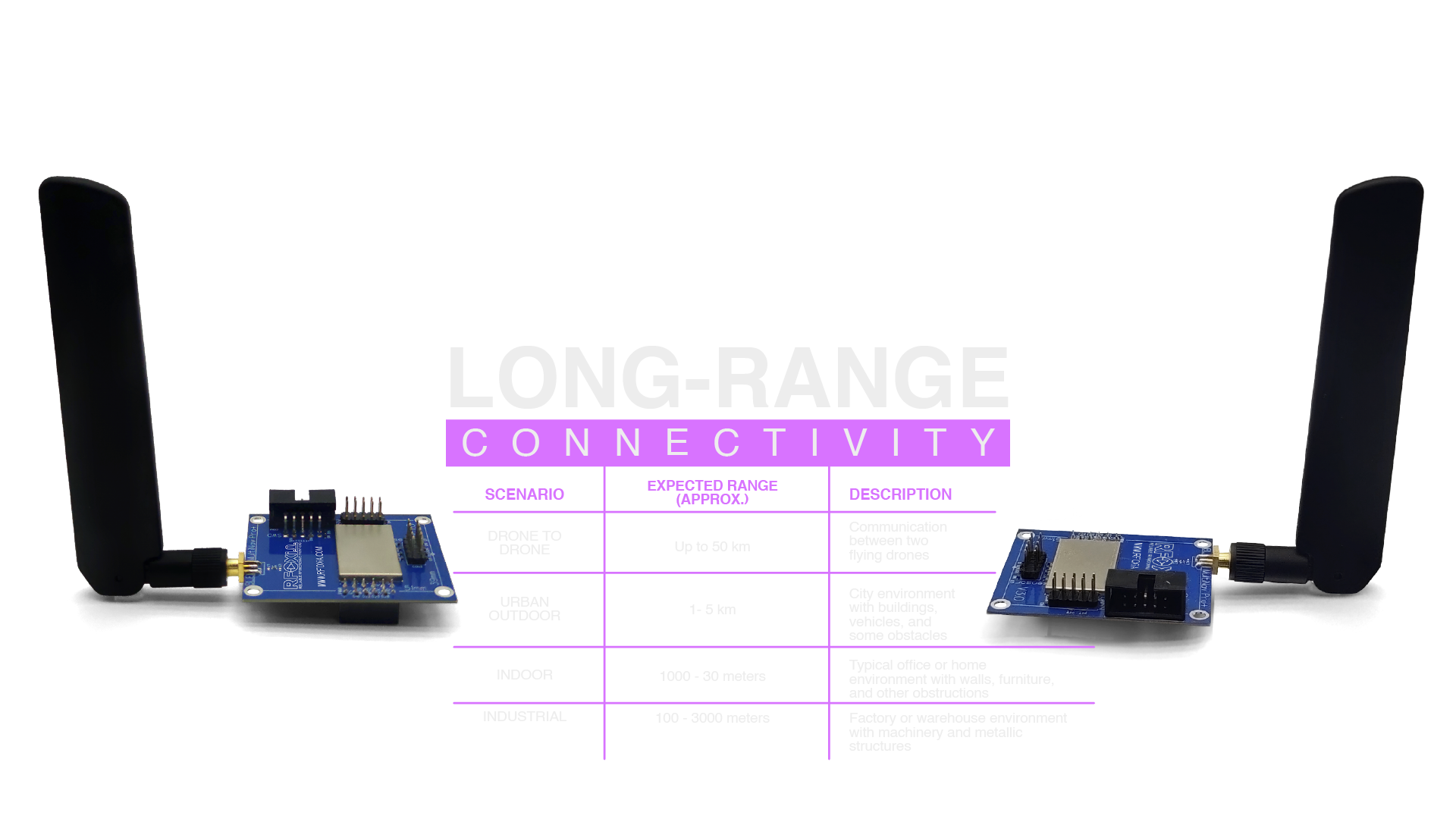
Layer 3: Antenna Design and Deployment Geometry
The third layer that answers how does long range Bluetooth work at extreme distances is often the most underappreciated: antenna design and deployment geometry.
Antenna Gain: A high-gain directional antenna focuses radio energy in a specific direction rather than radiating it uniformly in a sphere. A 6 dBi antenna provides 6 dB of effective gain in its primary direction — equivalent to quadrupling your transmit power without drawing any additional current. For fixed point-to-point links, directional antennas are a force multiplier.
Ground Reflections and Multipath: When both endpoints are at ground level, the radio signal arrives at the receiver via two paths: the direct line-of-sight path, and a reflected path off the ground. These two paths can destructively interfere — reducing effective range significantly compared to free-space predictions. This is why ground-to-ground Bluetooth links typically achieve less range than elevated links.
The Drone Advantage: When one or both modules are elevated — on a drone, for example — ground reflections are reduced or eliminated. The signal path becomes closer to free-space propagation, and the full theoretical link budget becomes achievable. This is why the range figures for module-to-drone and drone-to-drone configurations are substantially higher than ground-to-ground: the physics are simply better.
High-Gain Chip Antenna Integration: Modern long-range BLE modules integrate high-gain chip antennas directly on board, eliminating the need for external antenna connectors while maintaining strong signal performance in a compact form factor.
Real-World Range: What the Numbers Actually Mean
Let's ground this in concrete performance data. The RFOXiA Long Range Bluetooth Module — the MultiNav Pro+ — demonstrates exactly how these engineering layers combine to produce real-world results:
- Ground-to-ground (phone-to-phone): 5 km
- Man-to-drone (phone to airborne module): 15-20 km
- Drone-to-drone (both modules airborne): 50 km
These aren't theoretical figures from an anechoic chamber. They're operational specifications that reflect the actual deployment geometries that users will encounter. The progression from 5 km to 50 km directly illustrates the impact of removing ground reflections as the deployment altitude increases.
For context: the best commodity BLE module you can buy achieves 80-100 meters under ideal conditions. The MultiNav Pro+ achieves 5,000 meters under comparable ground-level conditions — a 50x to 60x improvement — through the engineering layers described above.
The Role of the Processing Core
Long-range capability is only part of the story. The processing architecture determines what you can actually do with that link.
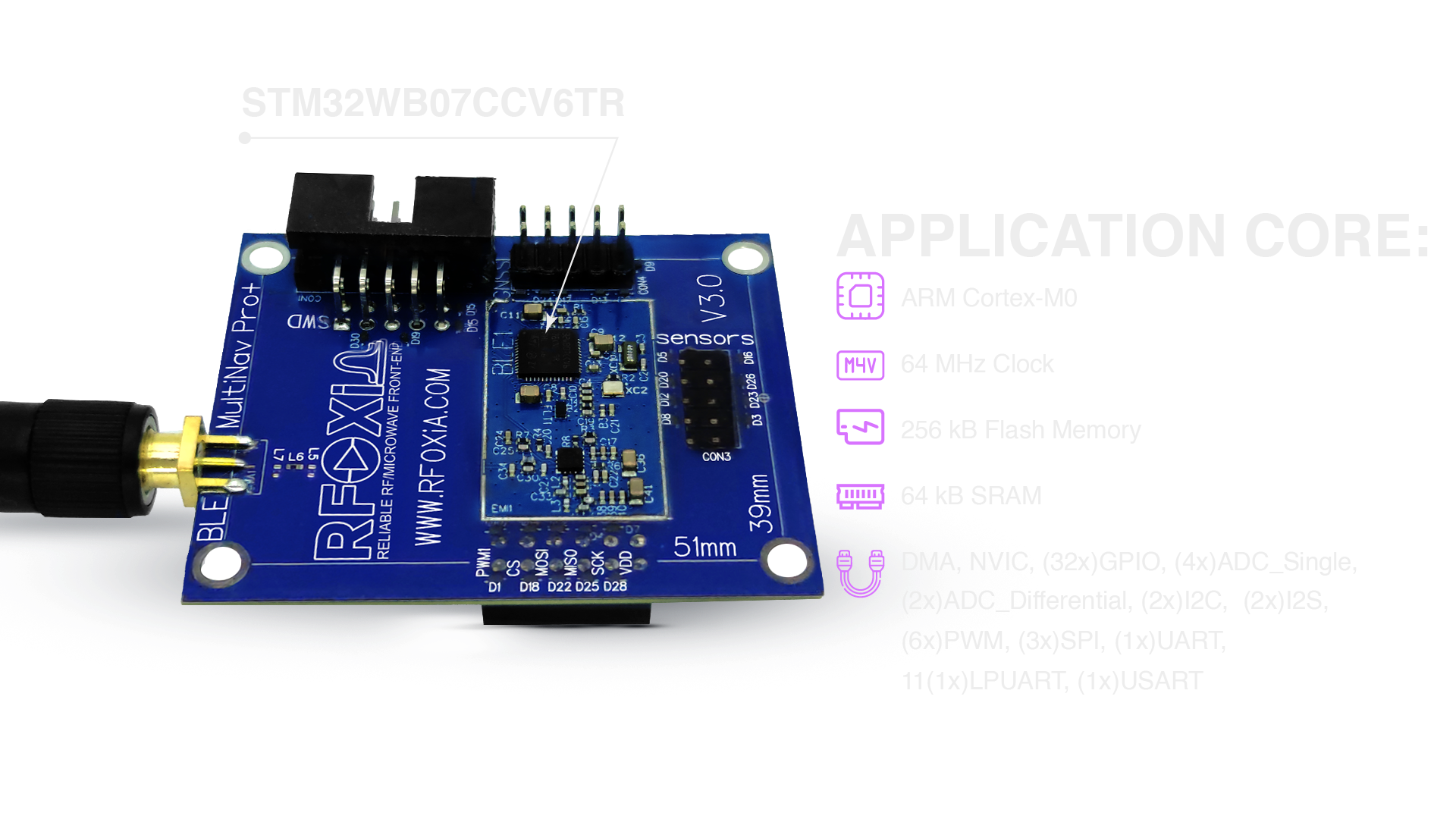
The MultiNav Pro+ is built around the STM32WB07CCV6 — a dual-core wireless SoC from STMicroelectronics. This chip runs the BLE stack on one core while leaving the second core fully available for user application logic. The result is a module that manages all the complexity of BLE protocol handling — connection management, error correction, frequency hopping — while simultaneously running your custom firmware for sensor processing, motor control, navigation computation, or any other application-specific logic.
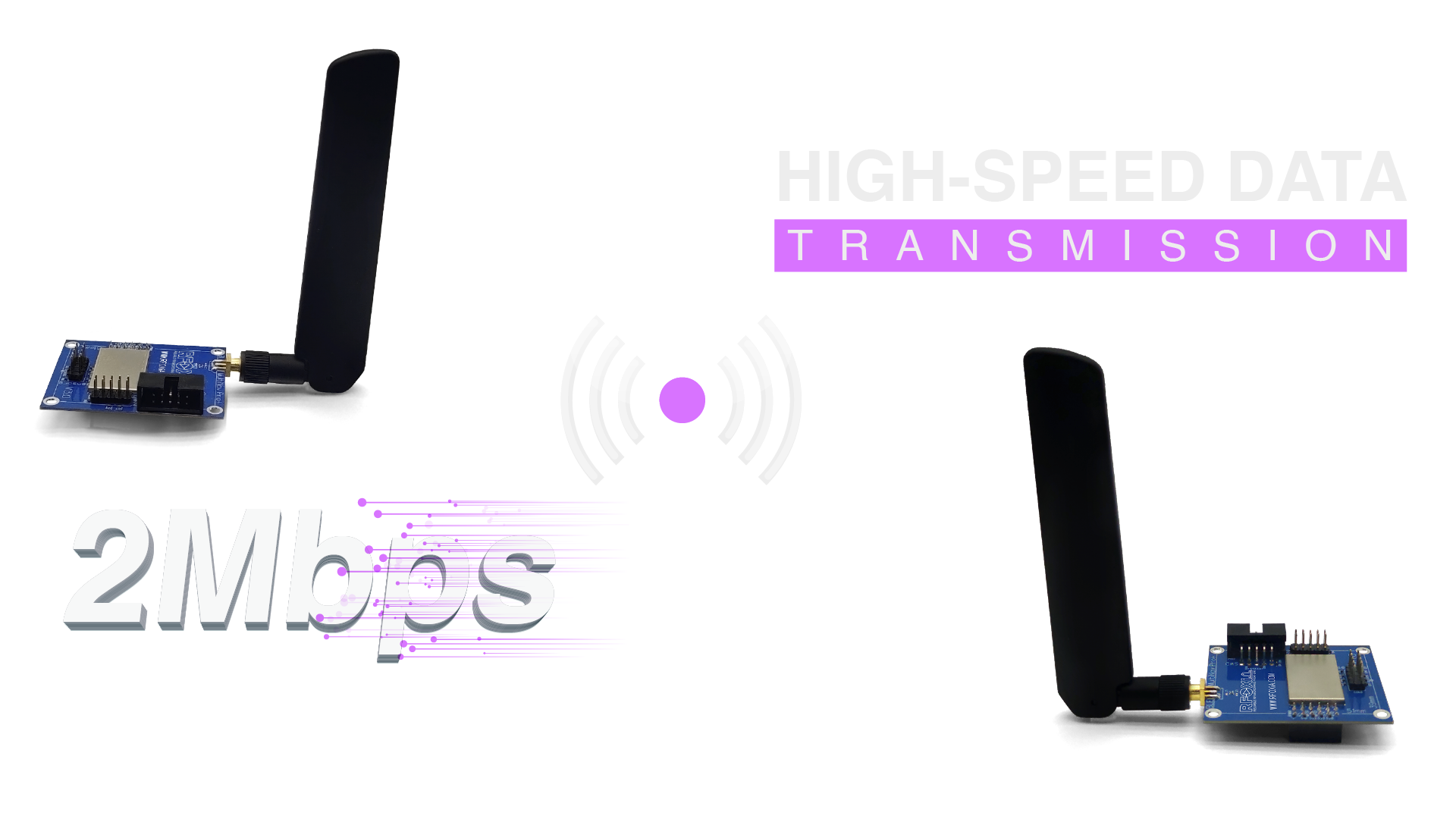
The 2 Mbps data rate in standard mode means that when you don't need maximum range, you have a fast, low-latency link suitable for real-time control applications — drone telemetry, robotic actuator commands, live sensor streaming.
Ecosystem Integration: Beyond the Radio Link
Understanding how long range Bluetooth works is one thing. Understanding what you can build with it is another.
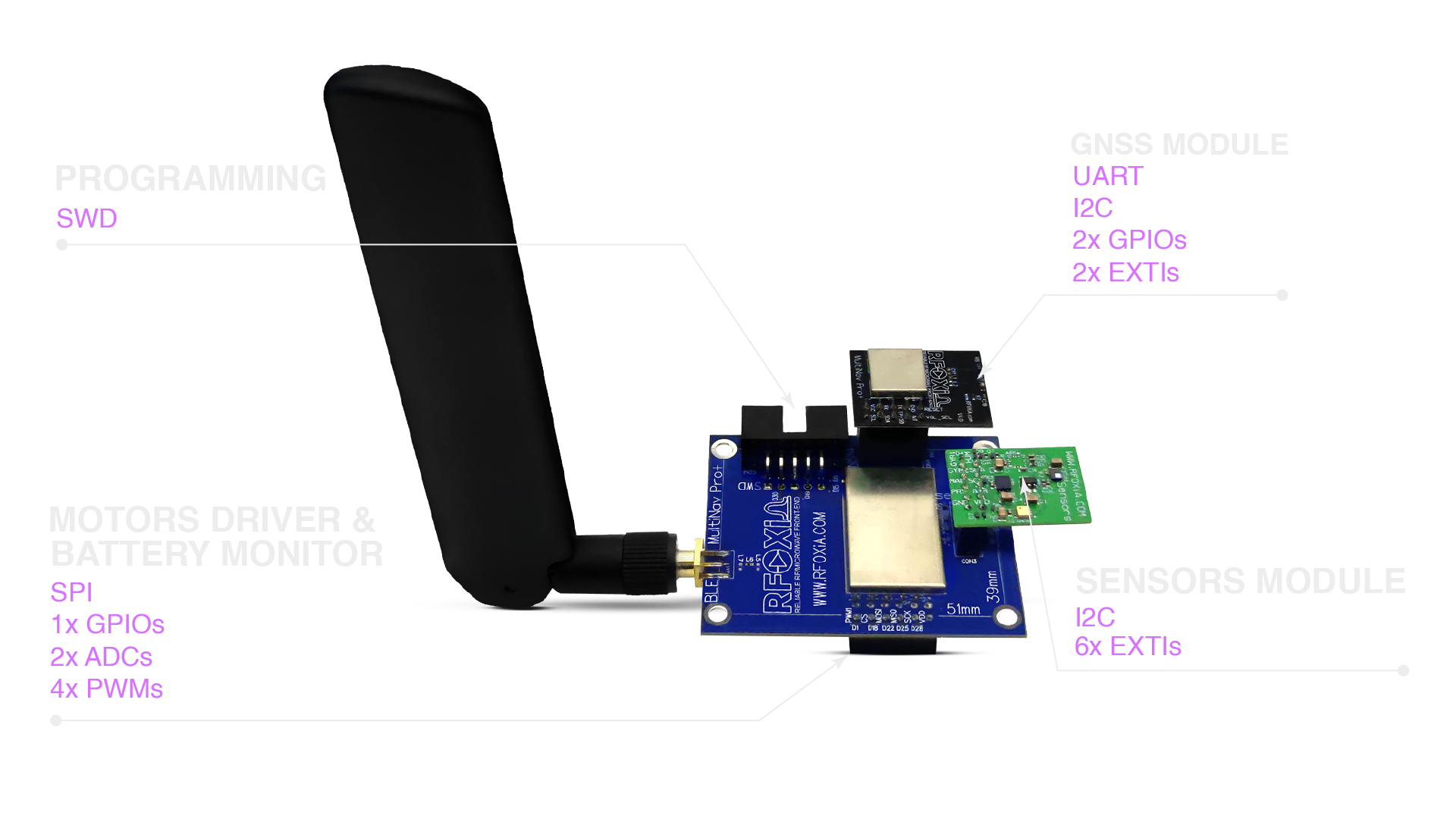
The MultiNav Pro+ BLE module is designed as the communication backbone of a complete modular hardware ecosystem. It connects directly with:
- GNSS Module — 1.5m accuracy, 18Hz fix rate for high-speed platform tracking
- Sensors Module — 7 integrated sensors: temperature, humidity, pressure, air quality, accelerometer, gyroscope, magnetometer
- Power/Program Kit — supercapacitor-based power system with 5-minute charge for 24-hour runtime
These modules interconnect through four dedicated interfaces on the BLE module: GNSS, Sensors, Motors & Battery Management, and Programming. You're not wiring together incompatible third-party boards — you're snapping together a purpose-designed system.
Mobile App Control: Long Range in Your Pocket
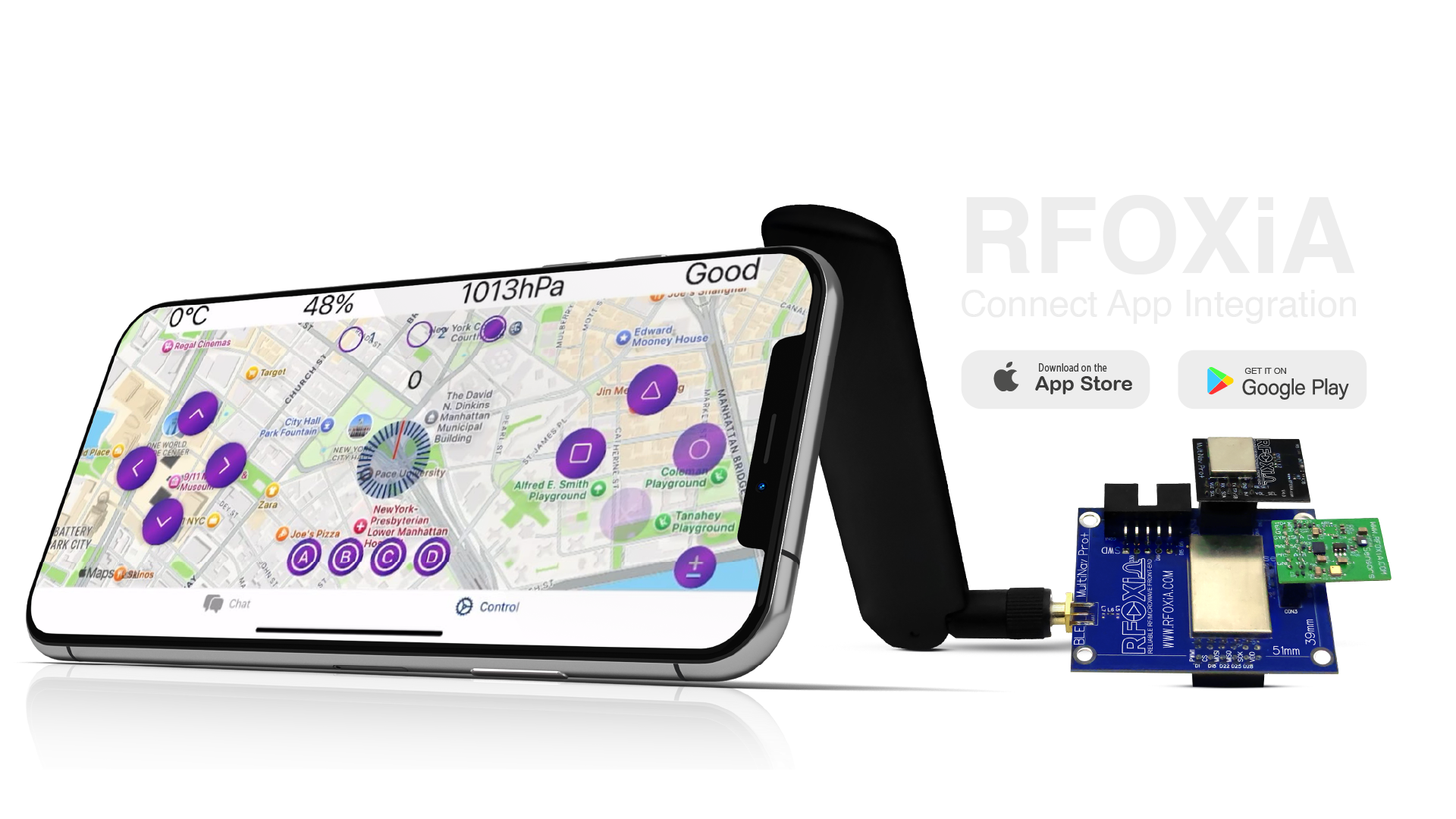
The RFOXiA Connect app puts long-range control directly in your hands. The app pairs with the MultiNav Pro+ over Bluetooth and provides:
- PS5-style controller interface for drone and robot control
- Live map view with real-time GPS tracking from the connected GNSS module
- Live sensor data display from all connected sensors
- Automation center for programmable control logic
Critically, the app operates completely without internet connectivity. The communication link runs entirely through the BLE modules — your phone is the ground station, and the module on your drone or robot is the remote node. At up to 20 km range man-to-drone, this is a professional-grade control solution at a fraction of the cost of dedicated RC systems.
BLE Chat: Internet-Independent Mesh Communication
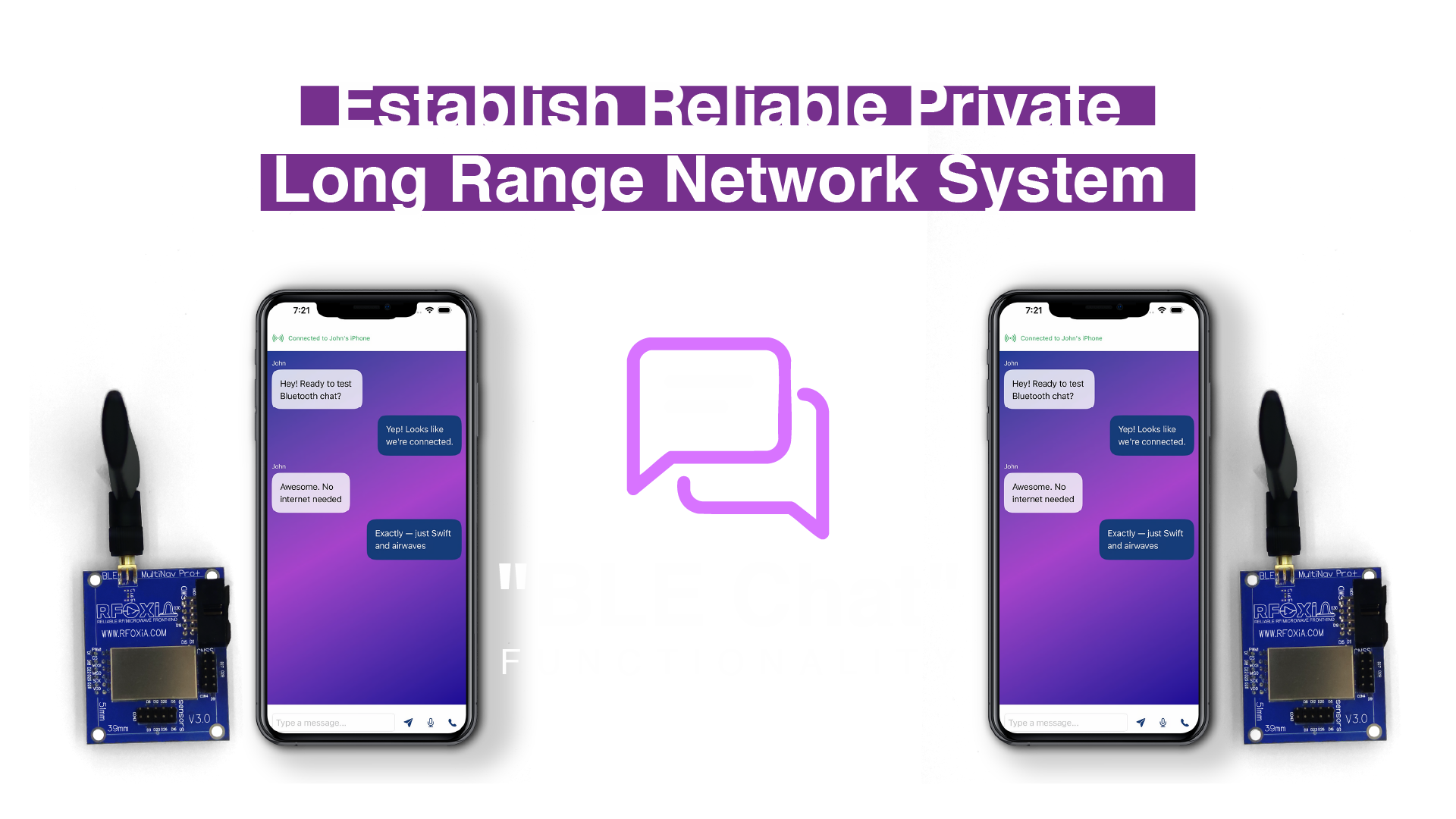
One of the most compelling applications of long-range Bluetooth is mesh communication — and the MultiNav Pro+ implements this through BLE Chat functionality.
When multiple users carry BLE modules, they form an ad-hoc communication network without requiring any internet infrastructure. Text messages, data packets, and voice calls route through the mesh. The range between any two nodes is determined by the module's link budget — up to 5 km ground-to-ground.
Applications include disaster response where cellular infrastructure is down, remote expeditions beyond cell coverage, field team coordination in industrial or agricultural settings, and any scenario where communication without infrastructure is a requirement rather than a preference.
This isn't a software feature bolted onto a commodity BLE chip. It's possible because the underlying hardware has the link budget to maintain reliable connections at distances where conventional BLE would drop entirely.
Compact Form Factor for Real-World Deployment
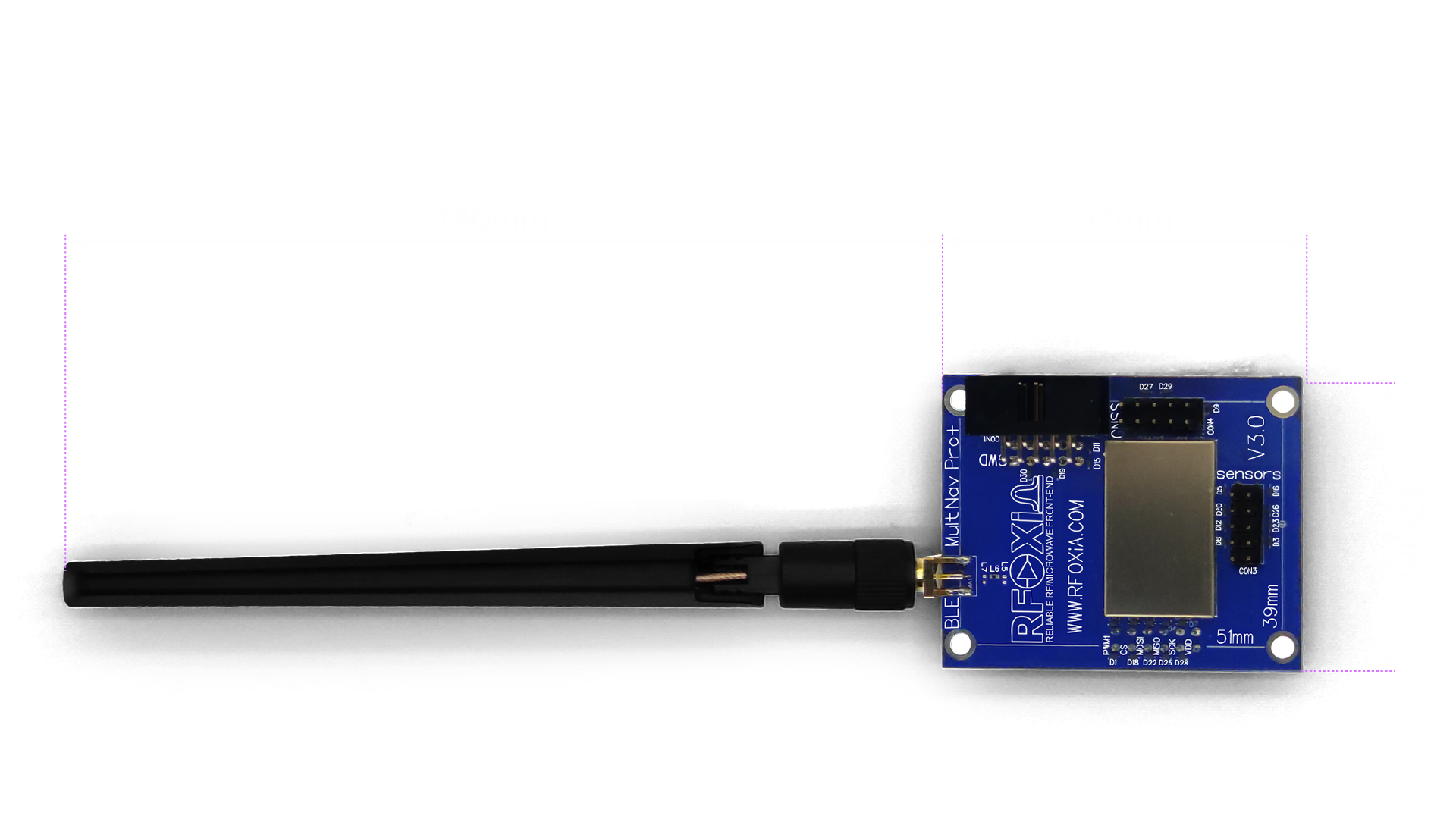
All of this capability — the PA, the LNA, the STM32WB07, the ecosystem connectors, the integrated antenna — fits into a 57mm × 47mm PCB. The fixing frame dimensions are 54mm × 34mm with corner mounting holes, enabling straightforward mechanical integration into drone frames, enclosures, and custom hardware platforms.
The integrated 140mm high-gain chip antenna eliminates the need for external antenna connectors and the associated complexity of external antenna selection, routing, and mechanical mounting. The module arrives ready to mount and deploy.
FCC certification on the module means you're not responsible for re-certifying your end product's radio — a significant compliance advantage for any commercial deployment.
Open Source Firmware and Full Programmability
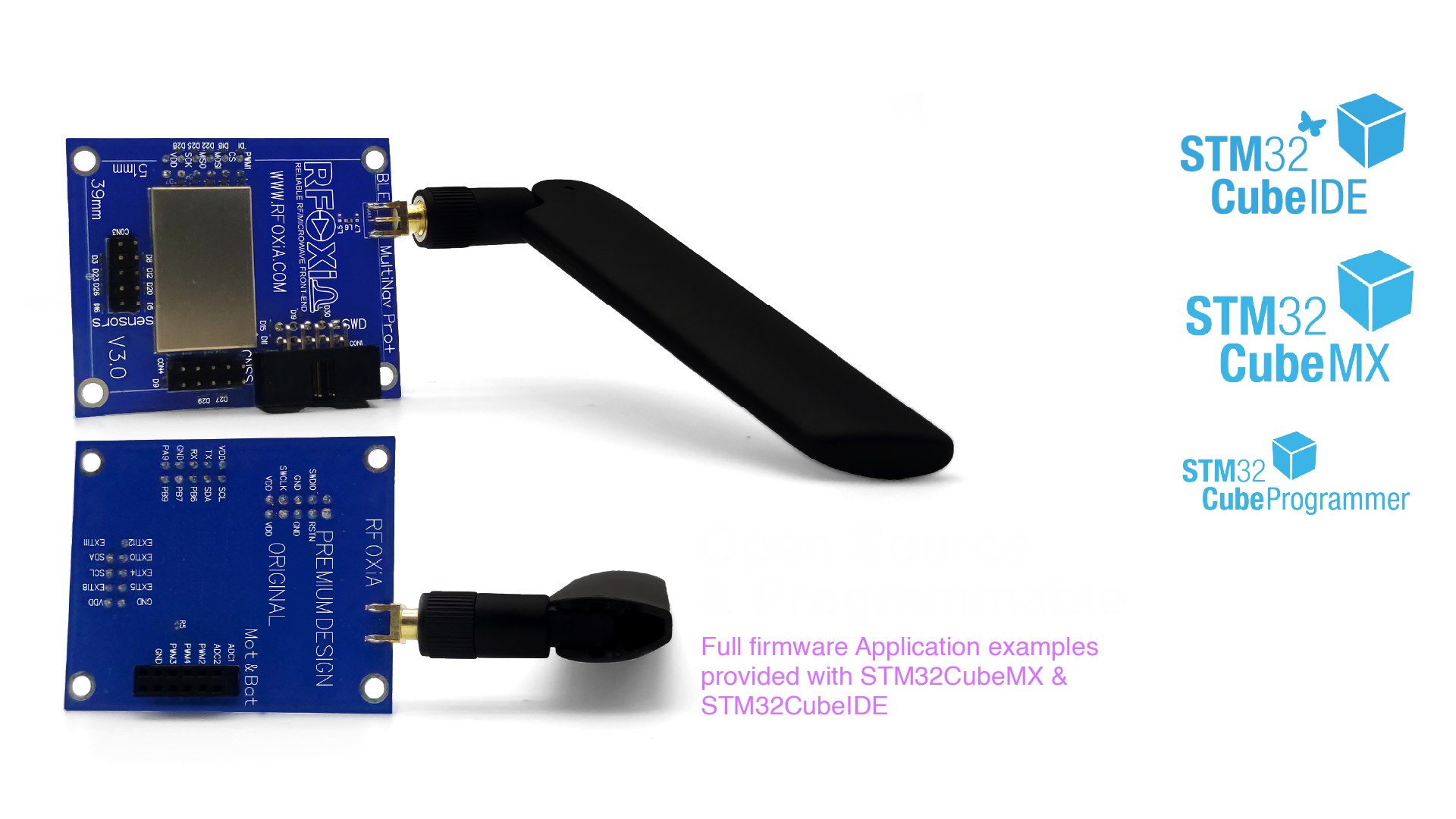
The MultiNav Pro+ is fully open-source and programmable via SWD (Serial Wire Debug). The complete firmware source code is available on GitHub, giving developers full visibility into and control over every aspect of module behavior.
For developers who want to customize without diving into low-level embedded C, RFOXiA's AI Firmware Builder — integrated into the RFOXiA Club platform — accepts plain-language descriptions of your application and generates production-ready firmware. Describe what you want your wireless system to do, and the AI generates the code.
This combination — open hardware, open firmware, AI-assisted development — dramatically compresses the development timeline for custom wireless applications. What might take months of embedded development can be prototyped in hours.
Precision Timing with Integrated RTC
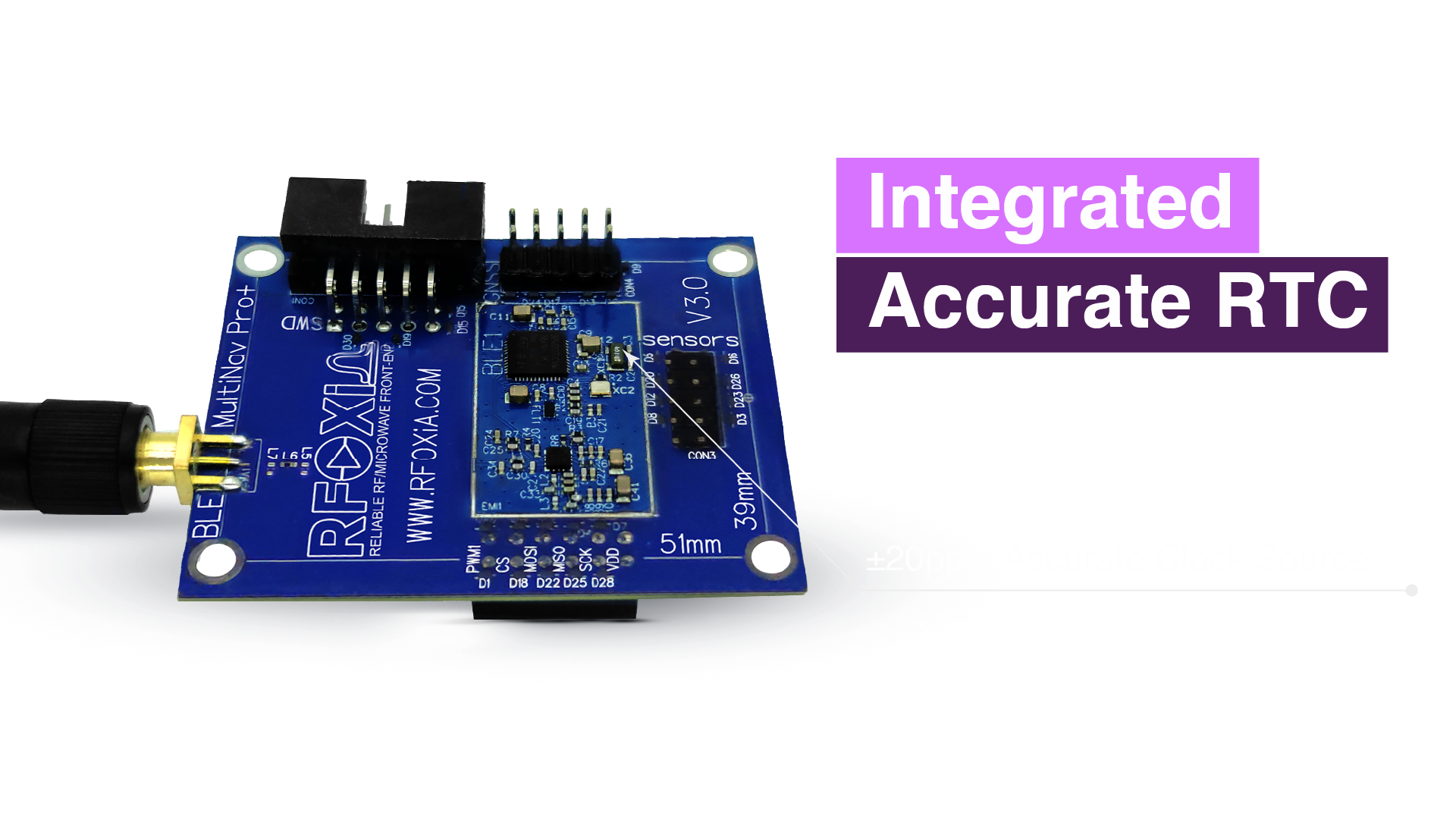
The MultiNav Pro+ integrates an RTC (Real-Time Clock) crystal directly on the module. For navigation systems, synchronized sensor logging, time-stamped telemetry, and any application where timing accuracy matters, the RTC provides a reliable reference without requiring an external component.
In a multi-node deployment — multiple modules communicating across a mesh — synchronized timing enables coordinated data collection, time-division channel access, and correlated telemetry across the network.
How Does Long Range Bluetooth Work at 50KM? A Summary
To bring the answer together:
How does long range Bluetooth work? It works through the deliberate engineering combination of:
- Bluetooth 5 Coded PHY — protocol-level sensitivity improvement through forward error correction
- RF front-end amplification — high-power PA on transmit and low-noise LNA on receive, expanding the link budget by 16-23 dB
- High-gain antenna design — focusing radiated energy efficiently
- Deployment geometry optimization — elevating modules to eliminate ground reflections and achieve near free-space propagation
- A capable processing core — running the BLE stack and user application simultaneously without compromise
None of these factors alone produces 50 km range. All of them together — in a carefully engineered hardware platform — do.
The RFOXiA Long Range Bluetooth Module is the product of exactly this engineering approach. It delivers performance that previously required military-grade hardware costing thousands of dollars — at $59 for two units, FCC certified, ready to ship.
Who Needs Long Range Bluetooth?
The applications for this technology span virtually every domain of hardware development:
Drone builders and FPV pilots — bidirectional control and telemetry at ranges that make real-world autonomous missions viable
Robotics engineers — reliable communication for remote ground vehicles operating in GPS-challenged environments
IoT developers — deploying sensor networks across large properties, farms, or industrial facilities without cellular data costs
Field researchers — environmental monitoring in remote locations where infrastructure doesn't exist
Emergency response teams — communication mesh that works when cell towers are down or congested
Precision agriculture operators — distributed sensor networks covering hundreds of hectares with a single gateway
The common thread: applications that need professional-grade wireless performance without a military budget.
Get the MultiNav Pro+ BLE Module
If you're building anything that needs reliable wireless communication beyond the 100-meter wall of conventional Bluetooth, the MultiNav Pro+ is the module to evaluate.
- 50 km drone-to-drone range
- 5 km ground-to-ground range
- 2 Mbps data rate
- FCC certified
- Open source firmware
- Complete ecosystem integration
- $59 for 2 units
Explore full specifications, documentation, and order directly from the RFOXiA Long Range Bluetooth Module product page. Join RFOXiA Club for $10 welcome credit toward your first order, access to the AI Firmware Builder, and the full developer community.
Long-range wireless belongs in the hands of every builder. Now it does.
Written by: Moamen Mohamed LinkedIn