
How to Achieve 20km Bluetooth Range
RFOXiA Long Range Bluetooth Module
How to Achieve 20km Bluetooth Range: The Engineering Behind Ultra-Long-Distance BLE
If you've ever asked yourself how to achieve 20km Bluetooth range, you've probably already run into the same wall every hardware developer hits: standard BLE modules top out at 80 to 100 meters under ideal conditions, and real-world obstacles cut that down dramatically. For drone builders, field robotics engineers, IoT researchers, and remote deployment specialists, that ceiling is not just frustrating — it's a fundamental technical barrier that blocks entire categories of applications.
This guide breaks down exactly what limits conventional Bluetooth range, what RF engineering changes are required to push that boundary to 20km and beyond, and how the RFOXiA MultiNav Pro+ BLE Module delivers those distances in a production-ready, FCC-certified package that ships today.
Why Standard Bluetooth Modules Cap Out at 100 Meters
Bluetooth Low Energy was designed with power efficiency as the primary constraint, not range. The typical commodity BLE module — from Silicon Labs, Nordic Semiconductor, or countless Chinese manufacturers — operates with:
- Output power: 0 dBm to +8 dBm
- Receiver sensitivity: approximately -96 dBm
- Antenna: simple PCB trace or chip antenna with minimal gain
- No RF front-end amplification
The result is a link budget of roughly 104 dB in ideal free-space conditions. In practice, with ground reflections, vegetation, buildings, and human bodies in the path, you get 80 to 100 meters of reliable communication — and often far less.
For a smart home sensor or a fitness tracker, that's perfectly sufficient. For a drone operating 5km away, it's useless.
The RF Engineering Required to Achieve 20km Bluetooth Range
So how to achieve 20km Bluetooth range in a real system? The answer lies in attacking every variable in the RF link budget simultaneously.
1. High-Power RF Front-End Amplification
The first lever is transmit power. By integrating a dedicated RF power amplifier into the module design — rather than relying solely on the SoC's internal PA — output power can be increased dramatically. More transmit power means the signal can travel farther before it falls below the receiver's noise floor.
The MultiNav Pro+ BLE Module uses an optimized RF front-end with external amplification specifically engineered to extend the link budget far beyond what any commodity module achieves.
2. High-Gain Antenna Design
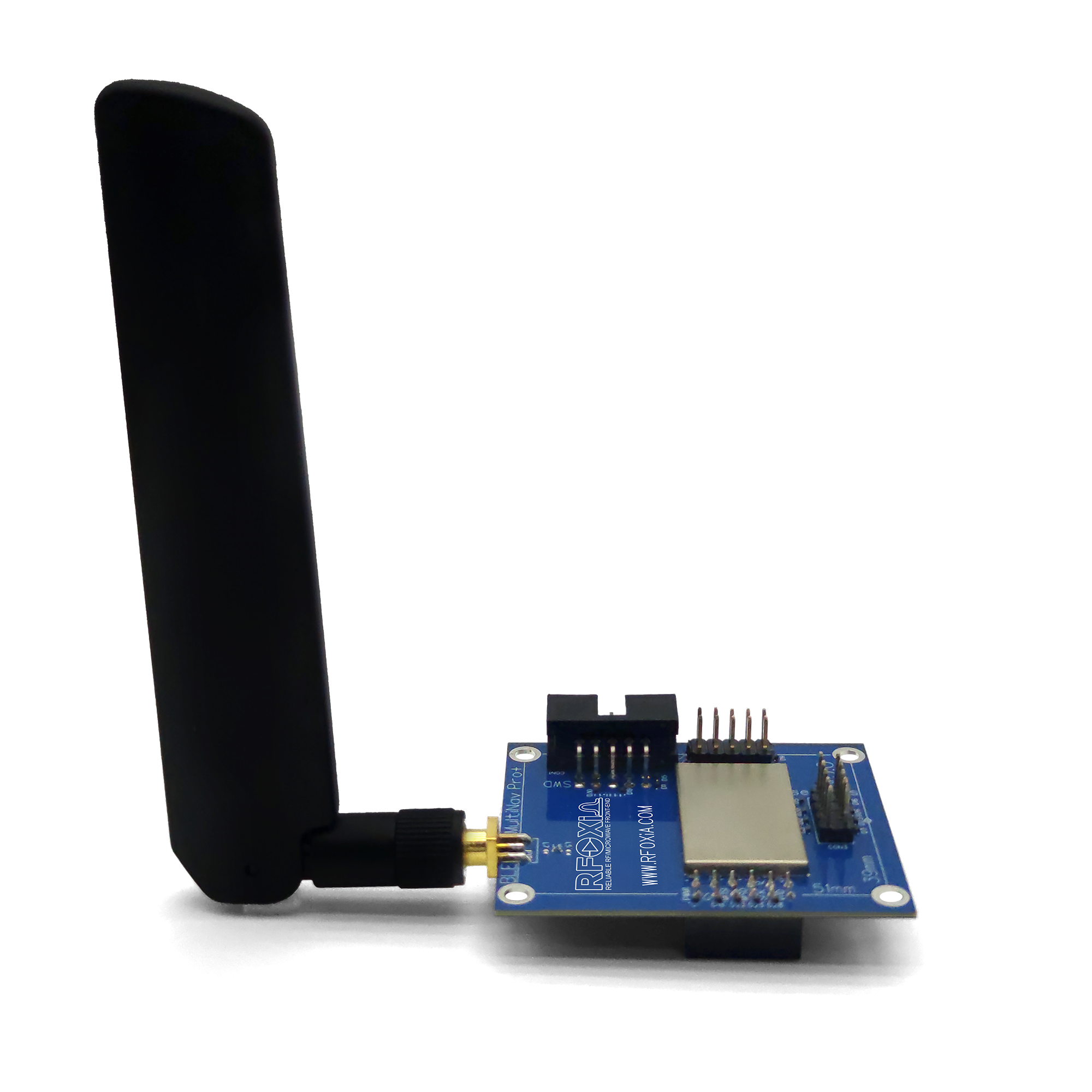
Antenna gain directly translates to effective radiated power. A high-gain directional or semi-directional antenna focuses the RF energy in the desired direction rather than radiating it uniformly in all directions. The MultiNav Pro+ features an integrated high-gain chip antenna with a 140mm antenna element — optimized for maximum gain within the BLE spectrum.
3. Ultra-Sensitive Receiver Design
Range is a two-way equation. It doesn't matter how powerful your transmitter is if the receiver can't detect the signal at the other end. Advanced receiver design — including low-noise amplifiers (LNAs) and careful RF front-end filtering — pushes receiver sensitivity beyond what standard BLE SoCs achieve. The MultiNav Pro+ is engineered for exceptional receive sensitivity, meaning it can detect signals that would be completely invisible to a standard module.
4. Elevation and Line-of-Sight
This is the physics variable that no amount of engineering can fully overcome on the ground. The reason how to achieve 20km Bluetooth range becomes dramatically more achievable when one or both nodes are elevated: ground reflections, terrain, vegetation, and the curvature of the Earth all attenuate radio signals. Move one node onto a drone at altitude and you eliminate the vast majority of those obstacles.
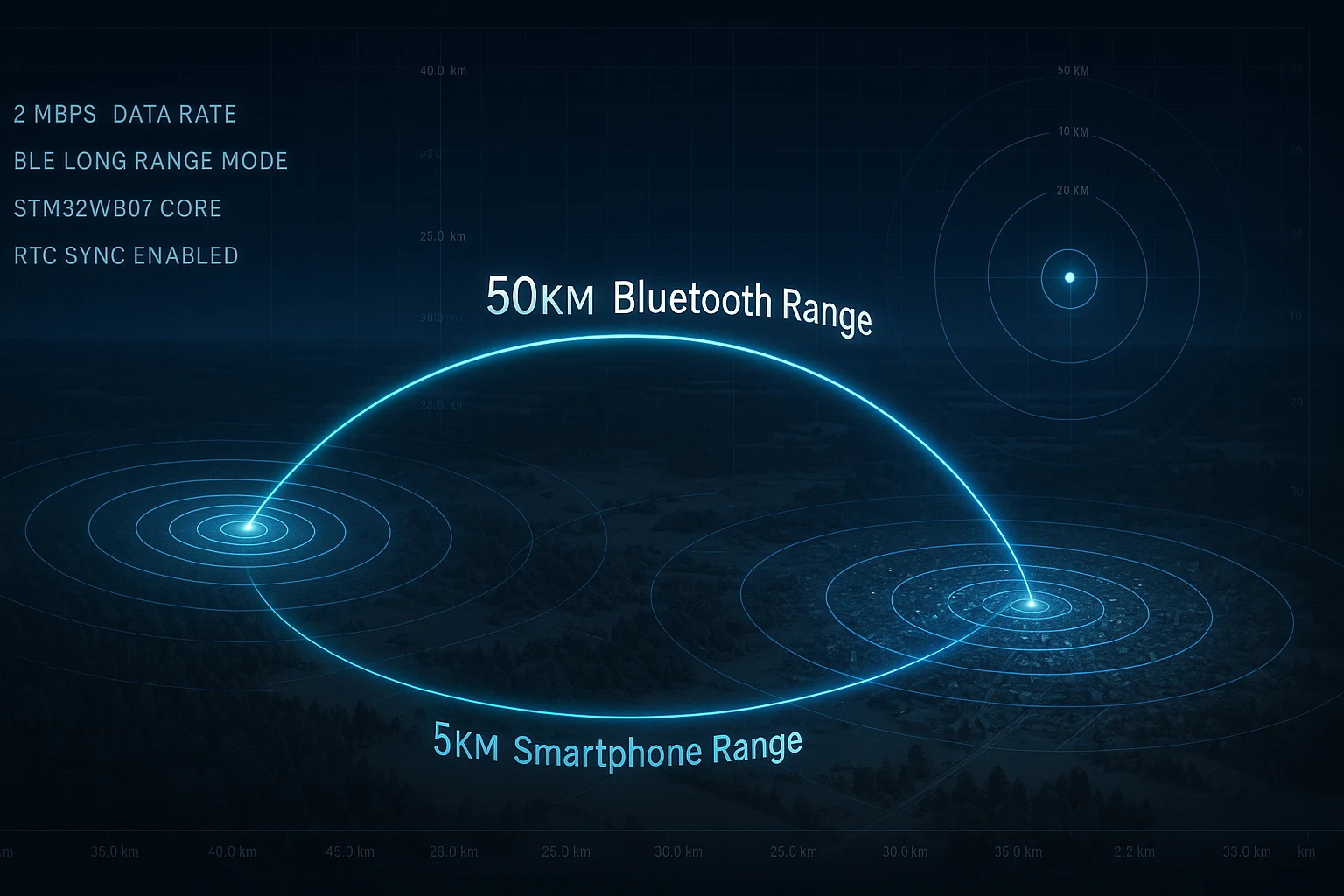
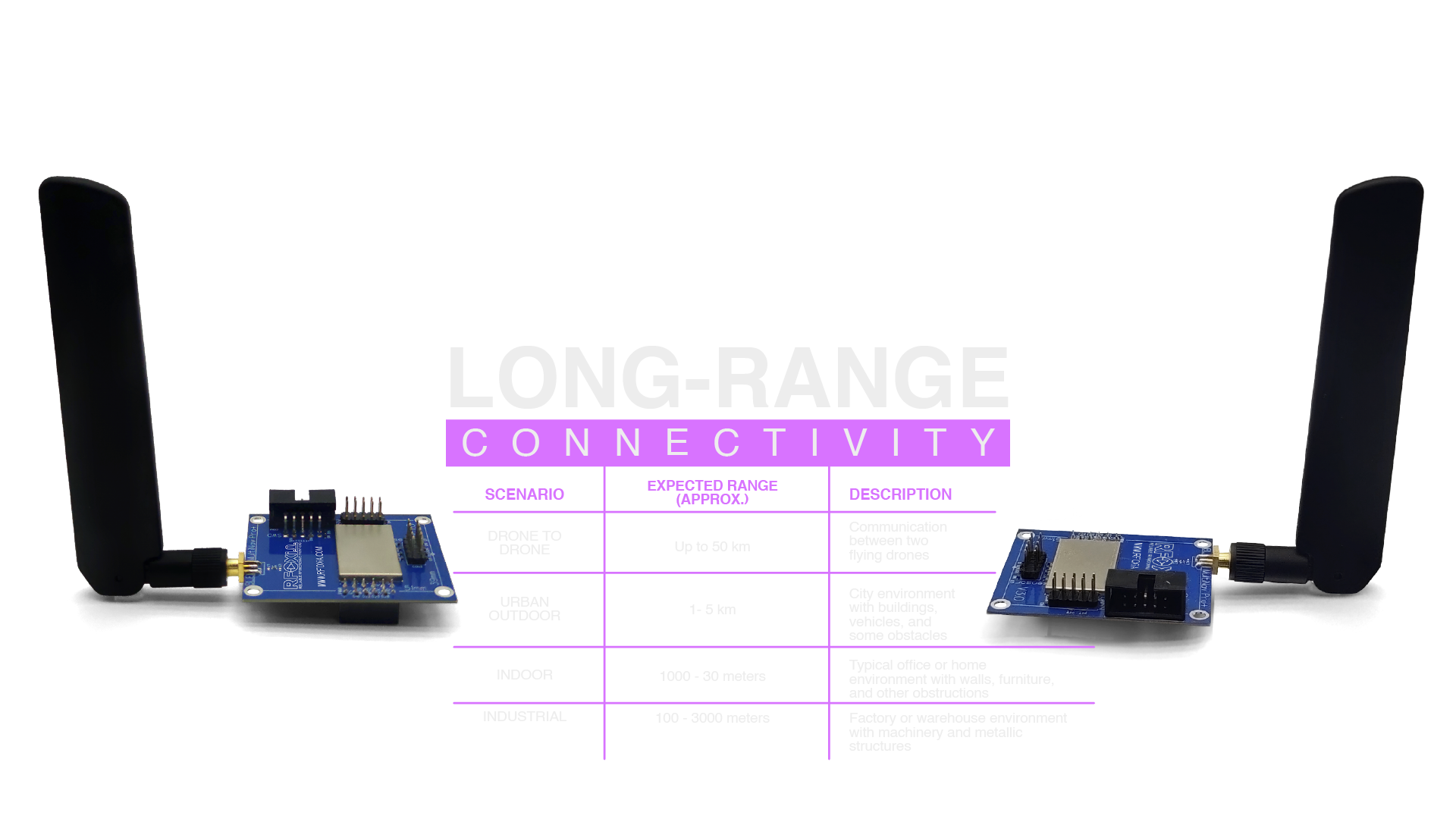
This is why the MultiNav Pro+ achieves:
- 5km ground-to-ground (both modules at ground level paired with smartphones)
- 15–20km man-to-drone (one module on the ground, one on a drone)
- 50km drone-to-drone (both modules airborne, ground reflections eliminated)
The MultiNav Pro+ BLE Module: Purpose-Built for Long-Range Applications
The RFOXiA MultiNav Pro+ BLE Module is the only commercially available, FCC-certified BLE module that solves the 20km range problem at a price accessible to individual developers. At $59 for two units, it delivers performance that previously required military-grade hardware costing $5,000 or more.
Here is what makes it technically unique.
Processing Core: STM32WB07CCV6
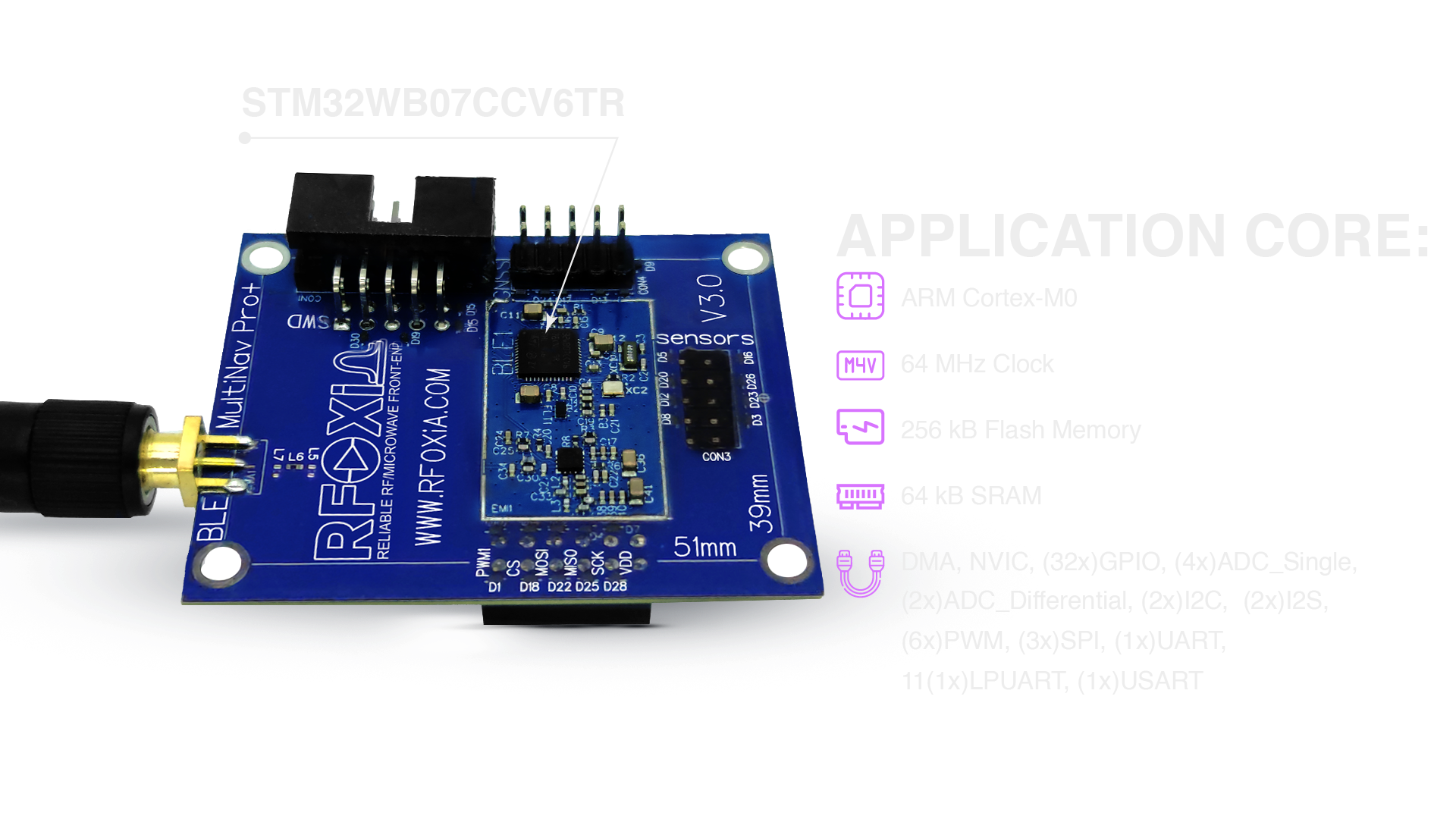
At the heart of the MultiNav Pro+ is the STM32WB07CCV6 from STMicroelectronics. This dual-core wireless SoC handles the complete BLE protocol stack on one core while leaving the second core available for your application logic. The result is a module that doesn't sacrifice application performance to manage radio communications — both operate independently and simultaneously.
The STM32WB07 series is engineered for demanding wireless applications, with:
- Ultra-low power modes for battery-sensitive deployments
- Full BLE 5.4 protocol support
- Hardware encryption for secure communications
- Flexible I/O configuration for peripheral integration
2 Mbps Data Rate: High-Speed Wireless Without Compromise
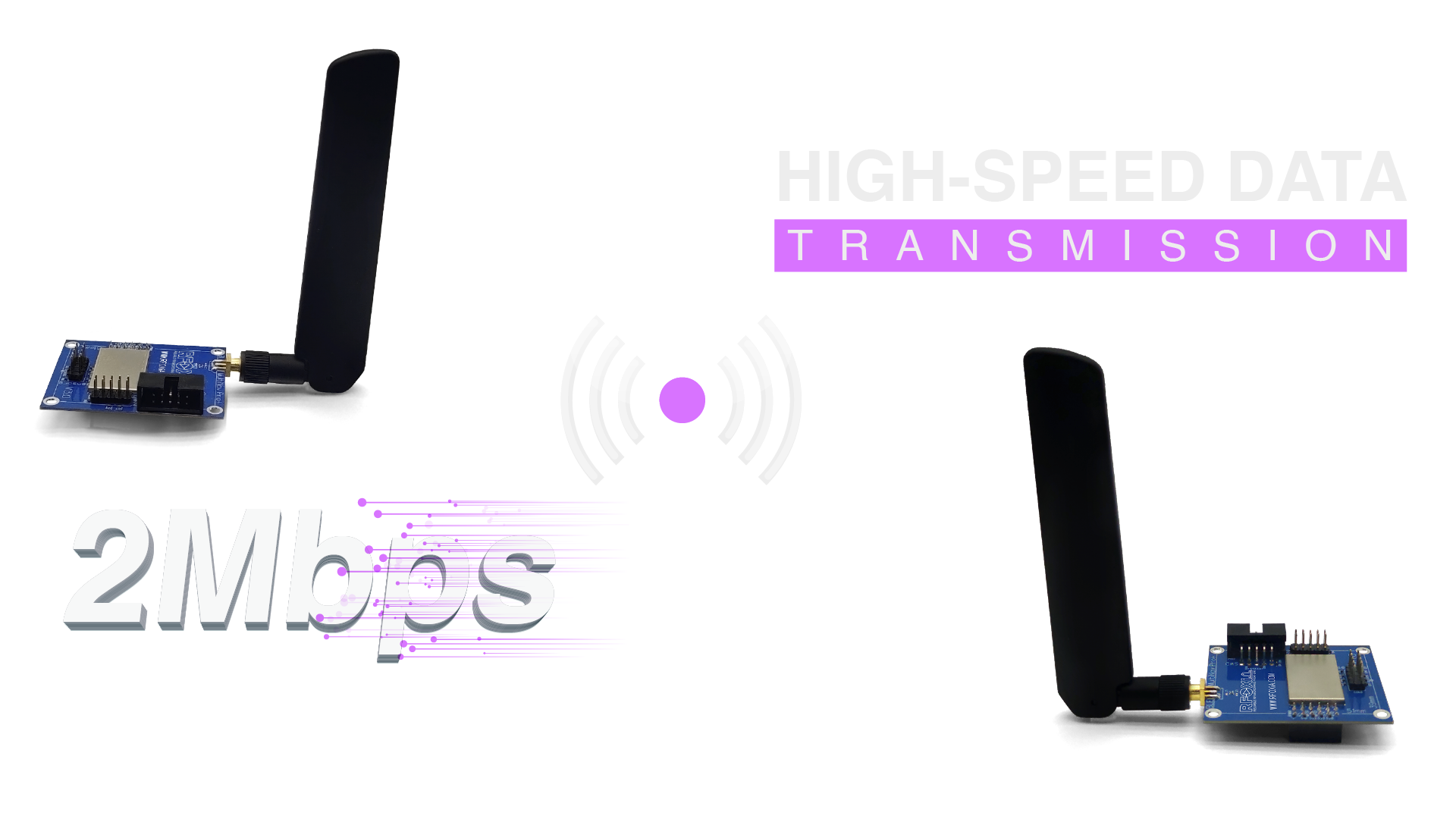
Unlike LoRa-based systems that achieve long range by sacrificing data throughput (often operating at just a few kilobits per second), the MultiNav Pro+ BLE Module maintains 2 Mbps data rate across its full range. This is not a theoretical specification — it's the operating mode used for drone control, sensor streaming, and real-time telemetry.
2 Mbps means:
- Real-time control commands for drones and robots with sub-millisecond latency
- High-resolution sensor data streaming from remote deployments
- Audio and voice data over the BLE Chat functionality
- Firmware updates over-the-air to remote modules
For applications where both range AND throughput matter, the MultiNav Pro+ BLE is in a class entirely its own.
Seamless Ecosystem Integration
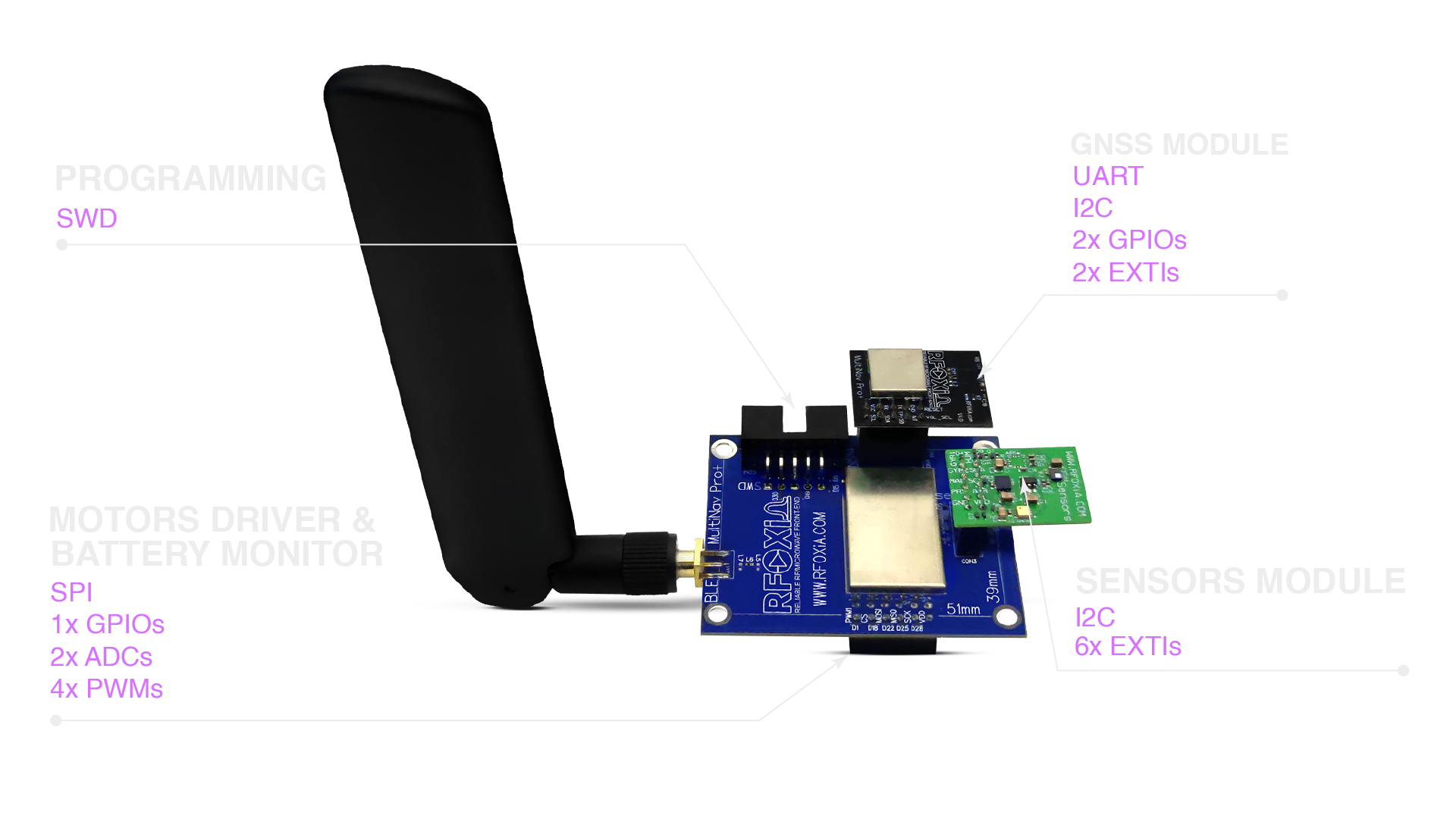
The MultiNav Pro+ BLE Module does not exist in isolation. It is the wireless backbone of the RFOXiA hardware ecosystem, designed to interface directly with:
- MultiNav Pro+ GNSS Module — 1.5-meter accuracy GPS at 18Hz fix rate for high-speed drone tracking
- MultiNav Pro+ Sensors Module — temperature, humidity, air pressure, air quality, accelerometer, gyroscope, and magnetometer in one board
- Power/Program Kit — supercapacitor-based power management with 5-minute charge time and 24-hour runtime
All four modules connect through standardized interfaces, creating a unified platform for autonomous systems, field research stations, and professional IoT deployments — without custom integration work.
RFOXiA Connect App: Control at 20km
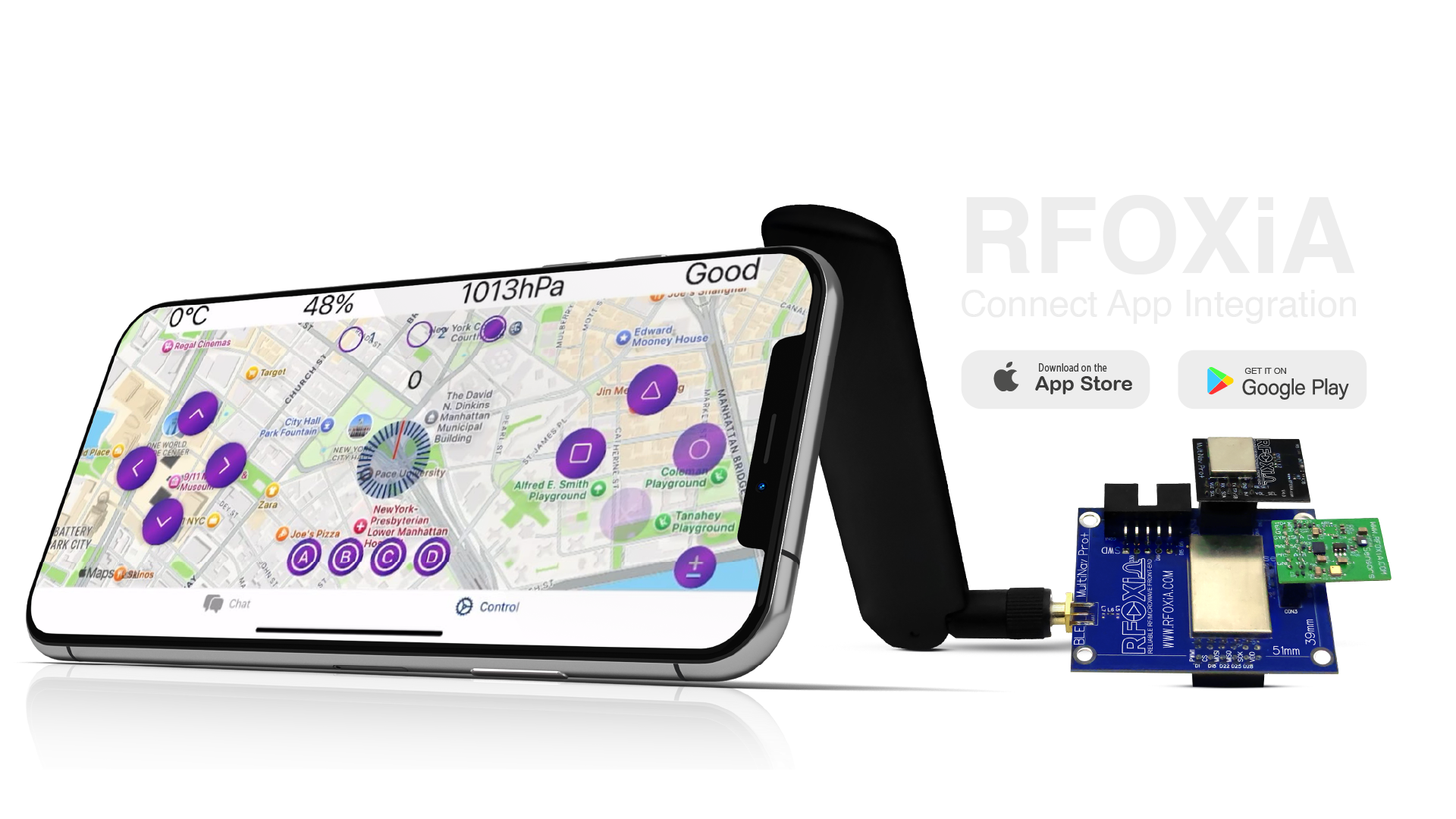
Knowing how to achieve 20km Bluetooth range is only half the equation. You also need a control interface that actually works at those distances without requiring a laptop, a custom radio controller, or proprietary ground station software.
The RFOXiA Connect App (iOS and Android) pairs directly with the MultiNav Pro+ BLE Module via Bluetooth and provides:
- PS5-style controller interface for intuitive drone and robot control
- Live map with real-time GPS tracking — see your asset's position update at 18Hz
- Live sensor data display — temperature, humidity, pressure, air quality from the field
- Automation center — define automated behaviors and responses
- Zero internet dependency — the entire control system works without cellular or WiFi connectivity
Your smartphone becomes a professional ground station. Your drone can fly 20km away. The app keeps working the entire time.
BLE Chat: Internet-Independent Mesh Communication
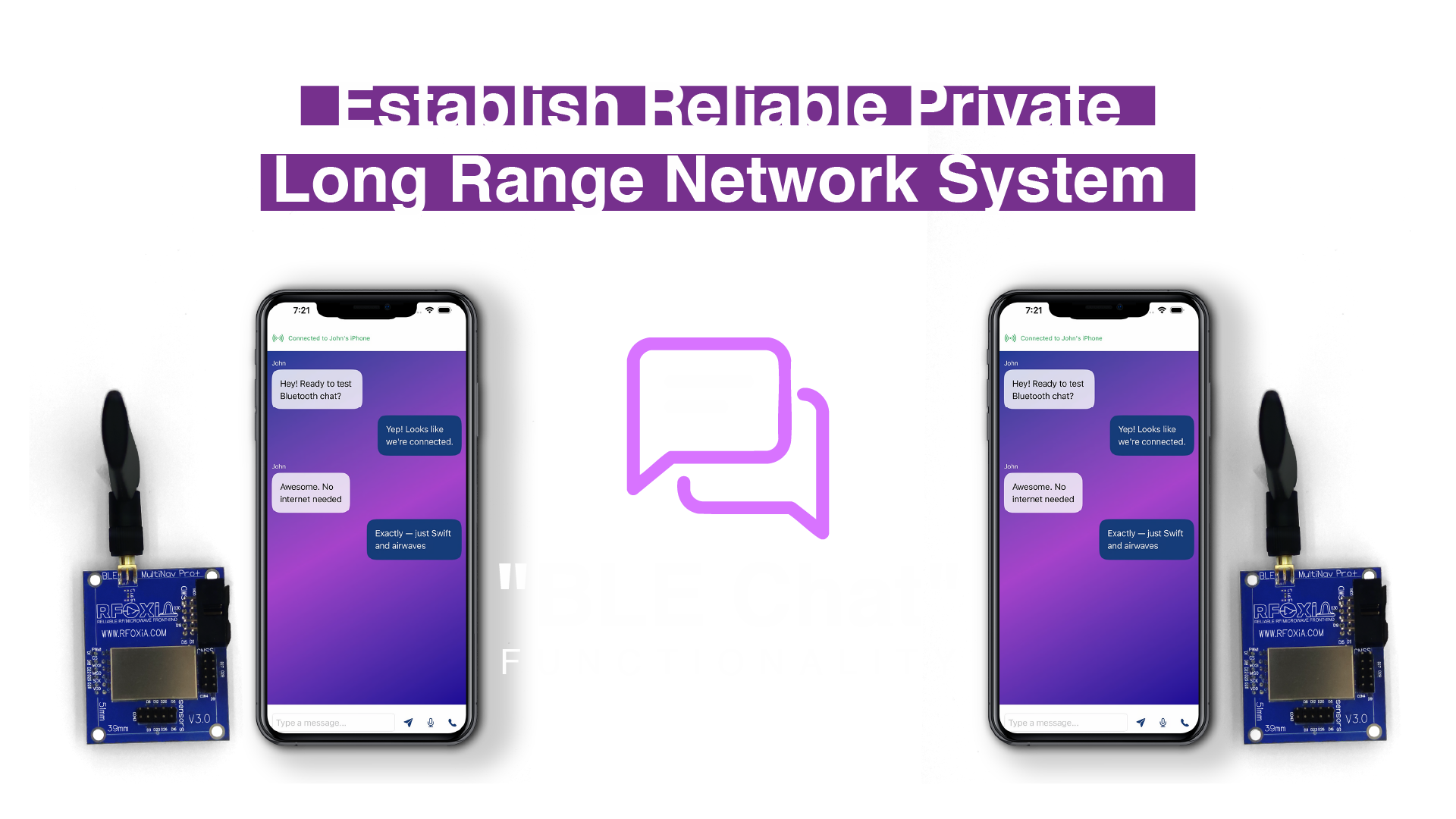
One of the most distinctive capabilities of the MultiNav Pro+ BLE ecosystem is BLE Chat — a completely internet-independent communication system that uses the BLE modules themselves as communication nodes.
Applications where this matters:
- Disaster response operations where cellular infrastructure is down
- Remote wilderness expeditions beyond cellular coverage
- Search and rescue teams operating in communication-dead zones
- Industrial facilities where RF interference makes cellular unreliable
- Offshore and maritime operations where internet connectivity is unavailable or expensive
BLE Chat supports text, data, and voice communication between any number of MultiNav Pro+ BLE users within range. No SIM card. No subscription. No infrastructure. Just the modules.
Compact and Field-Ready Design
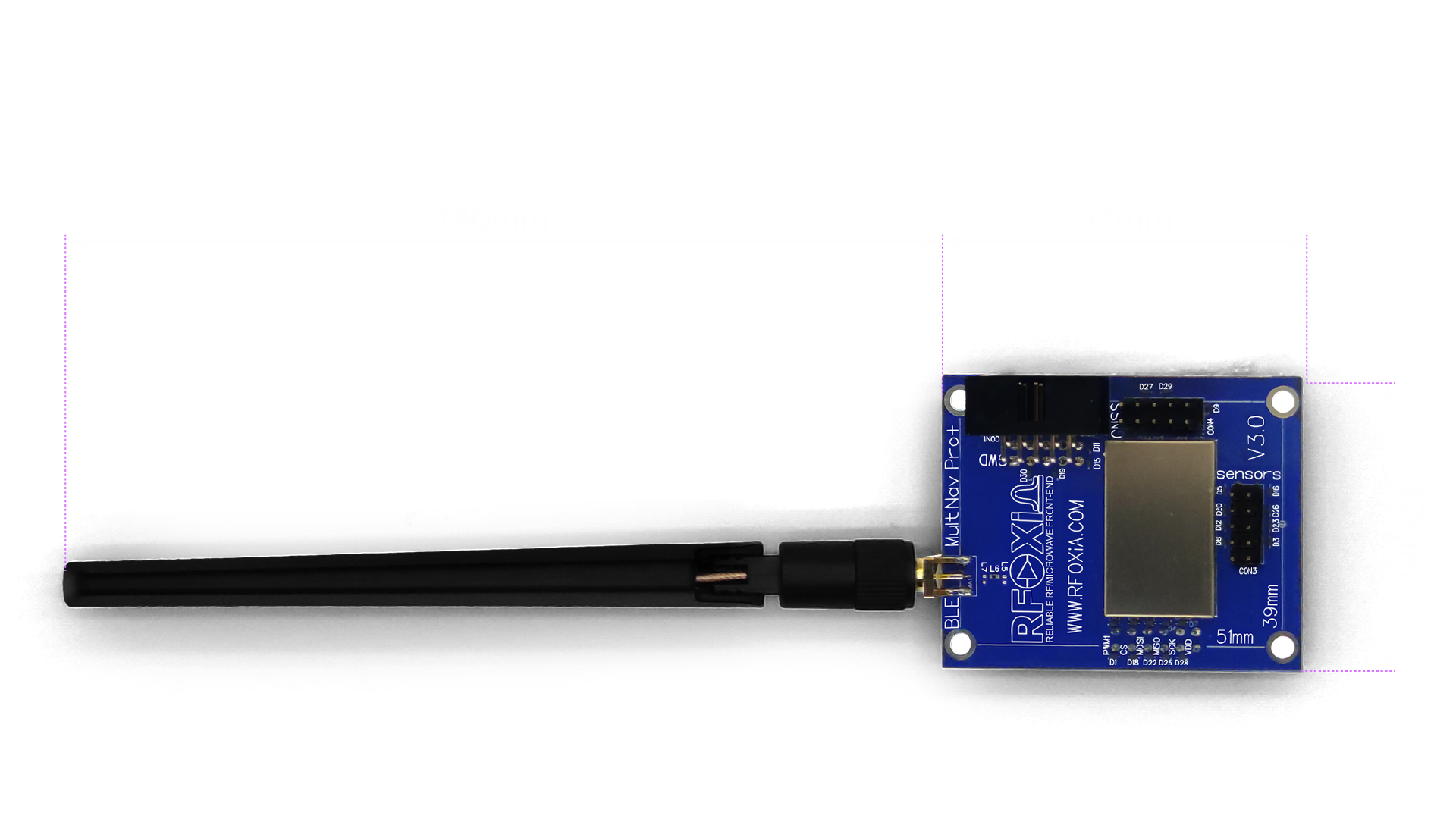
Delivering 20km Bluetooth range in a module that actually fits on a drone or inside a field device requires exceptional engineering discipline. The MultiNav Pro+ BLE Module measures 57mm × 47mm with a fixing frame size of 54mm × 34mm featuring corner mounting holes for secure mechanical integration.
The 140mm high-gain antenna is optimized for maximum RF performance within the BLE band while remaining practical for drone mounting. The robust PCB construction handles the vibration, temperature extremes, and mechanical stress of real-world deployment.
At this size, weight, and form factor, the MultiNav Pro+ integrates cleanly onto most commercial drone frames, robot platforms, and field enclosures.
Open Source and Fully Programmable
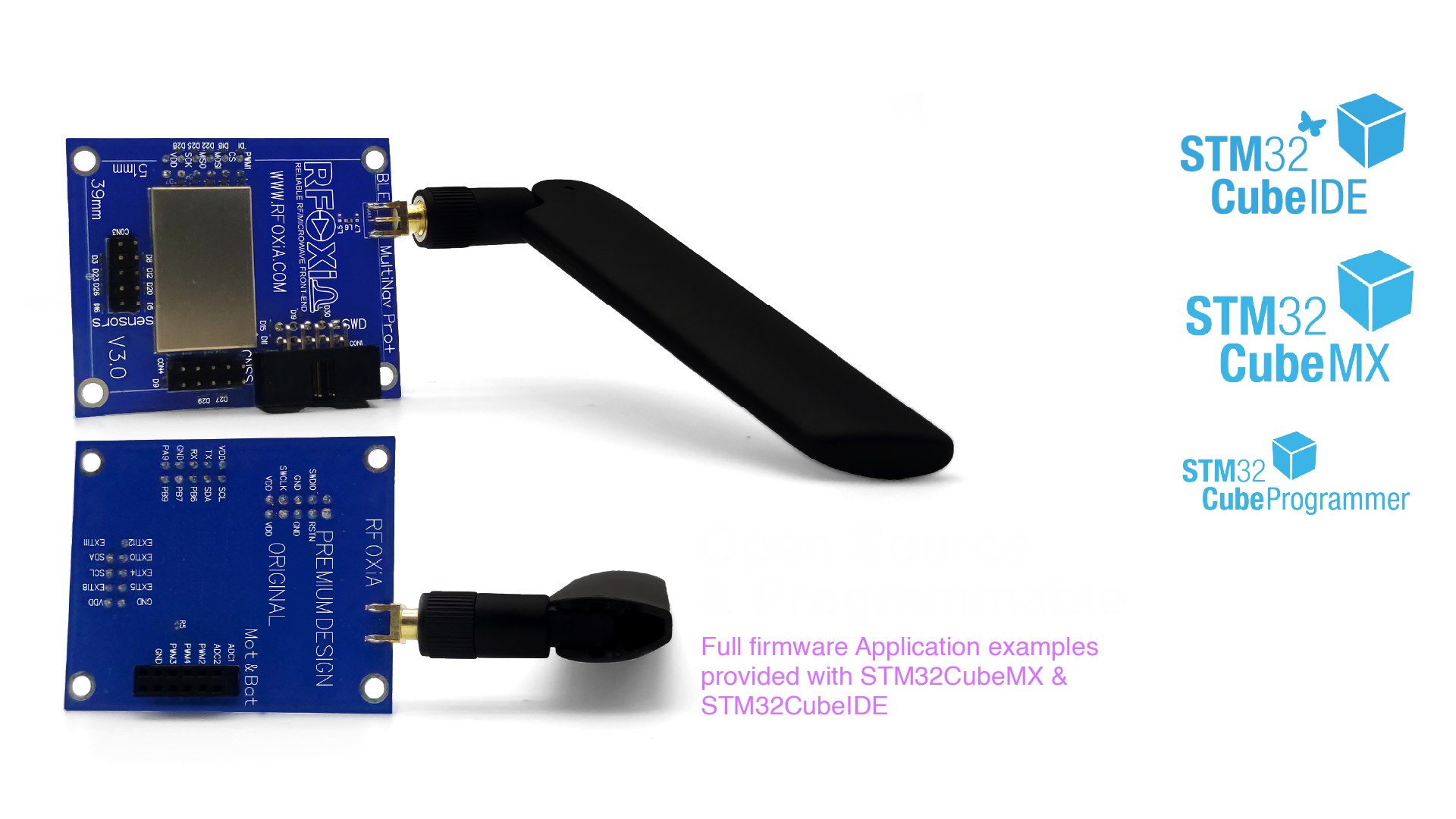
RFOXiA believes that professional hardware should be fully transparent and customizable. The complete firmware source code for the MultiNav Pro+ BLE Module is available on GitHub at github.com/RFOXiA/MultiNav-Pro-Long-Range-BLE-Module-Firmware-STM32WB07.
Programming is done via SWD (Serial Wire Debug) interface — the same professional programming interface used in production firmware development. The Power/Program Kit integrates an STLink programmer interface directly, eliminating the need for separate programming hardware.
For developers who want to build custom applications without writing firmware from scratch, the RFOXiA Club AI Firmware Builder lets you describe your application in plain language and generates production-ready firmware code — reducing development time from months to hours.
Integrated Accurate RTC
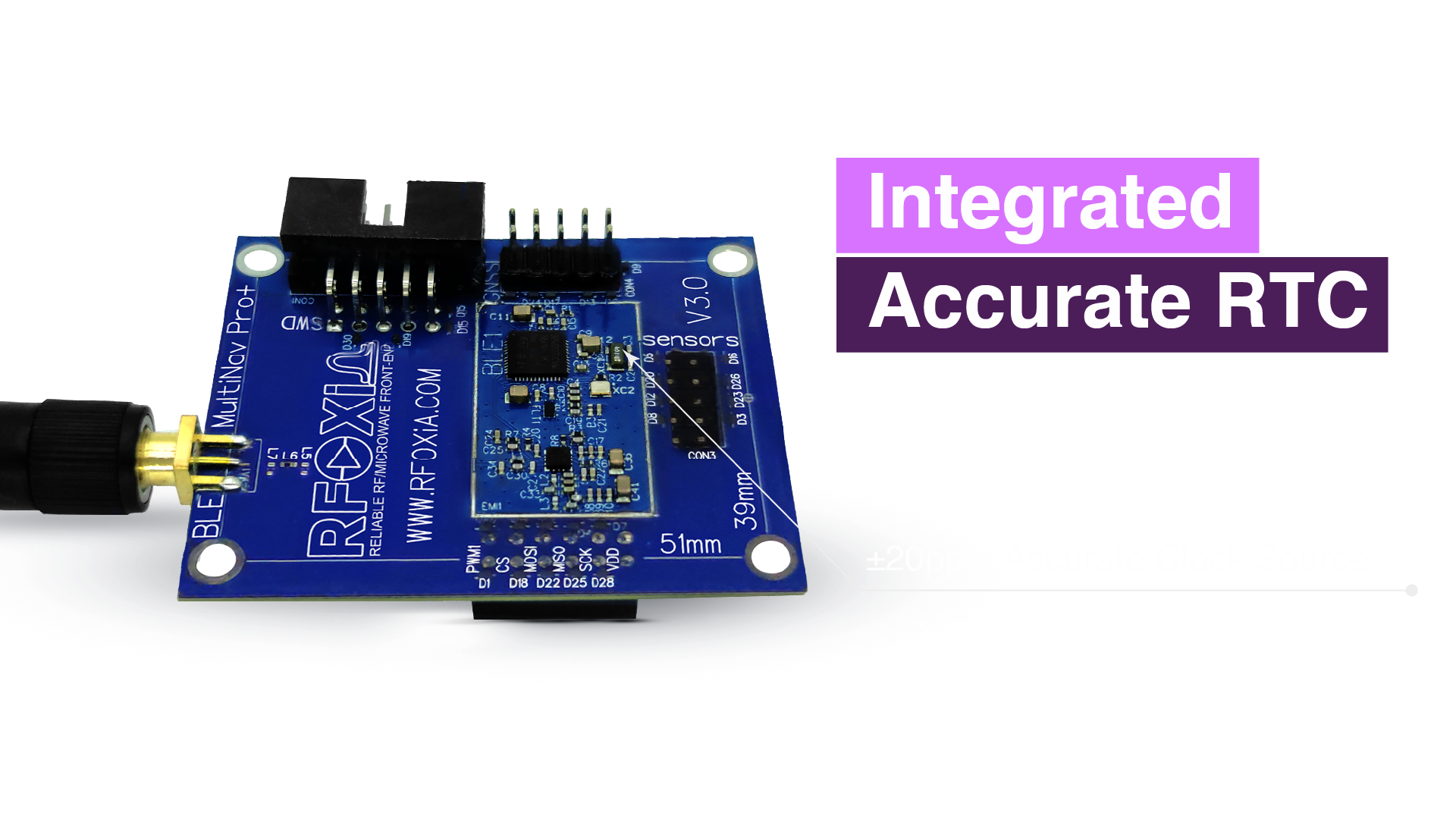
For navigation systems, data logging applications, and any deployment where timing synchronization matters, the MultiNav Pro+ BLE Module includes an integrated RTC crystal providing precise real-time clock functionality.
This matters in practice for:
- Time-stamped sensor data in research and monitoring applications
- Synchronized multi-node deployments where multiple modules must operate in coordinated timing
- Navigation system integration where time accuracy feeds into position calculations
- Low-power scheduling — the RTC enables the module to wake on precise intervals for power-efficient operation in long-term deployments
Technical Specifications Summary
| Specification | Value |
|---|---|
| Ground-to-ground range | 5km |
| Man-to-drone range | 15–20km |
| Drone-to-drone range | 50km |
| Data rate | 2 Mbps |
| Processing core | STM32WB07CCV6 |
| Module dimensions | 57mm × 47mm |
| Antenna length | 140mm |
| Fixing frame | 54mm × 34mm |
| Certification | FCC certified |
| Price (2 units) | $59 |
| Open source | Full firmware access via GitHub |
| App compatibility | iOS and Android |
Who Needs to Know How to Achieve 20km Bluetooth Range?
The practical applications for 20km Bluetooth range are broader than most developers initially realize:
Drone builders and FPV pilots gain a control and telemetry link that operates far beyond visual line of sight with no additional radio hardware.
Field robotics engineers can deploy autonomous ground vehicles into large-scale environments — mines, agricultural fields, construction sites — with reliable, high-data-rate communications.
IoT deployment specialists can create private wireless networks across industrial facilities, agricultural operations, or smart city infrastructure without cellular subscriptions or LoRa gateway hardware.
Research institutions conducting environmental monitoring, wildlife tracking, or atmospheric sensing can deploy distributed sensor networks with real communications range.
Emergency response teams gain a communication backbone that operates when every other infrastructure has failed.
Search and rescue operators can maintain team coordination and sensor data sharing across terrain that defeats cellular and satellite systems alike.
For every one of these use cases, the answer to how to achieve 20km Bluetooth range is the same: the MultiNav Pro+ BLE Module from RFOXiA.
Why No Competitor Solves This Problem
The market gap here is not a small one. It is a fundamental gap between:
- Commodity BLE modules ($5–15, 80–100m range, no ecosystem, no app, no FCC certification for professional use)
- Military and industrial long-range radio systems ($5,000–50,000+, 150km+ range, not accessible to individual developers)
The MultiNav Pro+ BLE Module sits exactly in the middle — delivering professional-grade range and data performance at a price that any serious developer can justify. No other product on the market today is FCC certified, ships in quantity, costs $59 for two units, and achieves 20km Bluetooth range between a smartphone and a drone.
That is not a marketing claim. It is a specification derived from RF engineering fundamentals, verified in real-world testing, and backed by FCC certification.
Start Building at 20km Range Today
If you've been searching for how to achieve 20km Bluetooth range for your drone, robot, IoT deployment, or research project — the engineering answer exists, and it ships today.
The RFOXiA MultiNav Pro+ Long Range Bluetooth Module is in stock, FCC certified, fully open source, and supported by a complete ecosystem of matching hardware modules, a professional control app, and an AI firmware development platform.
Two modules. $59. 20km range between you and your drone.
Visit rfoxia.com/premium-ble-module/ to order, or join the RFOXiA Club for free to access documentation, firmware examples, the AI Firmware Builder, and a $10 welcome credit toward your first purchase.
The technology to build wireless systems that actually reach — without military budgets or cellular infrastructure — is here. The only question is what you'll build with it.
Written by: Moamen Mohamed LinkedIn