
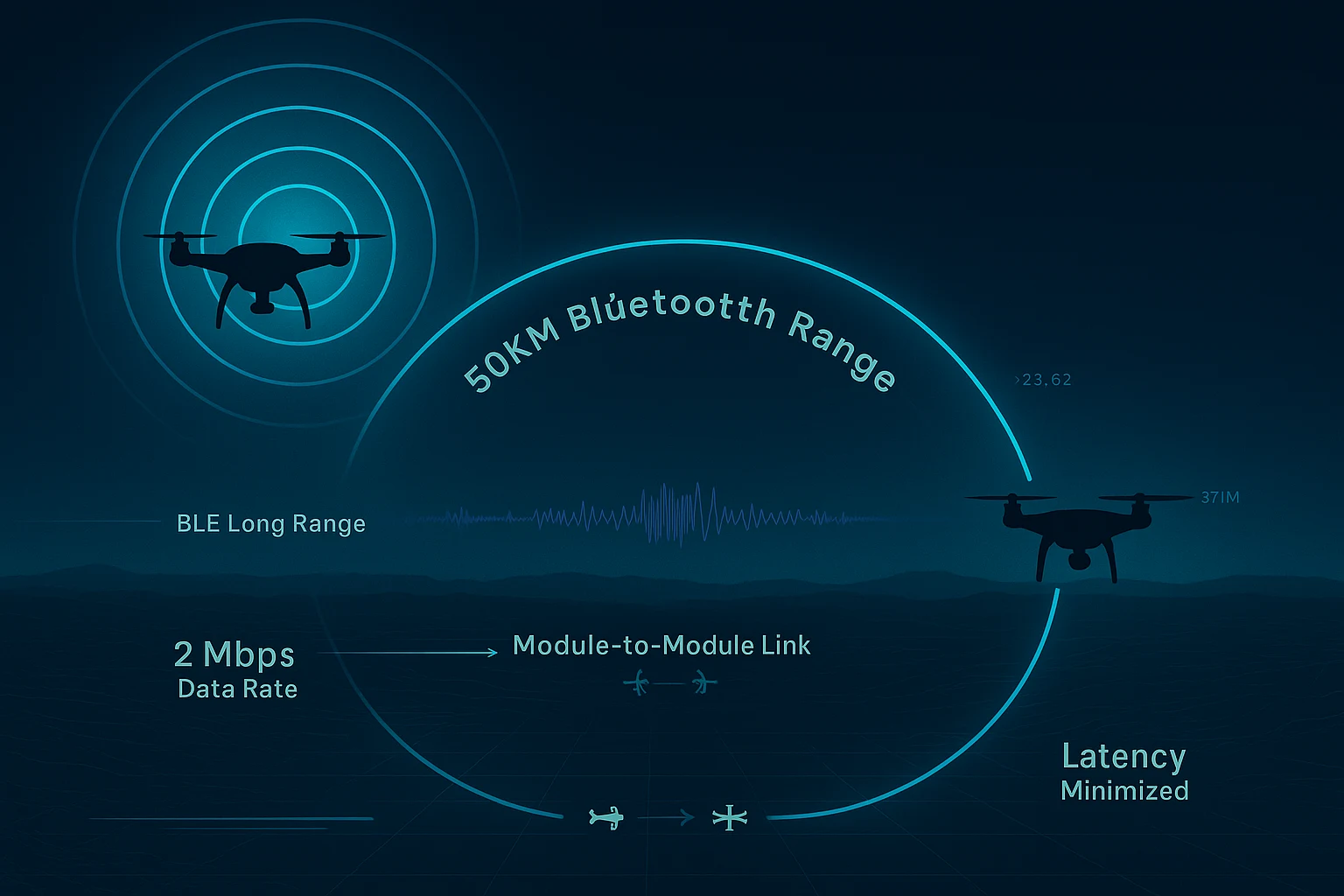
How to Extend Drone Bluetooth Range: The Complete 2025 Guide
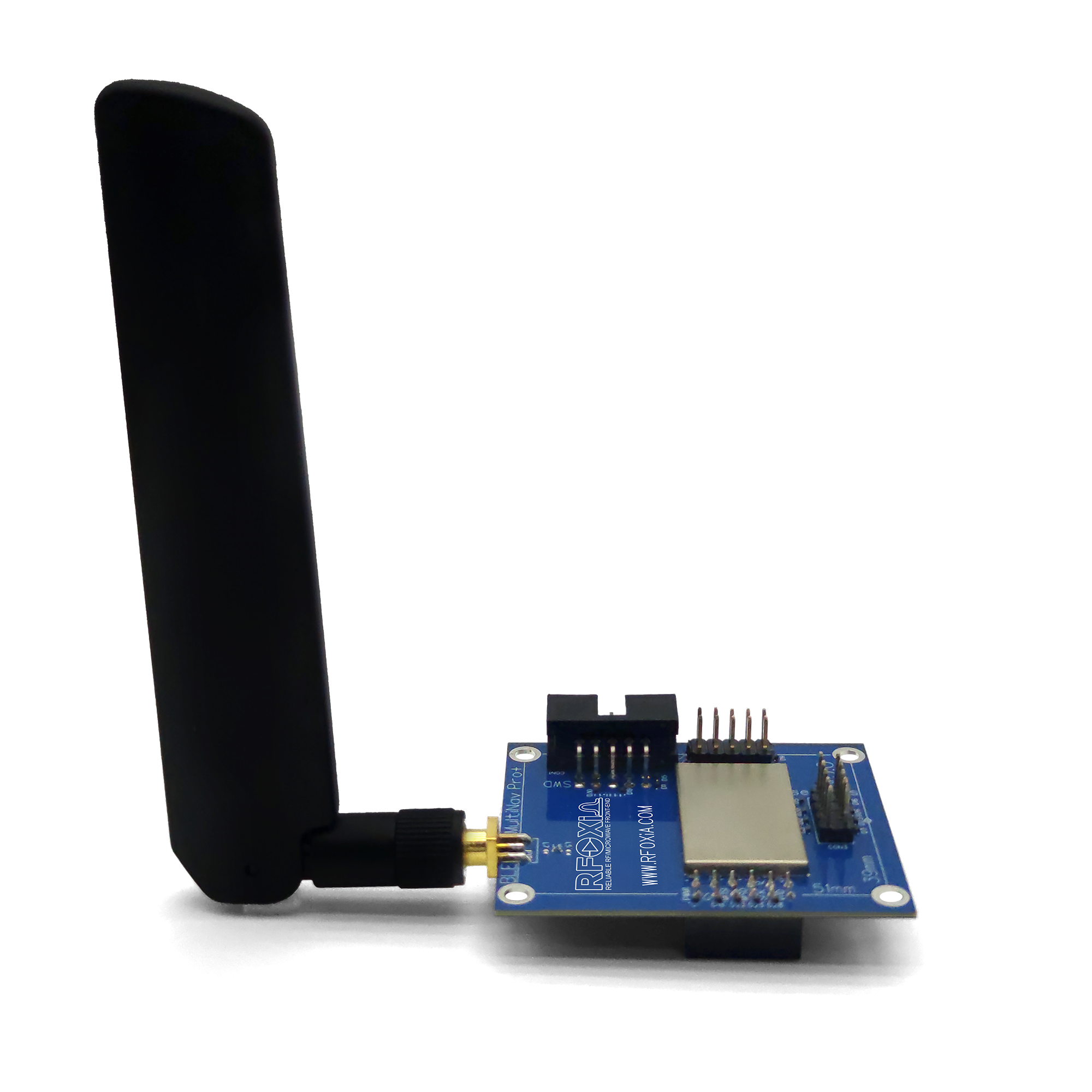
RFOXiA Long Range Bluetooth Module
How to Extend Drone Bluetooth Range Beyond 50KM — What's Actually Possible Today
If you've ever lost connection mid-flight, watched your FPV feed freeze at 80 meters, or had a drone drift because your Bluetooth link dropped, you already know the problem. Standard Bluetooth was never designed for the demands of drone control. It was built for earbuds, speakers, and keyboards — not for aircraft flying hundreds of meters overhead at speed.
But here's what most builders don't know: the limitation isn't Bluetooth itself. It's the hardware implementing it.
This guide breaks down exactly why standard Bluetooth fails at range, what the physics actually allow, and how hardware innovation has pushed practical drone Bluetooth range from 100 meters to over 50 kilometers. By the end, you'll understand precisely how to extend drone Bluetooth range in your own builds — and what hardware makes it possible today.
Why Standard Bluetooth Fails Drones
Stock Bluetooth Low Energy (BLE) modules — the kind found in commodity dev boards, breakout modules, and most commercial electronics — are engineered for power efficiency at short range. The typical performance envelope looks like this:
- Indoor range: 10–30 meters
- Outdoor range: 80–100 meters under ideal conditions
- TX power: 0 to +8 dBm
- Receiver sensitivity: around –95 dBm
- Antenna: tiny PCB trace or ceramic chip, minimal gain
For a wireless mouse, that's perfect. For a drone, it means you lose link before the aircraft clears your rooftop.
The RF link budget equation is straightforward: received signal power equals transmitted power plus antenna gains minus path loss. Standard modules don't invest in TX power amplification, high-sensitivity receivers, or antenna design because those things cost money and consume power — two things that matter when you're making a $5 module for headphones.
Drone applications need something categorically different.
The Physics of How to Extend Drone Bluetooth Range
Understanding range extension starts with the Friis transmission equation. Path loss in free space increases with the square of distance — double the range and you need four times the signal power to compensate. At 1 kilometer versus 100 meters, you're dealing with 10,000 times more path loss.
To overcome this, you can pull on several levers:
1. Transmit Power Amplification
Increasing TX power is the most direct lever. If a standard module outputs +4 dBm, an external PA stage can push this to +20 dBm or higher. Every 6 dB added approximately doubles the range in free space. A well-designed RF front-end with a power amplifier stage can add 10–16 dB of margin immediately.
2. Receiver Sensitivity
Sensitivity is the floor — how weak a signal can the receiver still decode? Professional-grade receiver designs push sensitivity to –100 dBm or lower. Combined with error correction and signal processing algorithms, this recovers range that TX power alone cannot buy.
3. Antenna Design
A high-gain directional antenna can add significant dBi to the link budget. Even a modest omnidirectional high-gain antenna adds 3–5 dBi compared to a PCB trace. For drone applications where orientation matters, careful antenna selection and placement is critical.
4. Ground Reflections and Multipath
Here's where drone-to-drone range dramatically outperforms ground-to-ground range: at altitude, ground reflections — the primary cause of multipath interference — are eliminated. This is why two airborne units achieve far greater range than two ground-based units. It's not a marketing trick; it's physics. A module rated for 5KM ground-to-ground can legitimately achieve 50KM when both units are airborne.
Practical Methods to Extend Drone Bluetooth Range
Method 1: Replace the Module Entirely
The most effective approach. Instead of fighting the limitations of a $5 commodity module, replace it with hardware engineered from the ground up for long-range performance. This is what purpose-built long-range BLE modules do — they integrate RF front-ends, PAs, LNAs, and optimized antenna design onto a single board specifically for applications like drone control.
This is the approach that unlocks true multi-kilometer performance.
Method 2: External Amplifiers on Existing Hardware
For existing builds, adding an external PA/LNA combination to a standard module's antenna output can recover 10–15 dB of link budget. This requires RF knowledge, proper impedance matching, and attention to regulatory compliance. It works, but adds complexity and requires PCB modifications.
Method 3: Antenna Upgrades
Replacing the stock antenna with a higher-gain omnidirectional or directional antenna improves range without modifying the RF chain. Practical gains: 3–6 dB, translating to roughly 1.4–2x range improvement. Not transformative on its own, but useful as part of a larger optimization.
Method 4: Optimize for Line-of-Sight
Bluetooth range degrades dramatically with obstructions. Flying higher — even 20–30 meters AGL — clears most ground clutter and dramatically improves real-world range. Combine elevation with optimized hardware and range numbers become far more achievable.
Method 5: Relay Nodes
For fixed infrastructure deployments (not aerial), mesh relay nodes can extend effective range beyond any single module's capability. Each relay hop introduces latency, so this approach suits data collection more than real-time control.
The MultiNav Pro+ BLE Module: Purpose-Built to Extend Drone Bluetooth Range
RFOXiA's MultiNav Pro+ BLE module was designed around a single mission: eliminate the range ceiling that hobbyist and commodity Bluetooth hardware imposes on serious builders.
The results speak in specifications:
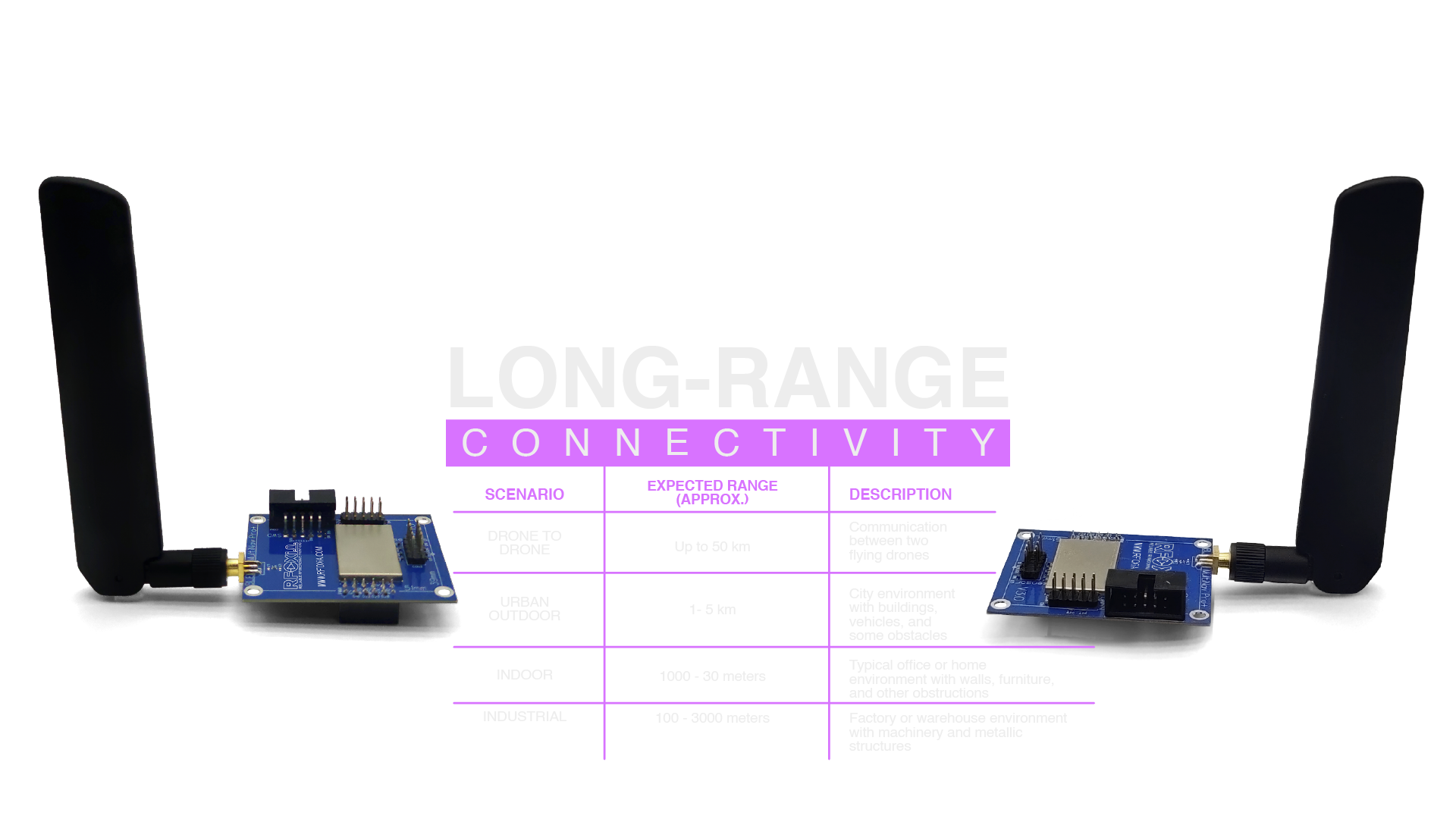
- Ground-to-ground range: 5KM (module paired with smartphone)
- Man-to-drone range: 15–20KM
- Drone-to-drone range: 50KM
- Data rate: 2 Mbps
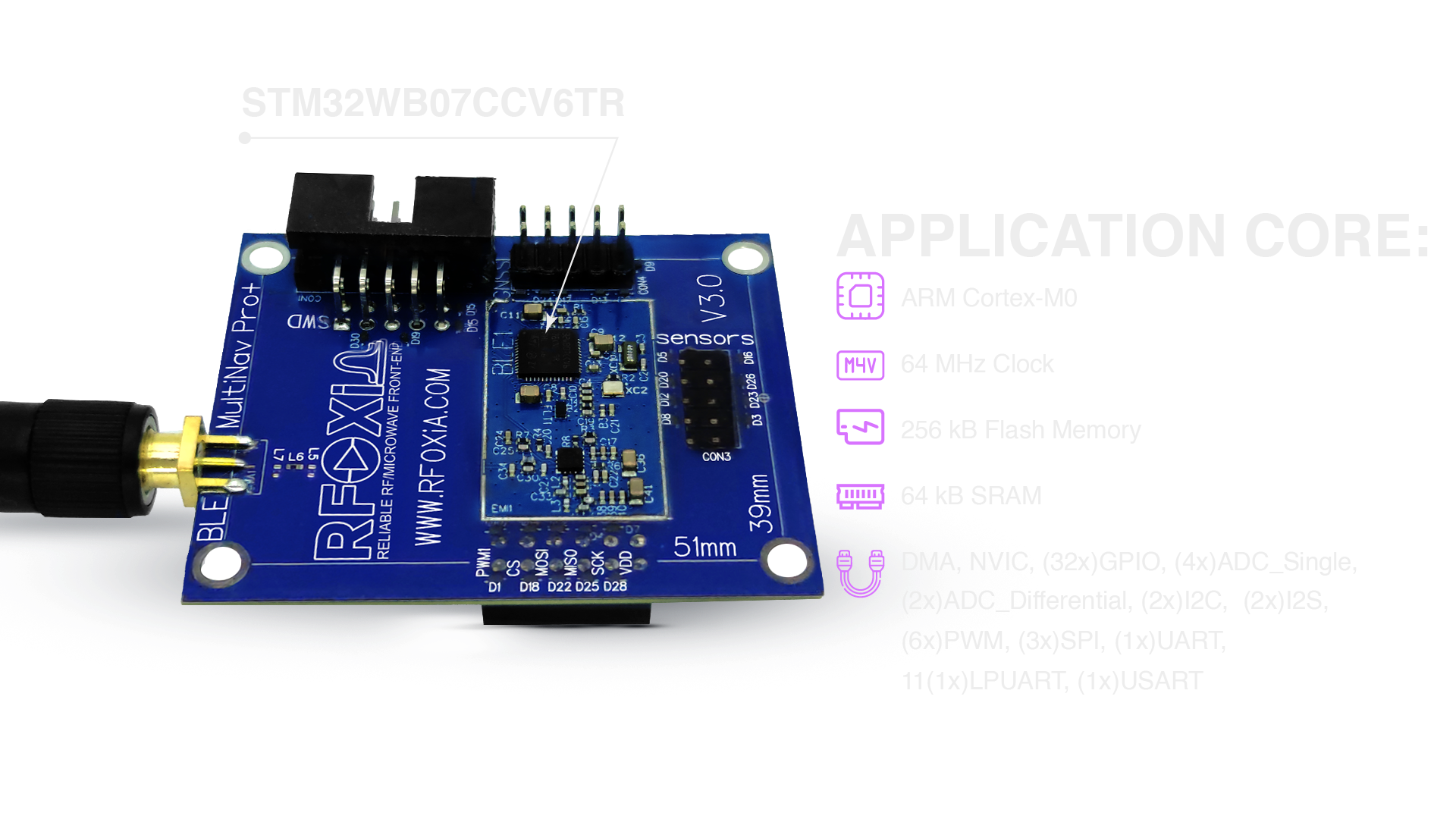
- Processing core: STM32WB07CCV6
- Certification: FCC certified
- Price: $59 for two units
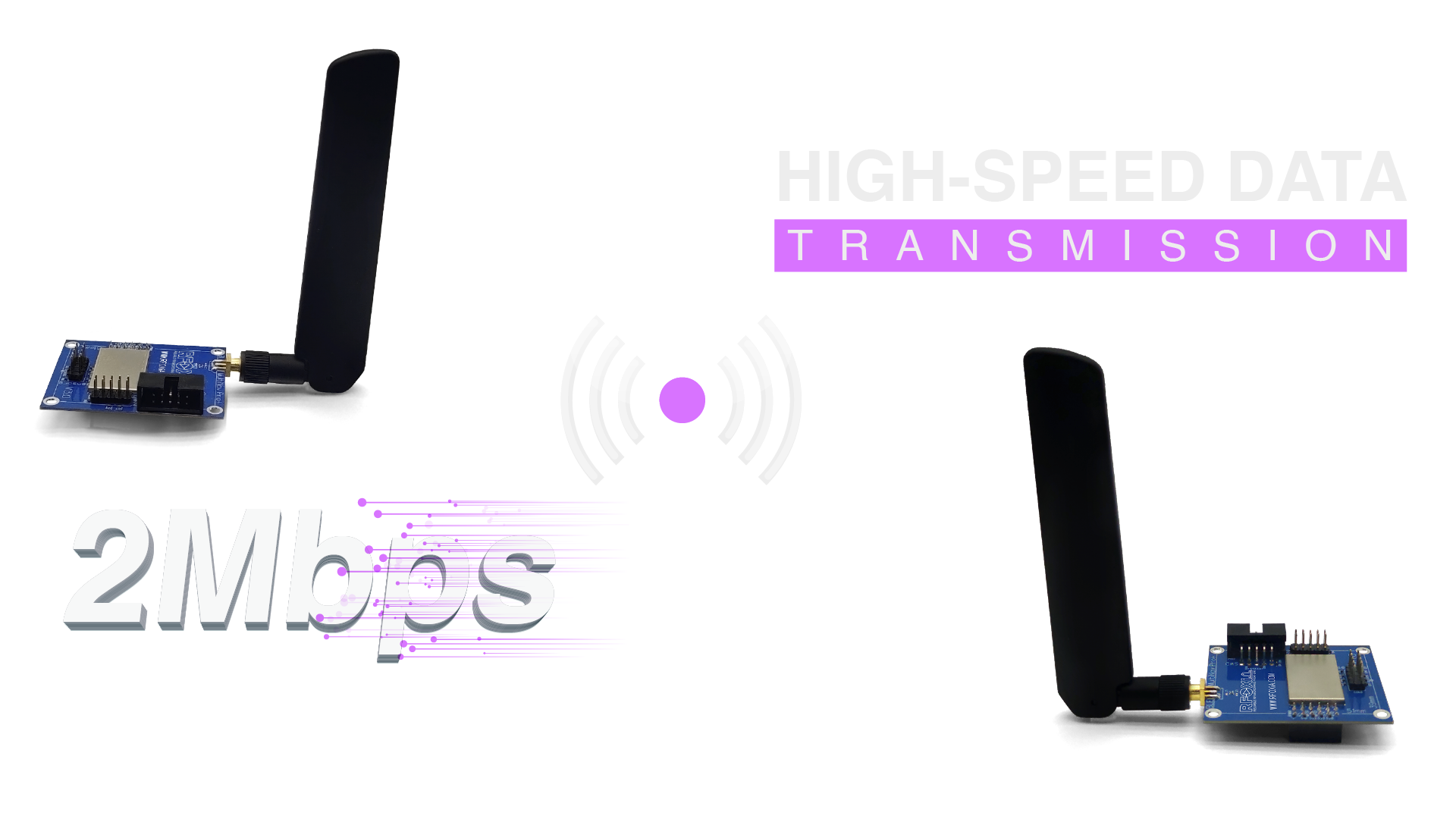
Those range numbers are achieved through a combination of optimized RF front-end design, external amplifier stages, and advanced receiver sensitivity engineering — the same technical levers described above, engineered onto a 57mm × 47mm board that slots directly into drone frames and robotic platforms.
The 2 Mbps data rate is particularly important for drone applications. Real-time control, telemetry streaming, live sensor data, and GPS position updates all compete for bandwidth. At 2 Mbps, the MultiNav Pro+ handles all of these simultaneously without the bottlenecking that plagues slower links.
For builders asking how to extend drone Bluetooth range without building custom RF hardware from scratch, this module is the direct answer.
RFOXiA Long Range Bluetooth Module
The Ecosystem That Makes Long Range Bluetooth Actually Useful
Extending range is only valuable if the software and application layer can take advantage of it. A 50KM link means nothing without a reliable control interface, live telemetry visualization, and a communication protocol that handles the bandwidth intelligently.
The MultiNav Pro+ BLE module is designed as part of a complete wireless development ecosystem, not as an isolated component.
RFOXiA Connect App
The companion mobile application provides the mission control layer that transforms raw RF range into practical drone operations.
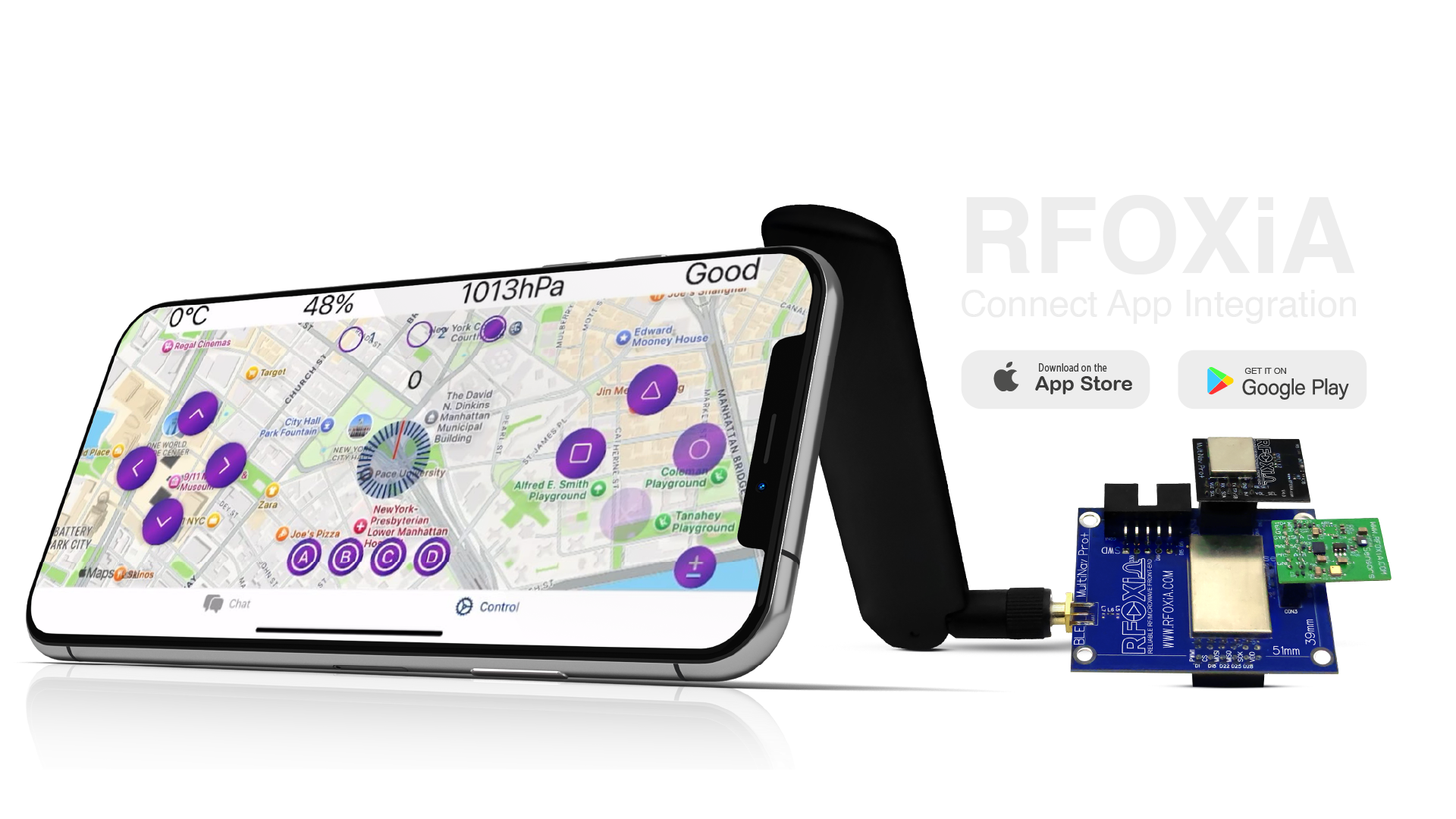
The app features:
- PS5-style controller interface for drone and robot control — familiar layout, zero learning curve
- Live map with real-time GPS tracking — see your aircraft's position updating in real time
- Live sensor data display — environmental telemetry from the Sensors module displayed alongside position
- Automation center — programmable responses and automation triggers
- Zero internet dependency — the entire control stack works completely offline. The range is the link between phone and module, not a connection to any server.
This last point matters enormously in operational contexts. Remote locations, international airspace, signal-limited environments — none of these affect a system that operates entirely peer-to-peer.
BLE Chat: Internet-Independent Communication
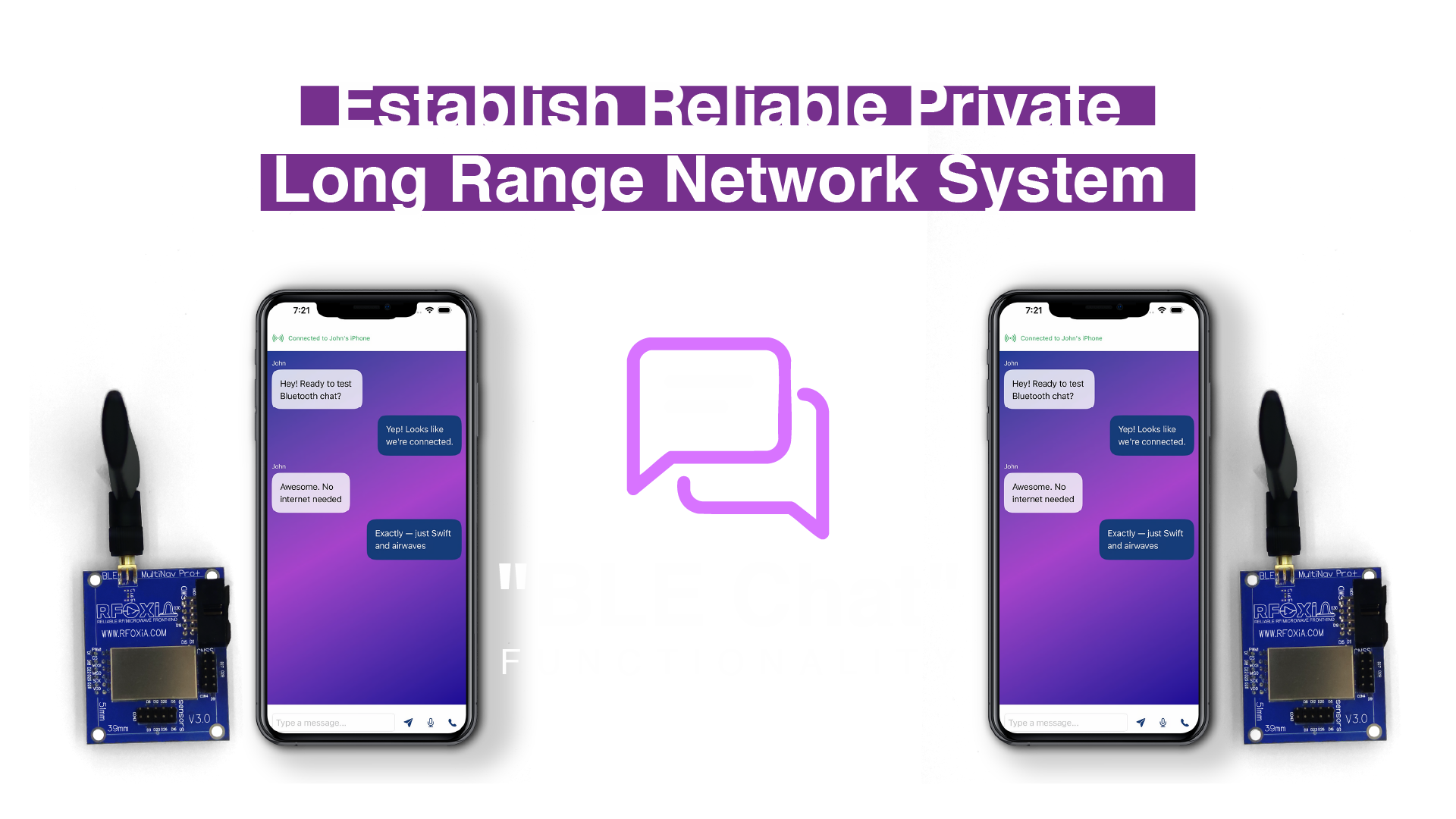
Beyond drone control, the MultiNav Pro+ enables direct device-to-device communication between users — text, data, and voice — without any internet infrastructure. At 50KM drone-to-drone range, this creates a communication mesh capable of covering vast areas entirely independently of cell networks or internet connectivity.
Applications include:
- Field team coordination in remote areas
- Disaster response communication when infrastructure is down
- Search and rescue mesh networks
- Off-grid expedition communication
- Research operations in signal-dead zones
Seamless Hardware Integration
The MultiNav Pro+ BLE module is designed to integrate directly with the rest of the MultiNav Pro+ hardware family — GNSS, Sensors, and Motor/Battery Management modules — creating a unified platform without jumper wire nightmares or incompatible protocols.
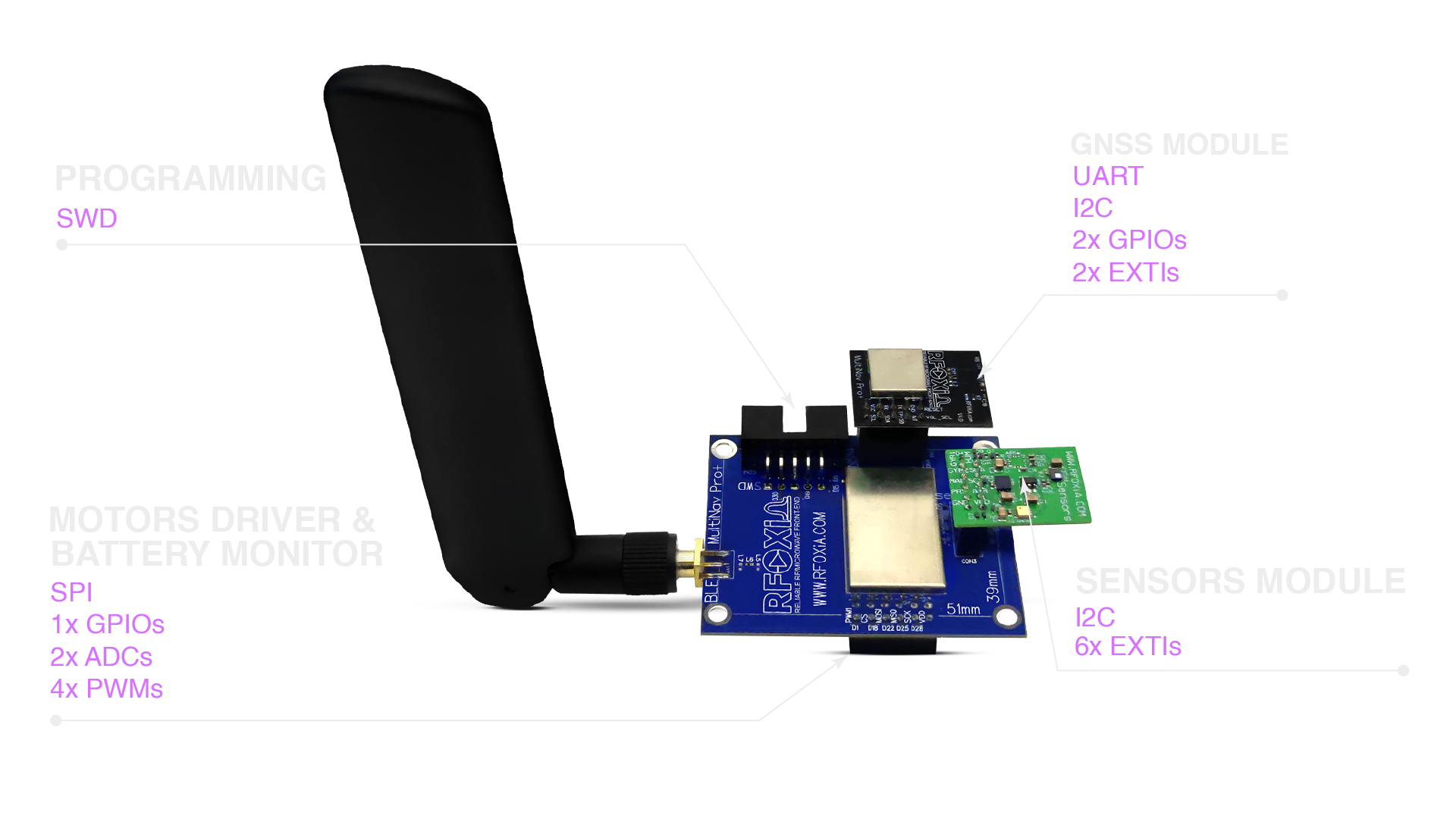
This modularity means builders can start with just the BLE module and expand as projects grow. An FPV pilot might begin with range extension alone. A researcher adds GNSS for precise position logging. An agricultural drone operator adds the Sensors module for environmental monitoring. The platform scales with the application.
Physical Design: Built for Integration
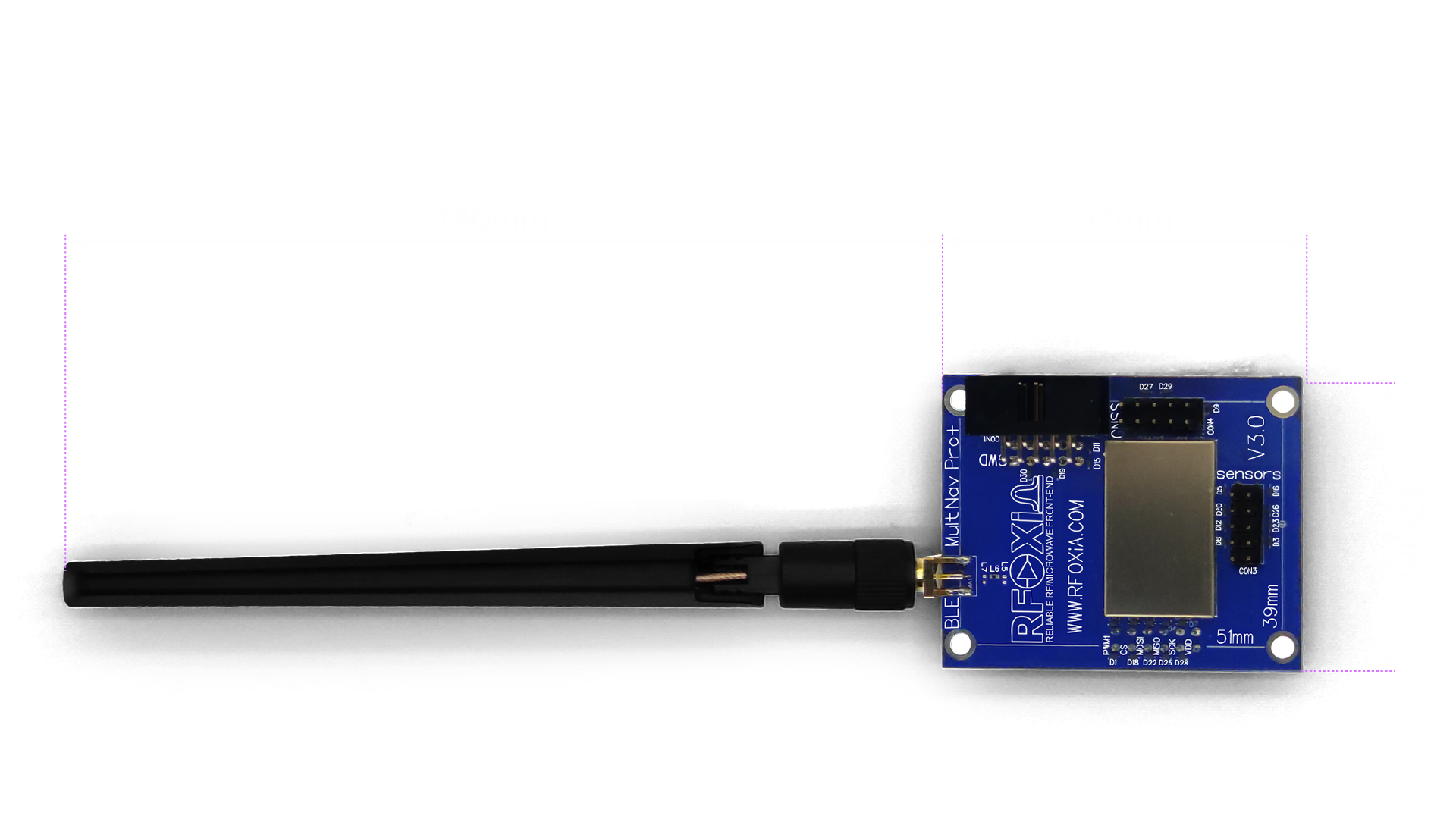
At 57mm × 47mm with a fixing frame of 54mm × 34mm featuring corner mounting holes, the MultiNav Pro+ BLE module is sized for real-world drone integration. The antenna measures 140mm — long enough for the gain characteristics that enable kilometer-scale range, compact enough for practical mounting.
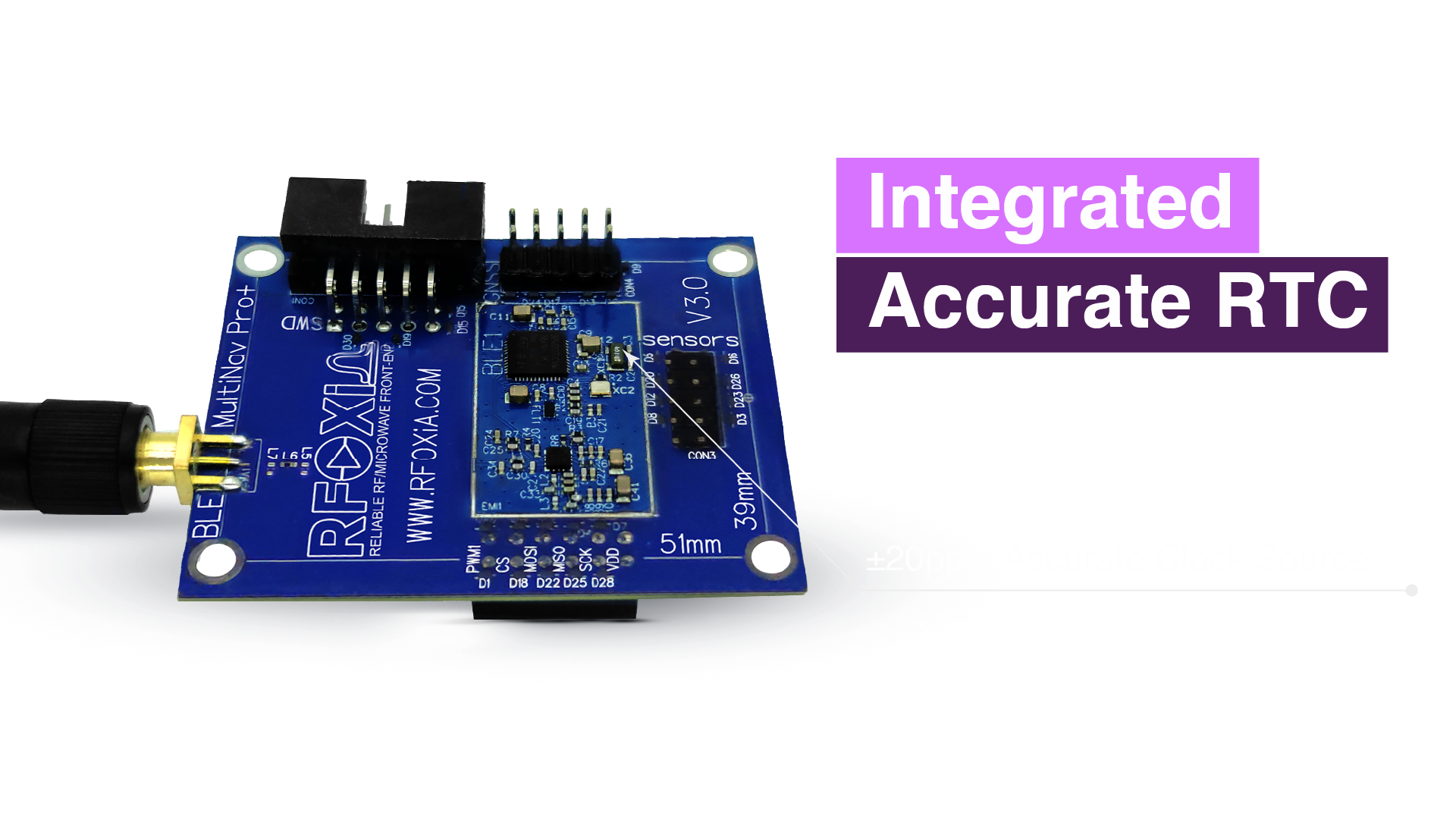
The high-gain chip antenna delivers strong signal performance without requiring external antenna assembly. The integrated RTC crystal ensures precise timing — essential for synchronization in navigation applications where timestamped telemetry matters.
Open Source and Fully Programmable
The MultiNav Pro+ BLE module ships with full open-source firmware access via GitHub, and is programmable through the SWD interface. Builders aren't locked into a proprietary stack — they have complete access to modify, extend, and customize the module's behavior for their specific application.
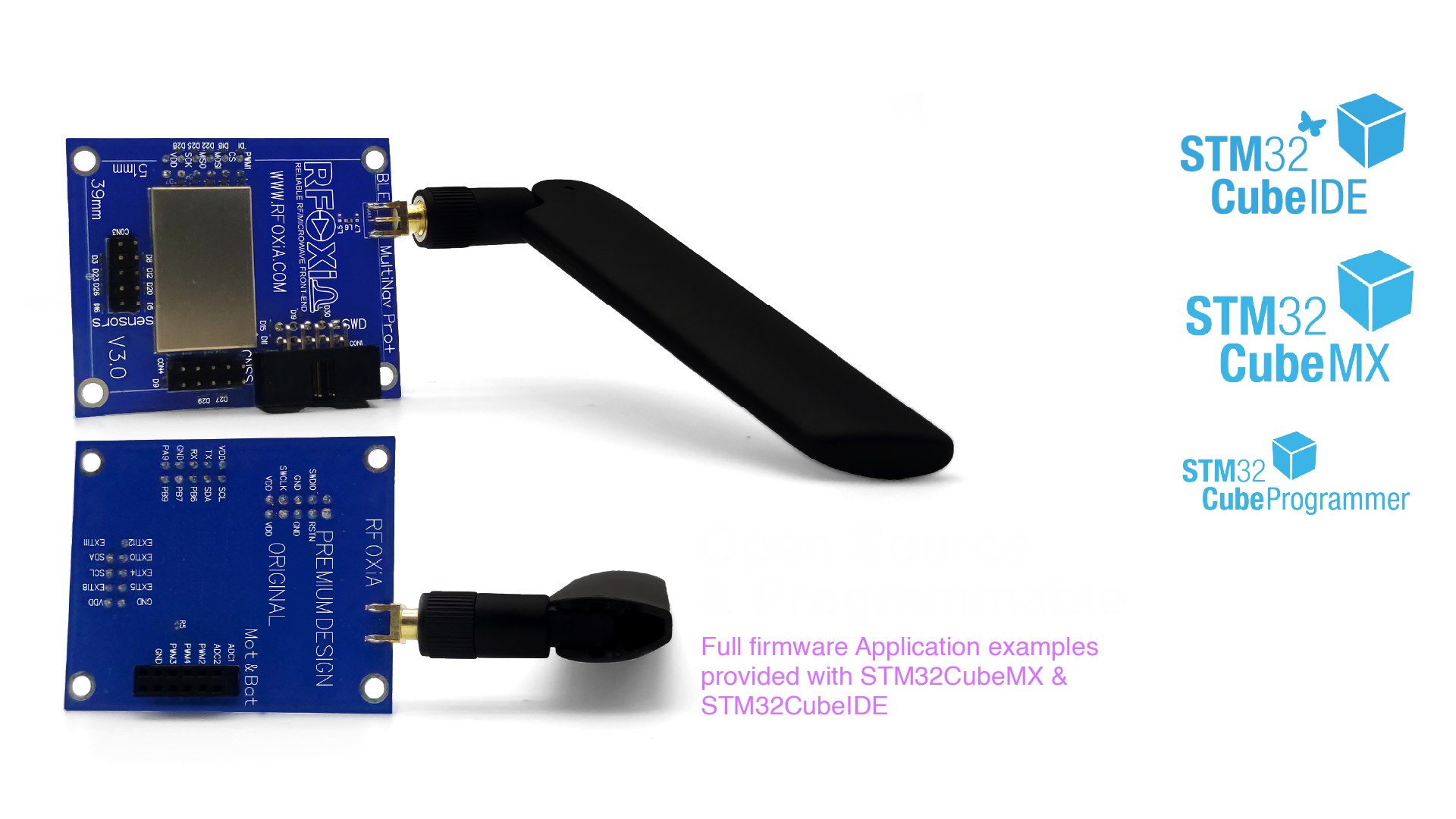
The full firmware source is available at the RFOXiA GitHub repository. The STM32WB07CCV6 core gives developers a powerful, well-documented platform to build on, with the BLE stack and user application space cleanly separated.
For builders who want to customize without starting from zero, the RFOXiA Club AI Firmware Builder allows plain-language application descriptions to generate production-ready firmware — reducing development time from months to hours.
Regulatory Compliance: FCC Certified
Long-range RF hardware occupies a complex regulatory space. The MultiNav Pro+ BLE module is FCC certified — a critical distinction for builders operating in the United States, and a baseline requirement for any hardware appearing in professional or commercial applications.
FCC certification means the module has been independently tested for emissions compliance. For builders integrating this hardware into products that may ship commercially, the certification carries significant value. For individual operators, it means legal confidence in operation.
How to Extend Drone Bluetooth Range: A Comparison
To put the MultiNav Pro+ BLE module's performance in context, here's an honest comparison of the available options:
| Approach | Max Range | Cost | Complexity | FCC Cert |
|---|---|---|---|---|
| Standard commodity BLE module | ~100m | $5–15 | Low | Varies |
| DIY PA/LNA modification | ~500m–1KM | $20–50 + labor | High | Void |
| External high-gain antenna | ~200–300m | $10–30 | Medium | Yes |
| Military/industrial long-range | 50–150KM | $5,000–50,000+ | High | Yes |
| MultiNav Pro+ BLE Module | 50KM (drone-to-drone) | $59 (2 units) | Low | Yes |
The gap in the market is clear. Nothing at this price point delivers comparable range with certification, app integration, and ecosystem support. The MultiNav Pro+ BLE module occupies a position that didn't exist before RFOXiA built it.
RFOXiA Long Range Bluetooth Module
Real-World Applications for Extended Drone Bluetooth Range
FPV and Freestyle Flying
For FPV pilots, range extension means more airspace to work with. Proximity flying at 80 meters is constrained. Building a long-range cruiser that holds link at 15–20KM opens entirely different use cases — long-distance FPV flights, geographic exploration, infrastructure inspection.
Autonomous Drone Operations
Autonomous systems need reliable telemetry at operational range. Whether that's package delivery, agricultural survey, or infrastructure mapping, the link between ground station and aircraft must hold for the entire mission envelope. A 15–20KM reliable link covers most practical autonomous mission profiles.
Drone-to-Drone Mesh Networks
At 50KM drone-to-drone range, multiple aircraft can maintain direct communication without ground infrastructure. Swarm operations, relay coverage, and coordinated multi-aircraft missions all become feasible with hardware that actually sustains link at altitude.
Search and Rescue
SAR operations benefit enormously from extended range and internet-independent communication. A ground team controller connected at 15KM to an airborne module — combined with BLE Chat for field team coordination — creates a self-contained communication and control system that operates regardless of infrastructure availability.
Remote IoT Deployment
Beyond drone applications, 5KM ground-to-ground range transforms IoT deployment economics. Sensors covering agricultural land, environmental monitoring across large geographic areas, and industrial IoT in facilities where WiFi coverage is impractical — all become viable without cellular data costs.
Getting Started
The MultiNav Pro+ BLE module ships as a pair — two units for $59 — with everything needed to establish the link. The RFOXiA Connect app is available for Android now, with iOS pending App Store approval.
For builders who want the complete platform — long-range BLE, precision GNSS, 7-sensor environmental monitoring, and professional power management — the Developer Bundle packages all four modules together.
New users on RFOXiA Club receive a $10 welcome credit on signup, redeemable toward hardware purchases. The Club platform provides documentation, firmware examples, AI firmware generation, community projects, and the full Dev Hub for technical support.
If you've been searching for how to extend drone Bluetooth range without spending five figures on military hardware or months building custom RF circuits, the answer is now a $59 module that ships ready to fly.
Get the RFOXiA Long Range Bluetooth Module
Conclusion
Extending drone Bluetooth range is fundamentally a hardware problem, and hardware problems have hardware solutions. The physics are clear: with the right RF front-end design, transmit power amplification, receiver sensitivity engineering, and attention to antenna performance, Bluetooth can operate at ranges that would have seemed impossible with commodity components.
The MultiNav Pro+ BLE module proves this at a price point that puts 50KM-capable hardware within reach of every serious builder — not just defense contractors and enterprise integrators. FCC certified, open source, app-integrated, and ecosystem-ready, it represents what happens when long-range wireless technology is built for the people who actually build things.
The question of how to extend drone Bluetooth range has a definitive answer in 2025. It starts at $59.
Written by: Moamen Mohamed LinkedIn