
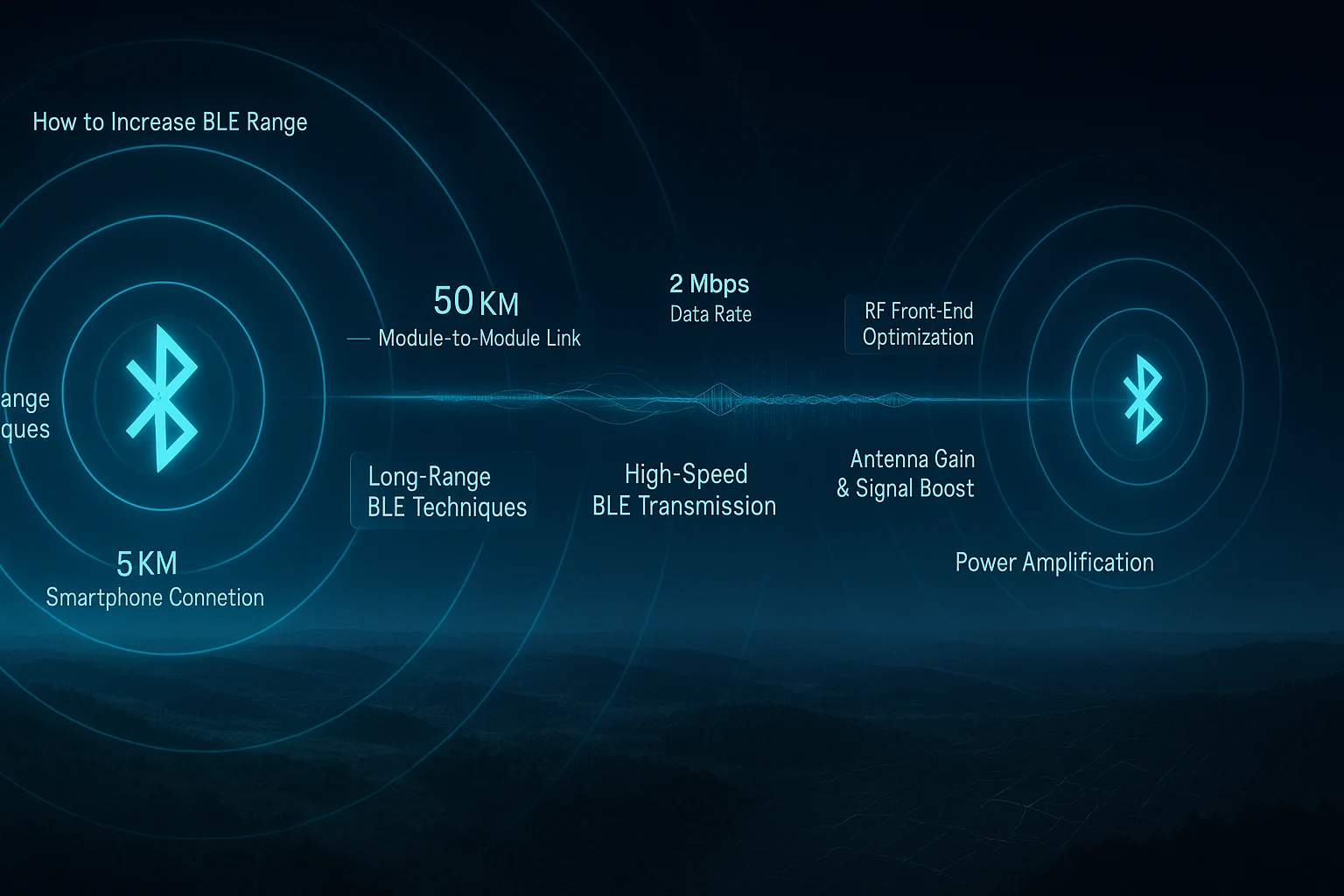
How to Increase BLE Range: The Complete Engineering Guide
RFOXiA Long Range Bluetooth Module
How to Increase BLE Range From 100 Meters to 50 Kilometers
If you've ever asked yourself how to increase BLE range beyond the frustrating 80–100 meter wall that most standard Bluetooth modules hit, you're not alone. Drone builders, robotics engineers, IoT developers, and field researchers have been wrestling with this limitation for years. The standard answer from most manufacturers is: you can't — at least not without switching to a completely different radio protocol, spending thousands on industrial hardware, or accepting severe compromises in data rate and ecosystem compatibility.
This guide breaks down exactly why BLE range is limited, what engineering techniques actually move the needle, and how modern hardware design has pushed that ceiling from 100 meters all the way to 50 kilometers — at a price makers can actually afford.
Why Standard BLE Modules Max Out at 100 Meters
To understand how to increase BLE range, you first need to understand why it's limited in the first place. Bluetooth Low Energy operates in the 2.4 GHz ISM band. At this frequency, radio signals suffer from free-space path loss, multipath interference, and absorption by obstacles like walls, trees, and the human body.
Standard BLE modules — the kind you find from Silicon Labs, Nordic Semiconductor, or generic Chinese suppliers — are designed for a very specific use case: low-power indoor connectivity. Think fitness trackers, smart home sensors, wireless earbuds. For those applications, 10–100 meters is more than sufficient, and the design priorities are:
- Minimum power consumption
- Minimum cost
- Minimum PCB footprint
- Maximum regulatory compliance with minimal effort
None of those priorities favor long-range performance. The result is a category of hardware that tops out around 80–100 meters outdoors under ideal line-of-sight conditions, and often far less in real-world environments.
The transmit power on most commodity modules is capped at 0 dBm to 4 dBm. Receiver sensitivity hovers around -96 dBm on a good day. The antenna is typically a tiny PCB trace or a ceramic chip antenna optimized for size, not gain. There is no RF front-end. There is no low-noise amplifier. There is no power amplifier. What you see is what you get.
The Real Engineering Levers Behind How to Increase BLE Range
Range in any radio system is determined by the link budget — the total margin between what you transmit and what your receiver can detect. The formula is straightforward:
Link Budget = TX Power + TX Antenna Gain + RX Antenna Gain + RX Sensitivity — Path Loss — Fade Margin
Every term in that equation is an opportunity. Here is how serious RF hardware design attacks each one:
1. Transmit Power Amplification
Commodity BLE modules transmit at 0–4 dBm. Purpose-built long-range modules add an external power amplifier (PA) stage on the RF output path, pushing transmit power to 20 dBm or higher. That's a 10x–100x increase in transmitted power, which directly extends range. More transmit power = more signal at the receiver = greater distance before the signal falls below the noise floor.
2. Low-Noise Amplifier on the Receive Path
The receive side matters just as much as transmit. A low-noise amplifier (LNA) placed before the radio's internal receive chain boosts incoming signals before the internal noise of the radio chip degrades them. This dramatically improves receiver sensitivity — often by 10–15 dB — meaning the radio can decode signals that are an order of magnitude weaker than a standard module could ever detect.
Improved receiver sensitivity is arguably the highest-leverage change you can make to a BLE radio system. A 10 dB improvement in sensitivity roughly doubles the communication range in free space.
3. Antenna Design and Gain
PCB trace antennas and ceramic chip antennas are compromise designs. They are omnidirectional, low-gain, and tuned for compactness. A proper external antenna — whether a monopole whip, a dipole, or a directional Yagi — can add 3–10 dBi of gain on both the transmit and receive sides. That gain directly increases the effective radiated power and the effective receive sensitivity without touching the radio hardware at all.
4. Receiver Sensitivity Optimization
Modern BLE chipsets like the STM32WB07 series from STMicroelectronics have significantly improved receiver sensitivity compared to earlier generations. Choosing the right silicon and configuring it correctly — including selecting the right data rate, coding scheme, and modulation parameters — yields several additional dB of margin that commodity designs leave on the table.
5. Ground Plane and RF Layout
This is where most designs fail silently. Poor PCB layout near the antenna creates reflections, impedance mismatches, and standing waves that waste transmit power and introduce receive noise. Expert RF PCB design — controlled impedance traces, proper ground plane management, antenna keepout zones — can mean the difference between hitting specifications and falling 10–15 dB short of them.
How Deployment Geometry Multiplies Range
Another factor most tutorials on how to increase BLE range overlook entirely is deployment geometry. The Friis transmission equation assumes free-space propagation, which is a decent model for high-altitude radio paths but a terrible model for ground-level communication.
At ground level, your signal battles:
- Ground reflection — signals bouncing off the earth's surface create destructive interference
- Fresnel zone obstruction — even with clear line of sight, objects within the Fresnel zone cause significant signal degradation
- Multipath fading — reflected signals arriving at different times cause phase cancellation
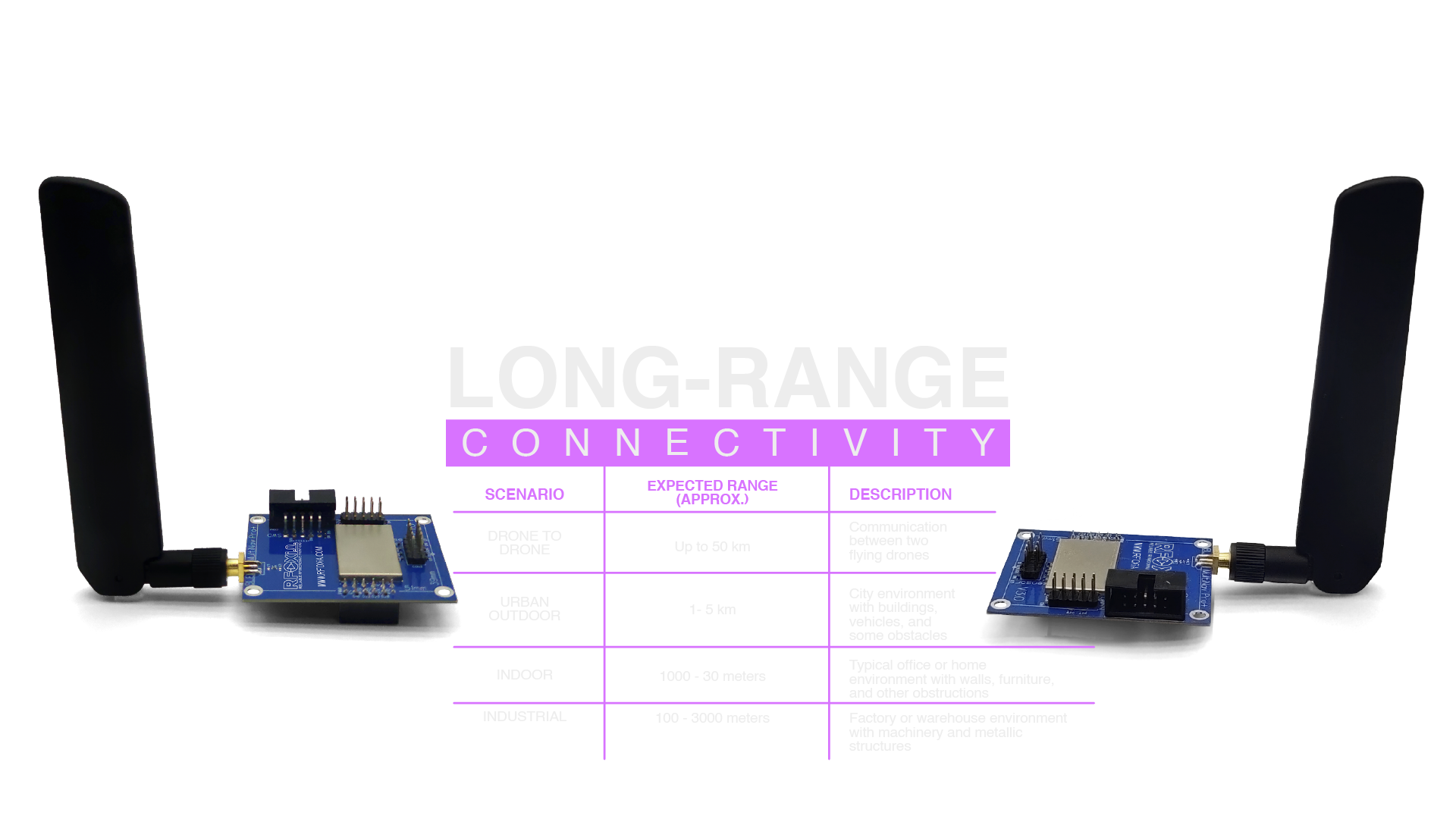
This is why the same hardware achieves dramatically different ranges depending on how it's deployed:
| Deployment Scenario | Effective Range |
|---|---|
| Ground-to-ground (both users on foot) | ~5KM |
| Man-to-drone (one unit on a UAV) | 15–20KM |
| Drone-to-drone (both units airborne) | 50KM |
Lifting even one radio above ground level eliminates ground reflection losses and clears the Fresnel zone. Lifting both radios achieves the full free-space link budget and explains how the same hardware can reach 50KM between two airborne platforms when it achieves only 5KM at ground level.
For ground-based applications, height matters enormously. A module mounted at 10 meters versus 1 meter above the ground can see 3x the range simply due to geometry — no hardware change required.
What a Purpose-Built Long-Range BLE Module Actually Looks Like
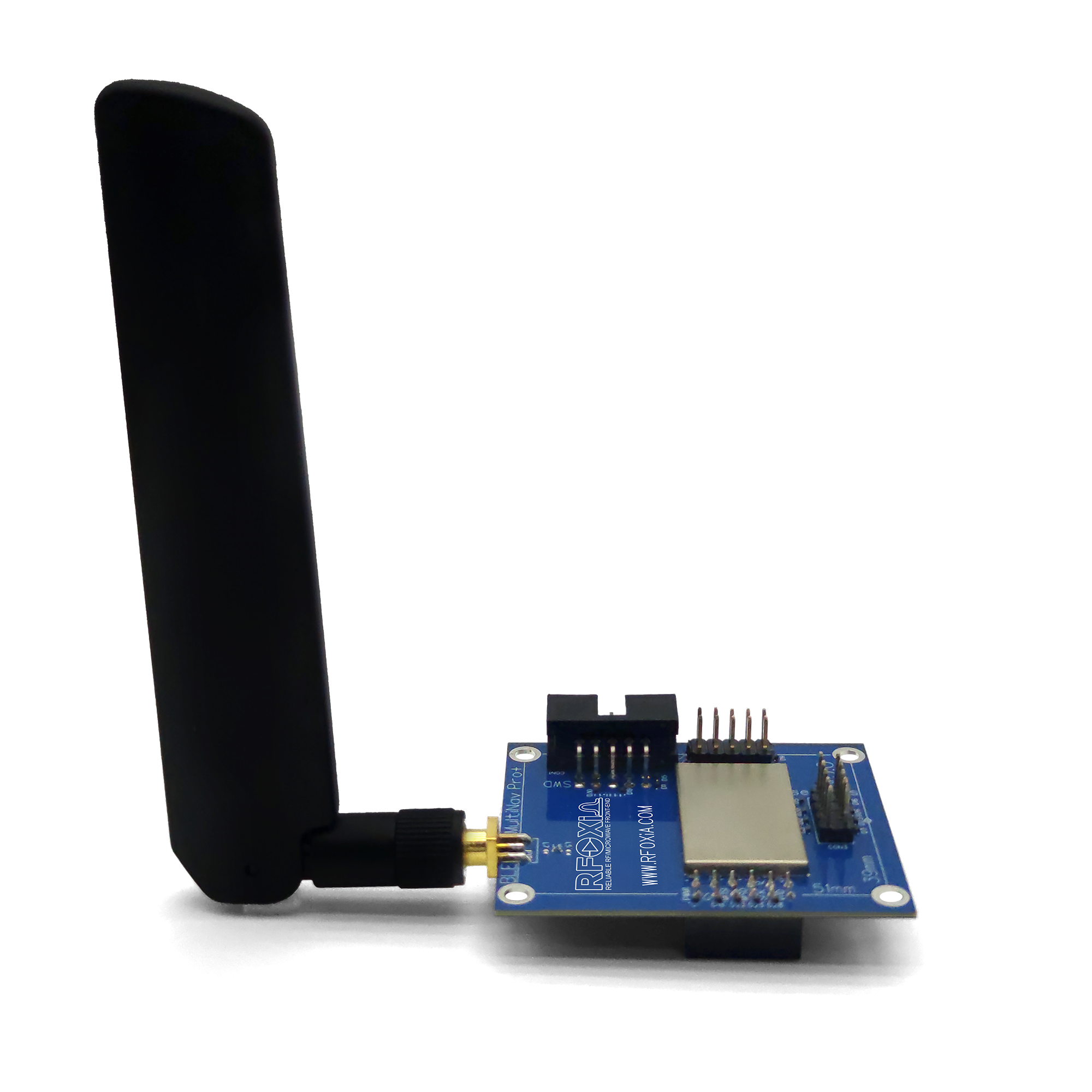
The MultiNav Pro+ BLE module from RFOXiA is the concrete answer to the question of how to increase BLE range without abandoning the BLE ecosystem, switching to proprietary protocols, or spending $5,000 on military-grade hardware.
The engineering approach combines every technique described above into a single 57mm × 47mm module:
- External RF power amplifier on the transmit path for maximum effective radiated power
- Low-noise amplifier on the receive path for best-in-class receiver sensitivity
- High-gain chip antenna with 140mm external antenna for optimized radiation pattern
- STM32WB07CCV6 processor — a dual-core ARM Cortex-M0+ and Cortex-M4 SoC with an optimized BLE radio stack
- Professional RF PCB layout by an experienced RF hardware engineer
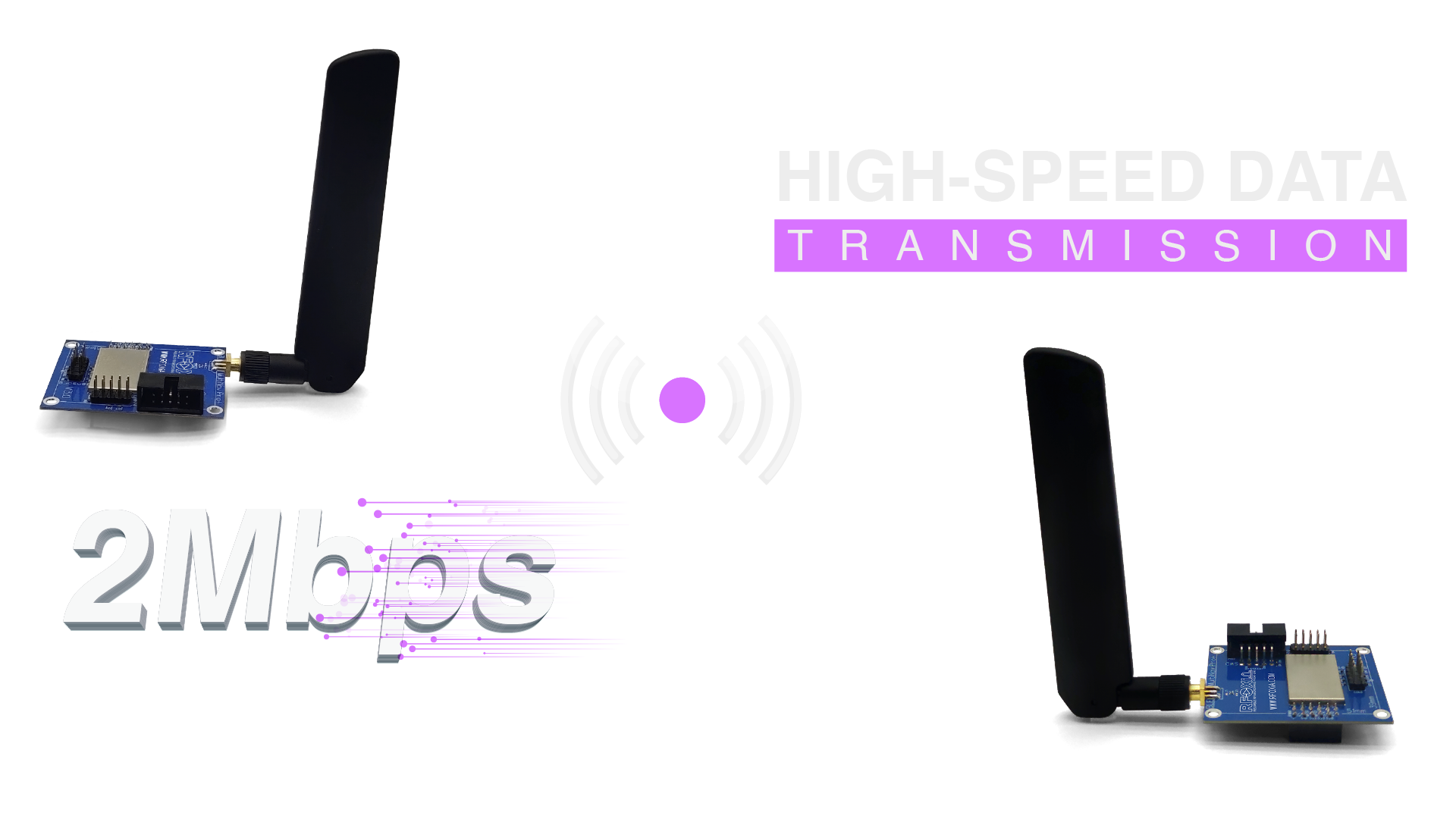
The result is a module that achieves what no commodity BLE product can: verified 50KM range between two airborne units, 15–20KM man-to-drone range, and 5KM ground-to-ground performance — all at 2 Mbps data rate with full Bluetooth Low Energy protocol compatibility.
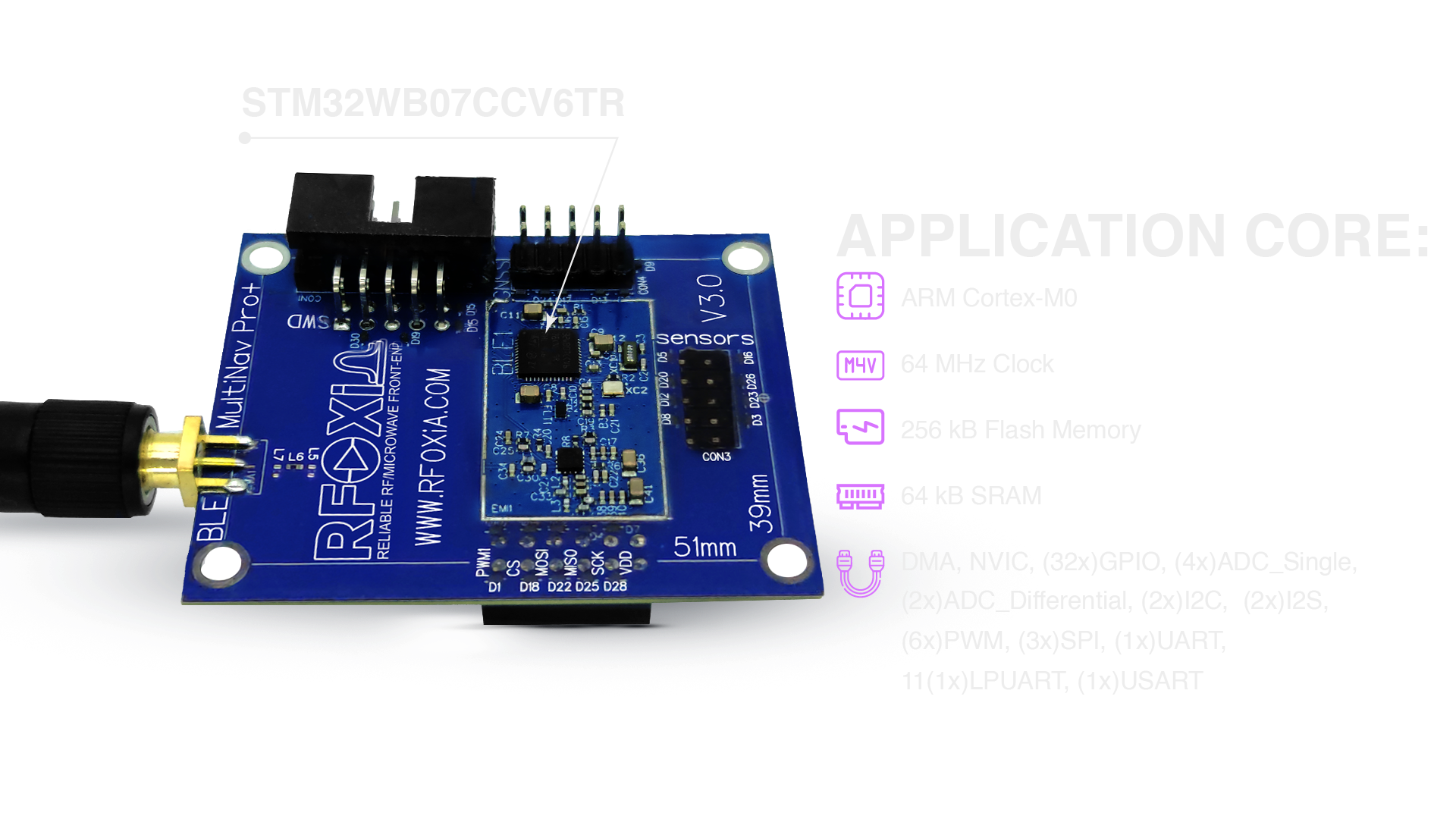
This is not a proprietary radio protocol. This is real Bluetooth, extended to ranges that were previously impossible at this price point. That means it pairs with smartphones, works with standard BLE libraries, and integrates with existing BLE toolchains — while offering a range increase of roughly 500x over commodity alternatives.
The Complete Ecosystem: More Than Just a Module
Range is only part of the story. The other reason developers choose the MultiNav Pro+ is everything that comes with it.
Seamless Module Integration
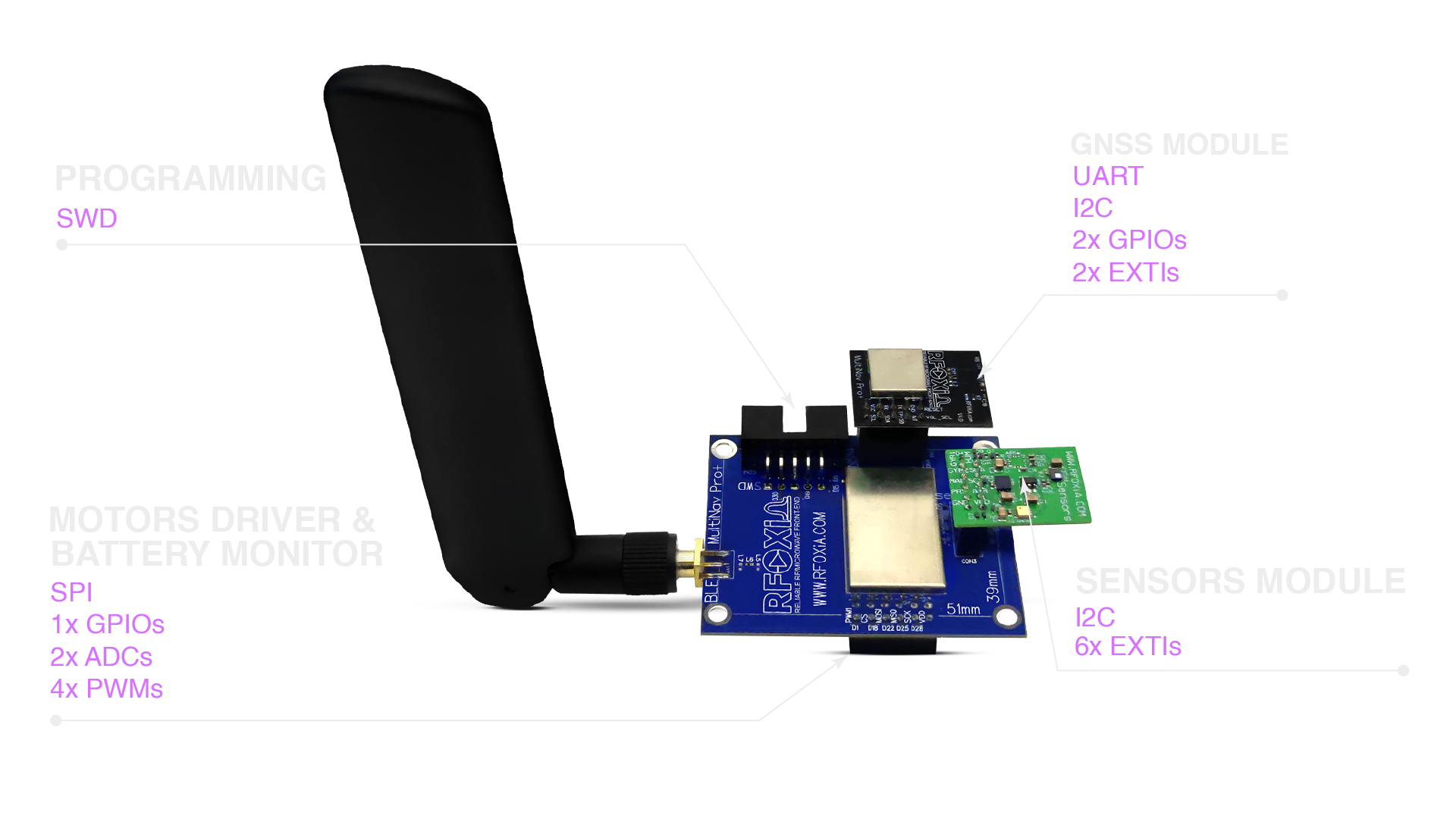
The MultiNav Pro+ BLE module connects directly with the rest of the RFOXiA hardware ecosystem: the GNSS module (1.5m accuracy, 18Hz fix rate), the 7-in-1 Sensors module (temperature, humidity, pressure, air quality, accelerometer, gyroscope, magnetometer), and the Power/Program Kit (supercapacitor-based, 5-minute charge, 24-hour runtime). All four modules plug together to create a unified wireless platform for autonomous systems.
Mobile App Control
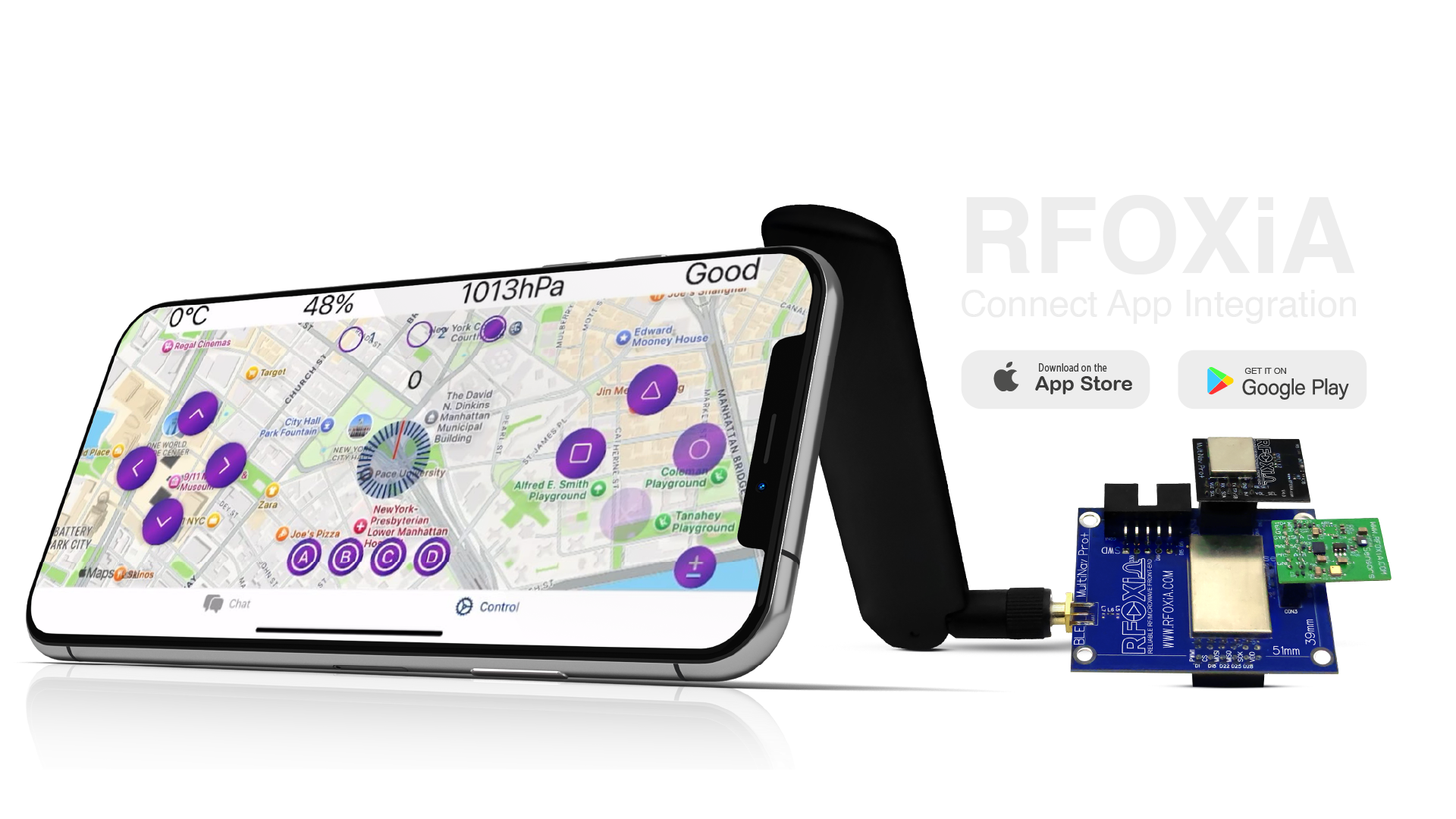
The RFOXiA Connect app (iOS and Android) provides a PS5-style controller interface, live map with real-time GPS tracking, sensor data visualization, and an automation center — all working completely without an internet connection. The app pairs with the BLE module and uses the module's full range as its control radius. That means drone control at 15–20KM, without a cellular connection, without a radio tower, and without a license.
Infrastructure-Free Mesh Communication
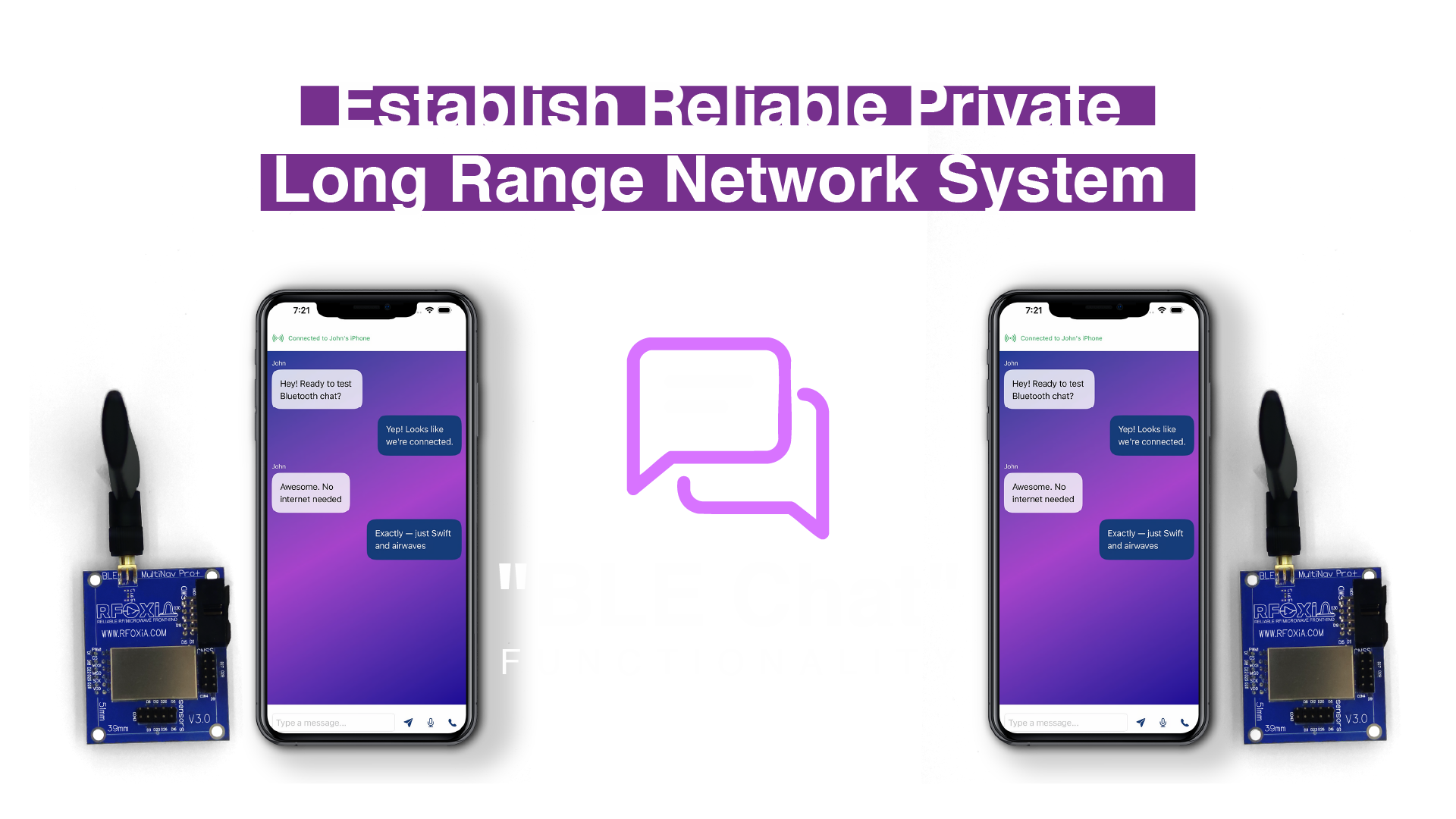
The BLE Chat function enables direct text, data, and voice communication between multiple MultiNav Pro+ users — completely internet-independent. Field teams, disaster response operators, remote expedition members, and off-grid researchers can maintain communications across several kilometers without any infrastructure. Each BLE module becomes a mesh communication node.
Open Source, Fully Programmable
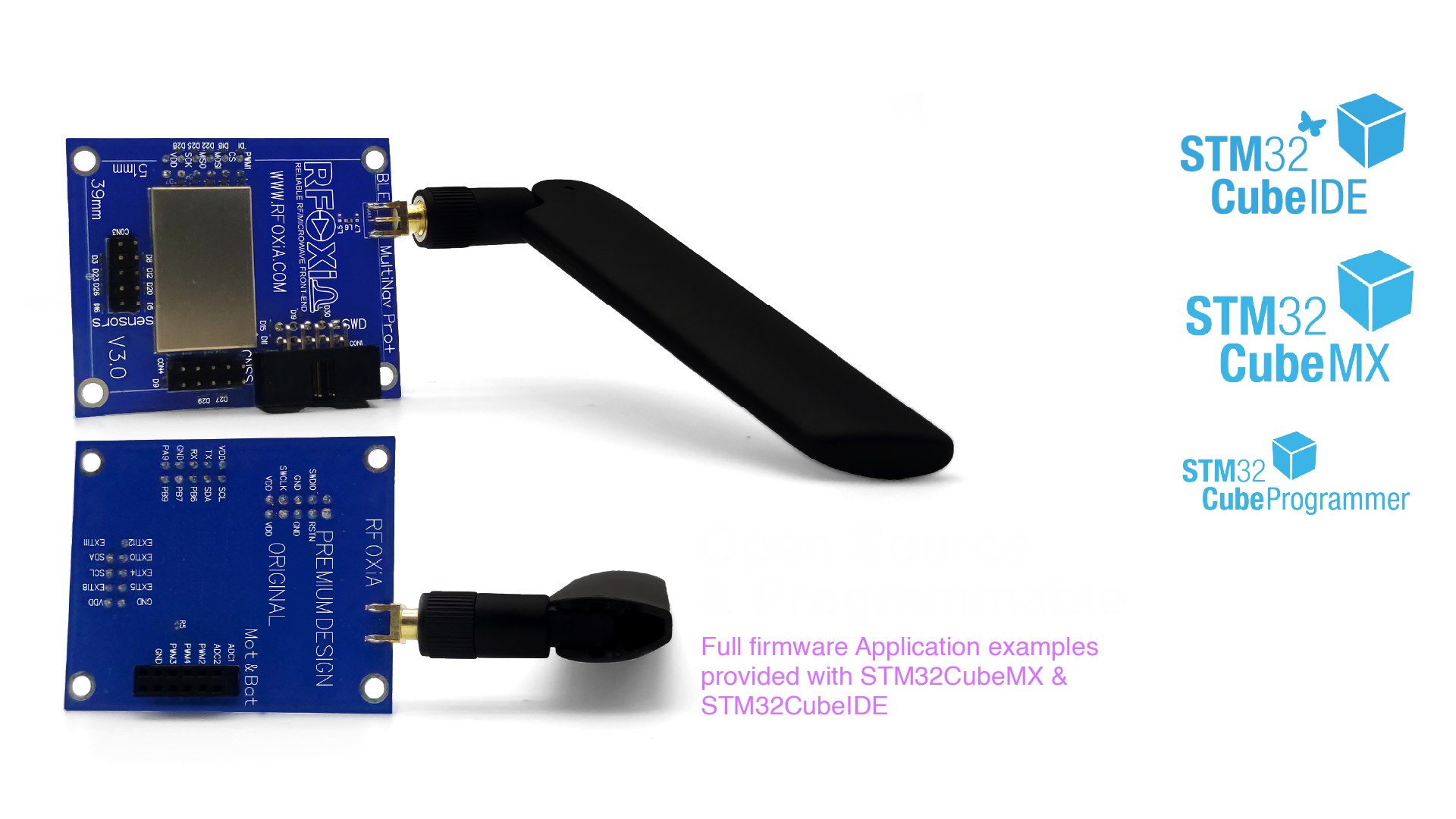
One of the most common complaints about long-range wireless hardware at higher price points is vendor lock-in. The MultiNav Pro+ takes the opposite approach: full open-source firmware access via the RFOXiA GitHub repository, programmable via SWD with integrated STLink support in the Power/Program Kit.
Developers who want to understand how to increase BLE range in their custom application can study the firmware, modify the RF configuration, tune the power amplifier settings, and adapt the protocol stack for their specific use case. The RFOXiA Club platform also includes an AI Firmware Builder — describe your application in plain language and receive production-ready firmware code in hours rather than months.
If you're building a custom long-range wireless application and want a proven hardware foundation, the RFOXiA Long Range Bluetooth Module gives you the hardware specs AND the source code to build on.
Compact Form Factor for Real-World Integration
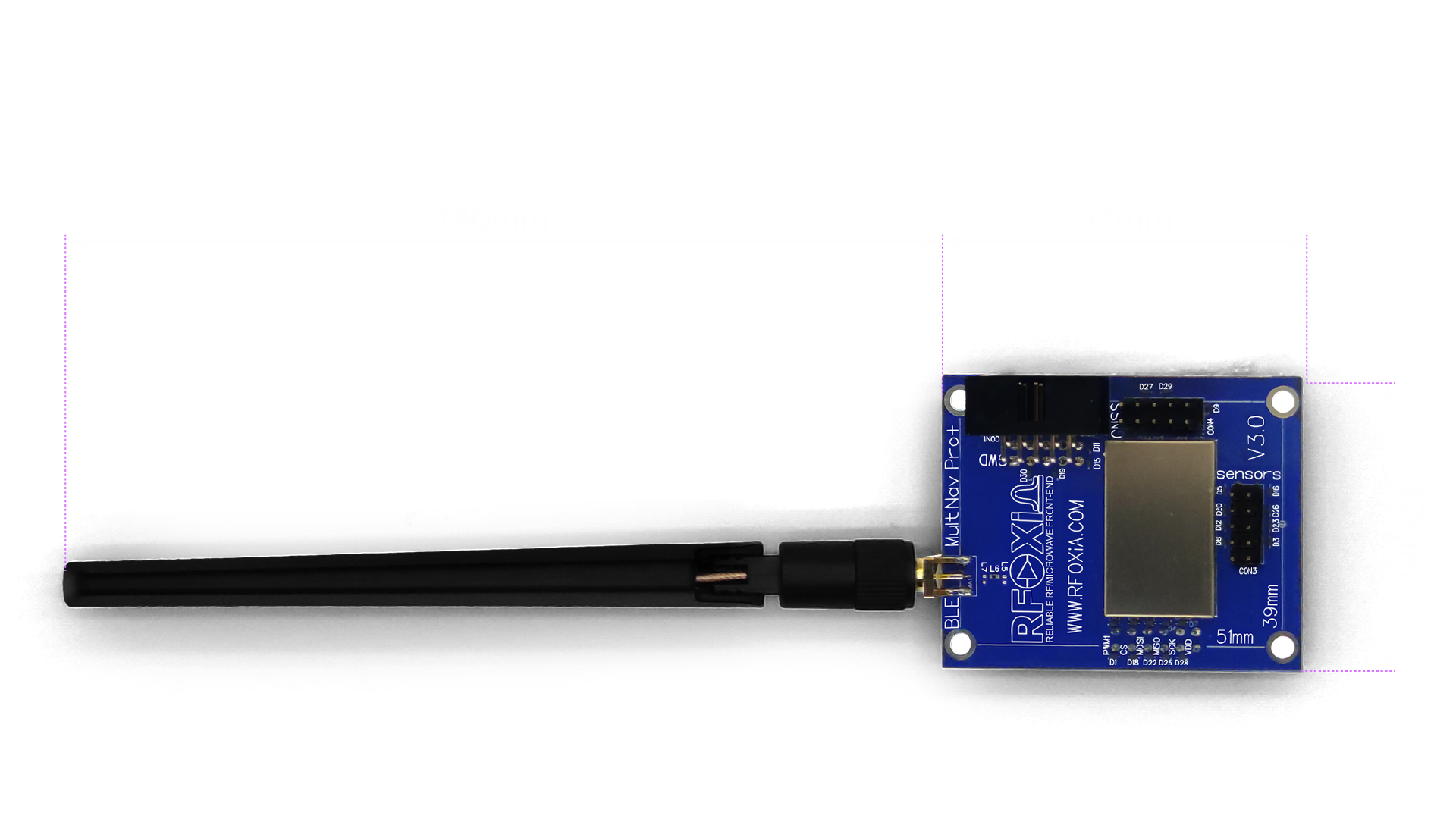
At 57mm × 47mm with a fixing frame footprint of 54mm × 34mm featuring corner mounting holes, the MultiNav Pro+ BLE module is designed for integration into real hardware, not just breadboard experiments. Drone frames, robot chassis, field monitoring enclosures, and custom PCB stacks all have enough room to house this module without redesigning the entire mechanical structure around it.
The 140mm external antenna provides the high-gain radiation pattern needed for maximum range while remaining compact enough for most airframe configurations.
Precision Timing for Synchronized Applications
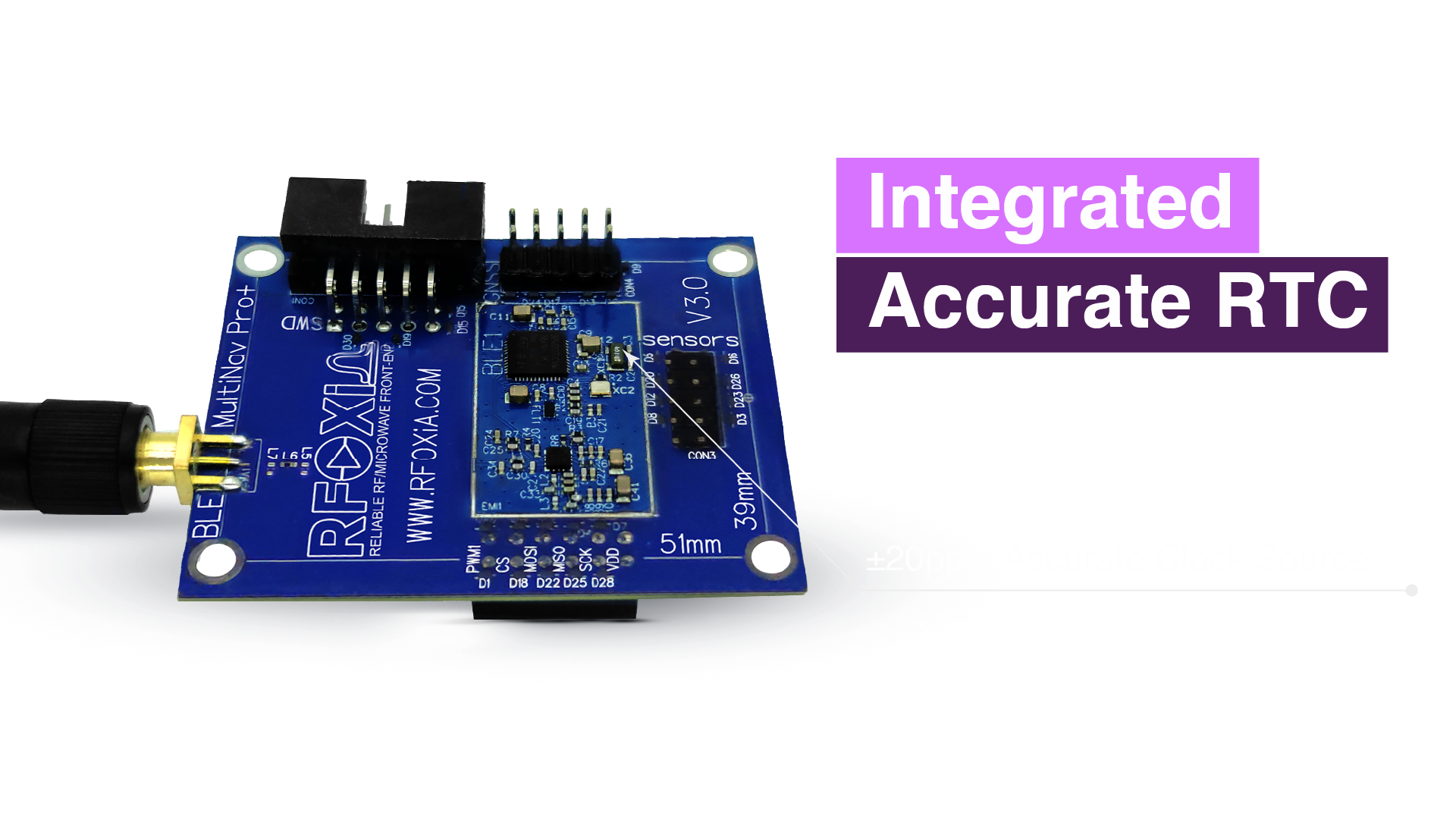
For applications where timing matters — synchronized sensor logging, time-division multiple access (TDMA) protocols, navigation systems, or any multi-node deployment requiring coordinated operation — the integrated RTC crystal provides accurate timekeeping independent of the main processor clock. This is a feature absent from most commodity BLE modules and critical for professional field deployments.
Practical Use Cases: Where 50KM BLE Range Changes Everything
Understanding how to increase BLE range is interesting from an engineering perspective, but the more important question is: what does this enable that wasn't possible before?
Long-Range Drone Control
FPV pilots and autonomous drone developers can operate at ranges that previously required dedicated RC systems with separate frequency bands, licenses, and hardware. A single MultiNav Pro+ pair provides control and telemetry at 15–20KM man-to-drone range, with real-time GPS tracking through the RFOXiA Connect app.
Remote IoT Deployments
Field sensors deployed kilometers from the nearest gateway can now communicate back to a central node without cellular connectivity, LoRa infrastructure, or satellite modems. A single BLE module pair can bridge 5KM of open terrain to aggregate data from remote sensors.
Disaster Response Communication
In scenarios where cellular infrastructure is down or unavailable, field teams can maintain voice and data communication using BLE Chat over several kilometers. No towers, no internet, no SIM cards — just the modules and the app.
Multi-UAV Drone Swarms
When multiple drones each carry a MultiNav Pro+ module, the drone-to-drone communication range extends to 50KM. Coordinated swarm operations, relay node configurations, and distributed sensor networks become achievable without custom radio hardware.
Environmental Data Networks
Deployed with the Sensors module, the BLE module relays verified environmental data — temperature, humidity, pressure, air quality, GPS location — back to an aggregation point. RFOXiA's data monetization network pays daily rewards for verified data contributions, turning field-deployed sensor nodes into passive income generators.
Specifications Summary
| Parameter | Value |
|---|---|
| Ground-to-ground range | 5KM |
| Man-to-drone range | 15–20KM |
| Drone-to-drone range | 50KM |
| Data rate | 2 Mbps |
| Processor | STM32WB07CCV6 |
| Module size | 57mm × 47mm |
| Antenna length | 140mm |
| Fixing frame | 54mm × 34mm |
| Certification | FCC certified |
| Price | $59 (2 units) |
| Firmware | Open source via GitHub |
| App | RFOXiA Connect (iOS + Android) |
The Market Gap This Fills
The honest answer to how to increase BLE range has always existed in the RF engineering literature — better amplifiers, better antennas, better silicon, better layout. What hasn't existed until now is a product that applies all of those techniques simultaneously, delivers verified real-world results, carries FCC certification, ships with an open-source firmware stack, and costs $59 for a pair.
Commodity BLE modules: $5–15, 100m maximum. Military and industrial long-range systems: $5,000+, 150KM+. The MultiNav Pro+ sits in the gap that nobody else occupies: professional-grade long-range BLE hardware at maker-accessible prices, backed by a complete development ecosystem.
For developers who have spent time trying to squeeze more range out of standard modules — adding external antennas, boosting transmit power within regulatory limits, experimenting with sensitivity settings — the practical ceiling on that approach is around 300–500 meters before you hit fundamental hardware constraints. Crossing into the kilometer range requires a purpose-built RF front-end. That is exactly what the MultiNav Pro+ delivers.
Getting Started
If you're ready to stop fighting range limitations and start building applications that actually use the distances your project requires, the RFOXiA Long Range Bluetooth Module is available now at $59 for a pair of FCC-certified modules, in stock and ready to ship.
Join RFOXiA Club for free to access the AI Firmware Builder, developer community, documentation, and $10 in welcome credits toward your first order. The platform is open — sign up, explore, and start building without spending a dollar.
The range problem is solved. What you build with it is up to you.
Written by: Moamen Mohamed LinkedIn