
IoT Sensor No Internet Required: How the MultiNav Pro+ BLE Module Changes Everything
RFOXiA Long Range Bluetooth Module
Build a True IoT Sensor No Internet Required — Up to 50KM Range, 2Mbps Speed, FCC Certified
For most builders, IoT has always meant one thing: you need the internet. You need a router, a SIM card, a cloud gateway, a subscription plan, a cell tower in range — something connecting your device to the outside world before it can do anything useful.
That assumption is wrong. And the MultiNav Pro+ BLE module from RFOXiA is the proof.
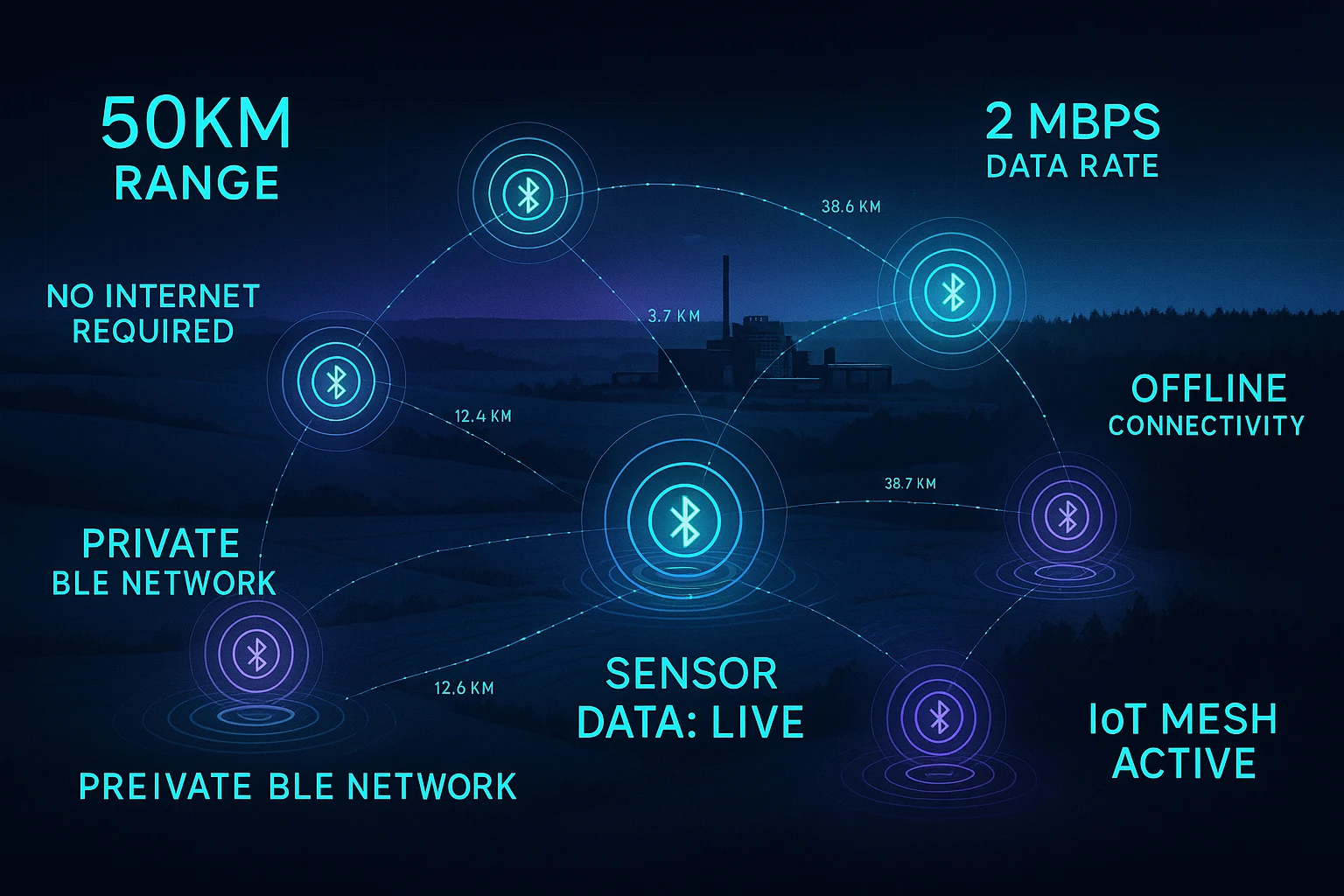
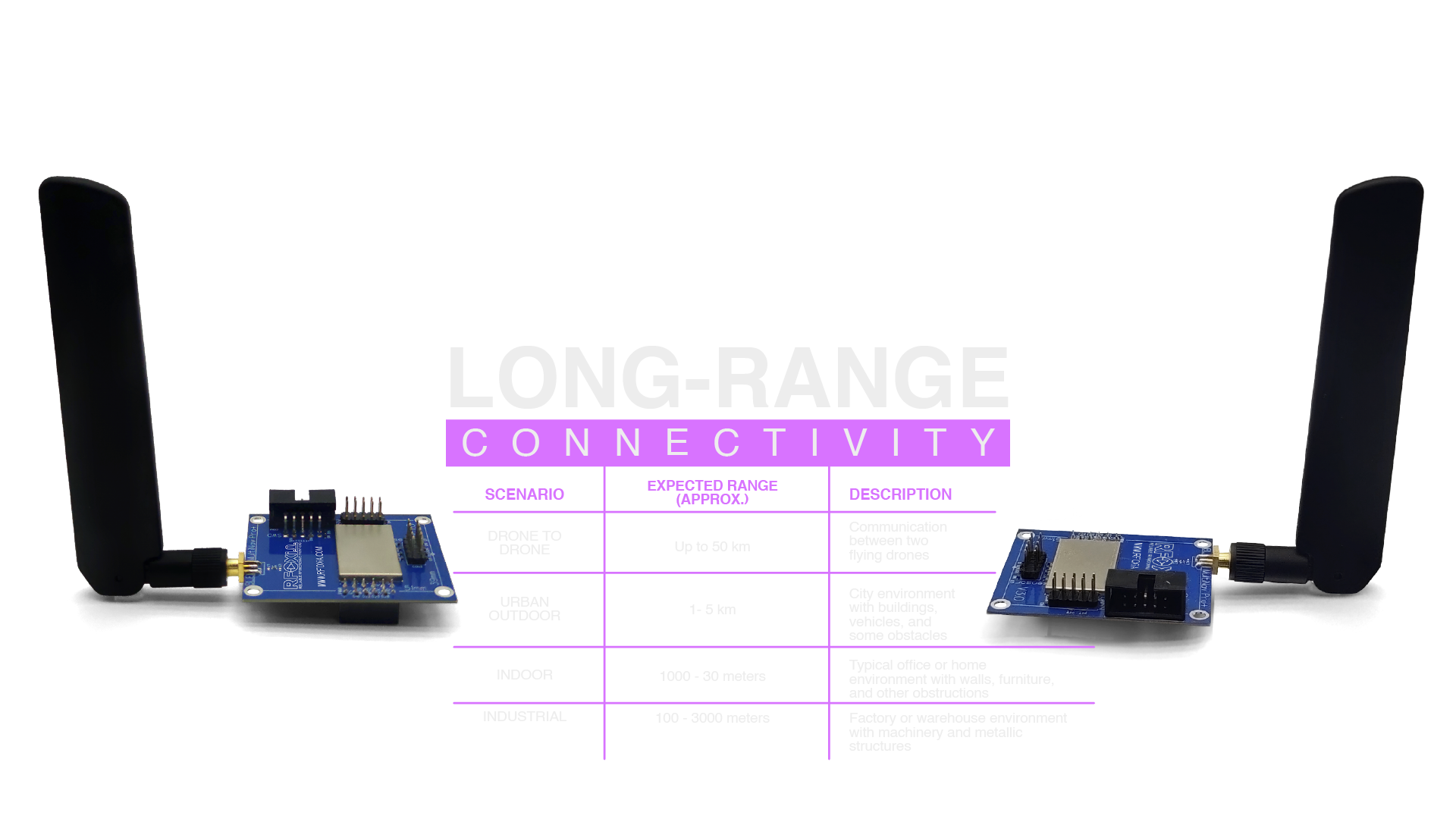
This is not a Bluetooth module in the way most developers think about Bluetooth. It is not the short-range, line-of-sight, "works in the same room" radio that ships on commodity development boards. The MultiNav Pro+ BLE achieves real-world communication distances of up to 5KM between two ground-based smartphones, up to 15–20KM between a smartphone and a drone or robot, and up to 50KM between two airborne modules — all without a single internet packet, cellular tower, or Wi-Fi router involved.
If you have ever needed to deploy an IoT sensor no internet required — in a field, on a drone, at a remote industrial site, during a disaster response operation, or anywhere infrastructure simply does not exist — this module was built for exactly that mission.
Why "No Internet Required" Is Not a Limitation — It Is a Feature
When builders first hear "no internet required," they often interpret it as a compromise. The reality is the opposite.
Internet-dependent IoT systems carry a set of costs and failure modes that designers rarely talk about openly:
- Latency. Every sensor reading that travels through the cloud and back adds hundreds of milliseconds — sometimes seconds. For drone control, robotic actuation, or real-time monitoring, that delay is not acceptable.
- Cost. Cellular data plans for IoT devices accumulate. A fleet of ten sensors generating continuous telemetry can easily run $50–$200/month in data costs.
- Infrastructure dependency. If the tower goes down, the router drops, or the SIM plan lapses, your system goes dark. In industrial, agricultural, and emergency response applications, that is not just inconvenient — it is dangerous.
- Privacy. Every piece of data routed through a third-party cloud is data you no longer fully control.
- Range. Cellular coverage maps look solid until you actually try to deploy sensors in a canyon, a forest, a ship at sea, or a rural agricultural plot three miles from the nearest tower.
An IoT sensor no internet required eliminates all of these problems. You define the network. You own the range. You control the data. The MultiNav Pro+ BLE makes this possible at a price point — $59 for two units — that was previously impossible.
What Makes 50KM Bluetooth Possible
Standard BLE chips — the ones on commodity Arduino-style boards, off-the-shelf Nordic modules, or generic Chinese BLE breakouts — are designed for consumer electronics. They optimize for power consumption and cost, not range. The result is a practical real-world range of 80–100 meters in open space, far less in any environment with walls, vehicles, or terrain.
The MultiNav Pro+ BLE is engineered around an entirely different set of priorities.
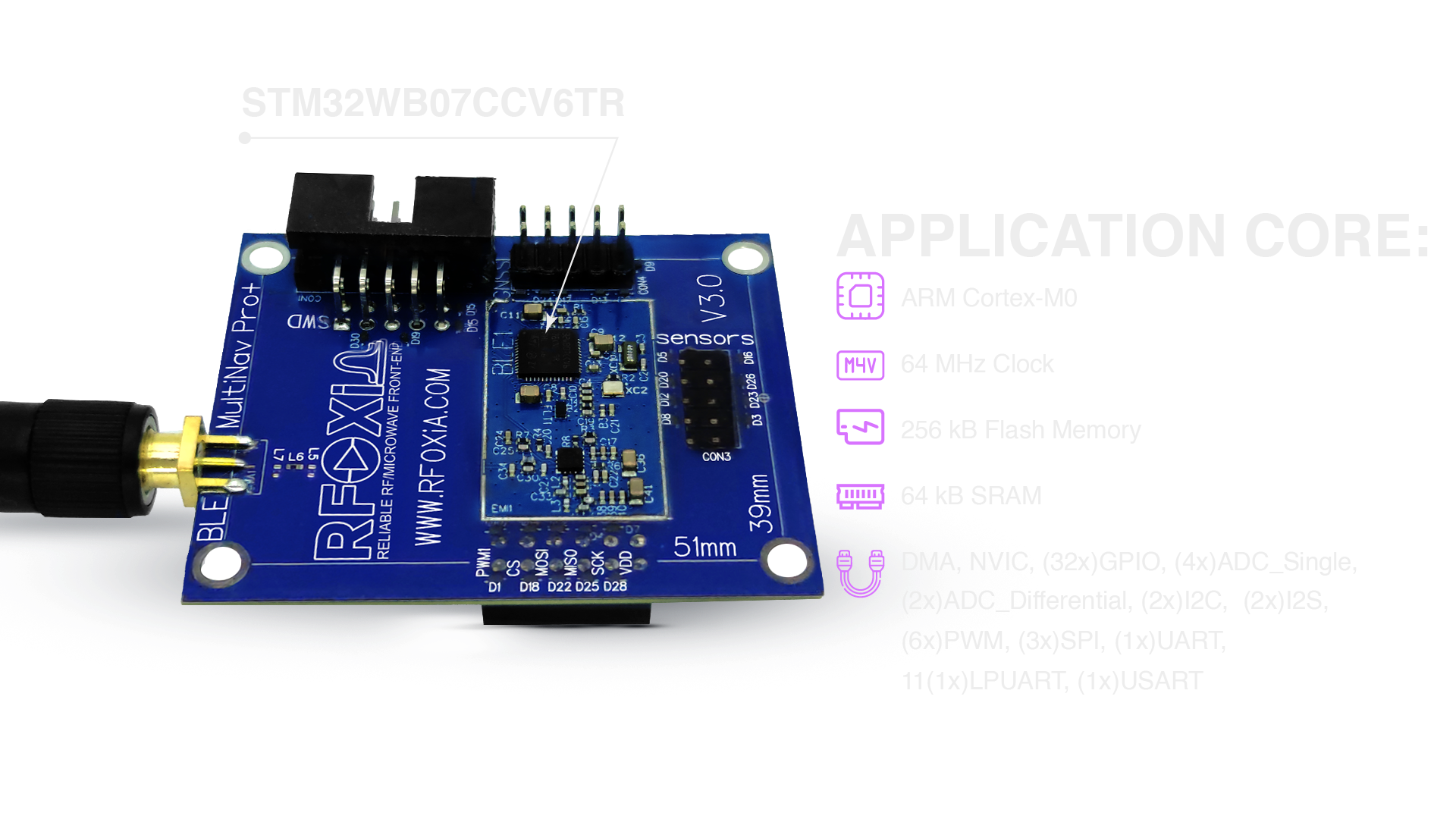
STM32WB07CCV6 Processing Core
At the heart of the module sits an STM32WB07CCV6 dual-core wireless microcontroller. This processor manages the full BLE stack while simultaneously running user applications — no external host MCU required for most deployments. The architecture delivers optimal performance, flexibility, and responsiveness without compromising the RF front-end.
RF Front-End Amplification
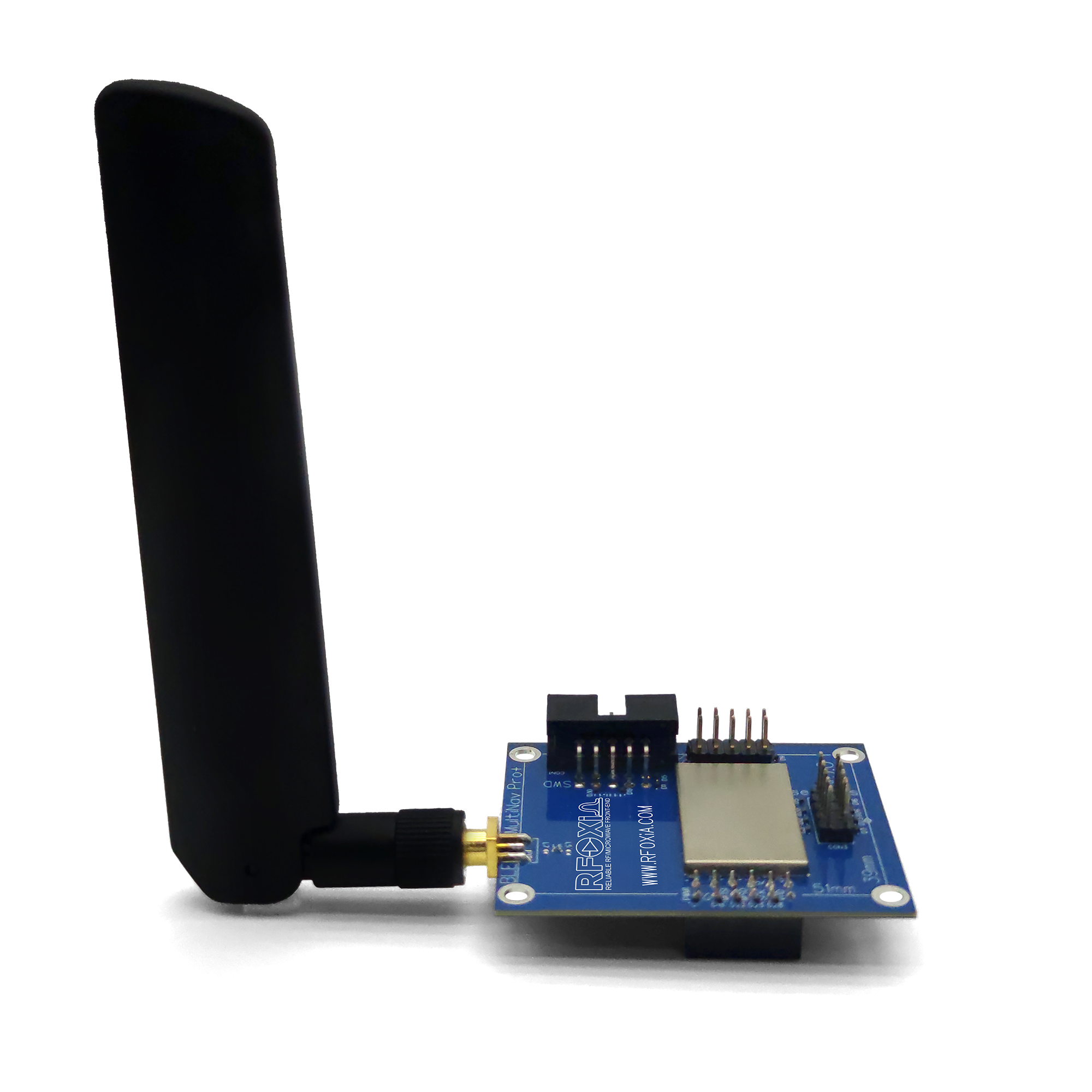
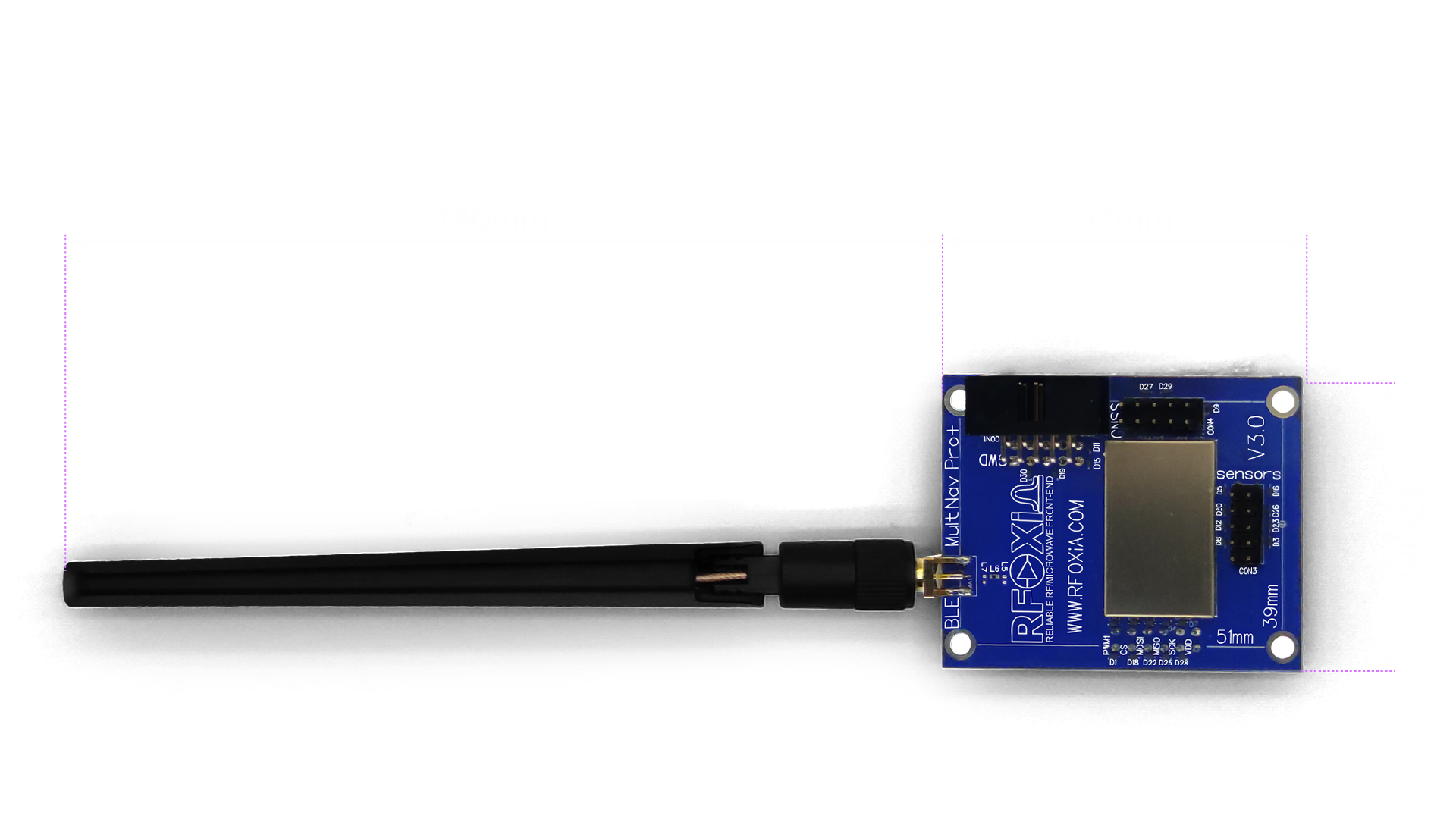
The extraordinary range figures come from RFOXiA's optimized RF front-end design — external amplifiers and advanced receiver sensitivity engineering that push BLE performance far beyond what the silicon alone can achieve. This is custom RF work, not a commodity module drop-in. The high-gain integrated chip antenna delivers a strong signal without requiring external antenna components for most applications, while the 140mm antenna configuration is available for installations demanding the full 50KM envelope.
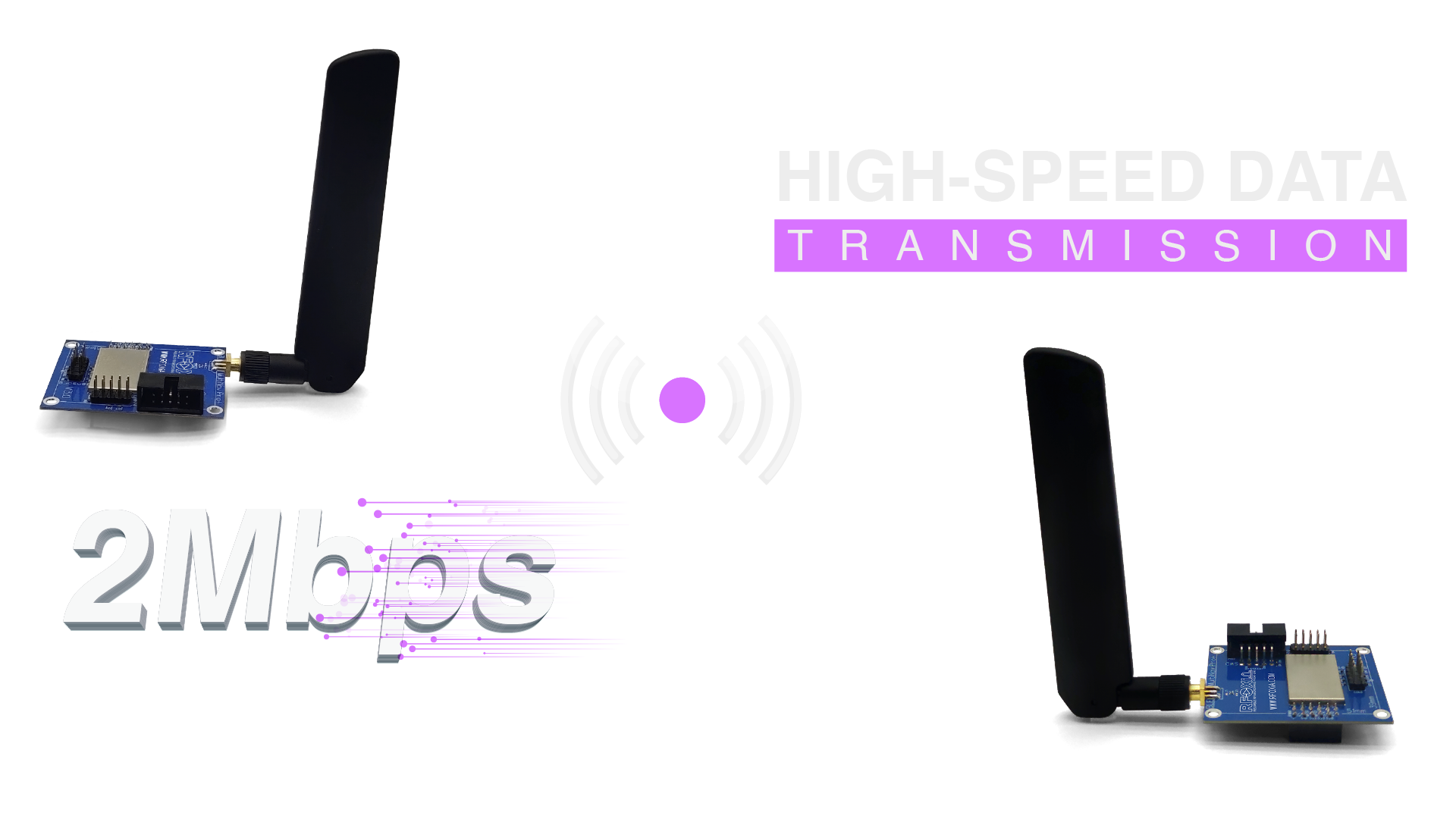
2Mbps Data Rate
Range alone is not enough. A system that reaches 50KM but delivers only a few bytes per second at that distance is not useful for real applications. The MultiNav Pro+ BLE maintains a 2Mbps data rate — fast enough to stream real-time sensor data, GPS coordinates, control commands, and telemetry without the buffering and delay that plagues slower long-range systems.
Real Use Cases: IoT Sensor No Internet Required in the Field
The specs are compelling. But the more important question is: what can you actually build with this?
Drone Telemetry and Control
FPV pilots and autonomous drone builders need a control link that is low-latency, long-range, and interference-resistant. At 15–20KM man-to-drone range and 2Mbps throughput, the MultiNav Pro+ BLE delivers a control and telemetry link that exceeds the requirements of most drone applications — without any internet connection, ground station software subscription, or external radio hardware.
Remote Agricultural Monitoring
A farm spanning hundreds of acres cannot rely on Wi-Fi. Cellular coverage is inconsistent and expensive. With MultiNav Pro+ BLE modules deployed across a property, a farmer can receive live soil condition data, equipment telemetry, and environmental sensor readings directly to a smartphone — no gateway, no cloud, no monthly fee.
Industrial and Infrastructure Monitoring
Oil pipelines, water treatment facilities, remote substations, and mining operations need sensor networks that work whether or not a cell tower is nearby. An IoT sensor no internet required is not a fallback for these environments — it is the right tool from the start.
Search and Rescue and Disaster Response
When infrastructure goes down — earthquakes, floods, wildfires — the first thing lost is often cellular and internet connectivity. A mesh communication and sensor network built on MultiNav Pro+ BLE modules continues operating because it never depended on that infrastructure in the first place. Teams can share location, sensor data, and voice communication across kilometers of affected terrain without waiting for networks to be restored.
Research and Scientific Deployment
Researchers deploying sensors in forests, oceans, mountains, or arctic environments cannot assume connectivity. The MultiNav Pro+ BLE provides the communication backbone for sensor arrays that need to transmit data back to a base station over distances and terrain types that would defeat any conventional wireless approach.
The Complete Ecosystem: Not Just a Module
What separates RFOXiA from every other long-range BLE solution on the market is that the MultiNav Pro+ BLE is not a standalone component — it is the communication backbone of an integrated development ecosystem.
Seamless Integration with the MultiNav Pro+ Family
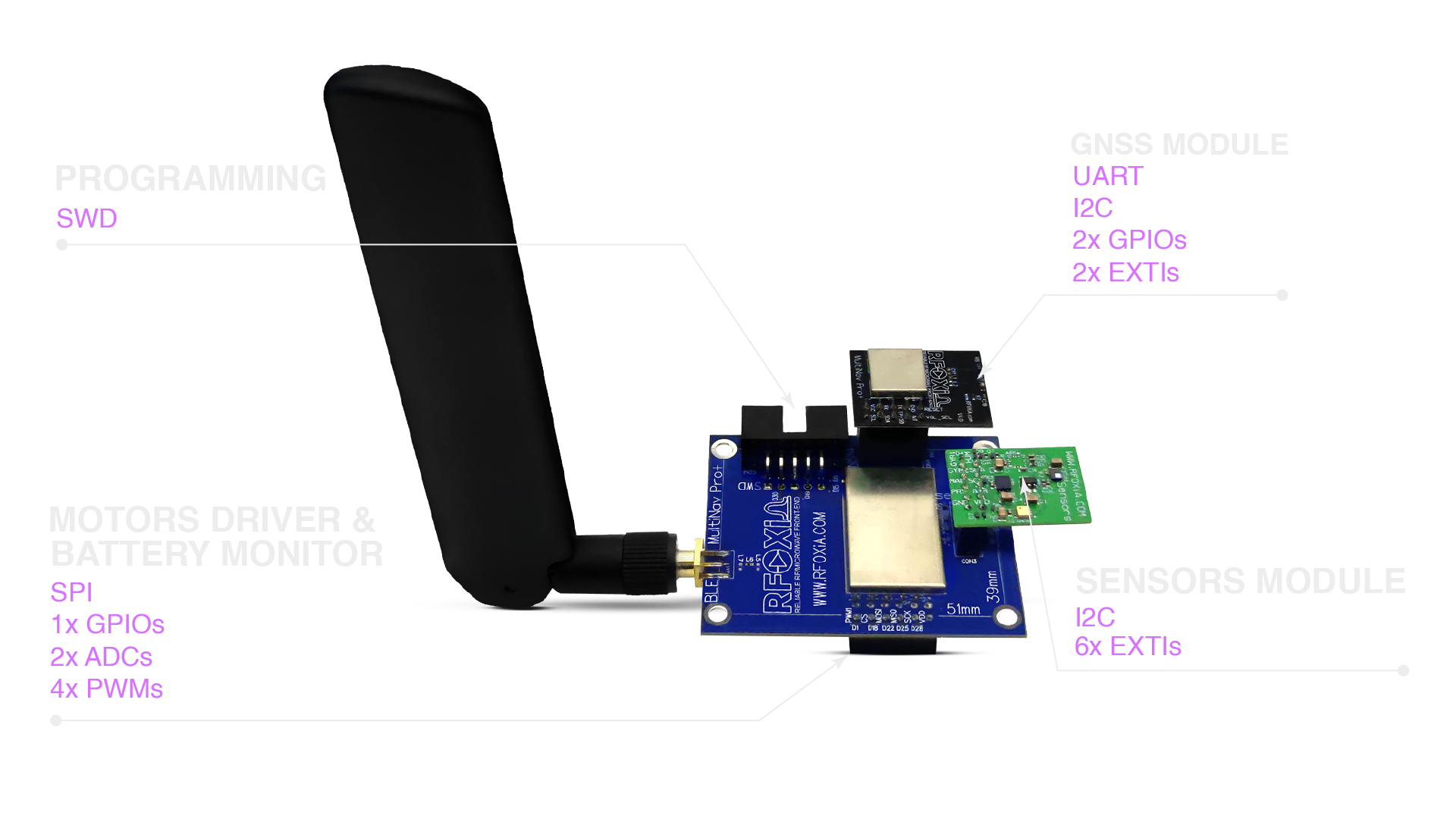
The BLE module is designed to connect directly with the MultiNav Pro+ GNSS module (1.5m accuracy, 18Hz fix rate), the Sensors module (temperature, humidity, pressure, air quality, accelerometer, gyroscope, magnetometer), and the Motor/Battery Management interface. Together, these modules form a complete autonomous system platform for drone builders, robotics engineers, and field researchers.
RFOXiA Connect App
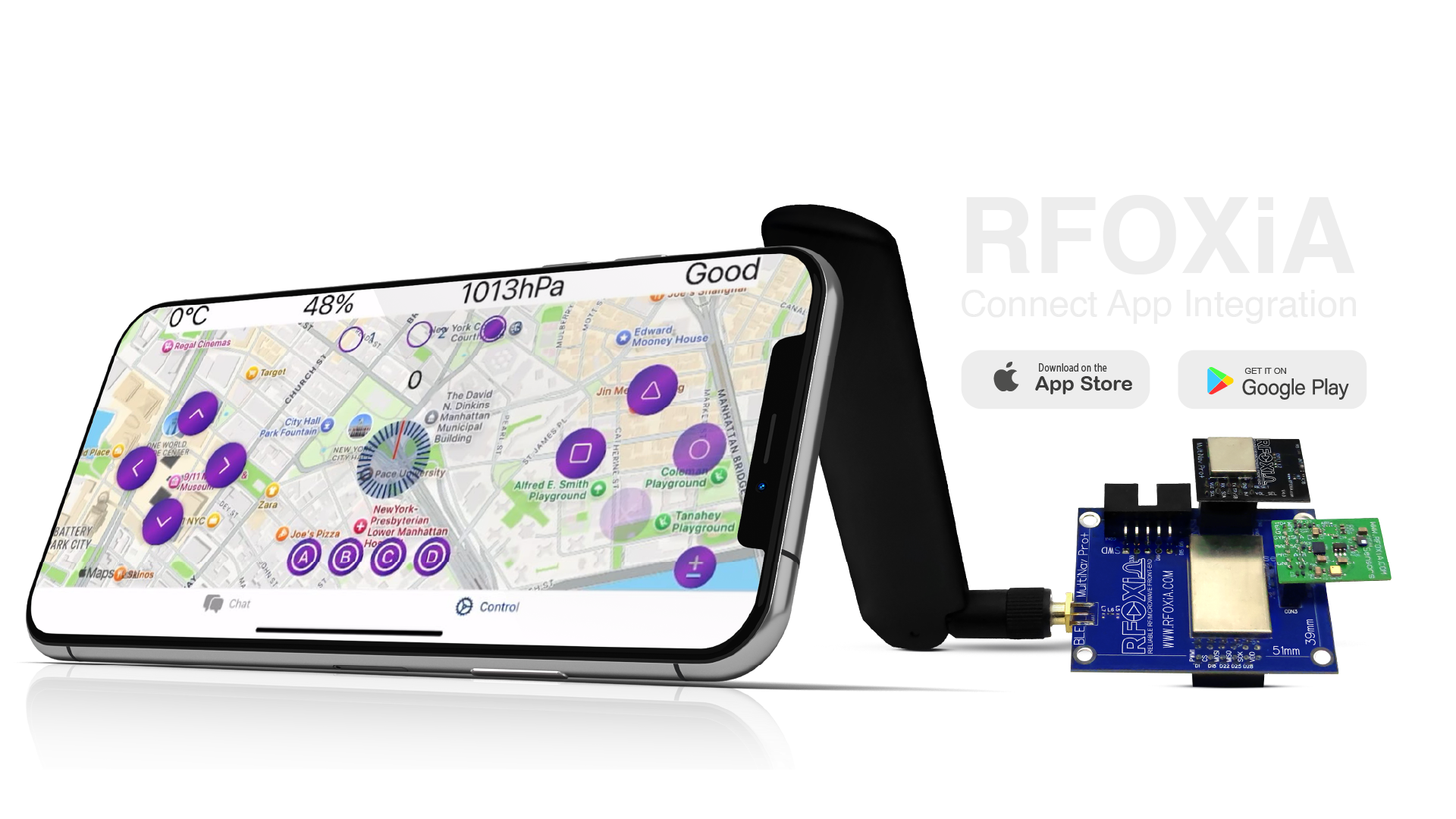
Every MultiNav Pro+ BLE module pairs with the RFOXiA Connect mobile application on iOS and Android. The app provides a PS5-style controller interface for drone and robot control, a live map with real-time GPS tracking, live sensor data visualization, and an automation center — all communicating directly with the BLE module over Bluetooth, with no internet connection required at any point.
BLE Chat: Internet-Independent Communication
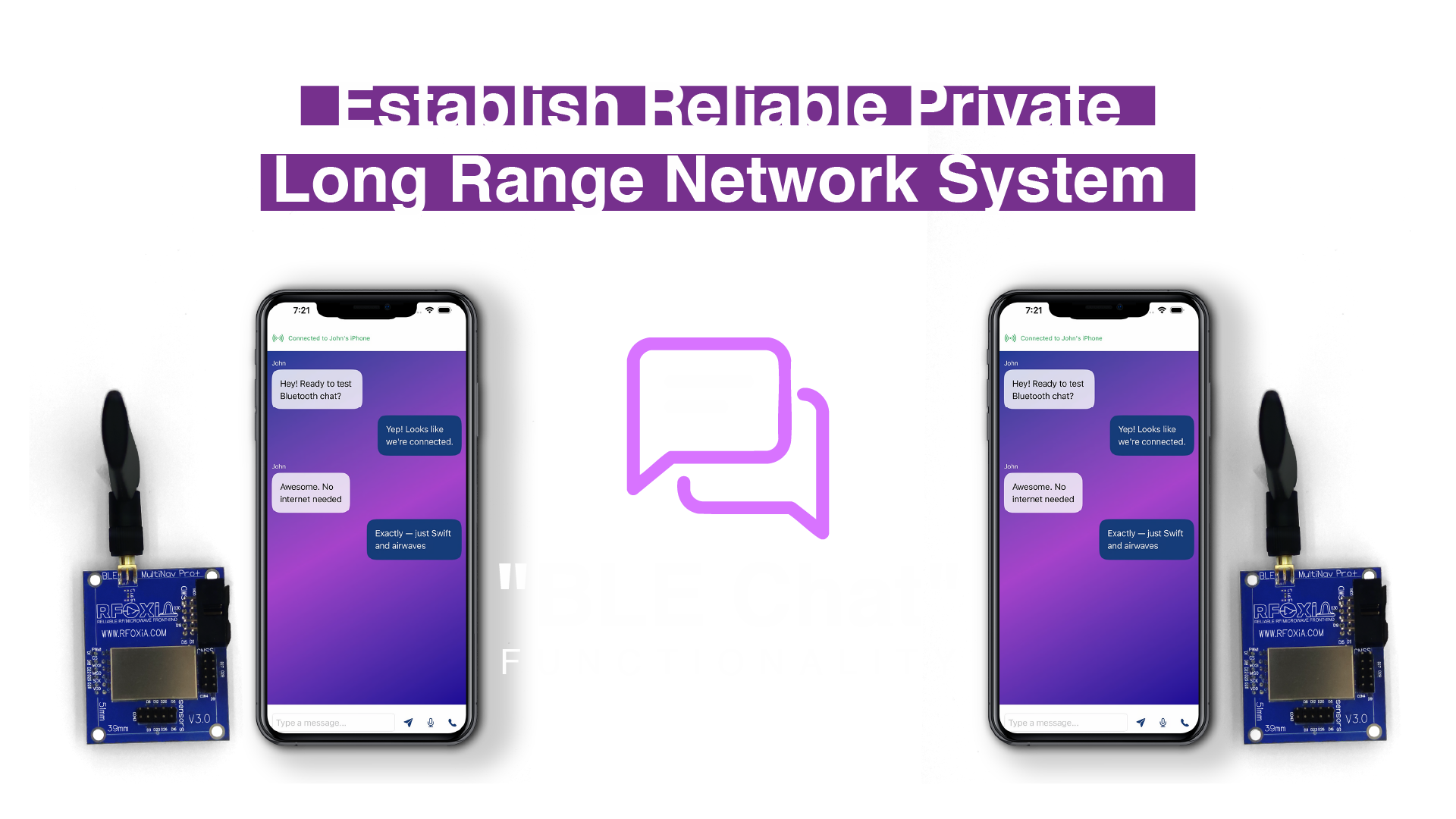
Beyond sensor data and control, the MultiNav Pro+ BLE enables direct device-to-device text, data, and voice communication between users through the BLE Chat functionality. This is peer-to-peer, mesh-capable, completely internet-independent communication — the kind of system that works when everything else has failed.
Hardware Design: Built for Real Deployments
Compact and Integration-Ready
At 57mm × 47mm, the MultiNav Pro+ BLE is sized for integration into real hardware projects — not lab benches. The fixing frame dimensions of 54mm × 34mm with corner mounting holes make mechanical integration straightforward. Whether you are mounting the module inside a drone frame, an enclosure for a field sensor node, or a custom handheld device, the form factor works.
Integrated RTC
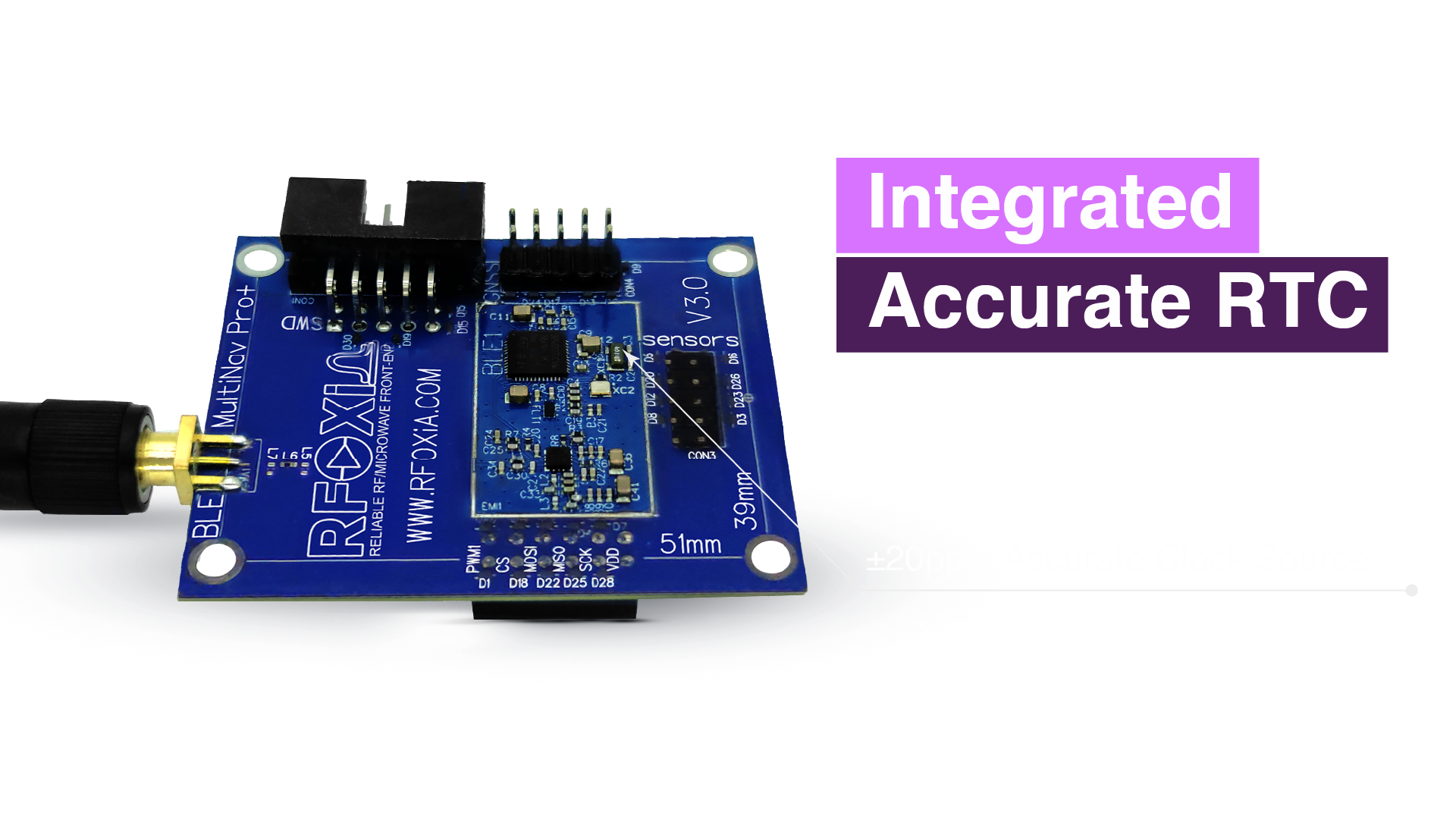
Precise timing matters in sensor networks. When you are logging environmental data, synchronizing communication between nodes, or timestamping telemetry from a moving platform, an accurate RTC is not optional. The MultiNav Pro+ BLE includes an integrated RTC crystal — a detail that separates professional hardware from hobby-grade solutions.
Open Source and Fully Programmable
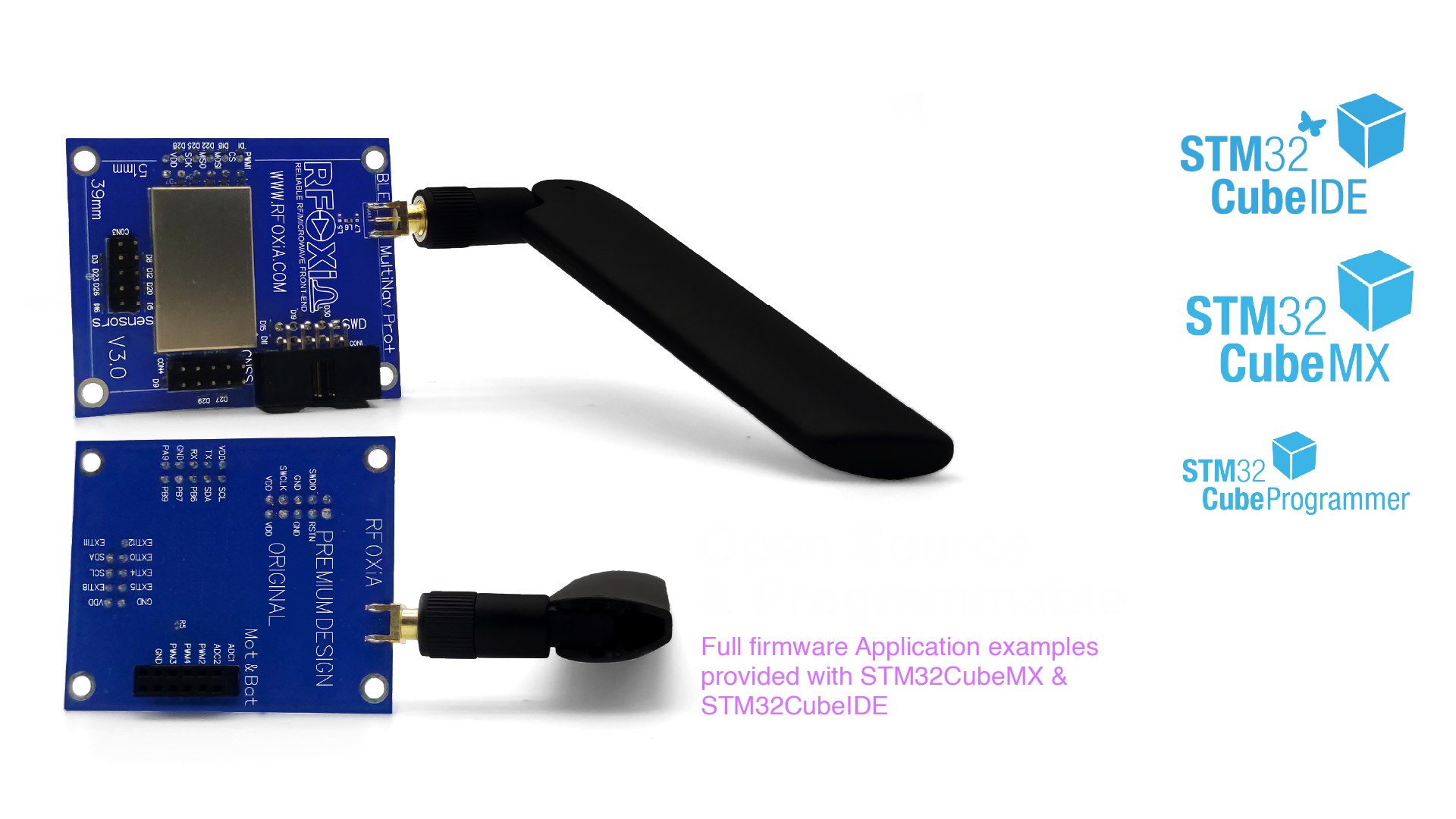
The MultiNav Pro+ BLE firmware is open source. Full customization is available via SWD programming interface. Developers can modify, extend, and replace the default firmware to suit any application. The GitHub repository at github.com/RFOXiA/MultiNav-Pro-Long-Range-BLE-Module-Firmware-STM32WB07 contains the complete firmware source.
For developers who want to build custom firmware without starting from scratch, the RFOXiA Club AI Firmware Builder allows you to describe your application in plain language and receive production-ready firmware code — reducing development time from months to hours.
FCC Certified and Ready to Deploy
This is not a development prototype waiting for certification. The MultiNav Pro+ BLE is fully FCC certified — which means it is legal to operate in the United States and accepted by major distributors and commercial customers. For builders integrating this module into products they intend to sell or deploy professionally, that certification is not a minor detail. It is the difference between a project and a product.
At $59 for two units, this represents a capability that previously cost thousands of dollars and required custom RF engineering to achieve. The RFOXiA Long Range Bluetooth Module ships ready to integrate.
The Data Network Advantage: Your IoT Sensor No Internet Required Can Still Earn
Here is where RFOXiA's ecosystem does something no other hardware provider offers: it pays you back.
When you deploy a MultiNav Pro+ Sensors module outdoors — tracking temperature, humidity, air pressure, air quality, and GPS location — you can contribute that verified environmental data to the RFOXiA data network. Enterprise buyers including agricultural technology companies, smart city operators, insurance firms, and research institutions purchase this hyper-local, high-resolution data.
You earn daily rewards for every verified data session your node contributes. Base rates run from $0.08 to $0.25 per day, with scarcity bonuses for nodes in data-sparse locations pushing the maximum to $0.40 per day.
Your IoT sensor no internet required for data transmission to your device still contributes to a monetized data network when you are home and connected. The module earns while you sleep.
Technical Specifications Summary
| Specification | Value |
|---|---|
| Range (ground-to-ground) | 5KM |
| Range (man-to-drone) | 15–20KM |
| Range (drone-to-drone) | 50KM |
| Data Rate | 2Mbps |
| Processing Core | STM32WB07CCV6 |
| Module Dimensions | 57mm × 47mm |
| Antenna Length | 140mm |
| Certification | FCC Certified |
| Interface | SWD (programmable) |
| App Compatibility | iOS & Android |
| Firmware | Open Source |
| Price (2 units) | $59 |
Who Should Be Using This Module
If you fall into any of these categories, the MultiNav Pro+ BLE should already be on your bench:
- Drone builders and FPV pilots who need a long-range control and telemetry link that does not depend on third-party infrastructure
- Robotics engineers building ground or aerial platforms that operate beyond Wi-Fi range
- IoT developers deploying sensor networks in environments where cellular and Wi-Fi coverage is unavailable, expensive, or unreliable
- Field researchers who need reliable data transmission from remote locations
- Search and rescue teams building communication systems that work when infrastructure is gone
- Agricultural operators monitoring large properties without relying on rural cellular coverage
- Makers and hardware enthusiasts who want professional-grade capability at a maker-accessible price
Anyone who has ever said "I need an IoT sensor no internet required" — this is the answer.
Getting Started
The MultiNav Pro+ BLE ships as a pair of two units at $59. Both units are FCC certified and ready to deploy. The RFOXiA Connect app (Android live, iOS pending) is available for immediate download. Full documentation, firmware source code, and AI-assisted firmware development tools are available inside RFOXiA Club — free to join, with a $10 welcome credit on signup.
For serious developers, the Developer Bundle combines the BLE Module, GNSS Module, Sensors Module, and Power/Program Kit into one integrated platform at $199 — the complete ecosystem for building autonomous wireless systems that operate entirely without internet infrastructure.
Ready to deploy a wireless system that does not ask permission from a cell tower? Explore the RFOXiA Long Range Bluetooth Module and see what 50KM of truly private, infrastructure-free connectivity makes possible.
Conclusion
The idea that IoT requires internet is a design assumption, not a physical law. The MultiNav Pro+ BLE module from RFOXiA makes that clear in the most direct way possible: 50KM of range, 2Mbps of throughput, a complete development ecosystem, FCC certification, and a price of $59 for two units.
For builders, engineers, researchers, and operators who need a deployable IoT sensor no internet required — one that actually works at professional distances, in real environments, without infrastructure dependencies — there is no comparable option at this price point. The market gap between an $8 commodity BLE chip and a $5,000 military radio system has been sitting open for years.
RFOXiA built the module that belongs in that gap.
Written by: Moamen Mohamed LinkedIn