
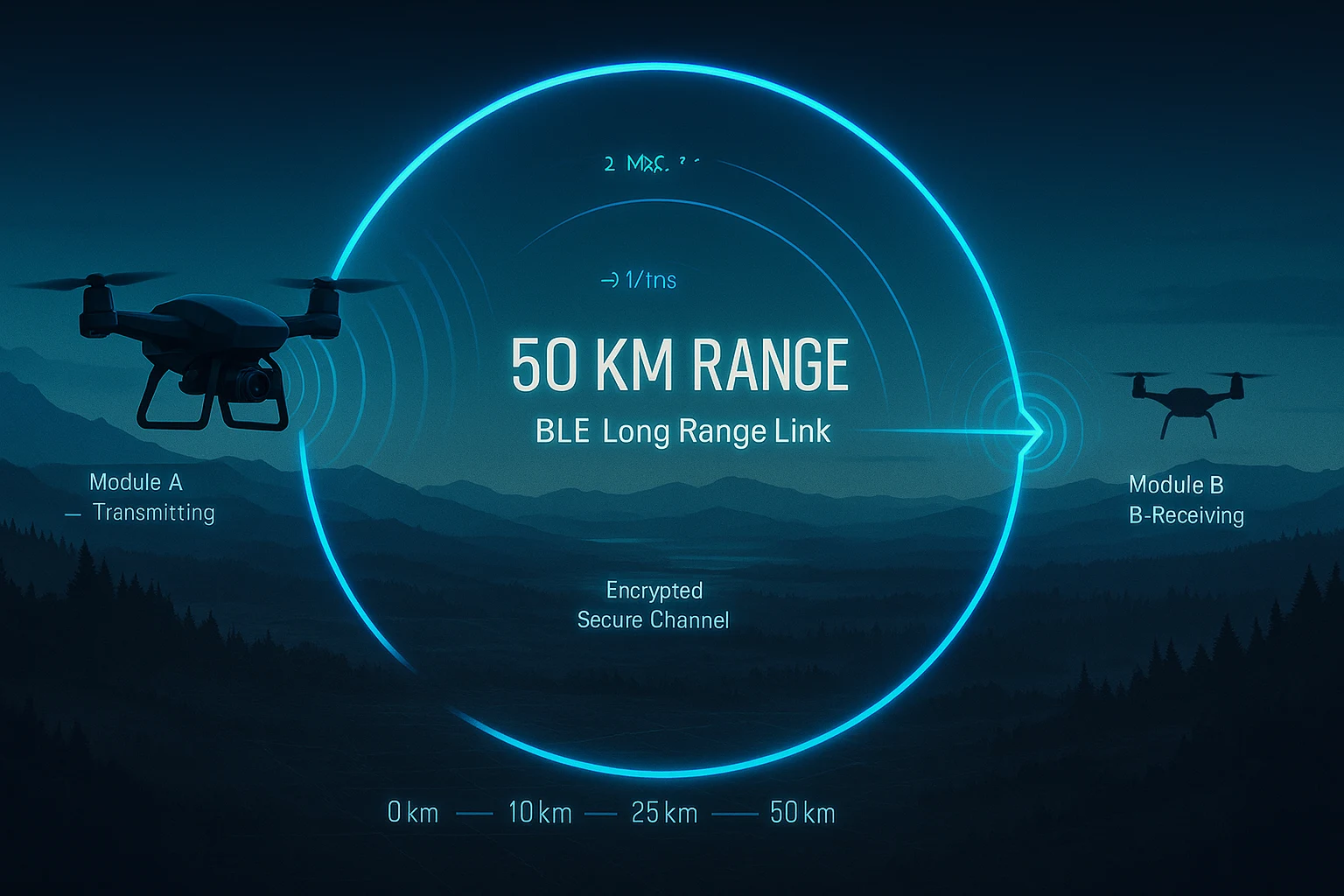
Long Range Bluetooth for Drone Control: The Complete Guide to 50KM Wireless Freedom
RFOXiA Long Range Bluetooth Module
Why Long Range Bluetooth for Drone Control Changes Everything
If you've ever pushed a drone to the edge of your controller's reach and watched the signal stutter, you already understand the problem. Traditional Bluetooth tops out at 80 to 100 meters in ideal conditions. RC systems using 2.4GHz or 900MHz proprietary protocols do better, but they come with locked ecosystems, no data streaming, and zero integration with the sensor payloads serious builders actually need.
The question the drone and robotics community has been asking for years is simple: why can't we have long range bluetooth for drone control that actually works at professional distances, integrates with real sensor data, runs without internet infrastructure, and costs less than a mortgage payment?
The answer is the MultiNav Pro+ BLE Module from RFOXiA.
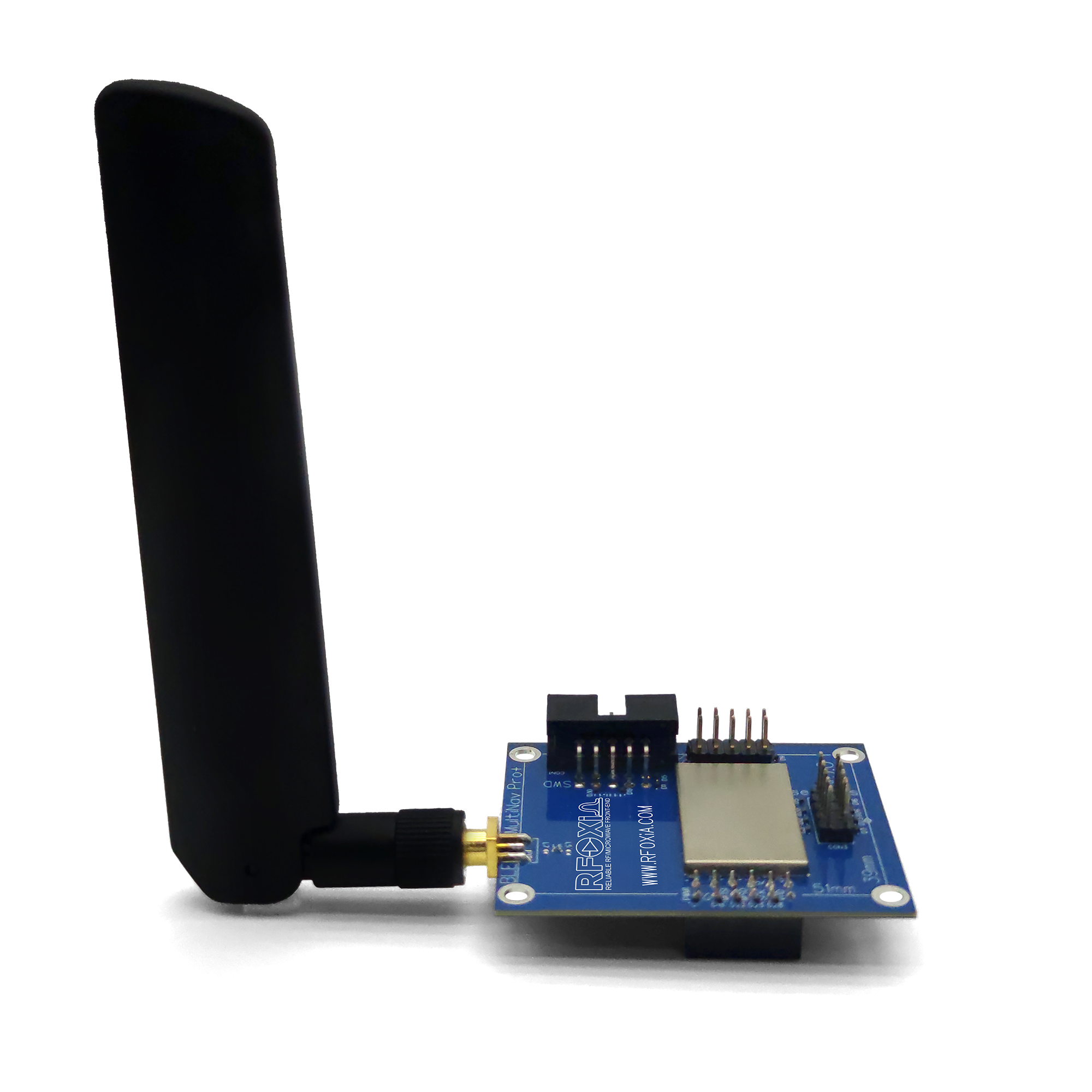
This is not a marketing claim dressed up in technical language. The MultiNav Pro+ BLE is FCC certified, ships from real inventory, and has been battle-tested by hundreds of backers across four completed Kickstarter campaigns. It achieves ranges that were previously reserved for military-grade RF systems — at a price point of $59 for two units.
Let's break down exactly what this module does, how it achieves these numbers, who it's built for, and why nothing else on the market competes at this price.
The Range Numbers — And What They Actually Mean
Range specs in the wireless world are notoriously optimistic. Manufacturers test in anechoic chambers, clear fields at altitude, or under conditions that no real deployment ever replicates. So when we talk about range, we need to be specific about the scenario.
Here is how the MultiNav Pro+ BLE performs across three real-world deployment configurations:
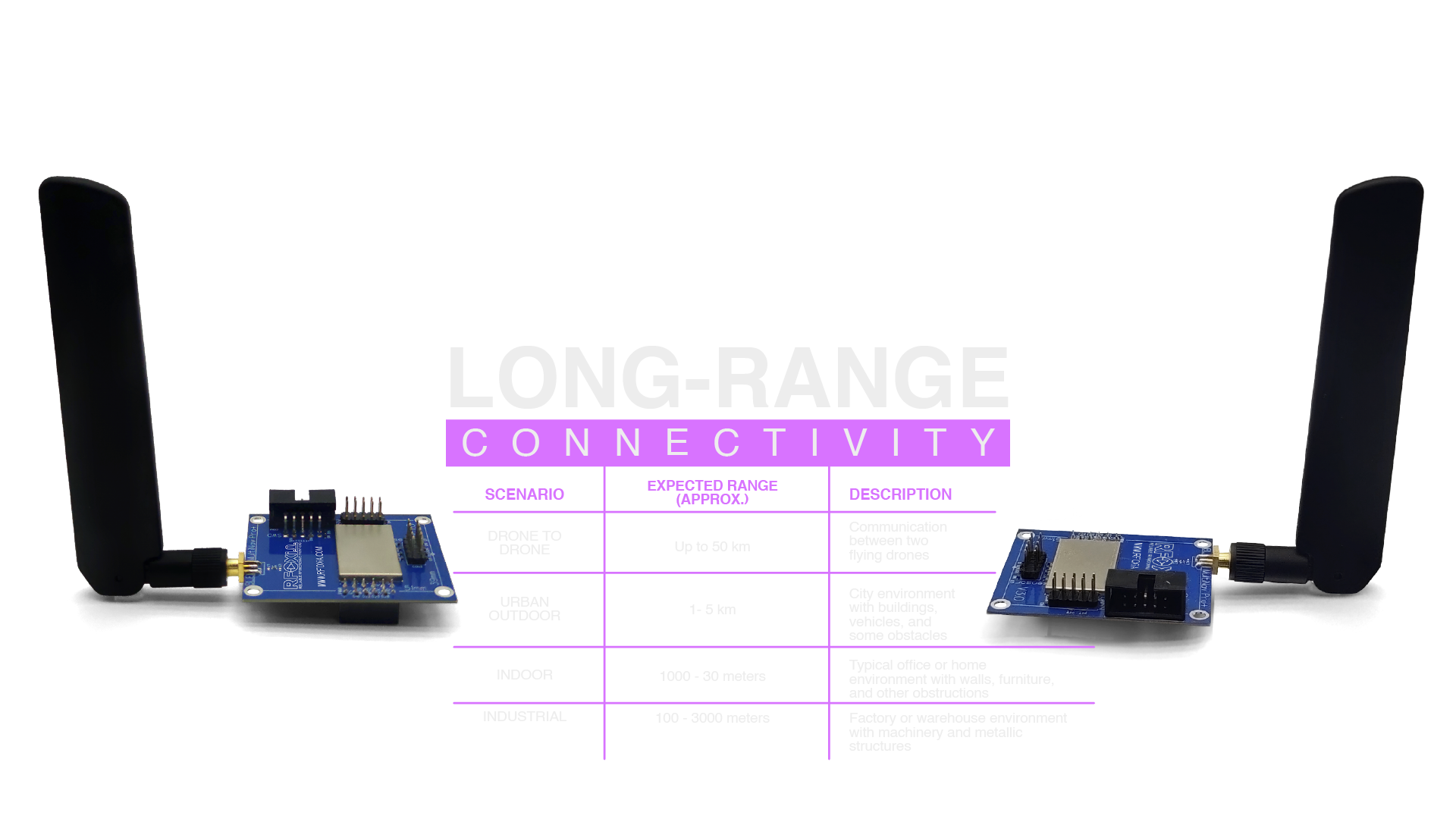
Ground to Ground (both modules paired with smartphones at ground level): Over 5KM. This is the most challenging configuration because ground reflections, obstacles, and multipath interference all work against the signal. 5KM ground-to-ground from a Bluetooth module is genuinely unprecedented at this price point.
Man to Drone (one module on a smartphone, one module on a drone): 15 to 20KM. As altitude increases, ground reflections disappear and line-of-sight improves dramatically. This is the primary use case for most drone builders using long range bluetooth for drone control.
Drone to Drone (both modules airborne): Beyond 50KM. With both nodes elevated and clear line-of-sight between them, the RF front-end of the MultiNav Pro+ achieves performance that puts it in the same category as systems costing fifty times more.
These numbers come from a combination of an optimized RF front-end design, external amplifiers integrated into the module's architecture, and advanced receiver sensitivity engineering. The underlying wireless protocol is Bluetooth Low Energy — the same BLE stack you'll find in your AirPods — but what RFOXiA has built around that stack is the key to the performance.
Hardware Architecture: What Makes the Range Possible
The STM32WB07CCV6 Processing Core
At the heart of the MultiNav Pro+ BLE is ST Microelectronics' STM32WB07CCV6 — a dual-core wireless SoC that handles both the BLE stack and user application logic simultaneously. This separation of concerns means your application code never competes with the radio stack for processing time, which translates directly into communication reliability at long range where packet loss margins are tighter.
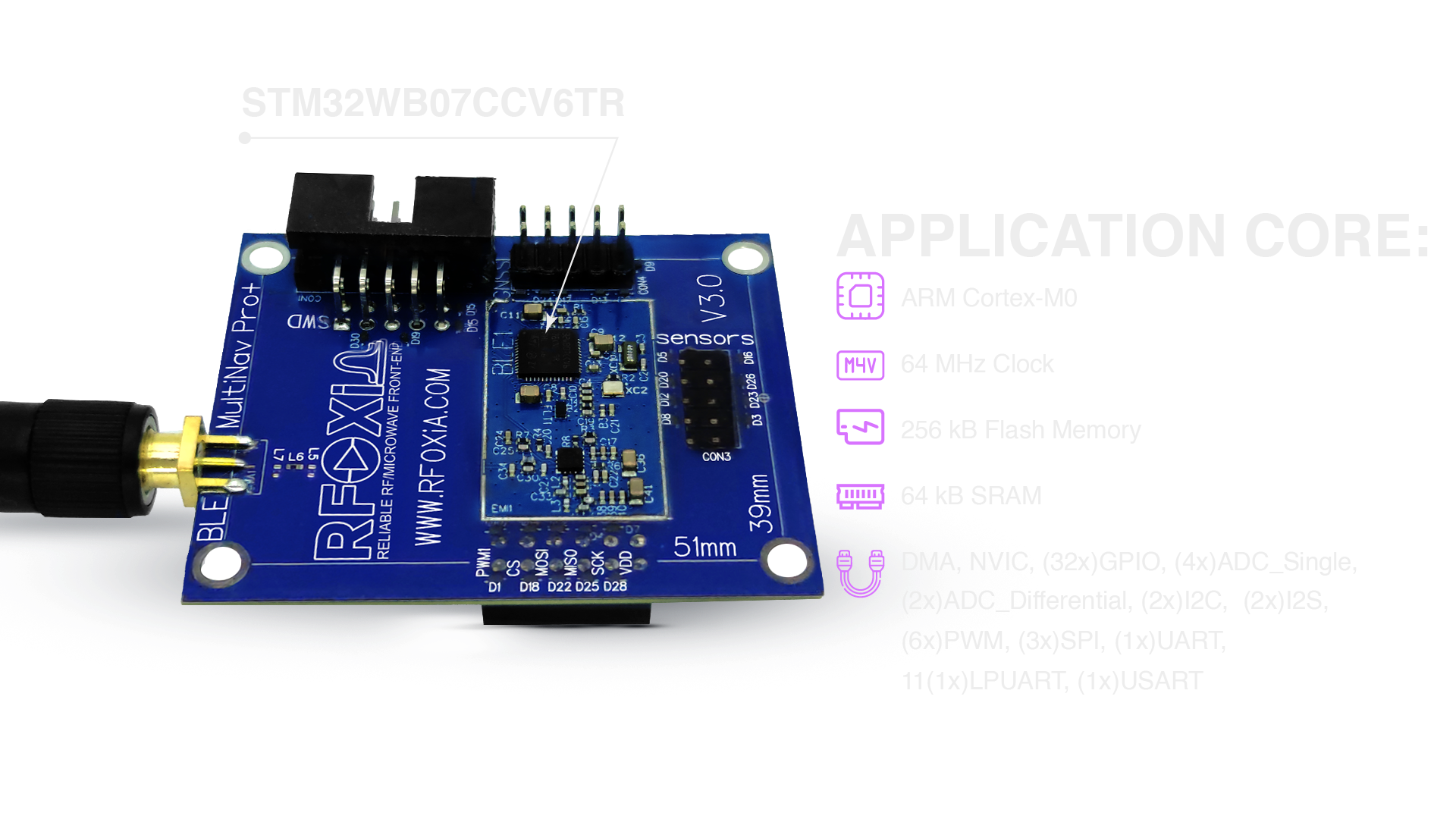
The STM32WB series was chosen specifically because it offers the best combination of BLE performance, processing headroom for user firmware, and power efficiency available in a single-chip solution. For applications where long range bluetooth for drone control is the primary objective, the radio sensitivity and output power characteristics of this chip — combined with RFOXiA's RF front-end design — are what make the 50KM figure achievable.
2Mbps Data Rate
Range without bandwidth is useless for most serious applications. The MultiNav Pro+ BLE supports the full 2Mbps BLE data rate, which means you're not choosing between range and data throughput. Telemetry, sensor streaming, GPS coordinates, actuator commands — all of it moves with minimal latency across the link.
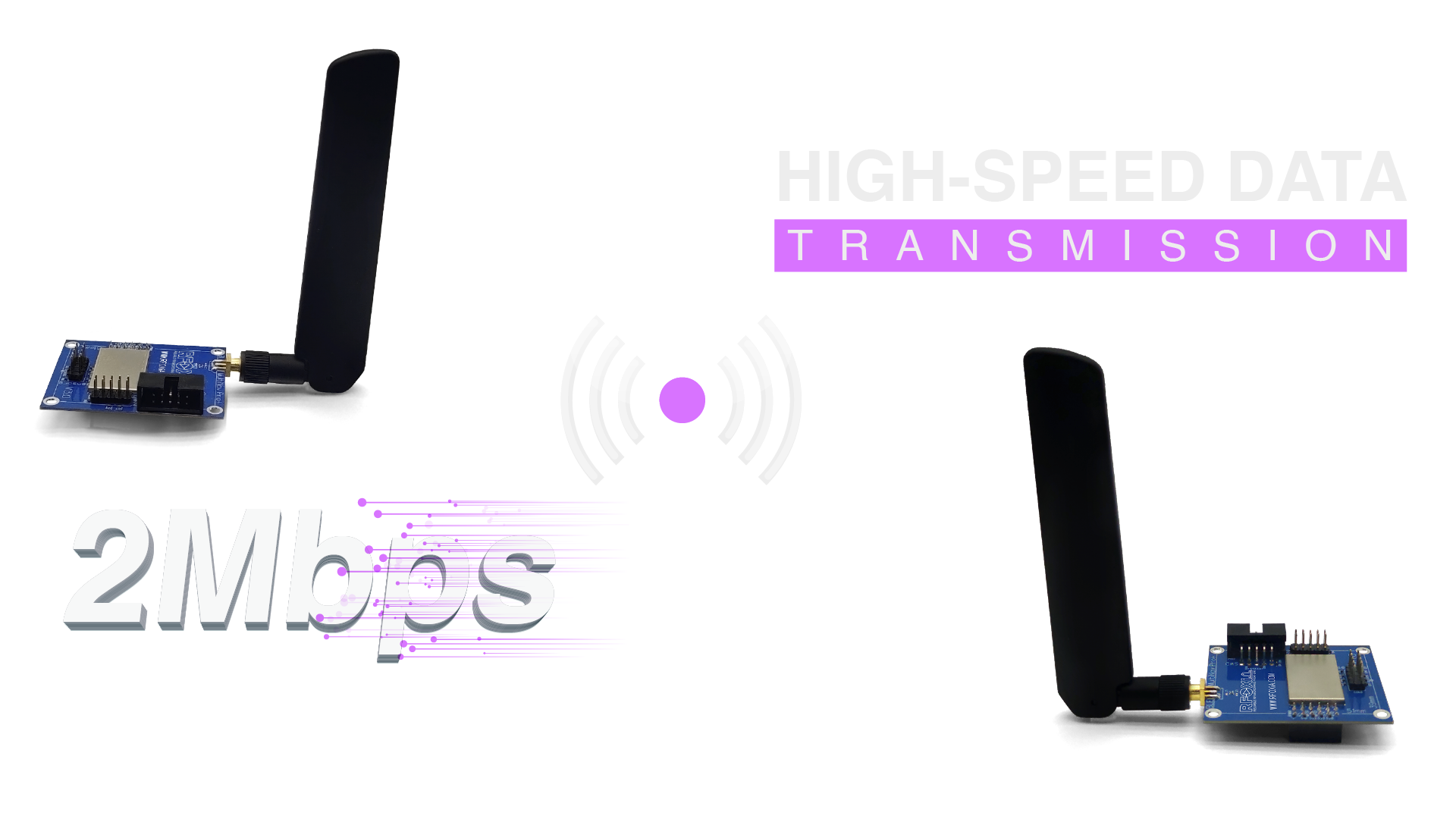
For a drone control application, this matters. You need command latency low enough that control inputs feel immediate. You need telemetry bandwidth sufficient to stream GPS coordinates, battery voltage, attitude data, and sensor readings simultaneously. The 2Mbps link budget of the MultiNav Pro+ handles all of this without compromise.
Integrated High-Gain Chip Antenna
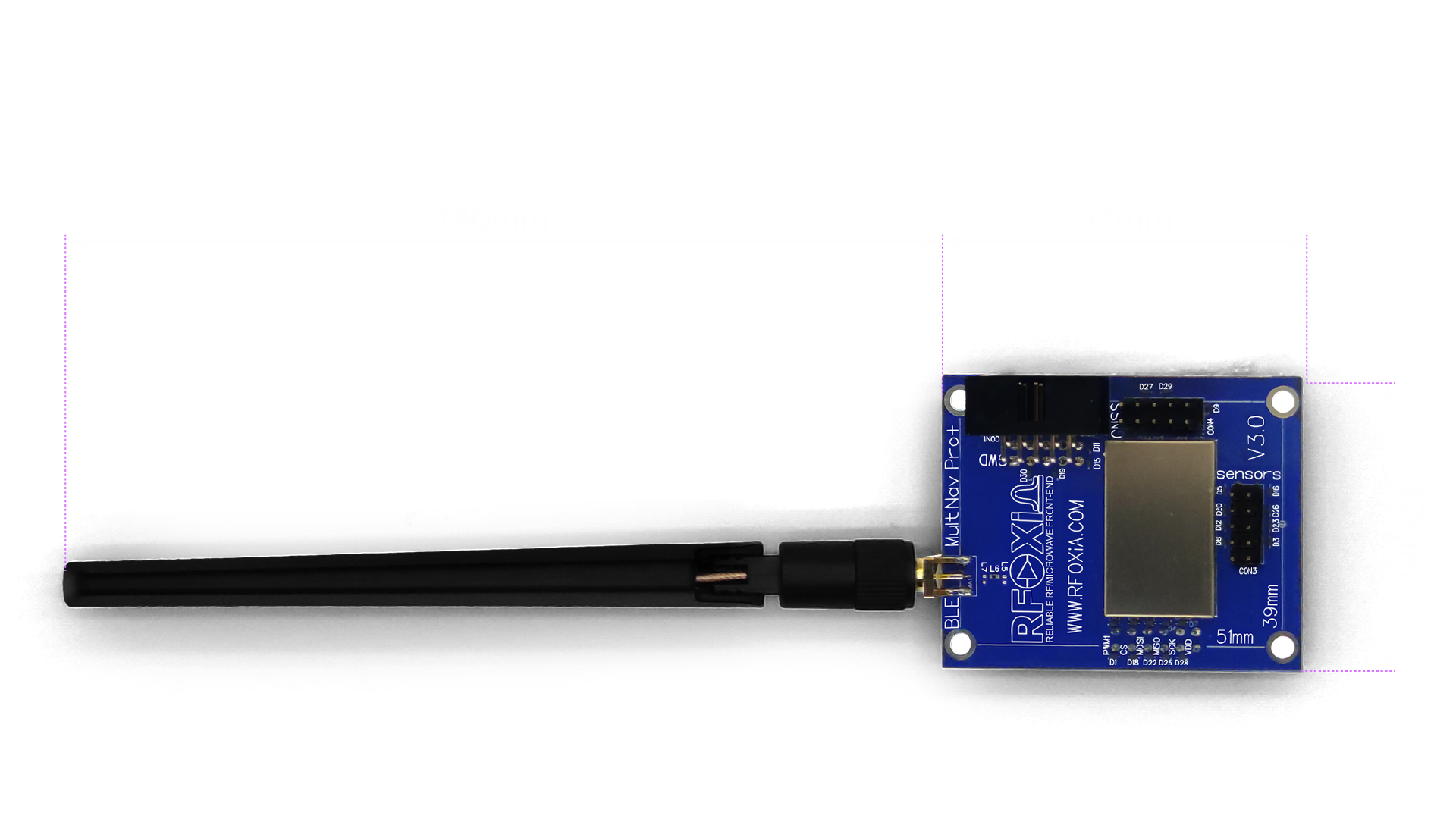
External antennas create mechanical complexity, failure points, and integration headaches. The MultiNav Pro+ BLE uses an integrated high-gain chip antenna with a 140mm antenna element that delivers strong directional gain without requiring external components. The module itself measures 57mm x 47mm with a fixing frame of 54mm x 34mm and corner mounting holes — compact enough to fit inside a drone frame, robust enough to survive real-world vibration and environmental exposure.
Integrated Accurate RTC
Time synchronization matters more than most builders realize until they're trying to correlate telemetry logs with GPS tracks or synchronize multi-node sensor networks. The MultiNav Pro+ BLE includes an integrated RTC crystal that provides precise timing reference without requiring an external clock source.
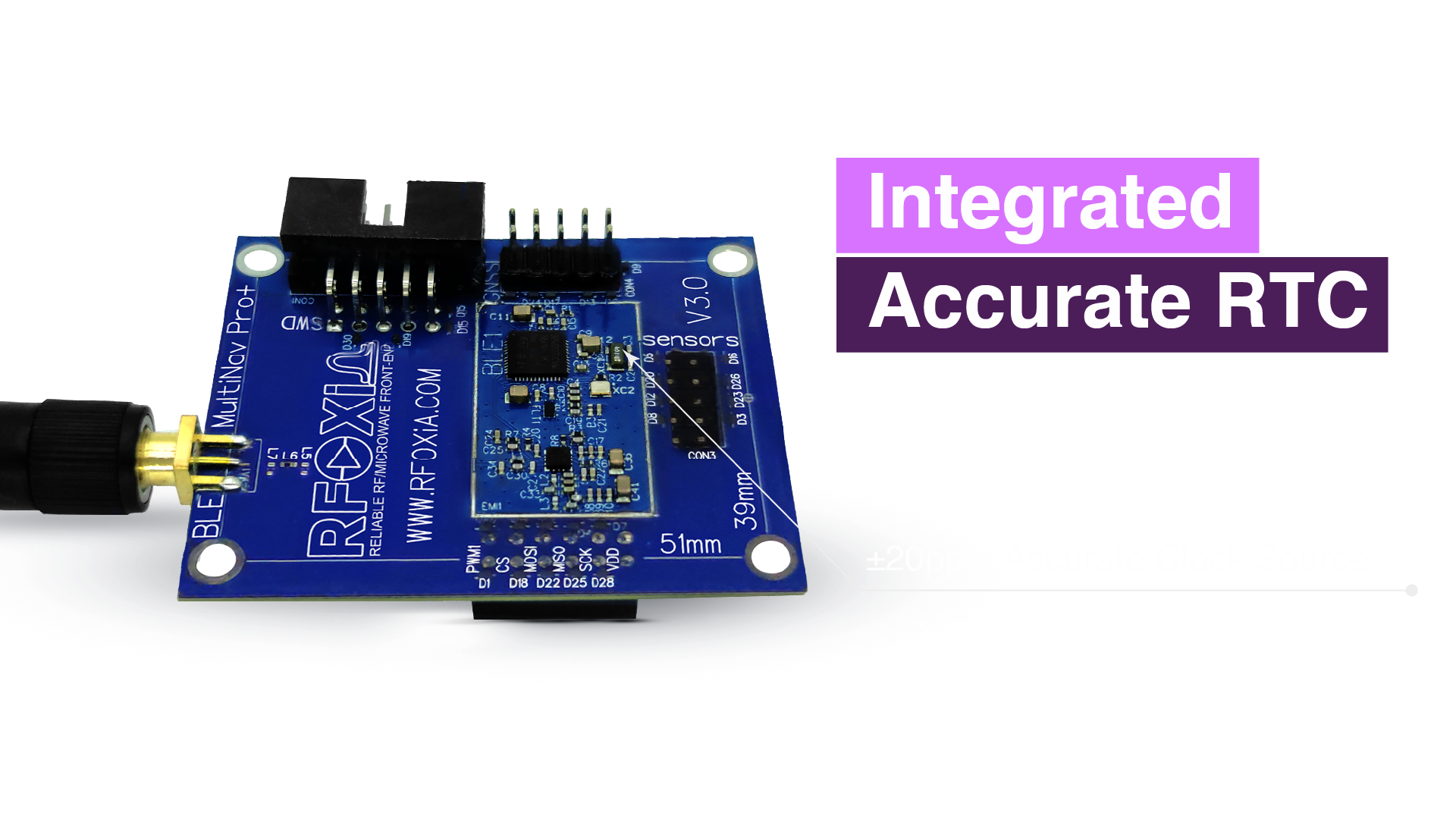
For applications like drone swarms, synchronized sensor networks, or any deployment where multiple modules need temporal alignment, this is not a nice-to-have — it's essential infrastructure.
The Ecosystem: Four Interfaces, One Unified Platform
The MultiNav Pro+ BLE module is designed from the ground up to be part of an integrated system, not a standalone component. Four distinct interfaces — GNSS, Sensors, Motors & Battery Management, and Programming — make it the connectivity backbone of any autonomous system you want to build.
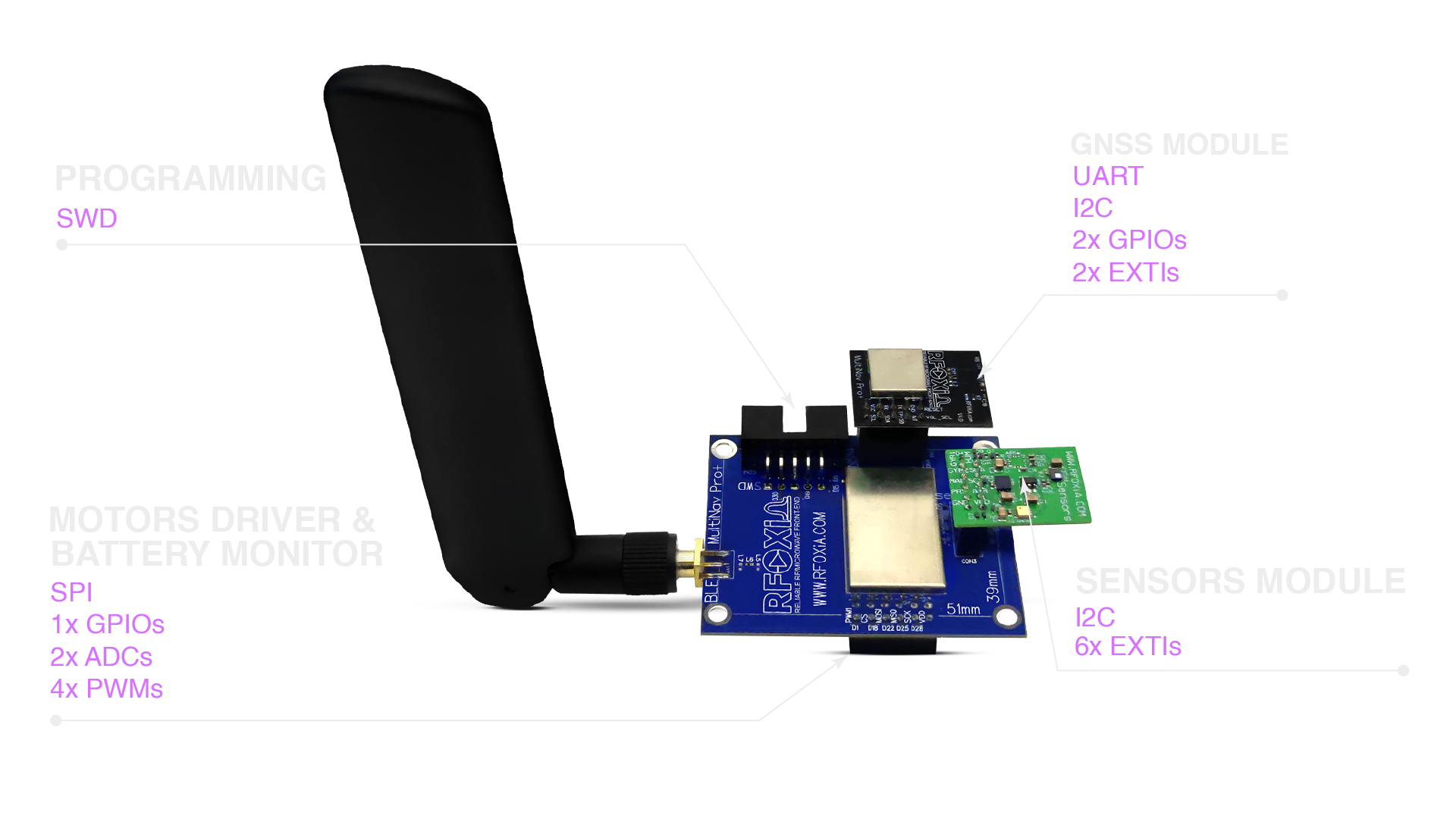
Pair it with the MultiNav Pro+ GNSS Module (1.5 meter accuracy, 18Hz fix rate) and you have real-time precision positioning streaming over your long-range BLE link. Add the Sensors Module (temperature, humidity, pressure, air quality, accelerometer, gyroscope, magnetometer) and your drone becomes an environmental monitoring platform while it flies. Connect the Power/Program Kit and your entire stack runs for 24 hours on a 5-minute supercapacitor charge.
This is the developer ecosystem that makes long range bluetooth for drone control more than just a radio link — it becomes the foundation of a complete autonomous platform.
For builders who want the complete stack, the RFOXiA Long Range Bluetooth Module is available as part of the Developer Bundle alongside all companion modules.
RFOXiA Connect App: Control Without Infrastructure
Hardware range means nothing if the control interface lets it down. RFOXiA developed the Connect App specifically to pair with the MultiNav Pro+ BLE module and unlock the full range capability through an interface that serious builders actually want to use.
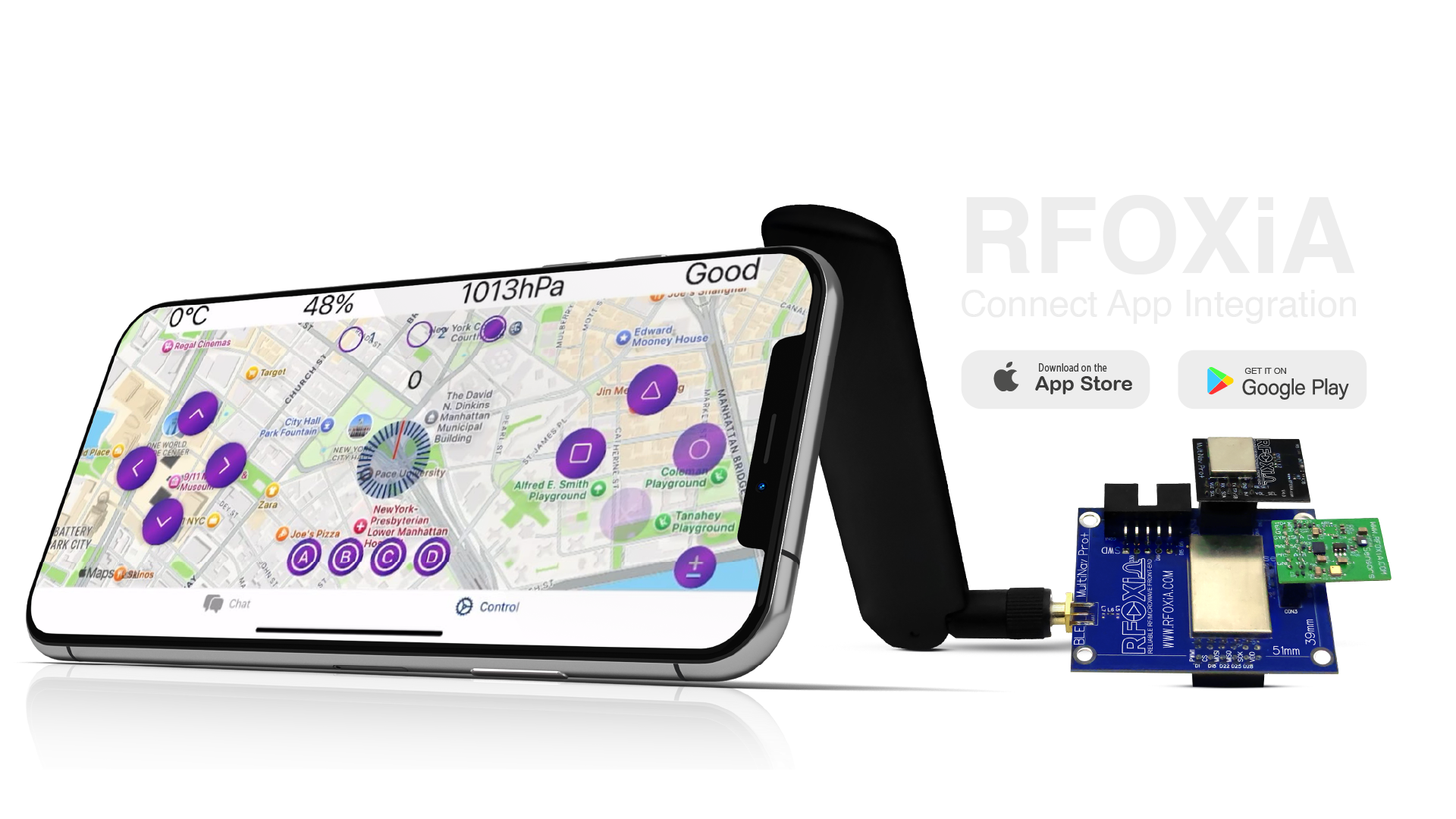
The Control Screen offers a PS5-style controller interface for drone and robot command inputs, a live map with real-time GPS tracking pulled from the GNSS module, and live sensor data display — all working simultaneously over the BLE link. No internet connection required. No cloud server dependency. No subscription. Your drone, your data, your infrastructure-free control link extending to 20KM.
The app is available now on Android, with iOS pending App Store approval.
BLE Chat: Mesh Communication Without Infrastructure
Beyond drone control, the MultiNav Pro+ BLE enables something that most builders don't expect from a BLE module: direct peer-to-peer communication between users, completely independent of cellular networks or WiFi.
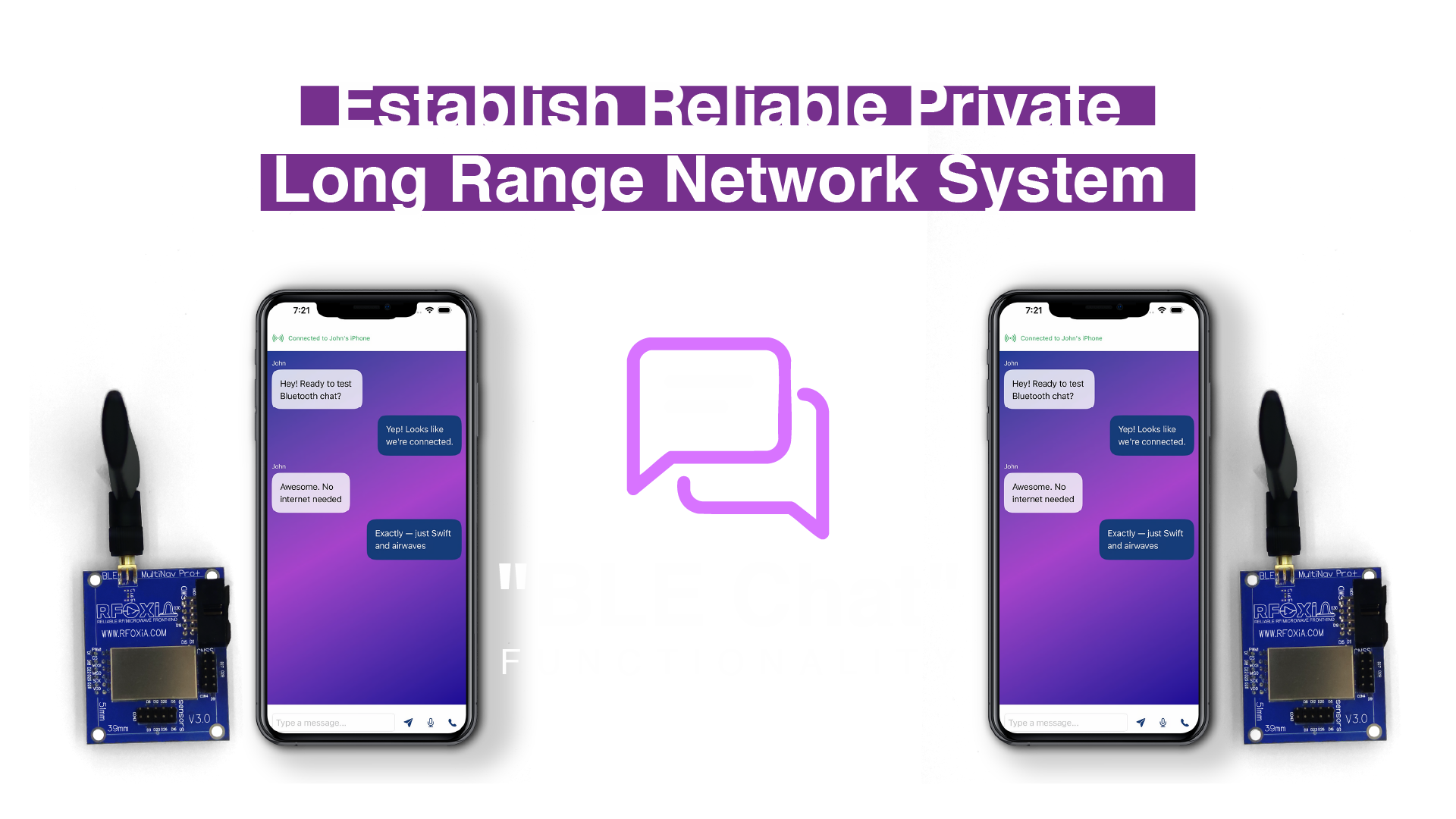
The BLE Chat feature built into the RFOXiA Connect App uses the MultiNav Pro+ BLE modules as communication nodes, creating a mesh network between users. Text, data, and voice communication across ranges up to 5KM ground-to-ground with no towers, no SIM cards, no internet.
The applications for this are significant: disaster response teams operating where cellular infrastructure has failed, field research teams in remote locations, FPV race coordinators needing reliable comms across a course, search and rescue operations in dead zones. Long range bluetooth for drone control is the headline feature — but the communication mesh is where this module opens doors that no other BLE hardware can.
Open Source and Fully Programmable
Closed ecosystems are a dead end for serious developers. The MultiNav Pro+ BLE is fully open source, with complete firmware available on GitHub and SWD programming access via the integrated interface.
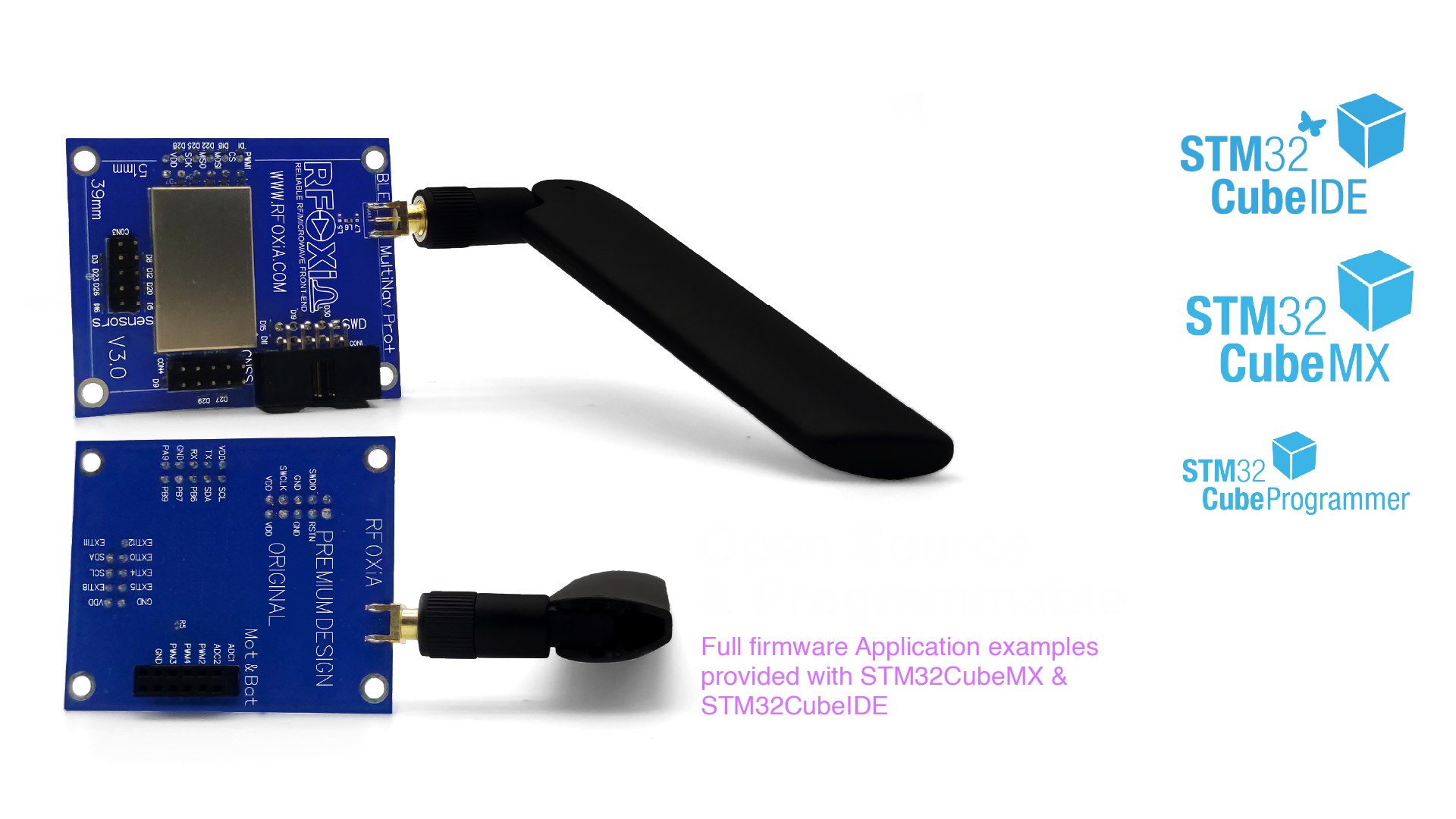
The full firmware repository is available at github.com/RFOXiA/MultiNav-Pro-Long-Range-BLE-Module-Firmware-STM32WB07. You can fork it, modify it, build on it, and contribute back.
For developers who want to build custom applications without spending weeks on firmware from scratch, RFOXiA Club includes an AI Firmware Builder — describe your application in plain language, and the AI generates production-ready firmware with full source code. The barrier to building something sophisticated on top of this hardware has never been lower.
FCC Certification: Why It Matters
Any wireless module operating in the 2.4GHz band in the United States legally requires FCC certification. Many modules sold on maker marketplaces operate in a grey zone — the module itself may be certified in its country of origin, but the end product is not. The MultiNav Pro+ BLE carries full FCC certification, which means:
- Legal operation in the United States without restriction
- Accepted by major distributors including DigiKey and Mouser
- Eligible for inclusion in FCC-compliant end products
- No risk of importation issues or regulatory seizure
For commercial drone builders incorporating long range bluetooth for drone control into a product they plan to sell, FCC certification on the communication module is not optional — it's a prerequisite.
Who This Module Is Built For
The MultiNav Pro+ BLE sits in a market position that previously didn't exist: professional-grade long-range wireless hardware at maker-accessible pricing. The $59 price for two units makes it accessible. The 50KM range makes it professional. The FCC certification makes it commercial.
This module is built for:
Drone builders and FPV pilots who need a reliable long-range control and telemetry link that integrates with sensor payloads and works without cellular coverage.
Robotics engineers building ground vehicles, underwater systems, or any platform that operates beyond the 100-meter range wall of commodity BLE.
IoT developers deploying sensors in remote locations where cellular coverage is absent or cost-prohibitive and where the long-range BLE link bridges the gap to a gateway.
Researchers in environmental monitoring, precision agriculture, wildlife tracking, and field data collection who need verified, high-resolution data from distributed sensor nodes.
Emergency response teams who need reliable communication and sensor networks in areas where infrastructure cannot be assumed.
If your application requires wireless connectivity beyond 100 meters and below military-system budgets, there is currently no competing product at this price point with these specifications.
Technical Specifications Summary
| Specification | Value |
|---|---|
| Wireless Protocol | Bluetooth Low Energy (BLE) |
| Range (Ground to Ground) | 5KM+ |
| Range (Man to Drone) | 15–20KM |
| Range (Drone to Drone) | 50KM+ |
| Data Rate | 2Mbps |
| Processing Core | STM32WB07CCV6 |
| Module Size | 57mm x 47mm |
| Antenna Length | 140mm (integrated) |
| Fixing Frame | 54mm x 34mm |
| RTC | Integrated crystal |
| Interfaces | GNSS, Sensors, Motors/Battery, Programming |
| Programming | SWD |
| Firmware | Open source |
| Certification | FCC |
| Price | $59 (2 units) |
The Competitive Gap No Other Product Fills
Let's be direct about the market landscape. Commodity BLE modules from Silicon Labs, Nordic, or Chinese manufacturers reach 80 to 100 meters. They're $5 to $15. They have no ecosystem, no app, no long-range RF front-end, and no path to the ranges that drone control requires.
At the other end of the spectrum, military and industrial long-range RF systems from manufacturers like DTC or Taisync reach 150KM+ but cost $5,000 to $50,000. They're not designed for makers, they're not open source, and they're not accessible to the builders who are actually pushing the boundaries of what drones and robots can do.
The MultiNav Pro+ BLE is the only product that occupies the space between these two extremes: genuine long-range wireless performance, professional-grade FCC certification, open source firmware, ecosystem integration, and a price that puts it within reach of individual builders and small teams.
For anyone seriously evaluating long range bluetooth for drone control, this is not a close competition — it's a category of one.
Getting Started with the MultiNav Pro+ BLE
The fastest way to evaluate the MultiNav Pro+ BLE for your application is to get the hardware in your hands. At $59 for two units, the cost of evaluation is lower than the engineering time you'd spend specifying alternatives that can't meet the range requirements anyway.
RFOXiA Club provides free access to documentation, firmware examples, the AI Firmware Builder, and the developer community. Sign up for free and receive a $10 welcome credit toward your first order. The entire ecosystem — hardware, firmware, app, and community — is accessible from day one.
For builders who want the complete platform, the Developer Bundle combines the BLE Module with the GNSS Module, Sensors Module, and Power/Program Kit into one integrated package at $199 after credits.
The RFOXiA Long Range Bluetooth Module page has full ordering details, inventory availability, and bundle options.
Conclusion: Long Range Bluetooth for Drone Control Is Here
The MultiNav Pro+ BLE module from RFOXiA delivers something the maker and drone communities have needed for years: a professionally engineered, FCC certified, open source long-range bluetooth solution for drone control that costs $59 for two units and reaches 50KM between airborne nodes.
It pairs with a purpose-built mobile app. It integrates with a full sensor and GNSS ecosystem. It supports mesh communication without any internet infrastructure. Its firmware is open source and AI-assisted development tools lower the barrier to customization to nearly zero.
If long range bluetooth for drone control is on your requirements list, there is one answer. Get the hardware, join the community, and build something that was impossible last year.
Explore the MultiNav Pro+ BLE Module and order yours today.
Written by: Moamen Mohamed LinkedIn