
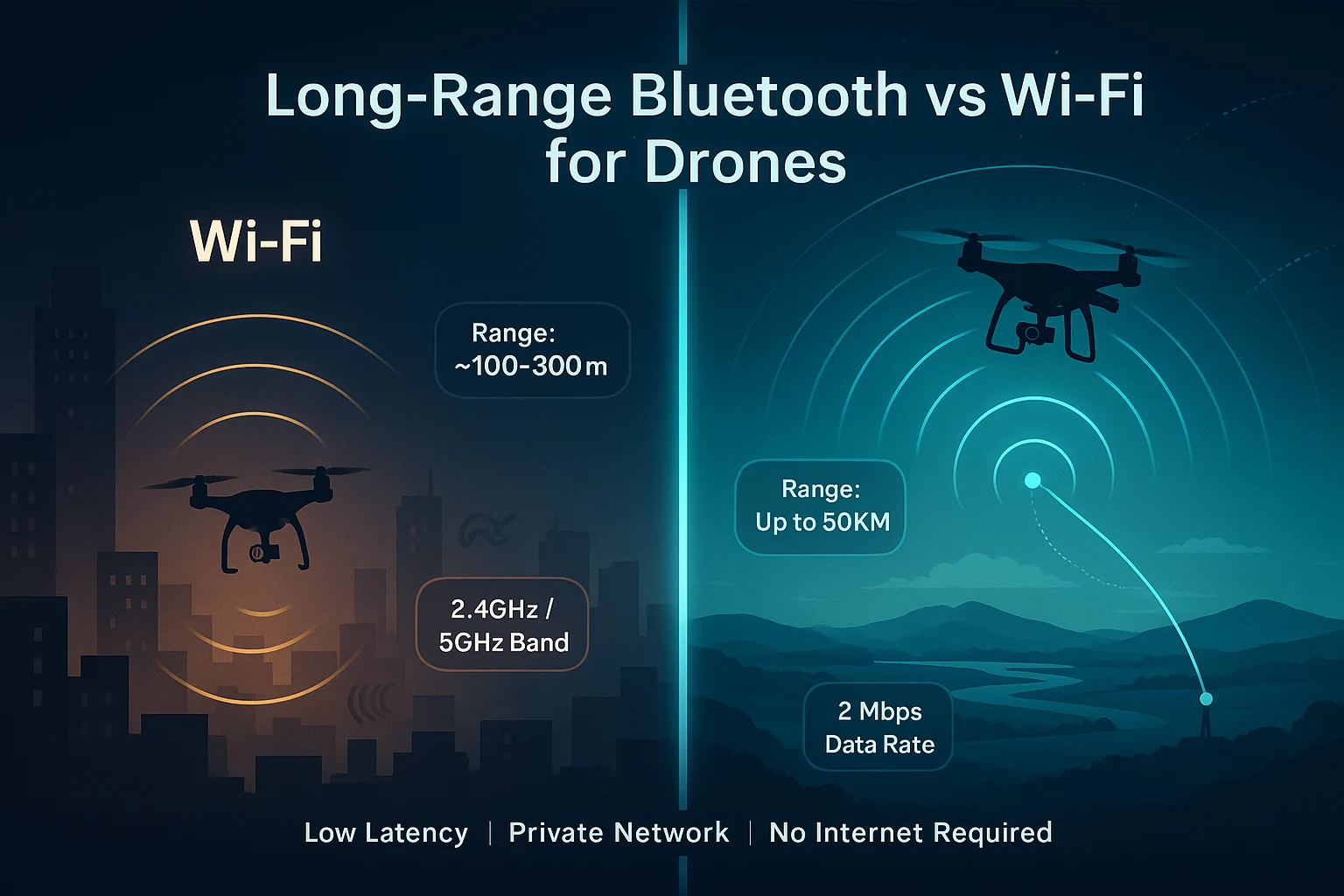
Long Range Bluetooth vs WiFi for Drones: Which Technology Actually Wins?
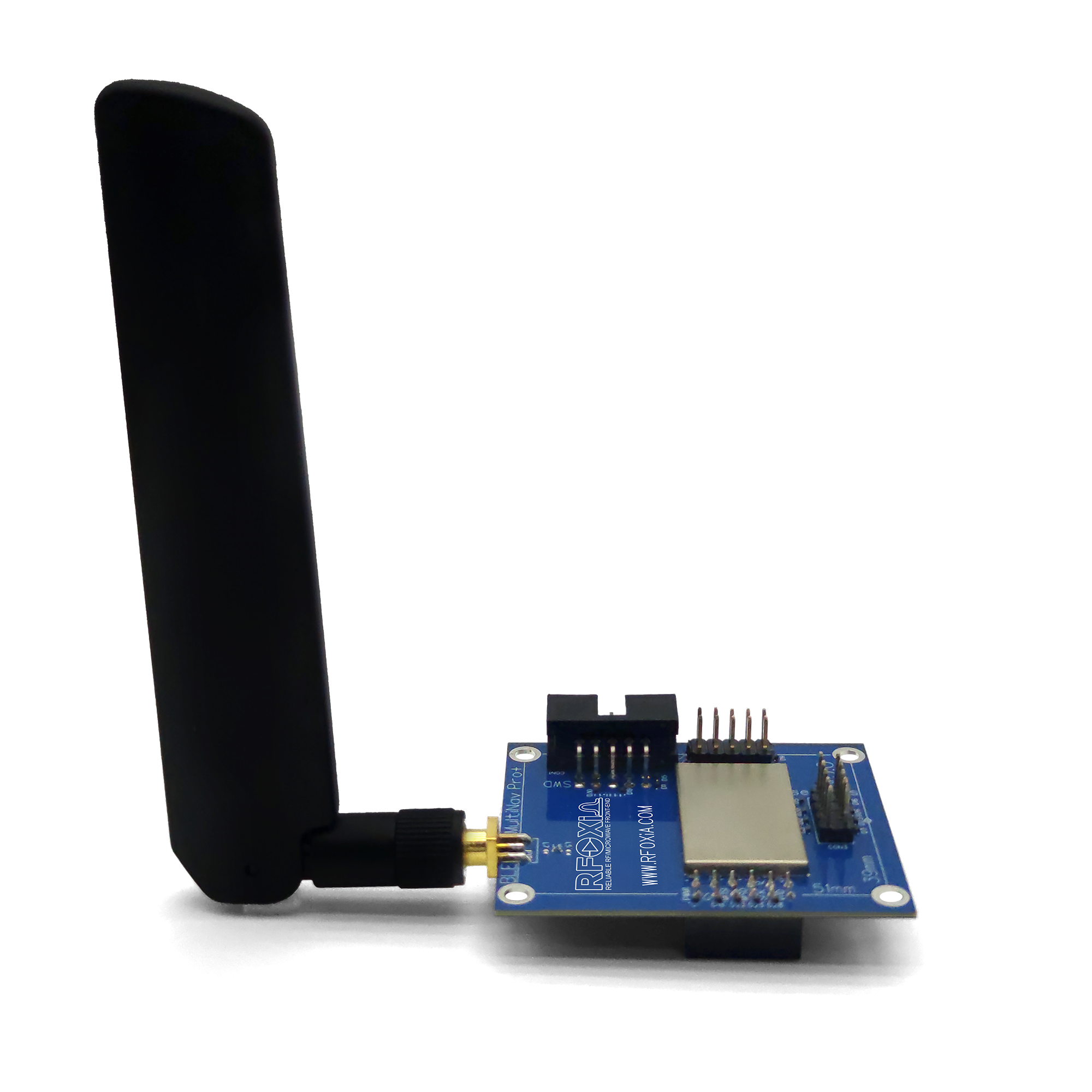
RFOXiA Long Range Bluetooth Module
Long Range Bluetooth vs WiFi for Drones — The Answer Most Builders Get Wrong
If you've ever asked which wireless technology is better for drone control and remote IoT, you've probably found conflicting answers. WiFi sounds powerful. Bluetooth sounds limited. But when you dig into the real numbers — range, latency, power consumption, and infrastructure dependency — the comparison between long range Bluetooth vs WiFi for drones becomes far less obvious than the conventional wisdom suggests.
This guide breaks down both technologies honestly, compares them across every metric that matters to drone builders, FPV pilots, robotics engineers, and IoT developers, and explains why a new generation of long-range BLE modules is completely rewriting the rules of what Bluetooth can do in the field.
What Standard WiFi and Standard Bluetooth Were Actually Designed For
Before comparing them for drone applications, it's worth understanding what both technologies were originally engineered to solve.
WiFi (802.11) was designed to replace wired ethernet connections inside buildings. It was built for high-bandwidth, moderate-range indoor connectivity — streaming video, transferring files, connecting laptops to routers. The typical indoor range is 30–50 meters. Outdoor range with a clear line of sight can extend to 150–300 meters under ideal conditions, but walls, interference, and signal absorption from terrain degrade this dramatically.
Standard Bluetooth (Classic and BLE) was designed as a short-range cable replacement for consumer devices — headphones, keyboards, health trackers. Standard BLE operates in the 2.4GHz ISM band with output power typically capped at 0–4dBm. The practical range for commodity BLE modules is 10–100 meters depending on environment and antenna quality.
Neither technology was engineered for the outdoors, for moving platforms, or for kilometer-scale communication. That's the baseline everyone needs to accept before comparing them.
Range: The Most Important Metric for Drone Applications
For any drone application — whether you're building an FPV racer, an autonomous survey drone, a search and rescue platform, or a remote monitoring system — range is the foundational constraint.
WiFi Range for Drones
Stock WiFi modules used in consumer drones (like DJI's OcuSync predecessors or early WiFi-based toy drones) typically achieve:
- Indoor/suburban environments: 50–150 meters
- Open field, clear line of sight: 300–500 meters with standard hardware
- High-power directional WiFi (802.11ac/ax with external antennas): Up to 1–2 kilometers under ideal conditions
Some specialized long-range WiFi solutions using directional antennas and high-power amplifiers can push further, but these systems are bulky, power-hungry, require careful antenna alignment, and cost significantly more than commodity hardware.
Long-Range BLE for Drones
This is where the comparison gets interesting — and where most people's assumptions about Bluetooth fall apart.
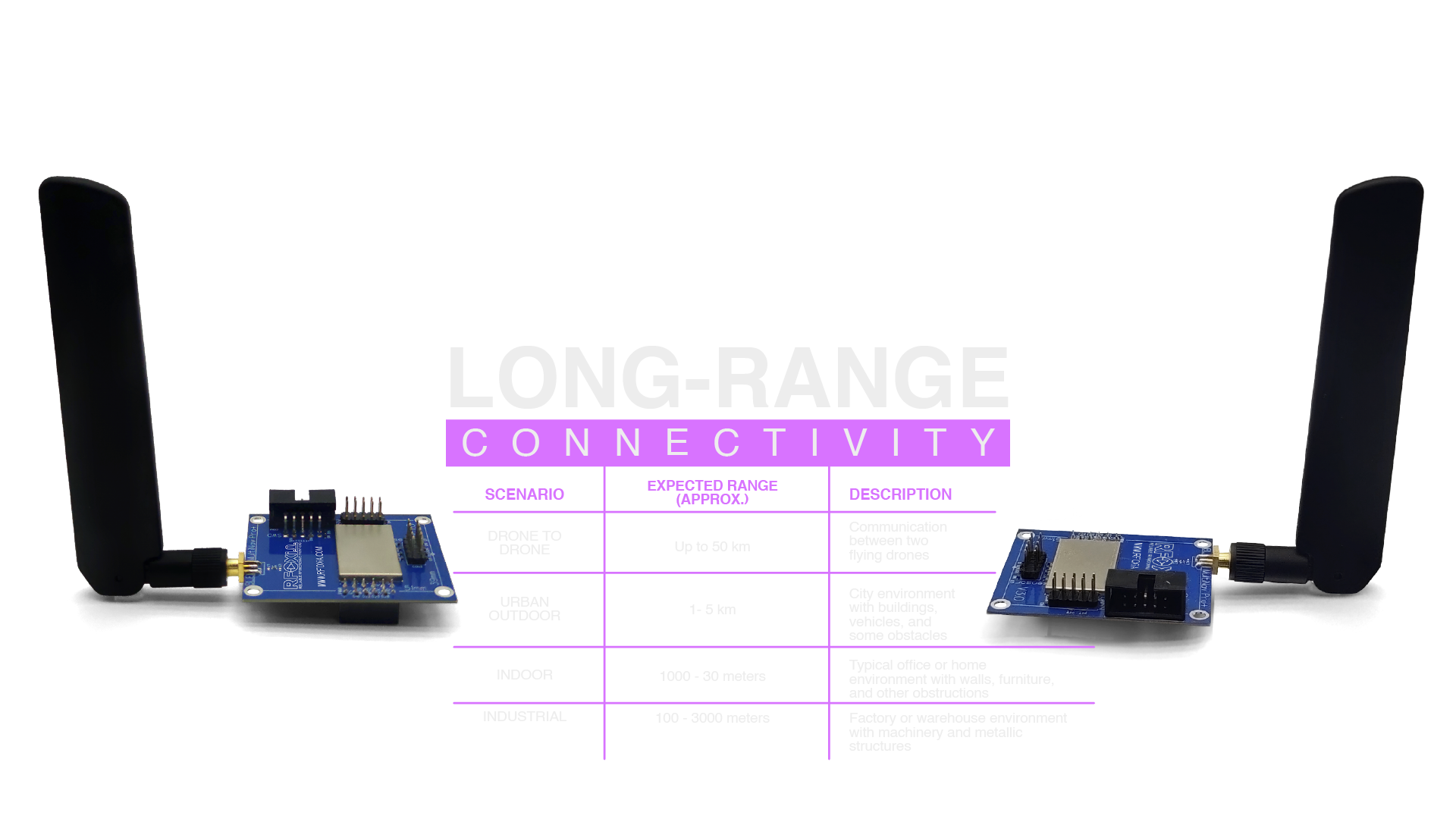
Modern long-range BLE modules built with optimized RF front-ends, external amplifiers, and advanced receiver sensitivity achieve ranges that commodity modules cannot approach:
- Ground-to-ground (phone to phone via BLE module): 5KM
- Man-to-drone (phone on ground, BLE module on drone): 15–20KM
- Drone-to-drone (both modules airborne, no ground reflection): 50KM
The RFOXiA MultiNav Pro+ BLE module achieves these figures in real-world conditions — not anechoic chamber lab tests. The elevation gain when a module is mounted on a drone eliminates ground-level multipath interference and dramatically extends the usable range.
Range verdict: Long-range BLE wins decisively for drone applications. The 50KM drone-to-drone range is not achievable with any WiFi solution at a comparable price point.
Latency: Does It Matter for Drone Control?
For drone flight control, latency is critical. A 200ms delay between stick input and motor response is the difference between smooth flying and a crash. Even for autonomous drones, sensor data latency affects flight stability.
WiFi Latency
WiFi was designed for throughput, not latency. Standard WiFi communication involves:
- CSMA/CA collision avoidance overhead
- TCP/IP stack processing
- Variable latency depending on channel congestion
- Typical application-layer round-trip latency: 20–150ms on uncongested networks, significantly higher in congested RF environments
In outdoor environments where your drone is operating near urban areas, WiFi networks from nearby infrastructure flood the 2.4GHz and 5GHz bands. This interference directly increases latency and packet loss.
BLE Latency
Bluetooth Low Energy's connection interval system allows for highly predictable, low-latency communication. With properly configured connection parameters:
- BLE connection interval: 7.5ms minimum
- Application-layer latency for control signals: 10–30ms in clean RF environments
- Latency impact of distance: Minimal — BLE latency is largely constant across its operational range
Latency verdict: BLE offers more predictable, lower-latency communication for drone control, especially in RF-congested environments where WiFi performance degrades significantly.
Power Consumption: The Payload Tax on Your Drone
Every gram and every milliwatt matters on a drone. Communication hardware that drains your battery fast reduces flight time. Heavy hardware reduces payload capacity.
WiFi Power Consumption
WiFi modules are power-hungry by design. A typical WiFi radio in active transmission mode consumes:
- 802.11n/ac module, active TX: 200–400mA at 3.3V (660mW–1.3W)
- With amplifiers for extended range: 800mA–1.5A (2.6W–5W)
For a drone with a 5000mAh 4S LiPo battery providing 3–4A for communication hardware, the power draw is significant and directly reduces flight time.
BLE Power Consumption
BLE was engineered specifically for low power operation. Even high-performance long-range BLE modules consume a fraction of what WiFi requires:
- BLE module, active connection: 15–50mA typical
- Long-range BLE with amplified RF front-end: 80–150mA during peak transmission
- Idle/standby: Under 5mA
The MultiNav Pro+ BLE module's 57mm × 47mm form factor and low power consumption make it genuinely suitable for even small-frame drones where space and weight are premium constraints.
Power verdict: BLE wins by a significant margin. The power efficiency advantage translates directly into longer flight times and greater design flexibility.
Infrastructure Independence: The Killer Advantage Nobody Talks About
Here's the question that separates serious drone builders from casual users: What happens when there's no internet, no cellular towers, and no WiFi infrastructure in range?
WiFi's Infrastructure Problem
Most WiFi-based drone communication systems rely on a hotspot, a router, or a cellular-tethered device as an intermediary. This creates hard dependencies:
- No router = no communication
- Cellular dead zone = system failure
- Interference from other networks = degraded performance
- Long-range outdoor WiFi requires dedicated access point hardware
For search and rescue, agricultural surveying in remote fields, offshore industrial inspection, or any operation in infrastructure-sparse environments, WiFi's dependency on external networks is a fundamental limitation.
BLE's Infrastructure-Free Operation
Long-range BLE modules communicate directly — device to device, without any infrastructure in between. The RFOXiA MultiNav Pro+ creates a private, free wireless network between two endpoints. No router. No internet connection. No cellular signal required.
This enables use cases that WiFi cannot support:
- Drone control in remote wilderness locations
- Disaster response communication when cellular infrastructure is down
- Offshore platform monitoring with no land-based connectivity
- Agricultural operations in rural areas without cellular coverage
- Military and defense applications requiring communication independence
Infrastructure verdict: BLE wins completely. A private 50KM network that requires zero external infrastructure is one of the most powerful capabilities available to drone builders today.
Data Rate: Where WiFi Has a Real Advantage
This is where honest analysis requires acknowledging WiFi's genuine strength.
WiFi Data Rate
- 802.11n (2.4GHz): 72–150 Mbps
- 802.11ac (5GHz): 433 Mbps – 1.3 Gbps
- 802.11ax (WiFi 6): Up to 9.6 Gbps theoretical
For applications requiring high-definition video streaming from drone to ground station, WiFi's bandwidth advantage is real and significant.
BLE Data Rate
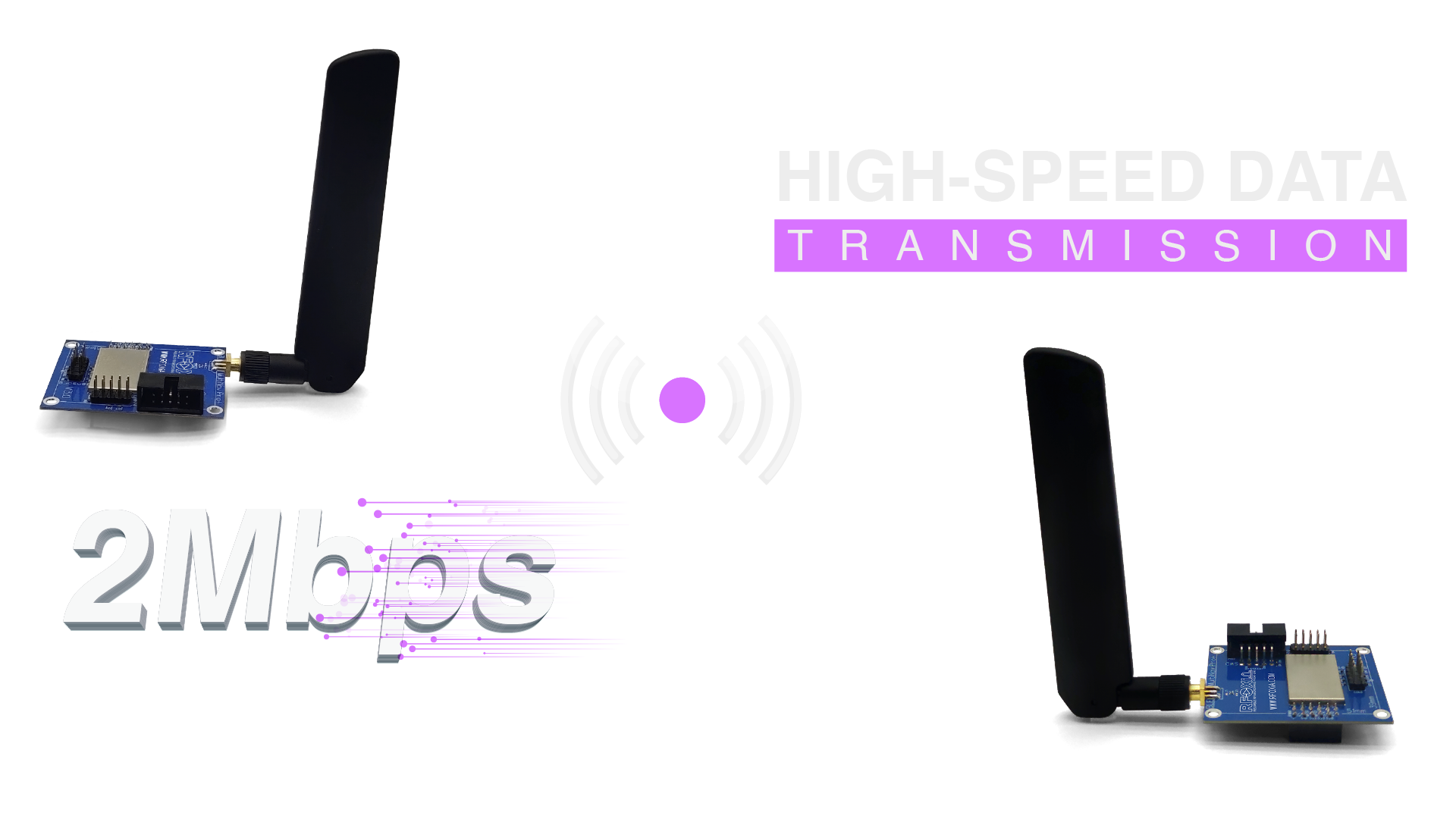
- Standard BLE: 1 Mbps
- BLE 2M PHY (Bluetooth 5.0+): 2 Mbps
- Long-range BLE (Coded PHY): 125 Kbps – 500 Kbps (trades rate for range)
The MultiNav Pro+ BLE module supports 2 Mbps data rate — sufficient for telemetry, control signals, sensor data streaming, GPS coordinates, and compressed data payloads. It is not suitable for raw HD video streaming.
Data rate verdict: WiFi wins for high-bandwidth video applications. BLE wins for control, telemetry, sensor data, and communication — which covers the majority of drone data link requirements. Most drone control protocols require only 10–100 Kbps of actual bandwidth.
Security and Privacy: The Overlooked Factor
WiFi networks broadcast on shared spectrum using standardized protocols. Your drone's control signal travels over infrastructure that others can see, intercept, and potentially jam or spoof. WiFi security vulnerabilities are well-documented.
Long-range BLE creates a direct encrypted link between two specific devices. There is no shared infrastructure for an attacker to target. The communication is device-paired and session-specific, making interception significantly more difficult.
For professional, industrial, and defense-adjacent drone applications, this security architecture matters.
The Complete Picture: Head-to-Head Comparison Table
| Metric | Standard WiFi | Long-Range BLE (MultiNav Pro+) |
|---|---|---|
| Max range (drone-to-drone) | 1–2 km (high-power) | 50 km |
| Max range (ground-to-ground) | 300–500m | 5 km |
| Latency | 20–150ms (variable) | 10–30ms (consistent) |
| Power consumption | 200–1500mA | 15–150mA |
| Infrastructure required | Yes (often) | None |
| Data rate | Up to 1+ Gbps | 2 Mbps |
| Frequency band | 2.4GHz / 5GHz | 2.4GHz |
| FCC certified | Varies | Yes (MultiNav Pro+) |
| Price for 2-node system | $30–$200+ | $59 |
| Ecosystem integration | Limited | Full (GNSS, Sensors, App) |
Why the MultiNav Pro+ BLE Module Changes the Comparison Entirely
Most discussions of long range Bluetooth vs WiFi for drones treat Bluetooth as a single, static technology. The reality is that engineered long-range BLE systems occupy a completely different performance category from commodity modules.
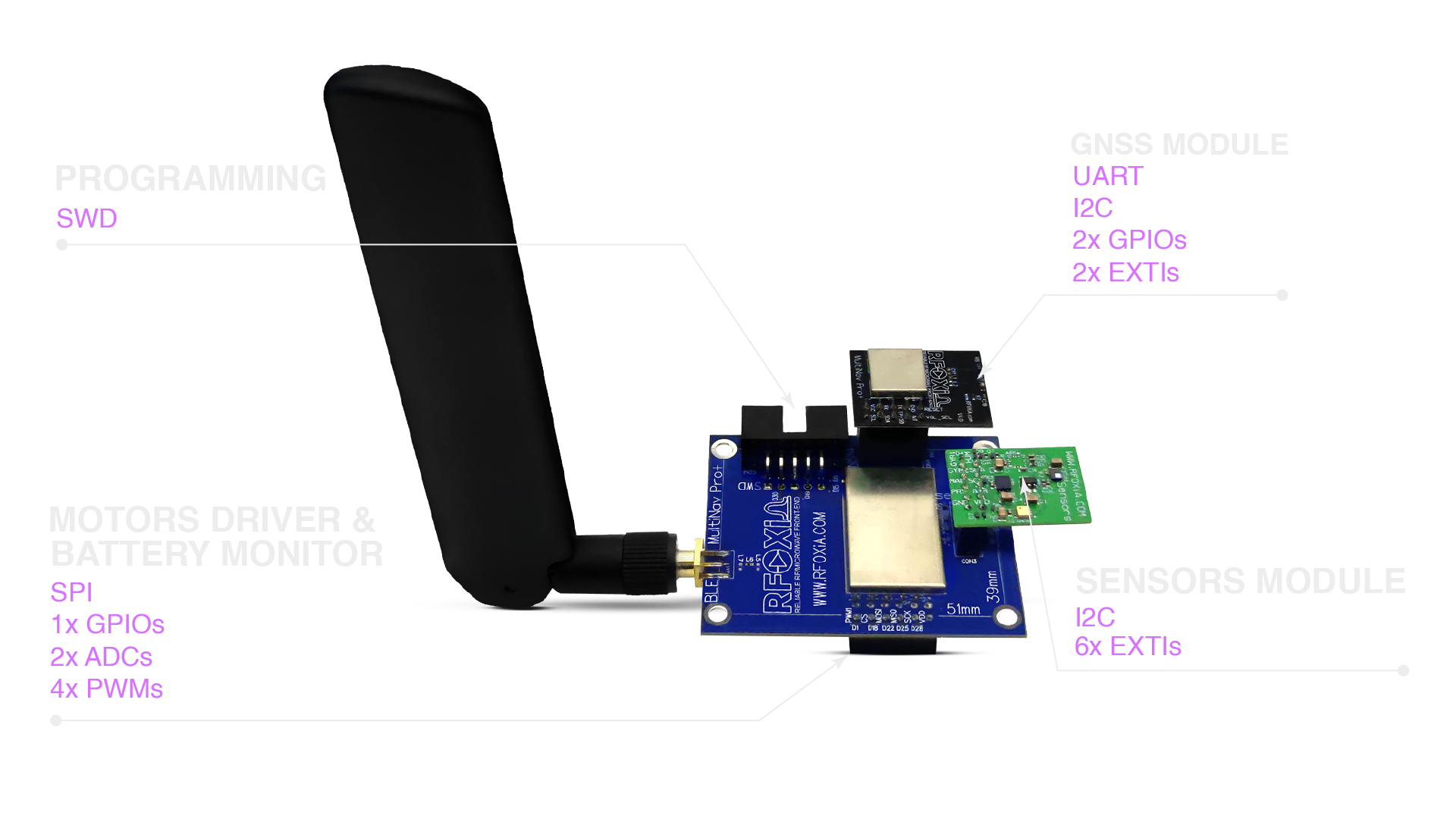
The RFOXiA MultiNav Pro+ is built around the STM32WB07CCV6 — a powerful processing core that manages the BLE stack and user applications simultaneously, delivering optimal performance and flexibility.
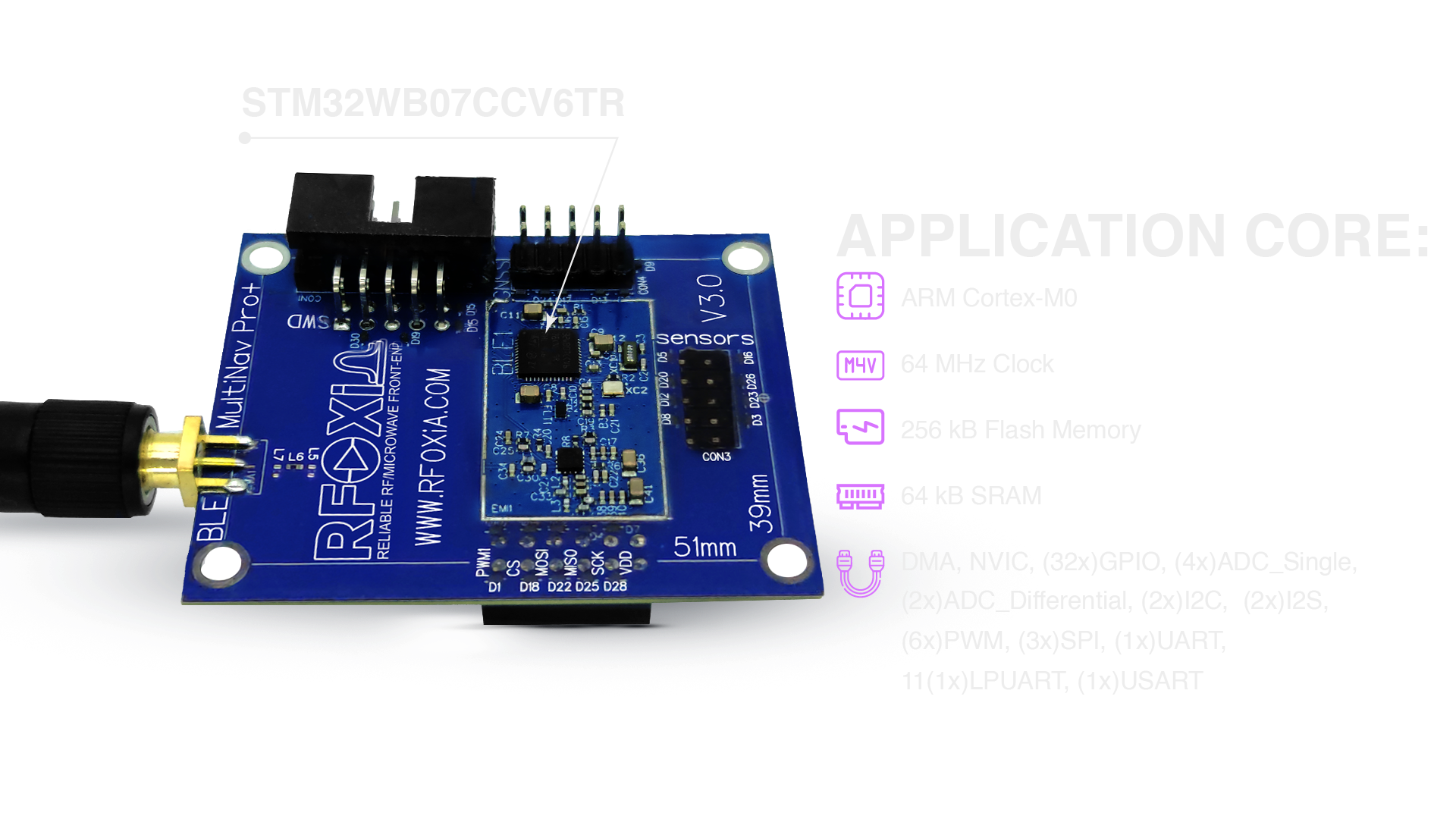
It achieves its 50KM range through:
- Optimized RF front-end design
- External amplifier integration
- Advanced receiver sensitivity
- High-gain integrated chip antenna (no external antenna required for ground use)
- 140mm antenna option for maximum range configurations
This is not commodity BLE. This is professional-grade wireless hardware at a maker-accessible price — a category that simply didn't exist at this price point before.
The Ecosystem That Makes It a Platform, Not Just a Module
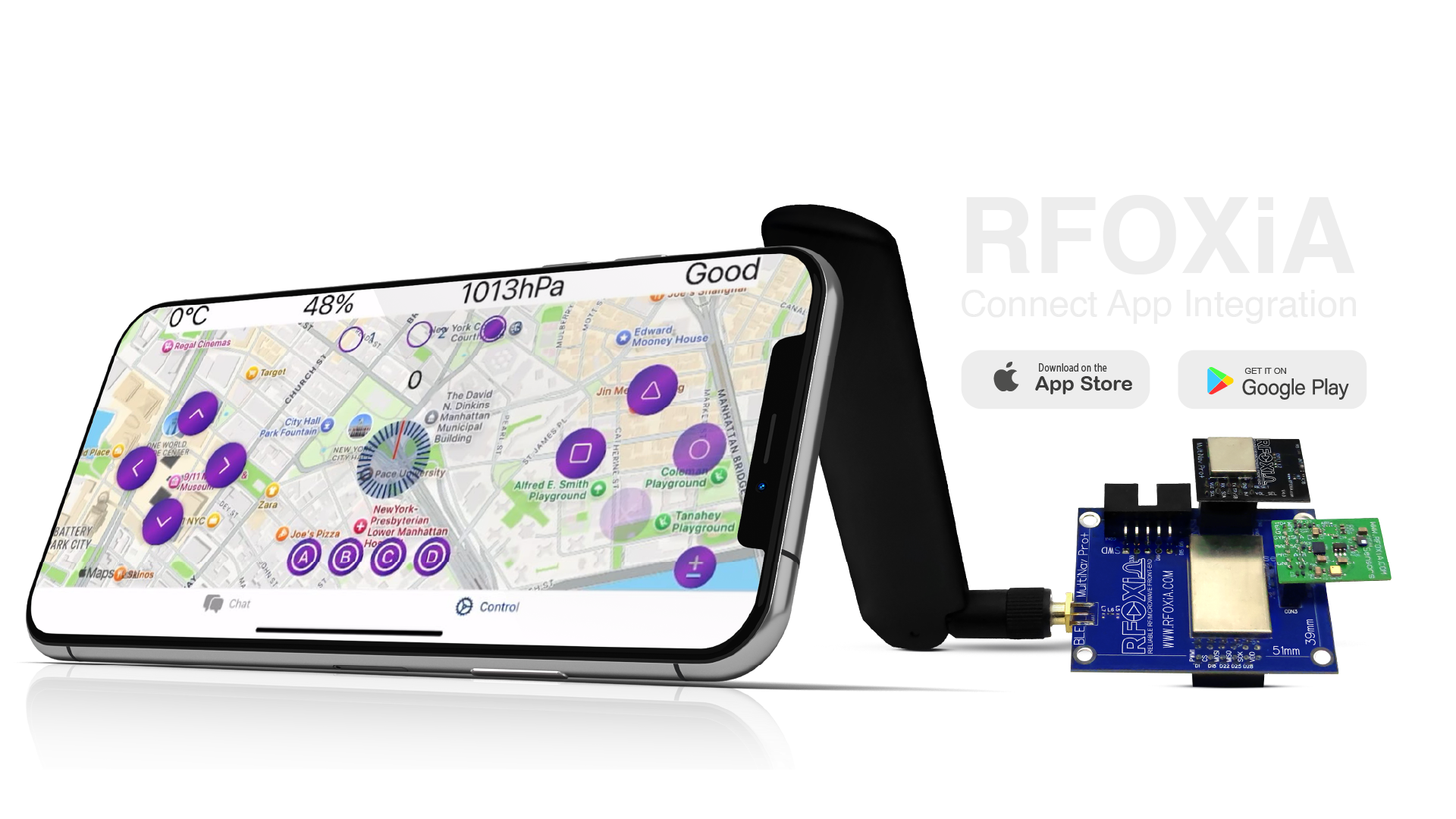
The MultiNav Pro+ BLE module integrates with the RFOXiA Connect app (iOS and Android), giving you:
- A PS5-style controller interface for drone and robot control
- Live map view with real-time GPS tracking
- Live sensor data display
- Automation center for programmable behaviors
- Complete offline operation — no internet required
This is a complete control system, not just a radio link.
BLE Chat: Communication Without Infrastructure
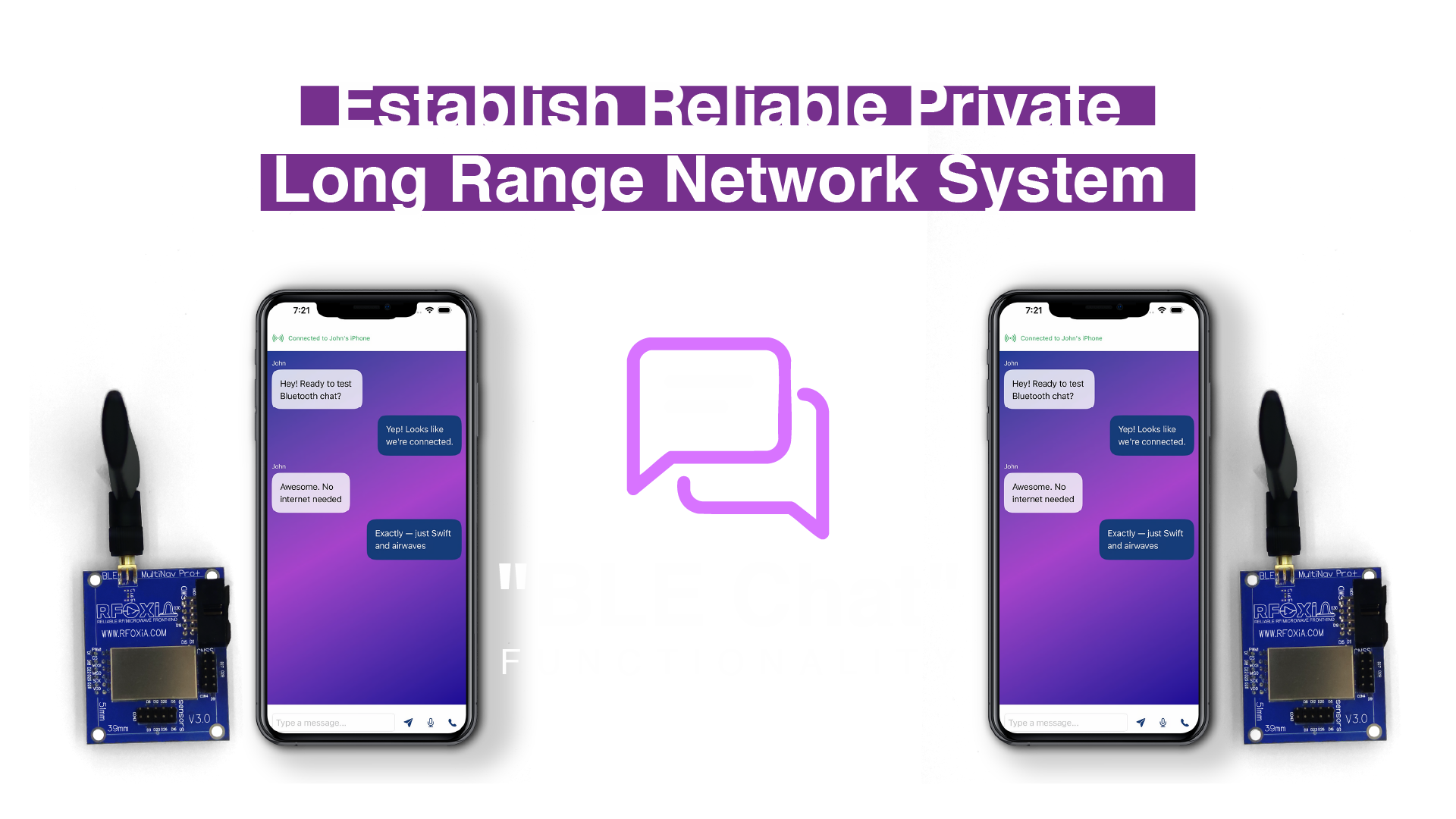
The MultiNav Pro+ also enables BLE Chat — direct, internet-independent communication between multiple module users. Text, data, and voice calls over a private mesh network. For field teams, disaster response crews, and remote expedition operators, this is a capability no WiFi-based system can match without infrastructure.
Compact, Durable, and Designed for Real Deployments
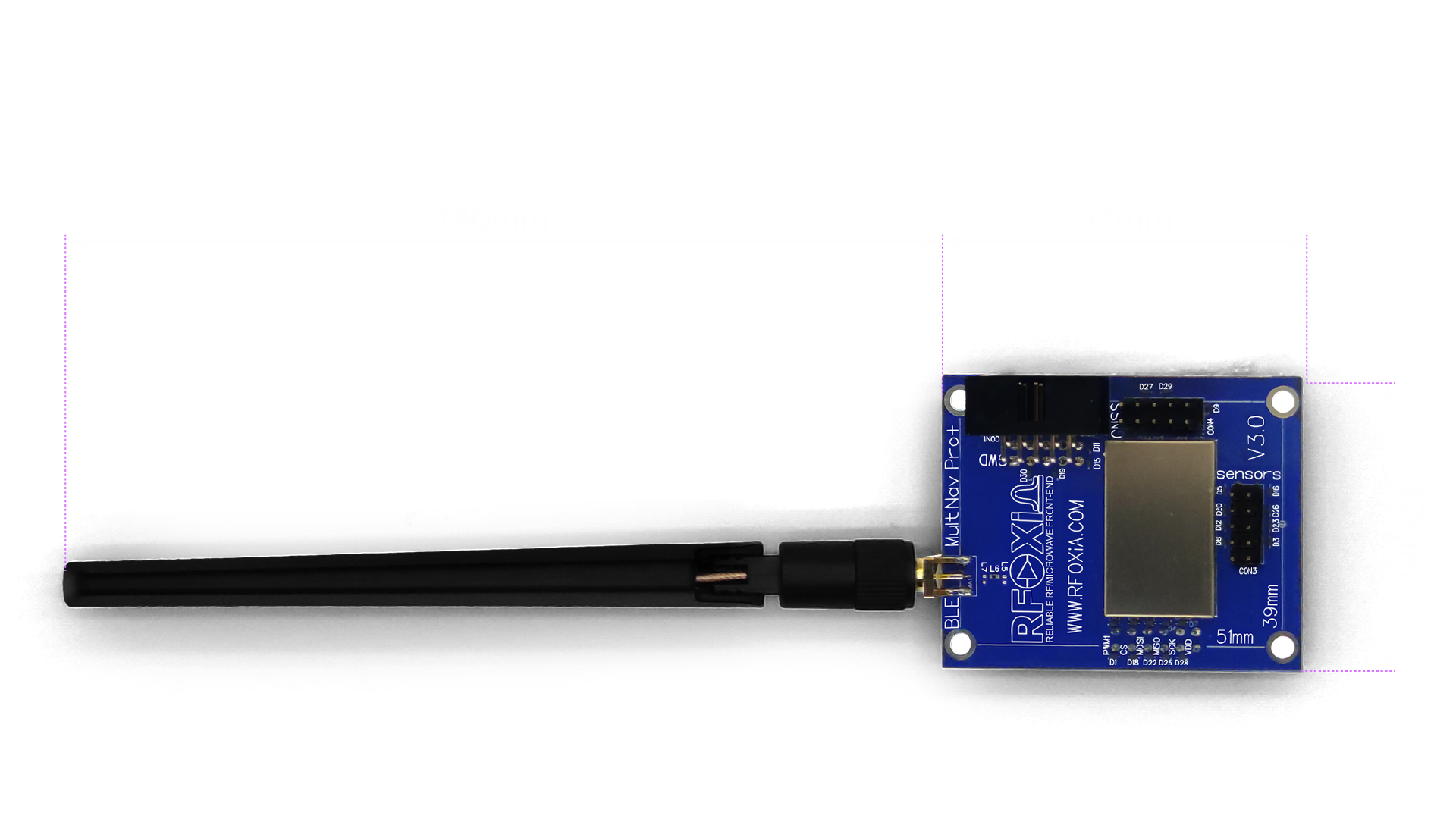
At 57mm × 47mm with a fixing frame of 54mm × 34mm and corner mounting holes, the MultiNav Pro+ integrates cleanly into drone frames, robotics platforms, and field enclosures. It's built for real-world deployment, not lab demonstrations.
Open Source and Fully Customizable
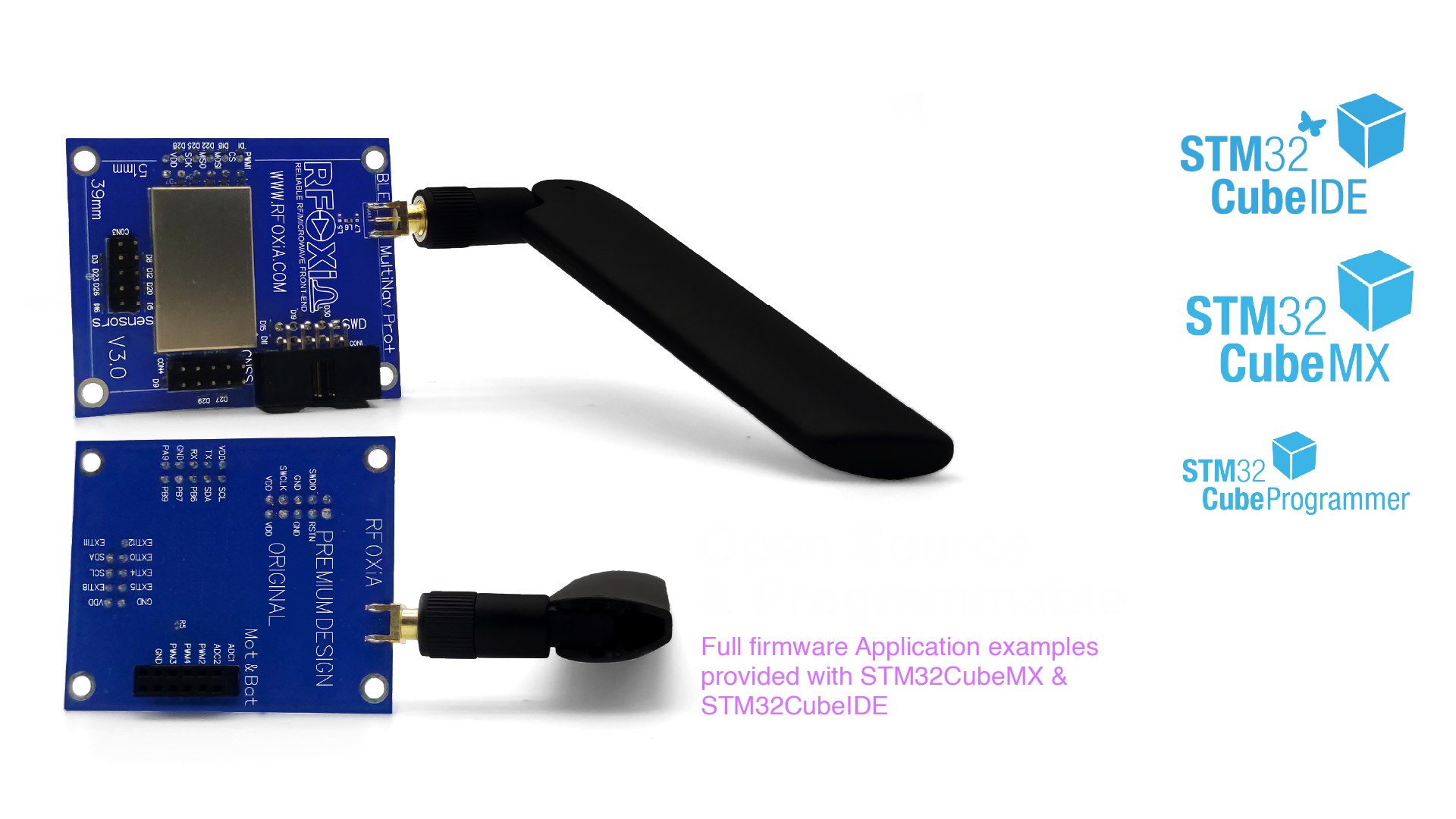
The MultiNav Pro+ is fully open-source and programmable via SWD. The complete firmware repository is available on GitHub, and RFOXiA's AI Firmware Builder lets you describe your application in plain language and generates production-ready firmware. You own your firmware. You control your system.
Precision Timing for Navigation-Critical Applications
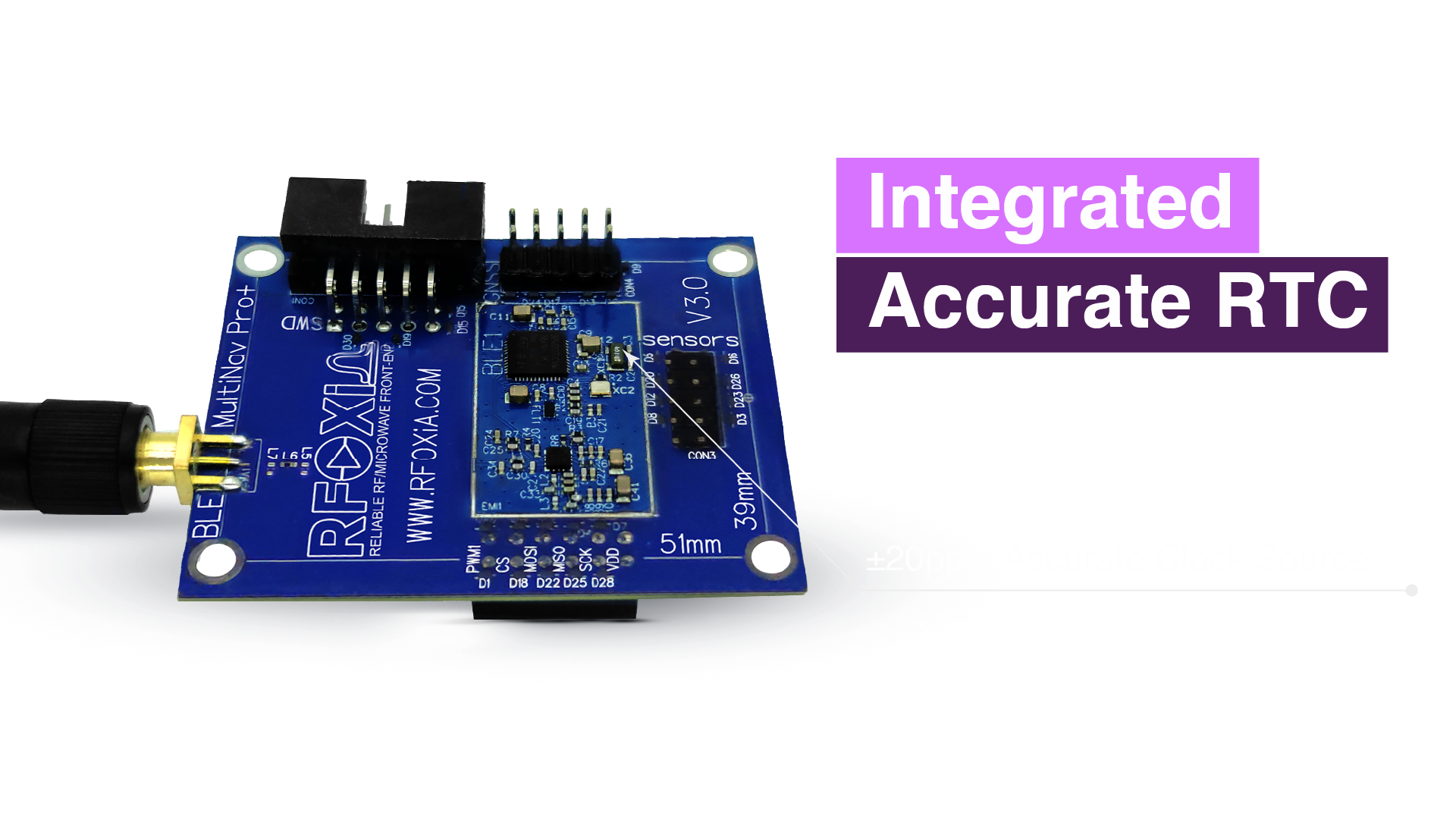
The integrated RTC crystal provides precise timing synchronization — essential for navigation systems, time-stamped sensor logging, and multi-node coordination where timing accuracy affects data integrity.
When Should You Actually Choose WiFi for Drone Applications?
Honest analysis requires acknowledging the cases where WiFi remains the right choice:
HD video downlink — If your primary requirement is streaming raw HD or 4K video from drone to ground station in real time, WiFi (or dedicated video link protocols like DJI's proprietary systems) offers bandwidth that BLE cannot match at equivalent range.
Short-range, high-bandwidth data transfer — If you need to bulk-transfer large files from a landed drone within 100 meters, WiFi is faster.
Infrastructure-integrated deployments — If your drone operates within an existing WiFi network and you need it to report to a central server over that network, WiFi may simplify integration.
For everything else — control signals, telemetry, sensor data, GPS tracking, long-range operation, infrastructure-independent deployment — the case for long-range BLE is overwhelming.
The Price Argument: $59 vs. Everything Else
Let's talk about cost. The comparison for long range Bluetooth vs WiFi for drones isn't just technical — it's economic.
- Commodity BLE modules: $5–15. Range: 80–100 meters. No ecosystem. No app. No certification.
- High-power WiFi solutions with comparable outdoor range: $100–500 per end. Power hungry. Infrastructure dependent.
- Military-grade long-range communication systems: $5,000–50,000+. Out of reach for 99% of builders.
The RFOXiA Long Range Bluetooth Module delivers 50KM drone-to-drone range, 2 Mbps data rate, FCC certification, full ecosystem integration, open-source firmware, and a mobile control app — for $59 for two units.
There is no other product at this price point with these specifications. The market gap is real, and the MultiNav Pro+ fills it.
Real-World Use Cases Where Long-Range BLE Outperforms WiFi
FPV and Drone Racing
Control link reliability and low latency matter more than raw bandwidth. BLE's consistent 10–30ms latency and extreme range give FPV pilots a control link that doesn't break at the edge of the flying zone.
Search and Rescue
Operations happen in remote locations with no cellular coverage. A 20KM man-to-drone range with zero infrastructure dependency is exactly what SAR teams need. BLE Chat adds team communication to the same hardware.
Precision Agriculture
Survey drones covering large fields need control links that extend beyond WiFi's reach. A 50KM drone-to-drone link allows relay configurations that cover entire farming operations from a single ground station.
Industrial Inspection
Offshore platforms, pipeline surveys, and remote infrastructure inspection all happen where WiFi infrastructure doesn't exist. Long-range BLE solves the communication problem without requiring cellular contracts or satellite uplinks.
IoT and Environmental Monitoring
Deploy sensor nodes across a 5KM radius and collect data to a central hub — all without internet. The MultiNav Pro+ combined with the Sensors Module creates a private environmental monitoring network anywhere on Earth.
Making Your Decision: The Framework
When evaluating long range Bluetooth vs WiFi for drones, apply this decision framework:
Choose long-range BLE if:
- Range beyond 500 meters is required
- Infrastructure independence is important
- Power efficiency matters for flight time
- You need a complete ecosystem (app, sensors, GNSS integration)
- Budget is a constraint
- You want FCC-certified hardware you can deploy legally
Choose WiFi if:
- HD video streaming is the primary requirement
- You're operating within 300 meters of a fixed access point
- Bulk data transfer on the ground is the main use case
For most serious drone builders reading this, the answer is long-range BLE — specifically because the range, power efficiency, infrastructure independence, and price combine into an argument that WiFi simply cannot counter.
Conclusion: Long Range Bluetooth vs WiFi for Drones — BLE Wins for Most Applications
The conventional wisdom that Bluetooth is short-range and WiFi is the go-to for outdoor wireless broke down when engineered long-range BLE hardware entered the market. At 50KM drone-to-drone range, 2 Mbps data throughput, millisecond-level latency, and a fraction of WiFi's power consumption — all without requiring a single router, tower, or internet connection — long-range BLE is the superior technology for the vast majority of drone control, telemetry, and field communication applications.
The gap between short-range commodity BLE and military-grade systems is exactly where RFOXiA operates. The MultiNav Pro+ is FCC certified, ready to ship, and proven across hundreds of real-world deployments.
If you're building a drone, a robot, a field monitoring system, or any wireless application that needs to operate beyond WiFi's range — without the cost and complexity of industrial radio systems — the RFOXiA Long Range Bluetooth Module is where your build starts.
Explore the full MultiNav Pro+ BLE module, specifications, and the complete RFOXiA ecosystem at rfoxia.com/premium-ble-module/.
RFOXiA — Democratizing Connectivity and Computing Power.
Written by: Moamen Mohamed LinkedIn