
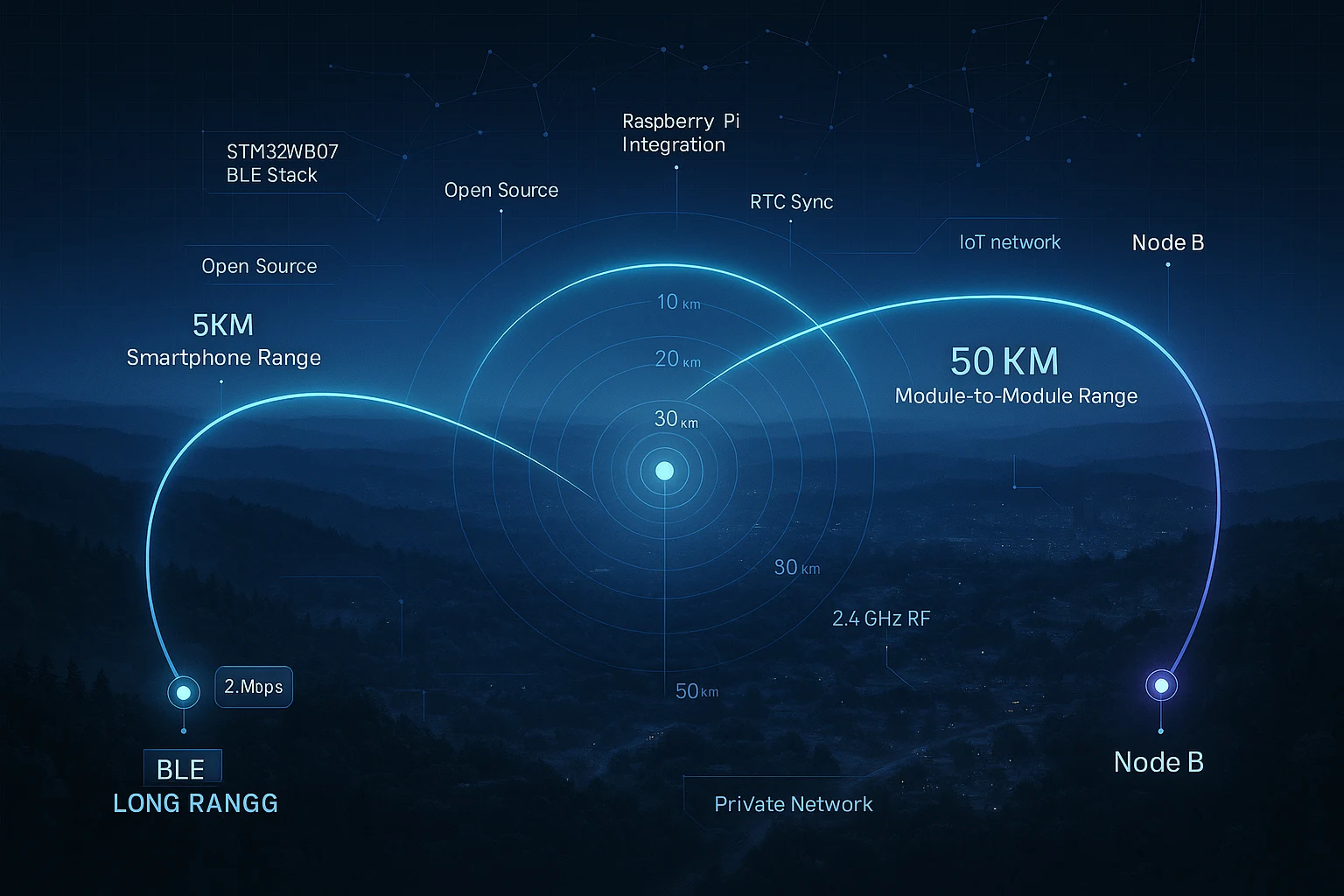
Raspberry Pi Long Range Bluetooth Project: How to Achieve 50KM with the MultiNav Pro+ BLE Module
RFOXiA Long Range Bluetooth Module
The Raspberry Pi Long Range Bluetooth Project Every Builder Has Been Waiting For
If you have ever tried to push a standard Bluetooth module past its limits on a Raspberry Pi project, you already know the frustration. You wire everything up, write clean firmware, get excited — and then watch your connection drop at 80 meters. Sometimes 100 meters if conditions are perfect. That ceiling is not a firmware problem. It is a hardware ceiling built into every commodity BLE module on the market.
The raspberry pi long range bluetooth project community has spent years working around this wall with repeaters, mesh hacks, and workarounds that add complexity without ever solving the core problem. Until now, the only real solution was military-grade hardware priced at $5,000 or more — completely out of reach for independent developers, drone builders, researchers, and makers.
The MultiNav Pro+ BLE Module from RFOXiA changes the equation entirely.
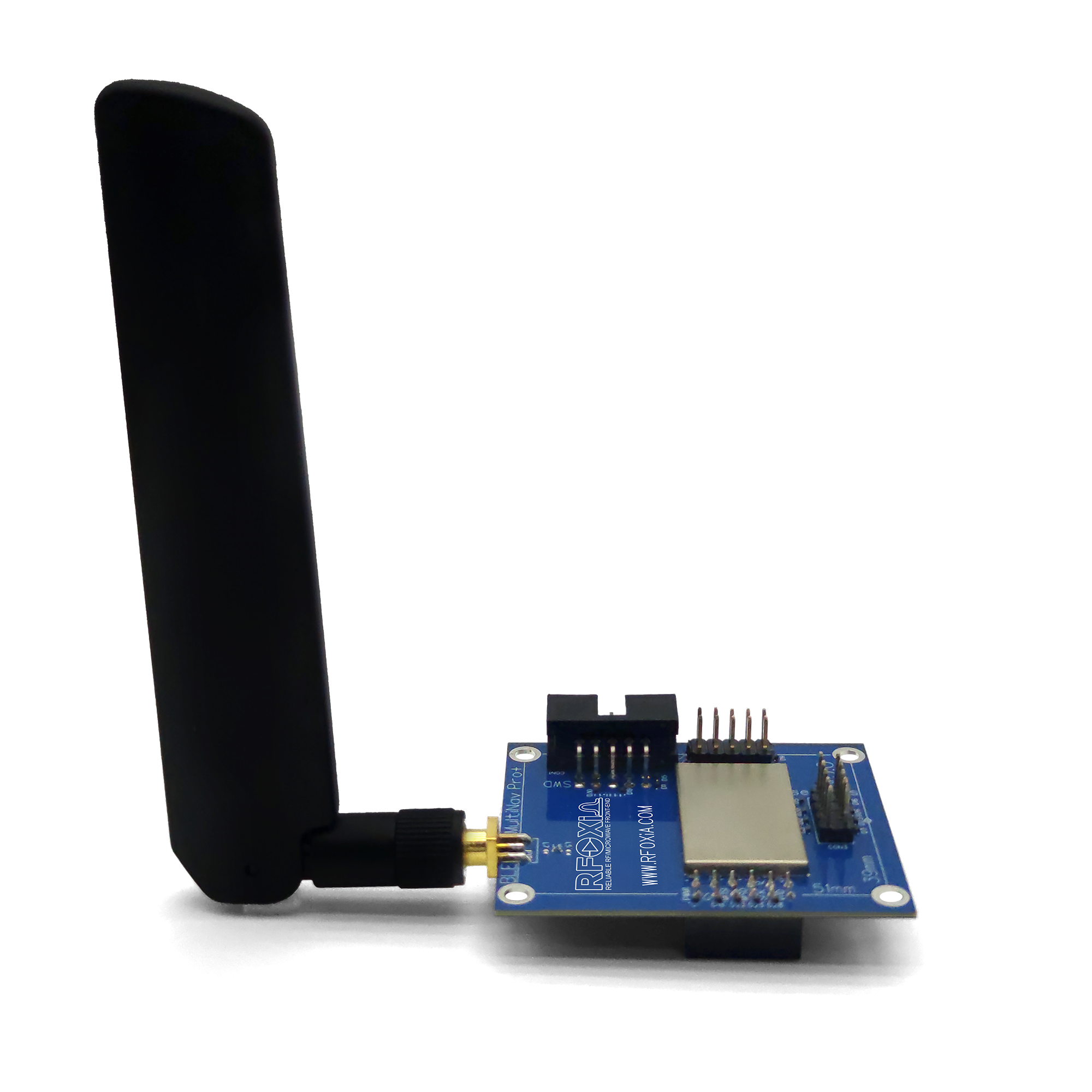
This is not an incremental improvement over a standard BLE chip. The MultiNav Pro+ is a purpose-engineered RF system that achieves 5KM ground-to-ground, 15–20KM man-to-drone, and 50KM drone-to-drone range — all over standard Bluetooth Low Energy, FCC certified, at a price point that actually makes sense for builders. Two units for $59.
Let's walk through what makes this module uniquely suited to any ambitious raspberry pi long range bluetooth project, how to integrate it, what you can build with it, and why nothing else on the market comes close.
Why Standard BLE Modules Fail Long-Range Raspberry Pi Projects
The Bluetooth Low Energy specification was designed for short-range personal area networks — wearables, beacons, headphones, proximity sensors. The radio architecture in virtually every commodity BLE chip (Nordic nRF52 series, Silicon Labs EFR32, ESP32 Bluetooth, and their Chinese equivalents) reflects that design intent.
Maximum output power is typically capped between 0 dBm and +8 dBm. Receiver sensitivity hovers around -95 dBm in ideal conditions. The antennas are minimal. There is no RF front-end amplification. The result is a link budget that runs out fast in real-world conditions — 80 to 100 meters is the honest number for most applications.
For a raspberry pi long range bluetooth project, this matters enormously. Whether you are building a remote sensor node, a field data logger, a drone telemetry link, or a mesh communication system, 100 meters is nearly useless the moment you leave an indoor lab environment.
The MultiNav Pro+ solves this at the hardware level. The module incorporates a powerful RF front-end with external amplifiers that dramatically extend both transmit power and receiver sensitivity. The result is a link budget that supports genuine long-range communication — the kind that makes entirely new application categories possible rather than just nudging the existing ceiling up slightly.
MultiNav Pro+ BLE Module: Technical Overview
Before diving into integration and project ideas, it is worth understanding exactly what is inside this module and why the specifications are meaningful.
Core Processor: STM32WB07CCV6
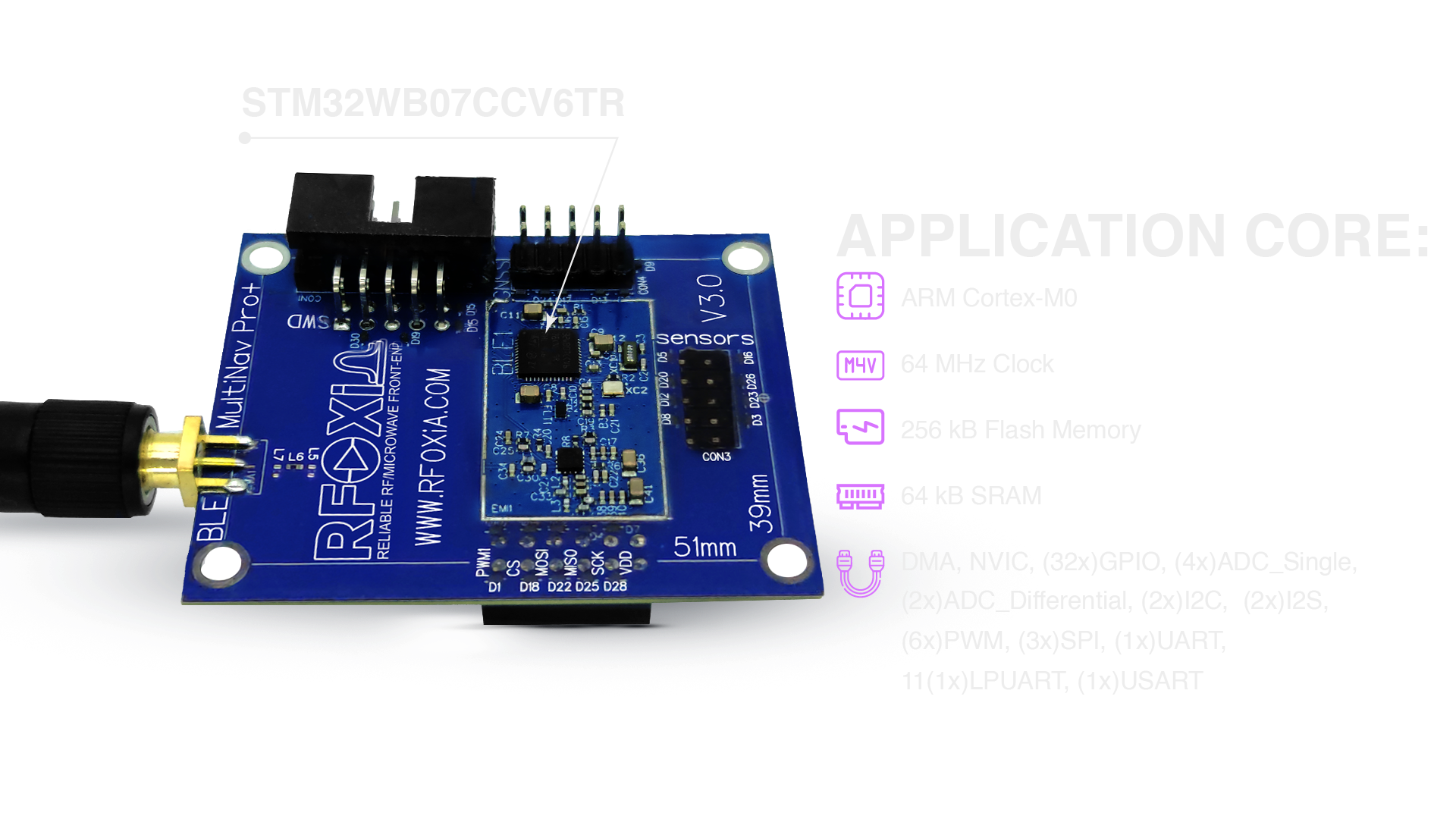
The module is built around the STM32WB07CCV6 from STMicroelectronics — a dual-core wireless SoC that manages the BLE stack and user application simultaneously. This architecture matters for real-world projects because it means your application code runs independently from the BLE stack, eliminating the timing conflicts and latency spikes that plague single-core BLE implementations. For drone control, robotics, and any application where communication latency is safety-critical, this is not a minor detail.
Range Specifications
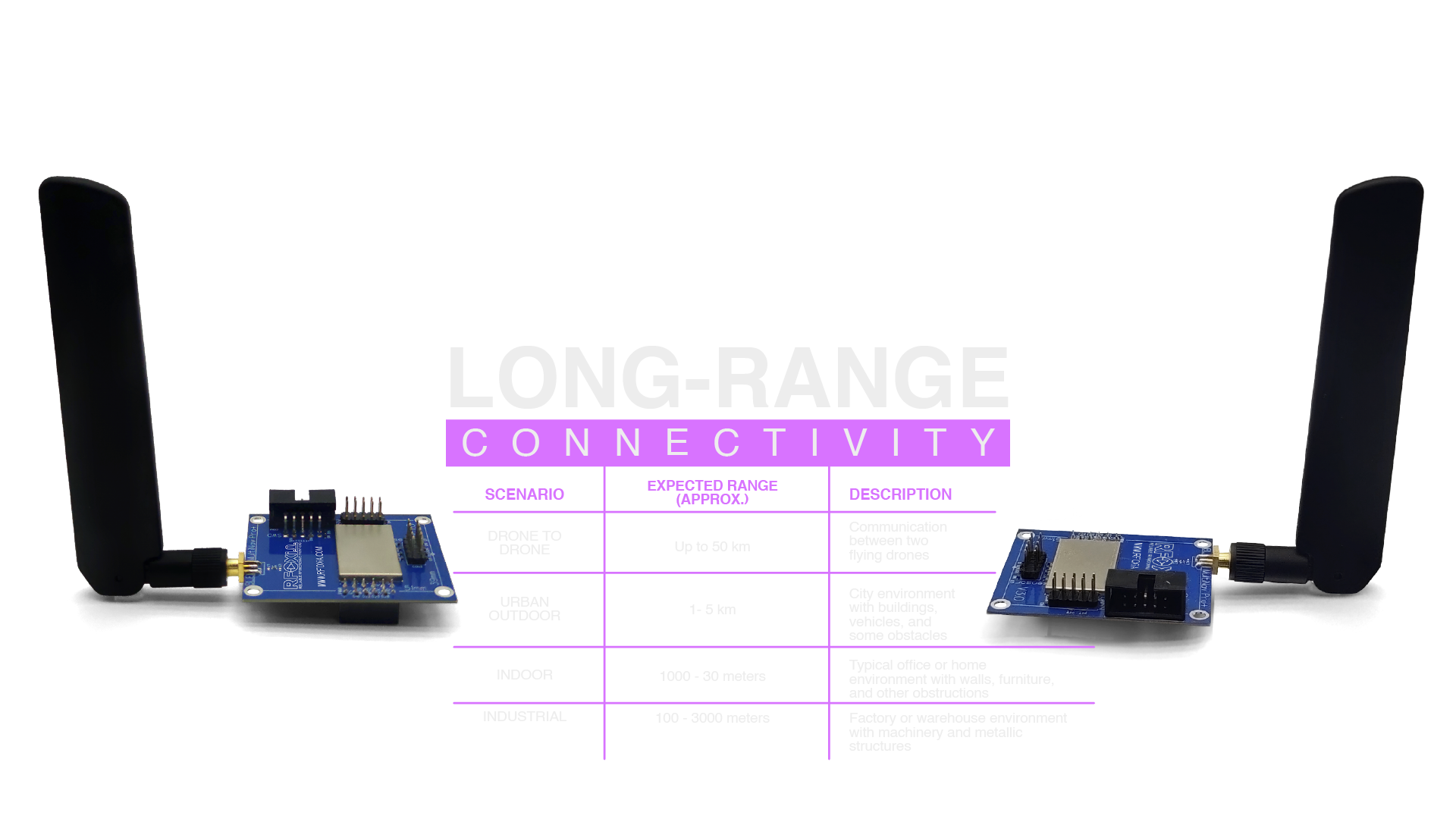
- Ground-to-ground (module paired with smartphone): 5KM
- Man-to-drone: 15–20KM
- Drone-to-drone (airborne, ground reflections eliminated): 50KM
These figures are achieved through optimized RF front-end design, external amplifiers, and advanced receiver sensitivity engineering — not software tricks or protocol changes.
Data Rate: 2 Mbps
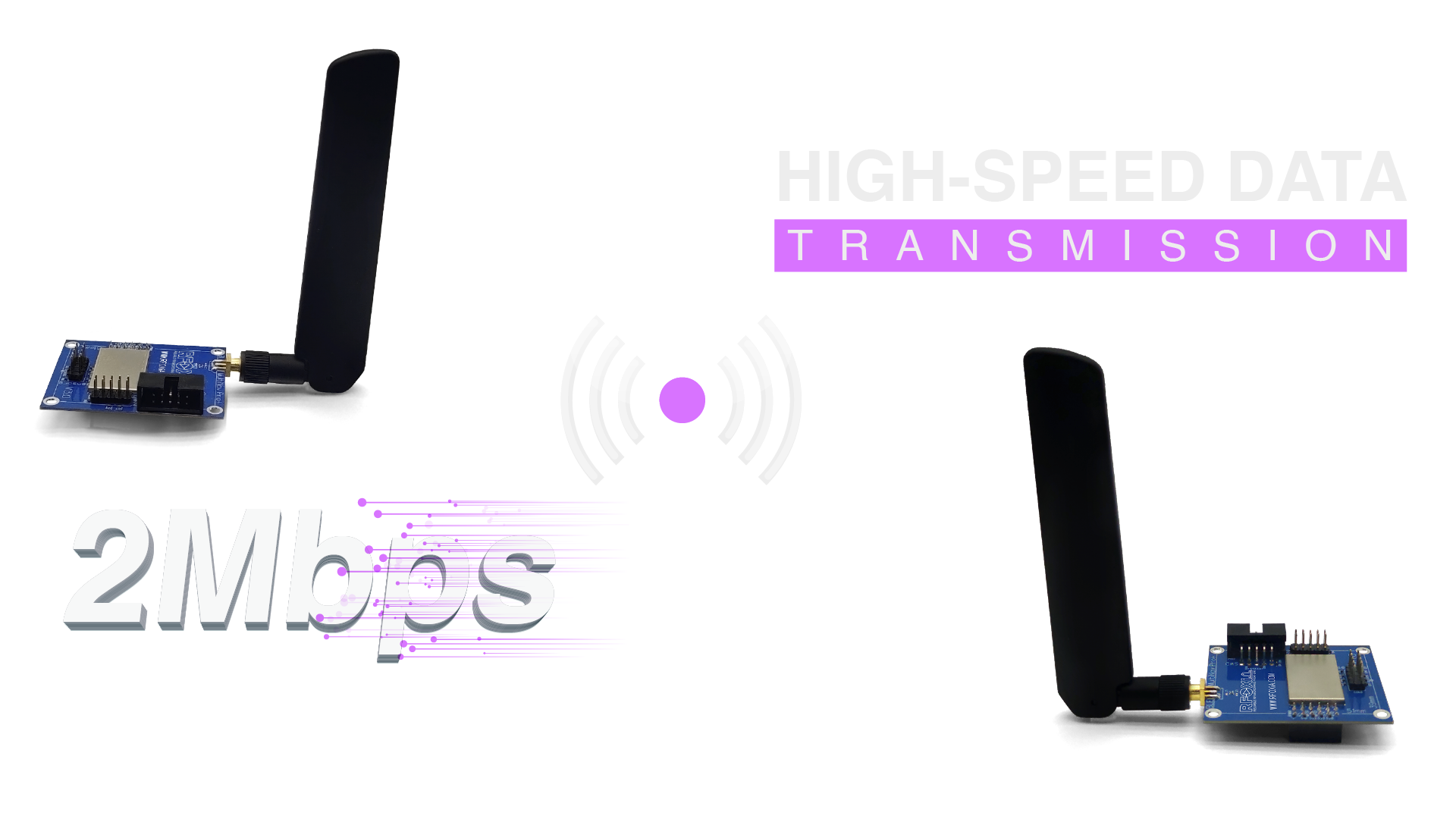
Long range is meaningless if the data throughput collapses under real application load. The MultiNav Pro+ maintains a 2 Mbps data rate — the maximum specified in the BLE standard — which is sufficient for sensor telemetry, control commands, real-time location data, and even compressed video metadata. For context, most long-range radio alternatives sacrifice data rate for range. The MultiNav Pro+ delivers both simultaneously.
Physical Specifications
- Module size: 57mm × 47mm
- Antenna length: 140mm
- Fixing frame holes: 51mm × 39mm corner mounting
- Integrated high-gain chip antenna — no external antenna required
- Integrated RTC crystal for precise timing synchronization
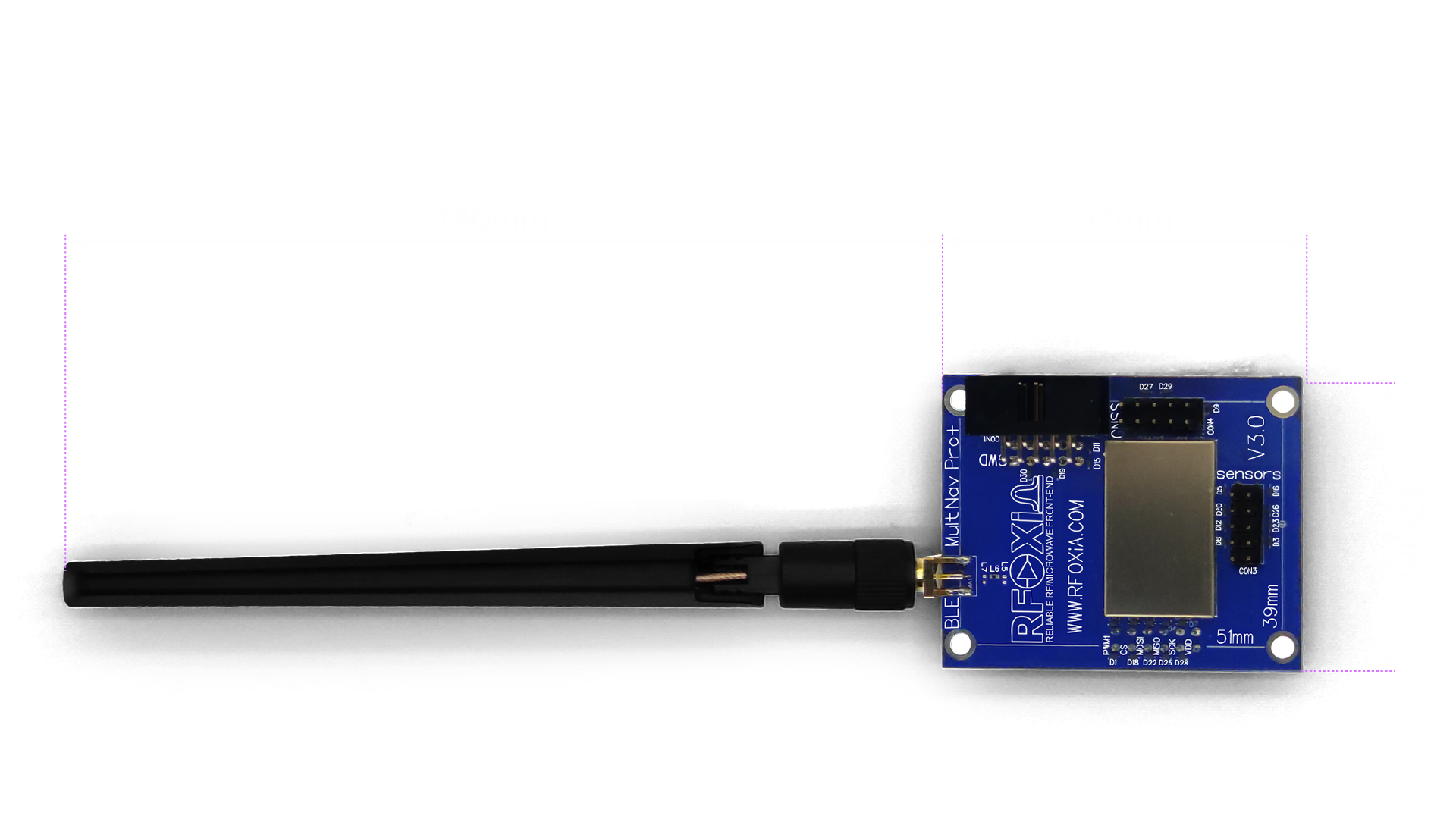
The compact footprint and standard mounting holes make mechanical integration straightforward on custom enclosures, drone frames, robotic platforms, and Raspberry Pi HAT-style boards.
Integrating the MultiNav Pro+ with Raspberry Pi
Raspberry Pi serves as the computational backbone for thousands of maker and professional IoT projects. The MultiNav Pro+ slots naturally into this ecosystem through its UART and SPI-compatible interfaces.
Interface Overview
The module exposes four distinct interface groups:
- GNSS interface — connect the GNSS module for real-time location data
- Sensors interface — connect the Sensors Module for environmental data
- Motors & Battery Management interface — connect motor controllers and power management hardware
- Programming interface (SWD) — full firmware access via ST-Link programmer
For a raspberry pi long range bluetooth project, the most direct integration path is through a Raspberry Pi's UART serial interface connected to the MultiNav Pro+ BLE module. The Raspberry Pi handles higher-level application logic — data processing, local storage, web server, display output — while the MultiNav Pro+ handles the long-range BLE radio communication.
Basic Connection Pattern
A typical setup for a long-range sensor gateway project:
- Raspberry Pi 4 or Pi Zero 2W at the base station
- MultiNav Pro+ BLE module connected via UART to the Pi's GPIO
- Remote node: second MultiNav Pro+ with sensor payload
- RFOXiA Connect app on smartphone for monitoring and control
This architecture gives you a genuinely useful field data system — real sensor data transmitted reliably over several kilometers, logged locally on the Pi, and accessible through a mobile app — built from off-the-shelf hardware that fits in a backpack.
The RFOXiA Ecosystem: Beyond the Module
What separates the MultiNav Pro+ from a standalone radio module is the complete ecosystem surrounding it. For any raspberry pi long range bluetooth project that goes beyond a basic proof-of-concept, the ecosystem components dramatically accelerate development.
RFOXiA Connect App
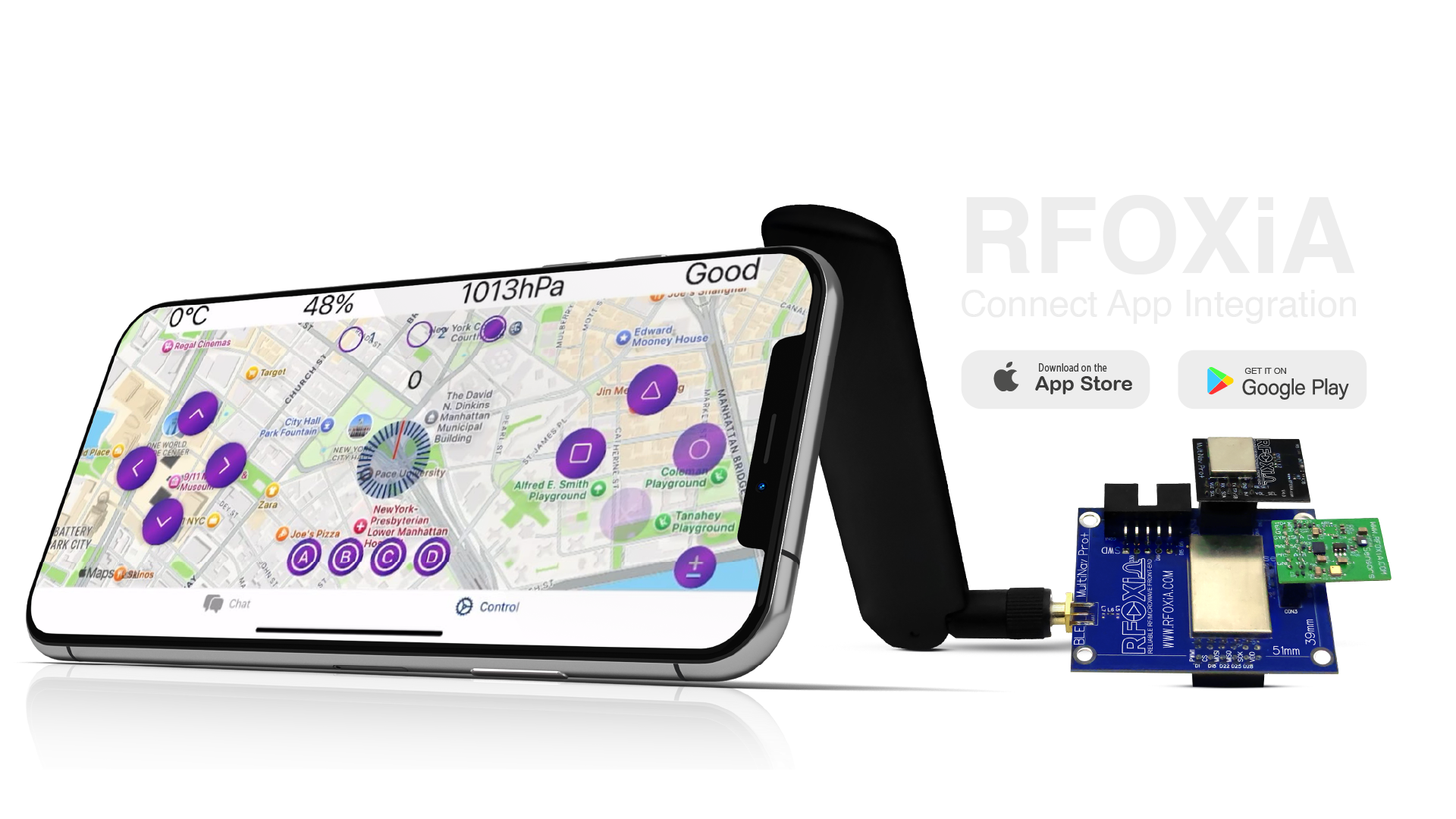
The RFOXiA Connect app (iOS and Android) gives you an immediate, ready-to-use interface for your projects. The app includes:
- Map view with real-time GPS tracking of connected modules
- Live sensor data display for all connected sensors
- PS5-style controller interface for drone and robot control
- Automation center for programmable control sequences
- BLE Chat for internet-independent text and voice communication between nodes
For Raspberry Pi projects, this means you can build a functional field system and have a polished mobile monitoring interface without writing a single line of mobile app code.
BLE Chat: Off-Grid Communication
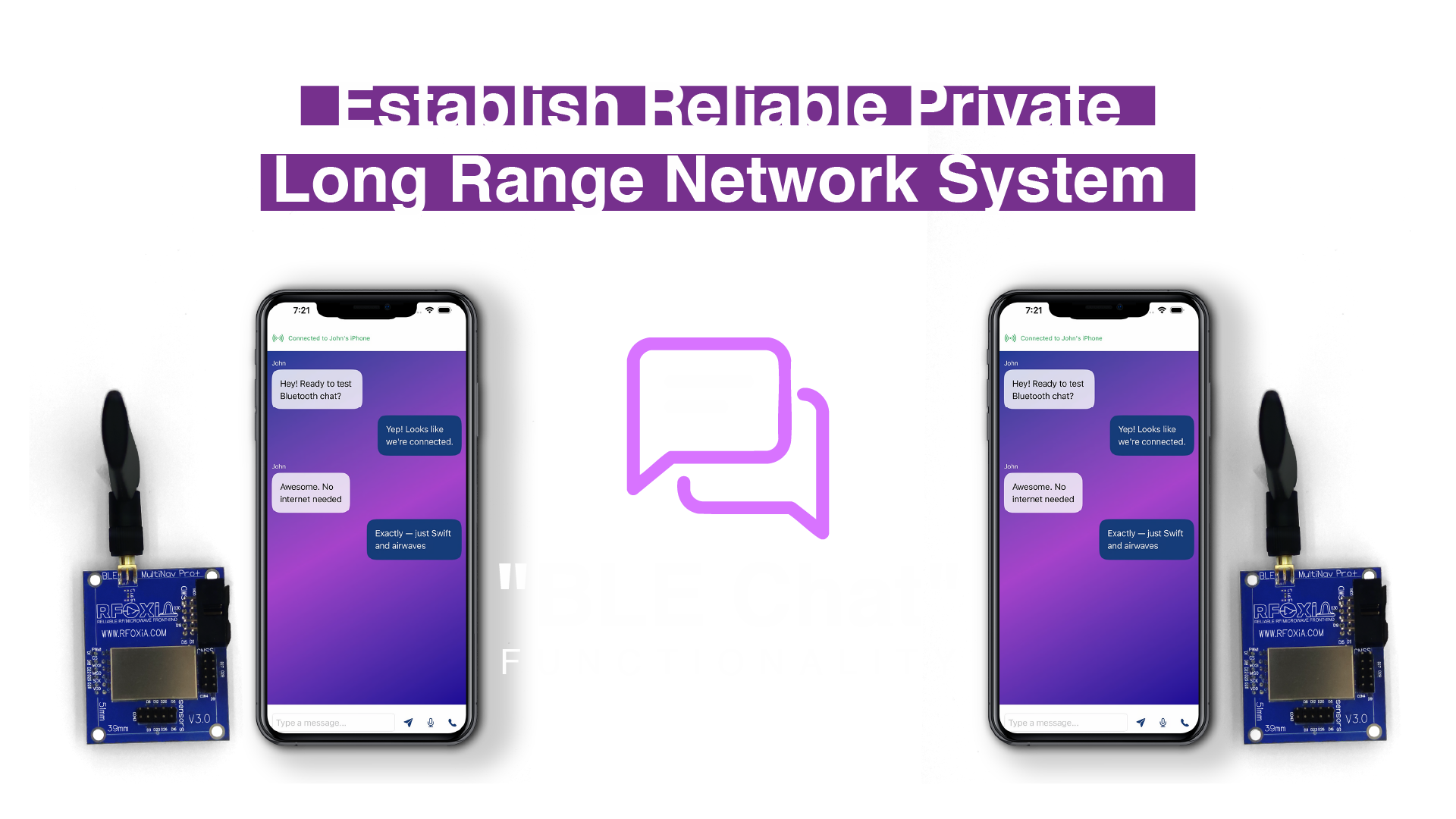
BLE Chat is a capability that has no equivalent in the commodity BLE module world. With two or more MultiNav Pro+ modules deployed, users can communicate through text, data, and voice completely independently of any internet connection or cellular infrastructure. For field research teams, disaster response operations, or remote expeditions where cellular coverage is absent, this is a genuinely transformative capability.
In a Raspberry Pi context, a Pi-based gateway node can serve as a BLE Chat relay point — extending the mesh communication range and creating a locally stored communication log.
Seamless Module Integration
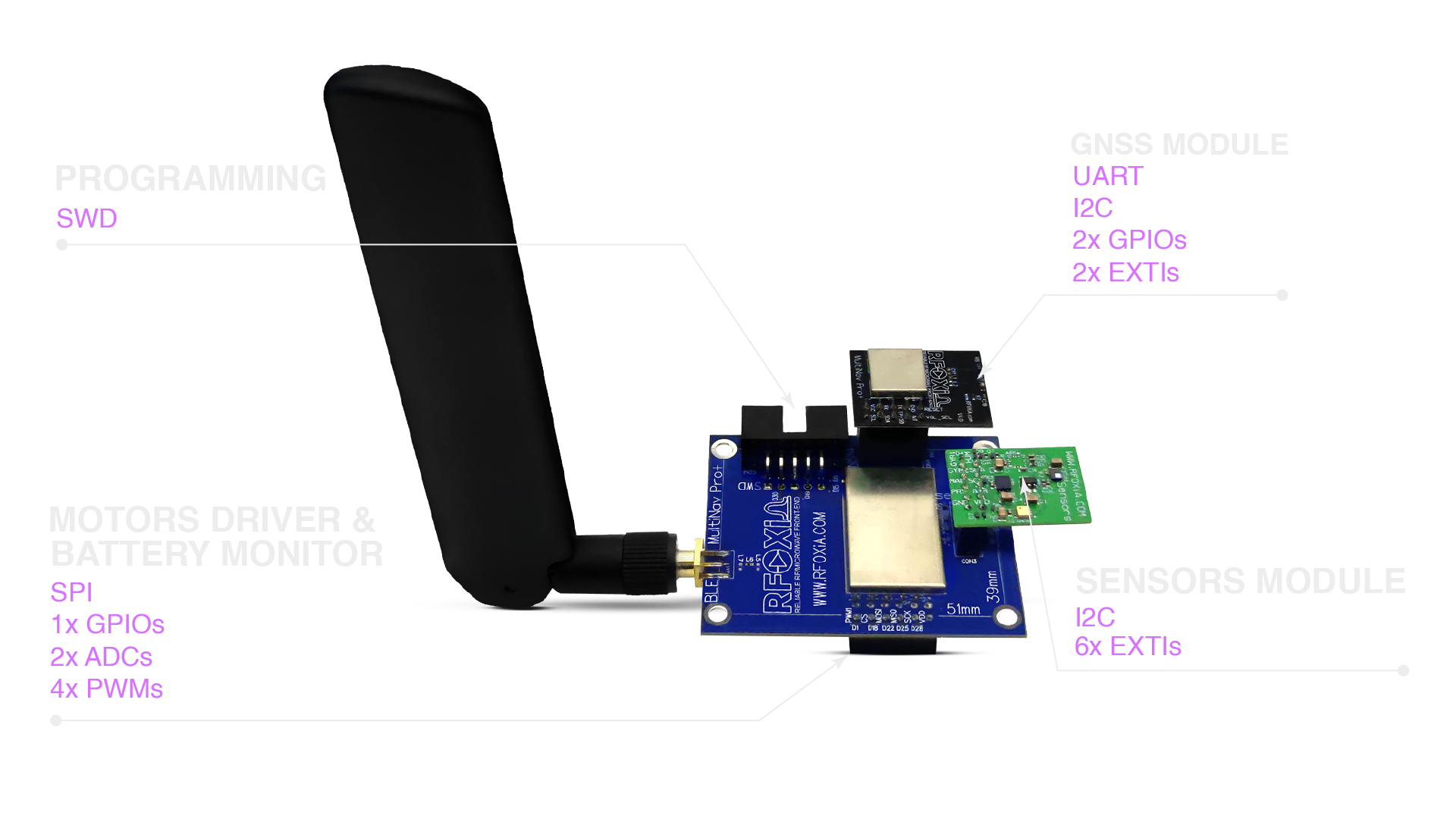
The MultiNav Pro+ BLE module is designed from the ground up to integrate with RFOXiA's companion modules:
- GNSS Module — 1.5m accuracy, 18Hz fix rate for fast-moving platform tracking
- Sensors Module — temperature, humidity, pressure, air quality, accelerometer, gyroscope, magnetometer
- Power/Program Kit — supercapacitor-based power with 5-minute charge, 24-hour runtime
For a raspberry pi long range bluetooth project, this means you can deploy a complete environmental monitoring node — location-verified, multi-sensor, self-powered — without hunting for compatible third-party hardware or writing cross-vendor integration code.
Integrated RTC for Precise Timing
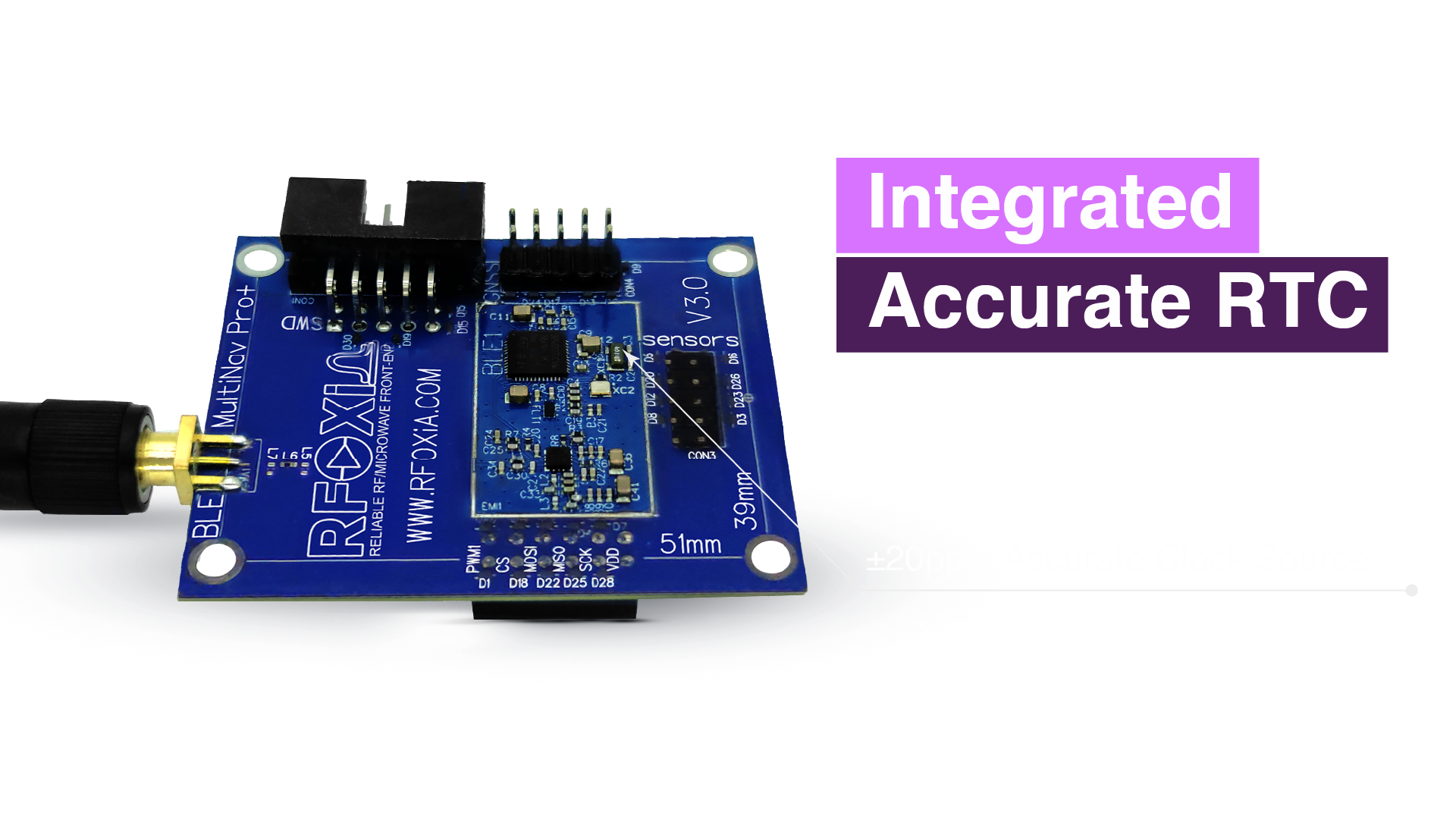
The integrated RTC crystal ensures that time-stamped sensor data, synchronized multi-node logging, and time-critical control sequences all operate with the precision that professional applications demand. When your Raspberry Pi is logging data from multiple remote nodes simultaneously, accurate timestamps are not optional — they are the difference between usable research data and noise.
Open Source and Fully Programmable
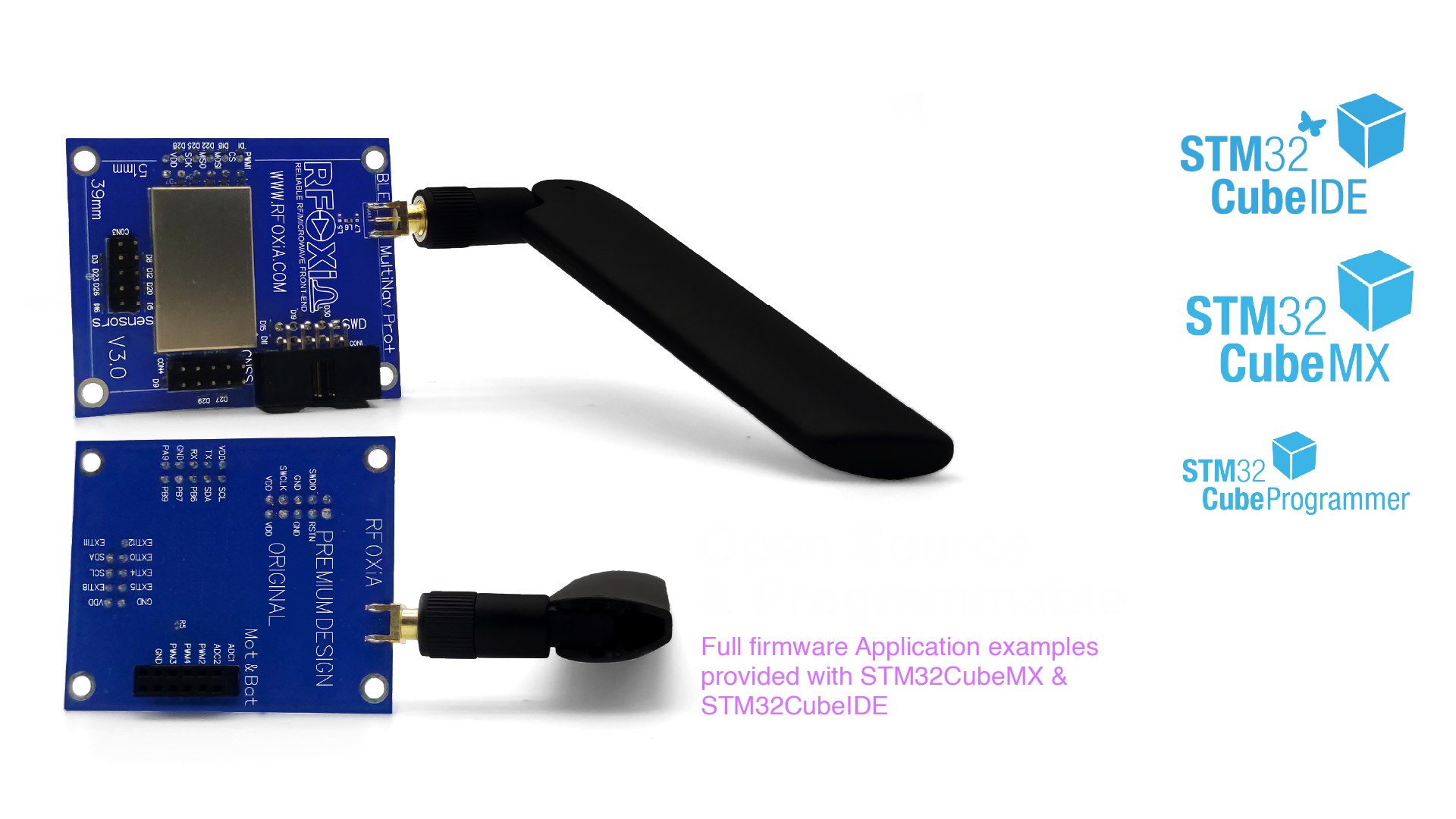
One of the most important aspects of the MultiNav Pro+ for serious raspberry pi long range bluetooth project developers is the complete open-source firmware access. The full firmware repository is available at GitHub: RFOXiA MultiNav Pro+, and the module is fully programmable via SWD through the ST-Link interface included in the Power/Program Kit.
This means:
- You are not locked into a black-box radio module with undefined behavior
- You can inspect, modify, and extend the firmware for your specific application
- Custom BLE service definitions, GATT profiles, and proprietary protocols are all possible
- The AI Firmware Builder in RFOXiA Club can generate custom firmware from plain-language descriptions — dramatically reducing development time
For researchers and professional developers, full source access is a non-negotiable requirement for any production deployment. The MultiNav Pro+ delivers this without compromise.
Project Ideas: What You Can Build
The combination of Raspberry Pi computational power and MultiNav Pro+ long-range BLE communication unlocks project categories that were previously either impossible or prohibitively expensive.
Long-Range Environmental Monitoring Network
Deploy multiple Raspberry Pi nodes, each carrying a MultiNav Pro+ BLE module and Sensors Module, across a large agricultural field, nature reserve, or industrial site. Each node streams temperature, humidity, pressure, air quality, GPS location, and motion data back to a central Pi base station at ranges up to 5KM. The base station aggregates data, provides local storage and analysis, and serves a web dashboard accessible on your local network.
This is a project that previously required dedicated radio hardware, custom protocols, and significant RF engineering expertise. With the MultiNav Pro+ ecosystem, it becomes a weekend build.
Raspberry Pi Drone Telemetry and Control System
Mount a Raspberry Pi companion computer on a drone frame alongside a MultiNav Pro+ BLE module. At the ground station, a second MultiNav Pro+ paired with a laptop or smartphone running RFOXiA Connect handles control input and data display. The link maintains 2 Mbps throughput at distances up to 20KM man-to-drone — sufficient for real-time sensor telemetry, GPS tracking, and control input with latency characteristics competitive with dedicated RC link systems.
This is the raspberry pi long range bluetooth project that the drone builder community has been asking for — a software-defined, open-source telemetry and control link that does not require a separate proprietary radio system.
Off-Grid Mesh Communication Gateway
A Raspberry Pi running as a BLE Chat gateway and relay extends the mesh communication range of multiple MultiNav Pro+ nodes. Field teams in areas without cellular coverage — search and rescue operations, geological surveys, remote construction sites — can maintain text and voice communication through the mesh, with the Pi logging all communications locally for later retrieval.
Remote IoT Data Node with Cloud Bridge
In locations with occasional internet connectivity, a Raspberry Pi with a MultiNav Pro+ can serve as a data aggregation point for remote sensor nodes deployed across a wide area. When connectivity is available, the Pi syncs accumulated data to cloud storage. When connectivity is absent, it continues logging locally. The long-range BLE link means sensor nodes can be deployed far beyond the range of WiFi or traditional BLE, in locations that would previously require cellular modems at each node.
FCC Certification: Why It Matters for Your Project
Every RFOXiA module — including the MultiNav Pro+ BLE — is FCC certified. For developers building products intended for commercial deployment or sale in the US market, this is critical. Operating non-certified radio hardware in commercial products creates regulatory liability. Using a certified module as the RF subsystem of your product substantially simplifies your own certification path.
For professional raspberry pi long range bluetooth project developers who intend to productize their builds, starting with an FCC-certified radio module is not just convenient — it is the correct engineering decision from day one.
Pricing and Availability
The MultiNav Pro+ BLE module is available as a pair (2 units) for $59 directly through RFOXiA. This price includes two complete modules — everything needed to establish a bidirectional long-range BLE link.
For developers who want the complete ecosystem, the Developer Bundle includes the BLE Module, GNSS Module, Sensors Module, and Power/Program Kit at $199 — and new RFOXiA Club members receive $50 in welcome credits that can be applied directly to that purchase.
If you are serious about building a raspberry pi long range bluetooth project that actually performs at the ranges the application demands, the RFOXiA Long Range Bluetooth Module is the only product on the market that delivers professional-grade range at a maker-accessible price.
The Competitive Landscape: Nothing Else Comes Close
It is worth stating plainly because the specifications are unusual enough that skepticism is reasonable:
- Commodity BLE modules (Nordic, Silicon Labs, ESP32): 80–100m range, no RF front-end, no ecosystem. Price: $5–15.
- Military and industrial long-range radio systems: 50–150KM range, proprietary protocols, no BLE compatibility, no maker ecosystem. Price: $5,000–50,000+.
- MultiNav Pro+ BLE: 5–50KM range depending on deployment, standard BLE protocol, complete maker ecosystem, FCC certified. Price: $59 for two units.
The gap between commodity modules and military systems has existed for decades. The MultiNav Pro+ occupies that gap with engineering rather than compromise.
Getting Started
The fastest path to a working raspberry pi long range bluetooth project with the MultiNav Pro+ is:
- Order the MultiNav Pro+ BLE module pair — two units, ready to ship
- Sign up for RFOXiA Club — free access, $10 welcome credit, AI firmware builder, documentation, and community
- Download RFOXiA Connect — Android available now, iOS pending
- Connect one module to your Raspberry Pi via UART — detailed documentation available in the Club Dev Hub
- Pair the second module with your smartphone — test the link, verify range, start building
The open-source firmware repository gives you full visibility into how the radio stack operates. The AI Firmware Builder in RFOXiA Club lets you describe your application in plain language and receive production-ready custom firmware. The developer community in the Dev Hub provides direct access to other builders working on similar projects.
For the first time, a raspberry pi long range bluetooth project that genuinely reaches kilometers — not meters — is within reach of any developer with a $59 budget and the ambition to build something worth building.
Get the MultiNav Pro+ BLE Module and start your long-range Raspberry Pi project today.
Written by: Moamen Mohamed LinkedIn