
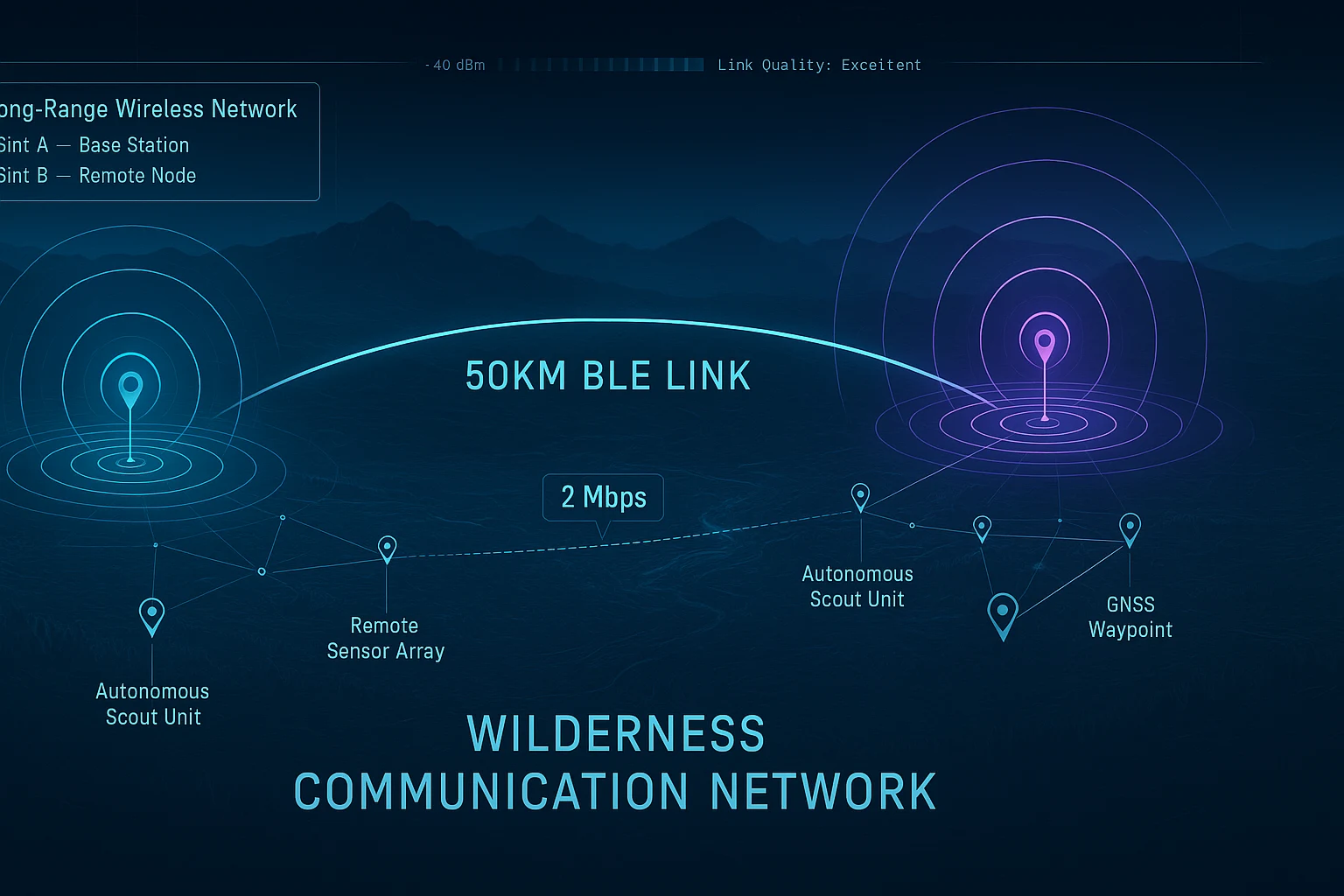
Wilderness Communication Device Maker: Build 50KM Off-Grid Networks with the MultiNav Pro+ BLE Module
RFOXiA Long Range Bluetooth Module
The Wilderness Communication Device Maker's Ultimate Hardware Has Arrived
If you are a wilderness communication device maker — someone who builds systems that must work when cell towers are gone, when satellites are the only thing overhead, and when failure means more than a dropped call — you already know how brutally limited the available hardware is. Commodity Bluetooth modules top out at 80 to 100 meters. Professional military-grade radio systems start at $5,000 and require licenses and contracts most independent builders will never qualify for. For years, the gap between what makers need and what they can actually afford has been enormous.
The MultiNav Pro+ BLE Module from RFOXiA closes that gap completely.
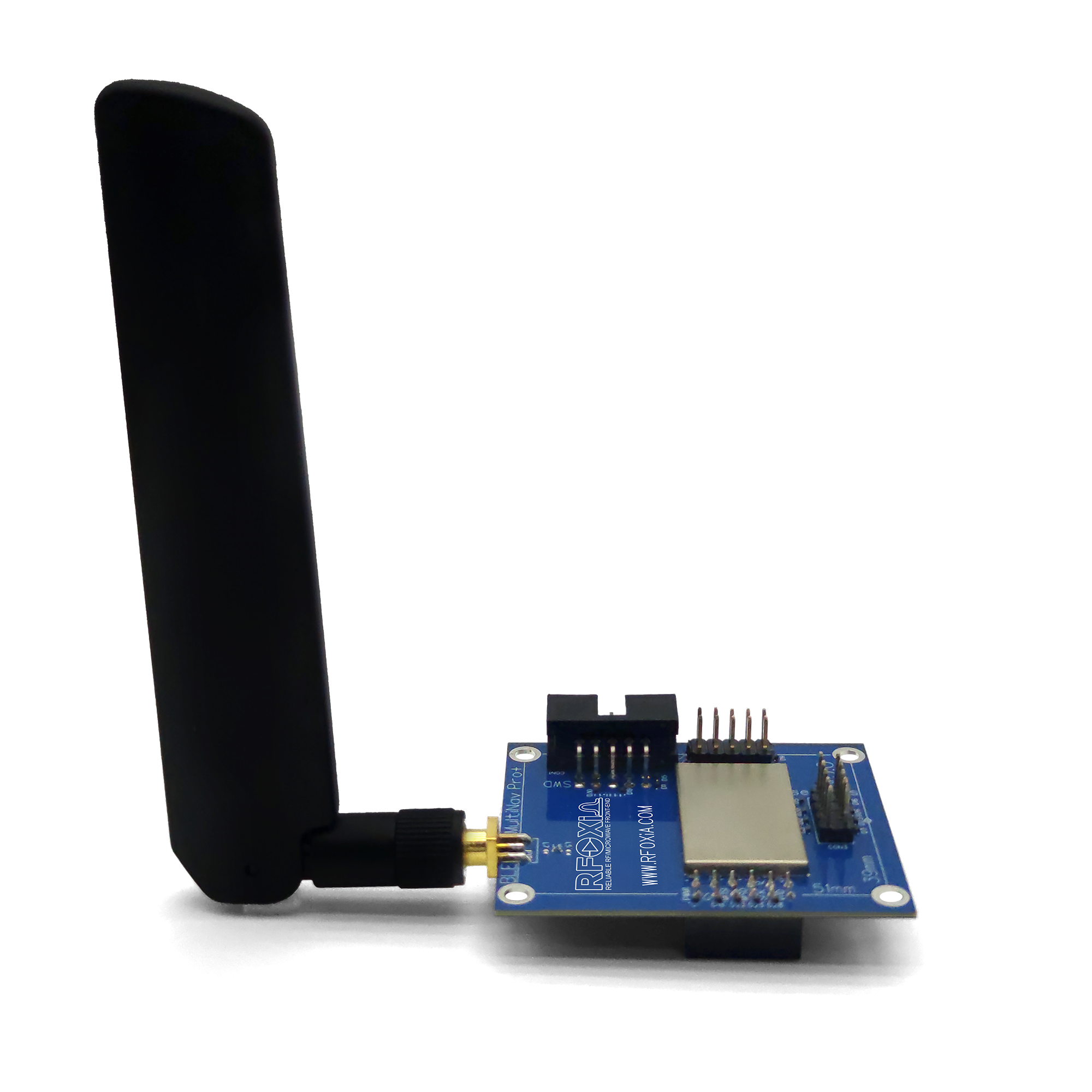
With a verified range of up to 50KM between two modules, a 2Mbps data rate, FCC certification, and a price of just $59 for two units, the MultiNav Pro+ is the first professional-grade long-range Bluetooth module built specifically for the maker market. Whether you are designing a search-and-rescue mesh network, a remote environmental sensor array, a long-range drone control link, or any other system that must communicate far beyond the reach of standard wireless infrastructure, this is the module you have been waiting for.
This guide covers everything a wilderness communication device maker needs to know: the hardware specifications, the range physics, the ecosystem integrations, the app, and the open-source firmware architecture that makes the MultiNav Pro+ the most capable and flexible long-range BLE module available at any price in its class.
Why Range Matters More Than Anything Else for Wilderness Communication
When you are building for the wilderness, range is not a convenience feature. It is the difference between a working system and an expensive paperweight.
Consider the real-world scenarios every wilderness communication device maker encounters:
- A search and rescue team deploying sensor nodes across a mountain valley that spans 8 kilometers
- An FPV pilot flying a long-range drone mission beyond visual line of sight over terrain with no cellular coverage
- A field researcher deploying a distributed environmental monitoring network across a remote watershed
- A backcountry expedition team needing reliable text and data communication between members spread across kilometers of trail
In every one of these scenarios, a standard Bluetooth module with 100 meters of range is completely useless. Even Wi-Fi, which can reach a few hundred meters under ideal conditions, falls far short. LoRa modules can reach longer distances but sacrifice data rate and bandwidth. The MultiNav Pro+ BLE is a fundamentally different category of device.
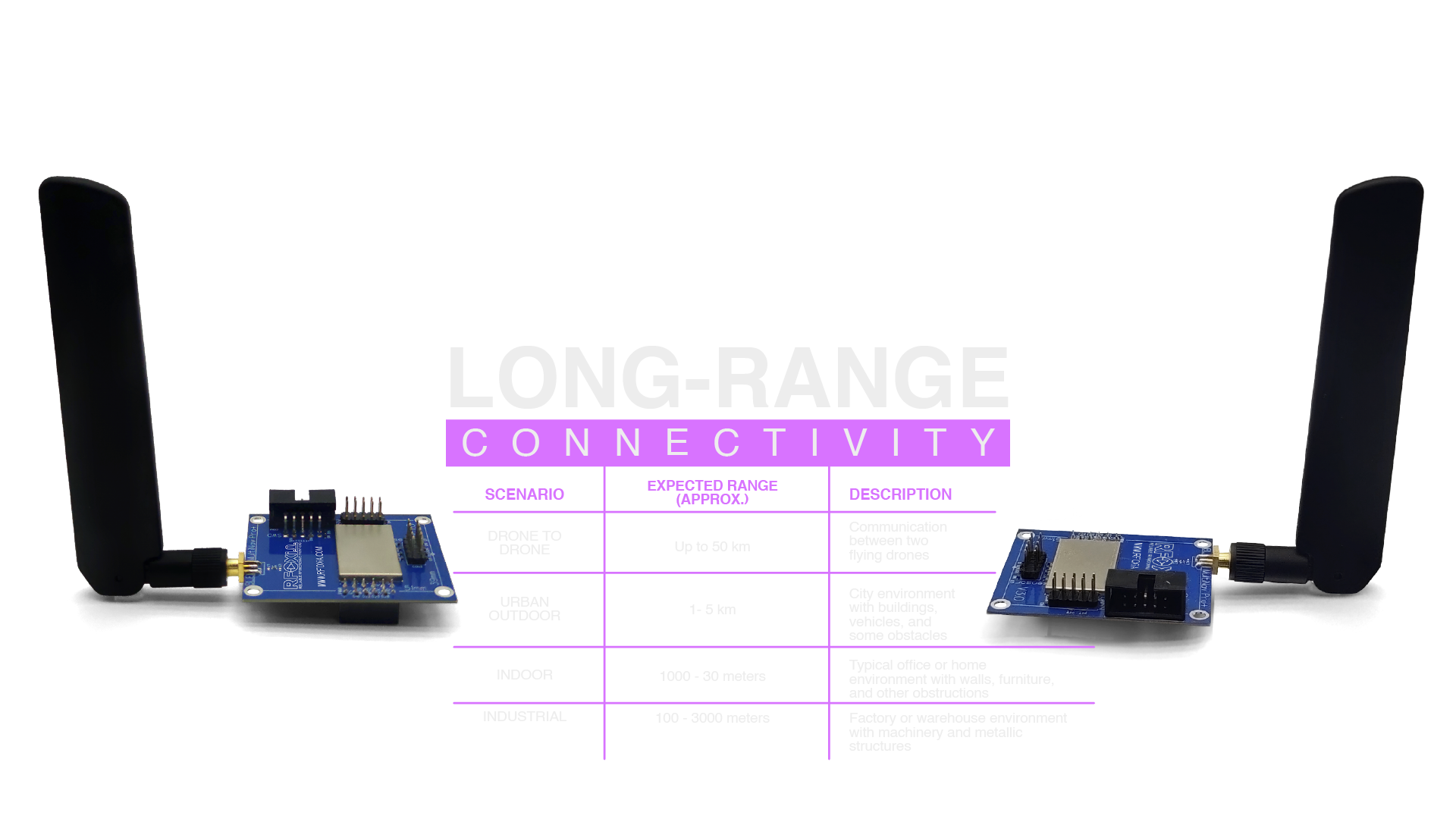
Here is how the range breaks down across deployment scenarios:
Ground-to-Ground (module paired with a smartphone on each end): Over 5KM of reliable communication between two people on the ground. This is already dramatically beyond any commodity BLE module on the market.
Man-to-Drone (one module on a smartphone, one module on a drone): 15 to 20KM of reliable link range. At this range, you can fly a drone far beyond visual line of sight and maintain a solid, low-latency data connection for telemetry, control, and sensor streaming.
Drone-to-Drone (both modules airborne, ground reflections eliminated): Beyond 50KM. When both endpoints are elevated, the RF signal travels line-of-sight without multipath interference from ground reflections, and the system achieves its maximum theoretical range. This is the specification that puts the MultiNav Pro+ in a completely different category from anything else available to makers and independent developers.
These numbers are not marketing estimates. They are achieved through a sophisticated RF front-end design, external amplifiers, and advanced receiver sensitivity engineering that simply cannot be replicated in a commodity $10 BLE module. The physics are real, the specs are verified, and the hardware is FCC certified.
Full Hardware Specifications
Every wilderness communication device maker needs to understand the technical foundation of the tools they build with. Here is the complete specification profile of the MultiNav Pro+ BLE Module:
| Specification | Value |
|---|---|
| Maximum Range (Drone-to-Drone) | 50KM+ |
| Maximum Range (Man-to-Drone) | 15-20KM |
| Maximum Range (Ground-to-Ground) | 5KM+ |
| Data Rate | 2 Mbps |
| Processing Core | STM32WB07CCV6 |
| Module Size | 57mm x 47mm |
| Fixing Frame Size | 54mm x 34mm |
| Antenna Length | 140mm |
| Fixing Holes | Corner-mounted, 51mm x 39mm spacing |
| Antenna Type | High-Gain Chip Antenna |
| RTC | Integrated crystal |
| Certification | FCC Certified |
| Price | $59 for 2 units |
| Firmware | Open Source (STM32WB07 platform) |
| Programming Interface | SWD |
The processing core — the STM32WB07CCV6 — is a dual-core ARM processor that manages the BLE stack and user applications simultaneously without performance tradeoffs. This architecture means you can run complex application logic and maintain a high-throughput BLE connection at the same time, which is essential for wilderness communication device maker applications where you need both communication and computation happening concurrently.
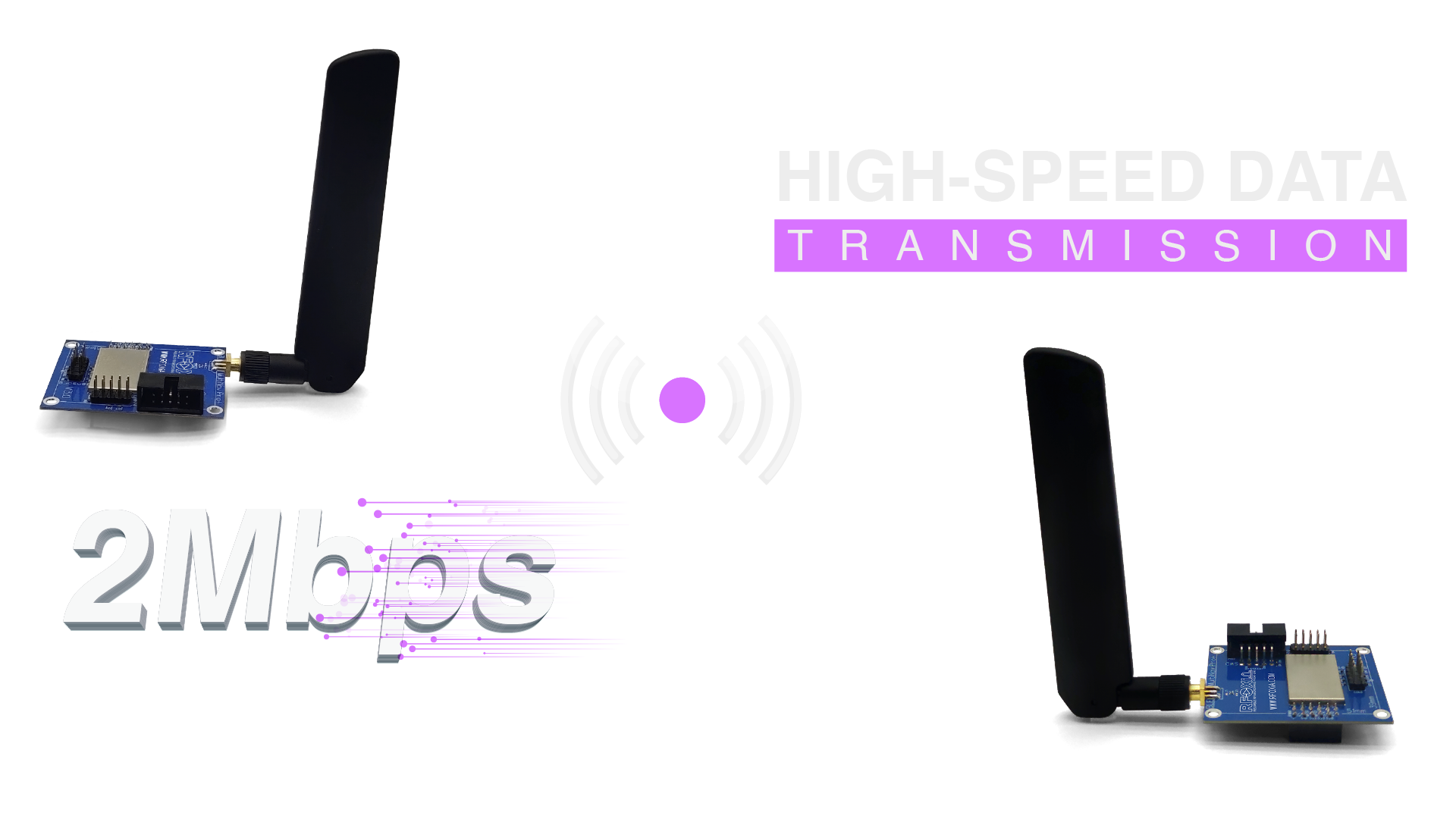
The 2Mbps data rate is particularly significant. At this bandwidth, you can stream real-time sensor telemetry, compressed video metadata, GPS coordinates, environmental data, and control commands simultaneously over a single BLE link — without the buffering, latency spikes, or packet loss that cripple lower-bandwidth wireless links in time-sensitive applications.
The Powerful Processing Core Behind the Range
Understanding why the MultiNav Pro+ achieves the ranges it does requires understanding what is inside the module.
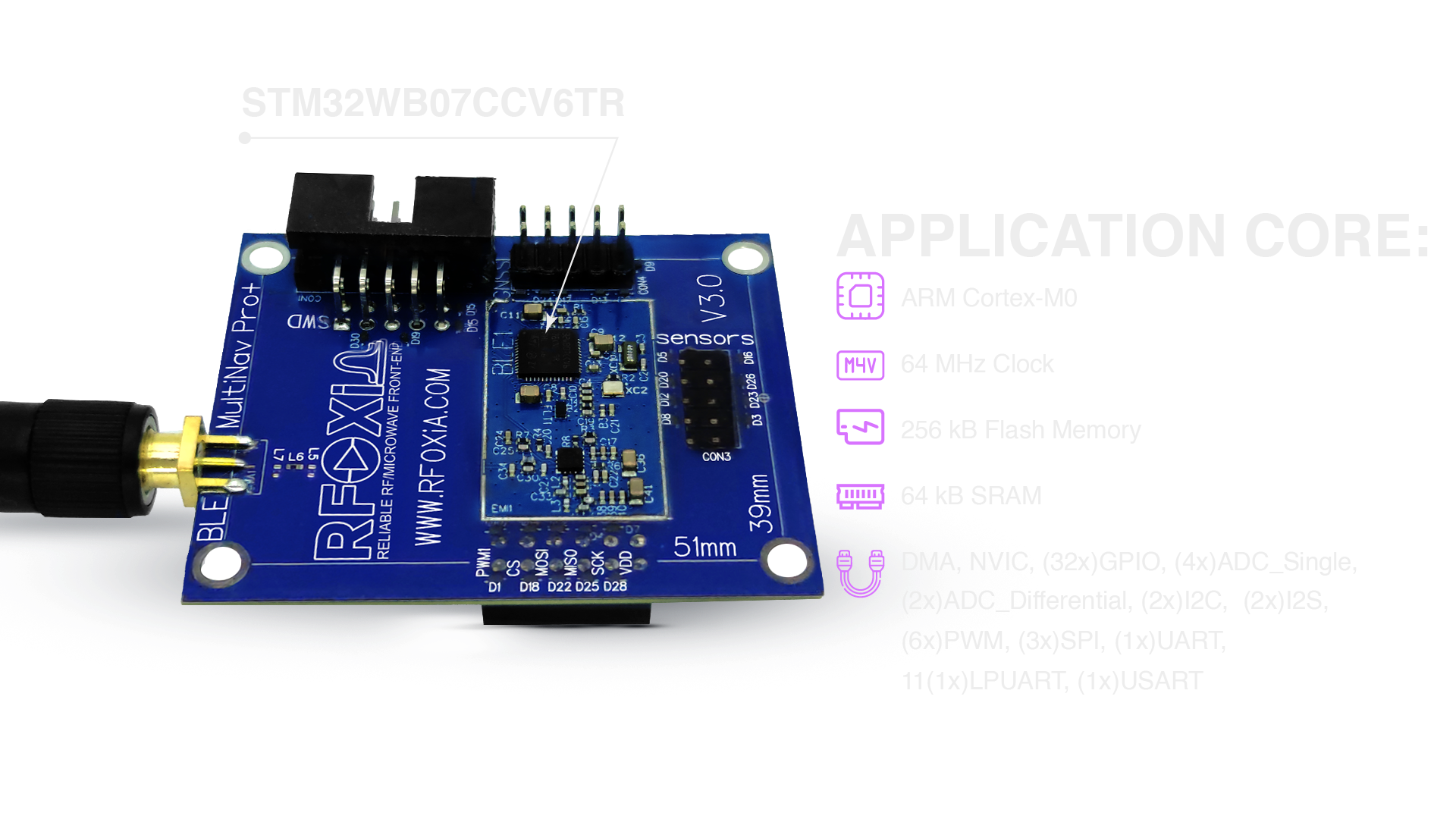
The STM32WB07CCV6 is not a generic BLE System-on-Chip. It is a dual-core wireless microcontroller from STMicroelectronics specifically designed for demanding BLE applications. One core manages the BLE protocol stack exclusively, while the second core runs your application firmware. This separation prevents the BLE stack from competing with your application code for processor time, which translates directly into more consistent timing, lower latency, and more reliable long-range communication.
The RF front-end adds external amplifiers on both the transmit and receive paths. Transmit amplification increases the effective radiated power. Receive amplification combined with advanced sensitivity optimization means the module can detect signals far weaker than any standard BLE chipset can process. The combination of higher transmit power and better receive sensitivity is what produces the remarkable range numbers — and the result is a link budget that commodity modules cannot match regardless of firmware optimization.
For the wilderness communication device maker, this means you can deploy nodes farther apart, use lower transmit duty cycles to preserve battery life, and still maintain reliable links in challenging terrain and RF environments.
Seamless Ecosystem Integration: More Than Just a Radio Module
Most long-range radio modules are just radios. You get RF in and RF out, and everything else is your problem. The MultiNav Pro+ BLE Module is designed from the ground up to integrate with the full RFOXiA hardware ecosystem, which means the complete capabilities of a professional wireless development platform are immediately available without custom integration work.
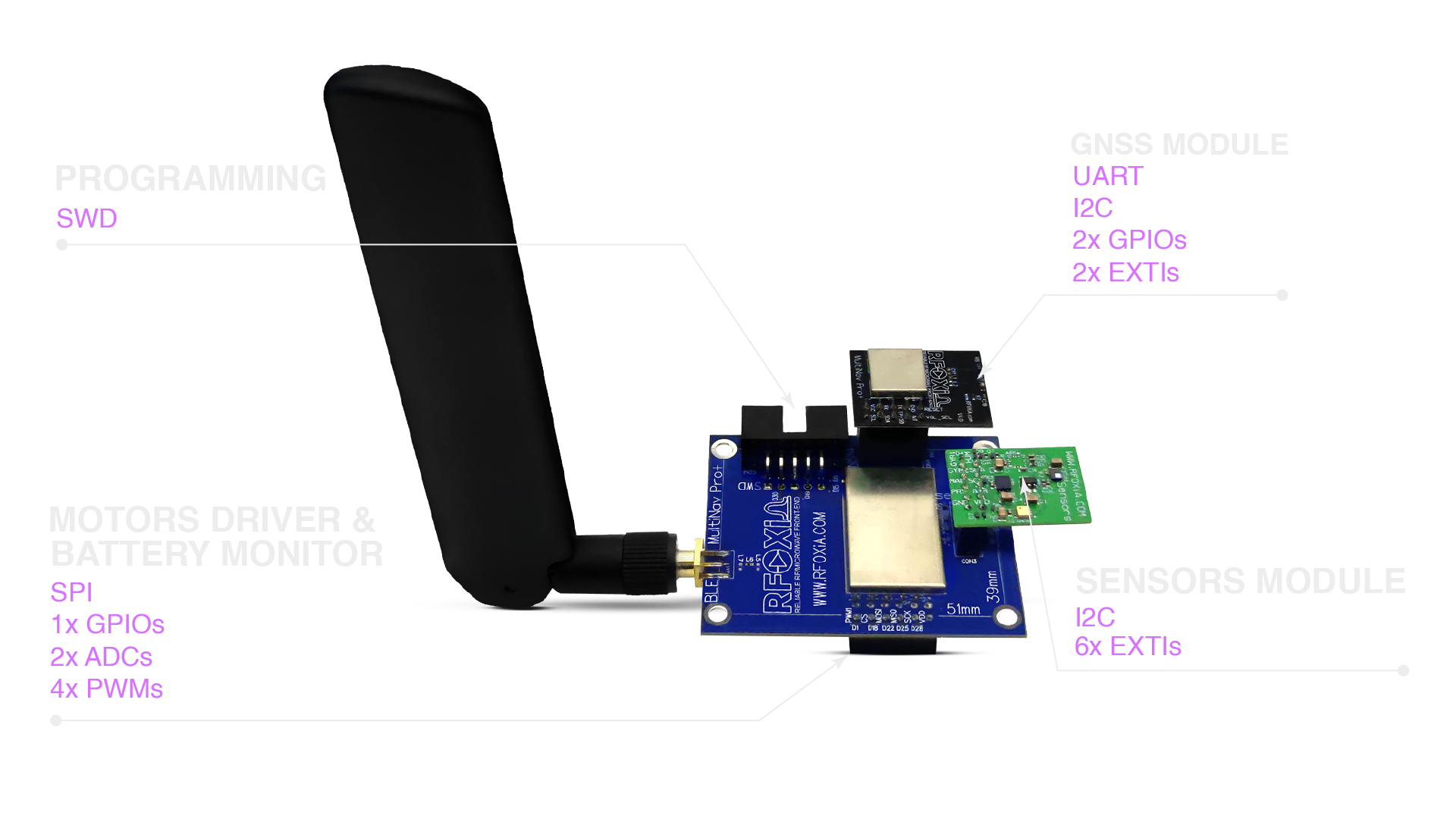
The MultiNav Pro+ BLE Module has four dedicated interface connectors:
GNSS Interface: Direct connection to the MultiNav Pro+ GNSS Module (1.5m accuracy, 18Hz fix rate). Position data flows directly into the BLE module and can be broadcast across the long-range link in real time — enabling live GPS tracking of remote nodes, drones, vehicles, or team members across the full 50KM range.
Sensors Interface: Direct connection to the MultiNav Pro+ Sensors Module (temperature, humidity, air pressure, air quality, accelerometer, gyroscope, magnetometer — 7 sensors total). For a wilderness communication device maker building environmental monitoring systems, this interface means you can deploy a complete environmental sensing node that reports all seven sensor values across a 50KM wireless link with no custom wiring or protocol translation.
Motors and Battery Management Interface: Direct connection to motor controllers and battery management systems. For drone builders and robotics developers, this means the BLE module can receive control commands from a remote operator and relay them directly to motor controllers — completing the drone control link without additional protocol conversion hardware.
Programming Interface: Integrated STLink-compatible SWD programming port for direct firmware development, debugging, and custom application deployment.
This four-interface architecture means that for most wilderness communication device maker applications, the MultiNav Pro+ BLE Module is the only development board you need to connect your sensors, navigation, power, and communication systems into a single coherent platform.
The RFOXiA Connect App: Your Wireless Dashboard
Hardware capability means nothing without software to surface it. The RFOXiA Connect app — available on both iOS and Android — is the command interface that transforms the MultiNav Pro+ from a radio module into a complete operational platform.
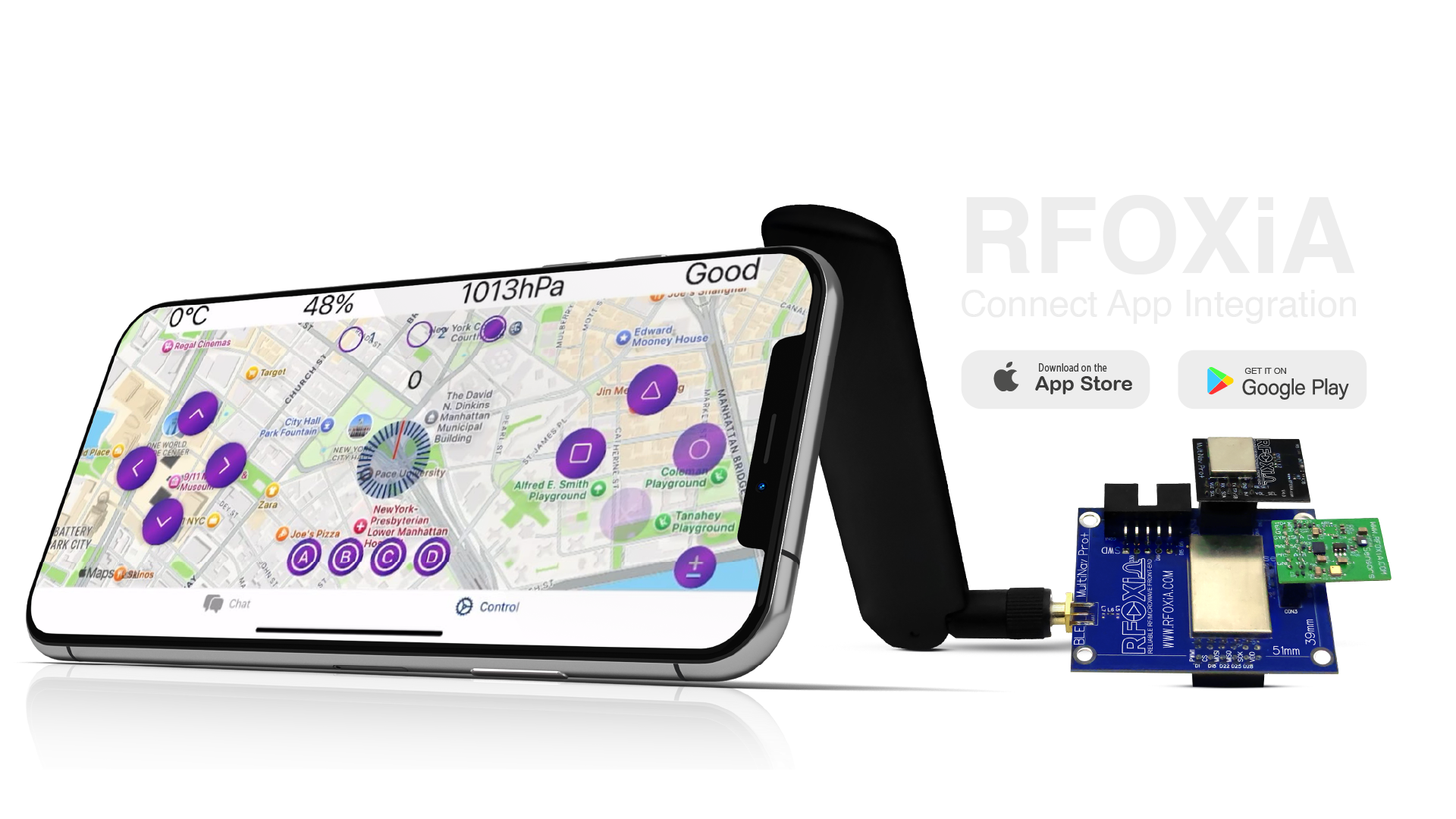
The app has two primary operational modes:
Control Mode: A PS5-style controller interface for drone and robot control, overlaid on a live map showing real-time GPS position of the remote module. Live sensor data — temperature, humidity, pressure, air quality, accelerometer, gyroscope, and magnetometer readings — stream continuously alongside the position data. The entire control interface works completely without an internet connection. Range is determined exclusively by the BLE module hardware — up to 20KM man-to-drone.
BLE Chat Mode: A long-range mesh communication interface that allows multiple MultiNav Pro+ users to exchange text messages, data packets, and voice calls completely without internet infrastructure. For wilderness communication device maker applications in disaster response, remote expeditions, or field operations, this mode creates an independent communication mesh that works anywhere the BLE modules can reach each other.
For a wilderness communication device maker, the combination of these two modes in a single app means you can simultaneously control a remote sensor deployment and communicate with your field team — all from your smartphone, all without a cell signal.
BLE Chat: Internet-Independent Mesh Communication
The BLE Chat functionality deserves special attention because it represents a genuinely novel capability for wilderness and remote-area applications.
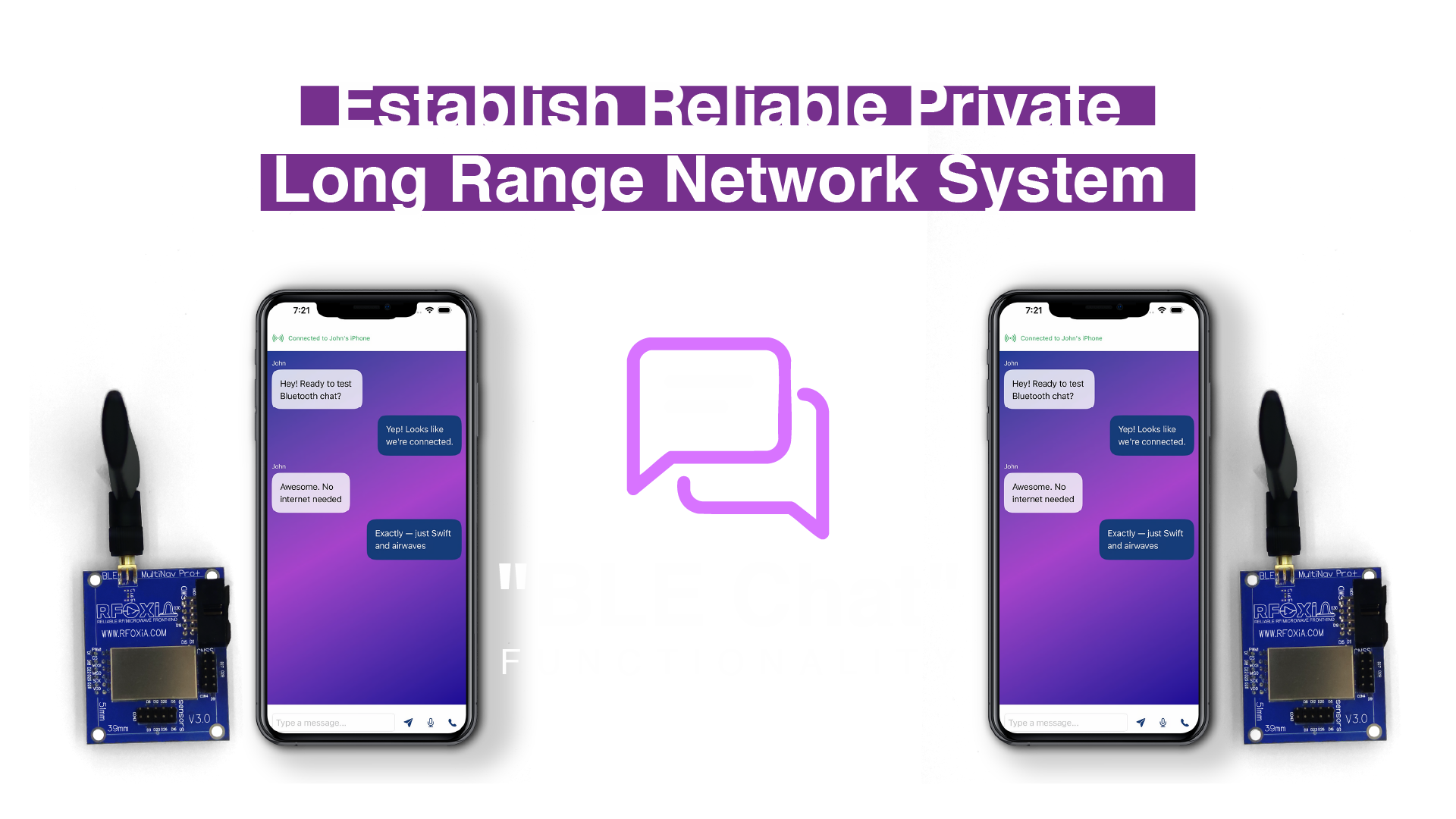
Every MultiNav Pro+ BLE Module can function as a communication node in a mesh network where messages hop from module to module across the full range of each individual link. In practice, this means:
- Two people 4KM apart on the ground can exchange text messages and voice calls using only their smartphones and their MultiNav Pro+ modules — no tower, no satellite subscription, no infrastructure of any kind
- A field team spread across 15KM of backcountry terrain can maintain a group communication channel with latency measured in milliseconds rather than the seconds common to satellite messenger services
- A drone operator can receive automated status messages from a remote sensor node and send configuration commands back — over the same BLE link used for GPS tracking and sensor streaming
For the wilderness communication device maker building systems for search and rescue, disaster response, military simulation, or remote expedition support, this is the capability that makes the MultiNav Pro+ genuinely mission-critical hardware rather than a hobbyist module.
Explore the RFOXiA Long Range Bluetooth Module and see the full specifications
Compact, Durable, and Designed for Field Deployment
A module that cannot survive field conditions is not a wilderness module. The MultiNav Pro+ BLE is designed for real deployment in real environments.
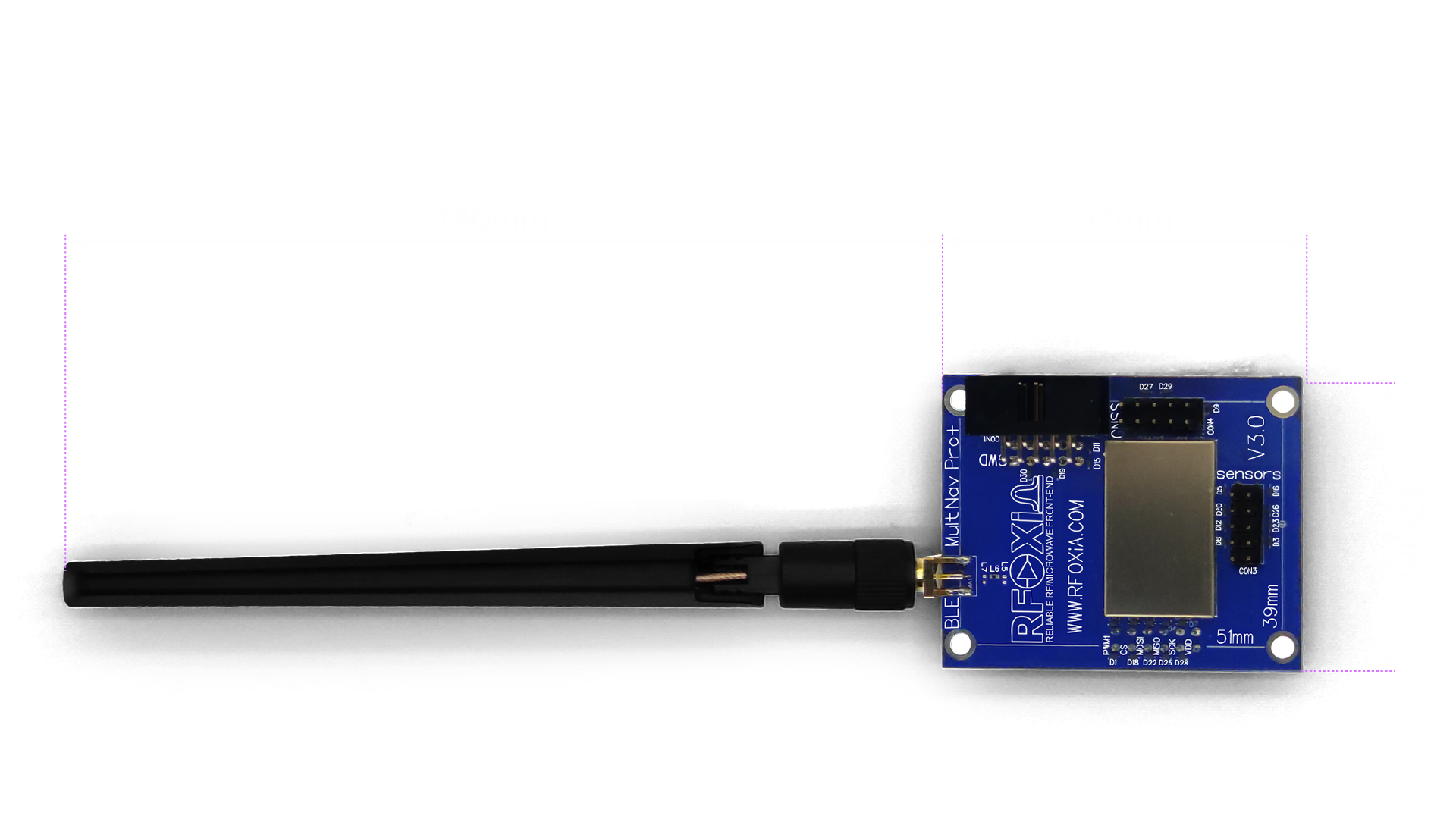
At 57mm x 47mm with a 54mm x 34mm fixing frame featuring corner mounting holes at 51mm x 39mm spacing, the module integrates cleanly into standard enclosures, drone frames, and custom PCB assemblies. The 140mm high-gain chip antenna is integrated — no external antenna connectors to loosen, no pig-tail cables to break, no protruding SMA connectors to snap off during a rough landing.
For the wilderness communication device maker working with drones, the compact form factor and integrated antenna mean you can mount the module in a clean aerodynamic position without the antenna-management complexity that plagues external-antenna designs. For ground-based sensor deployments, the corner mounting holes allow secure attachment inside weatherproof enclosures with standard M3 hardware.
The integrated RTC crystal deserves specific mention for time-sensitive wilderness applications.
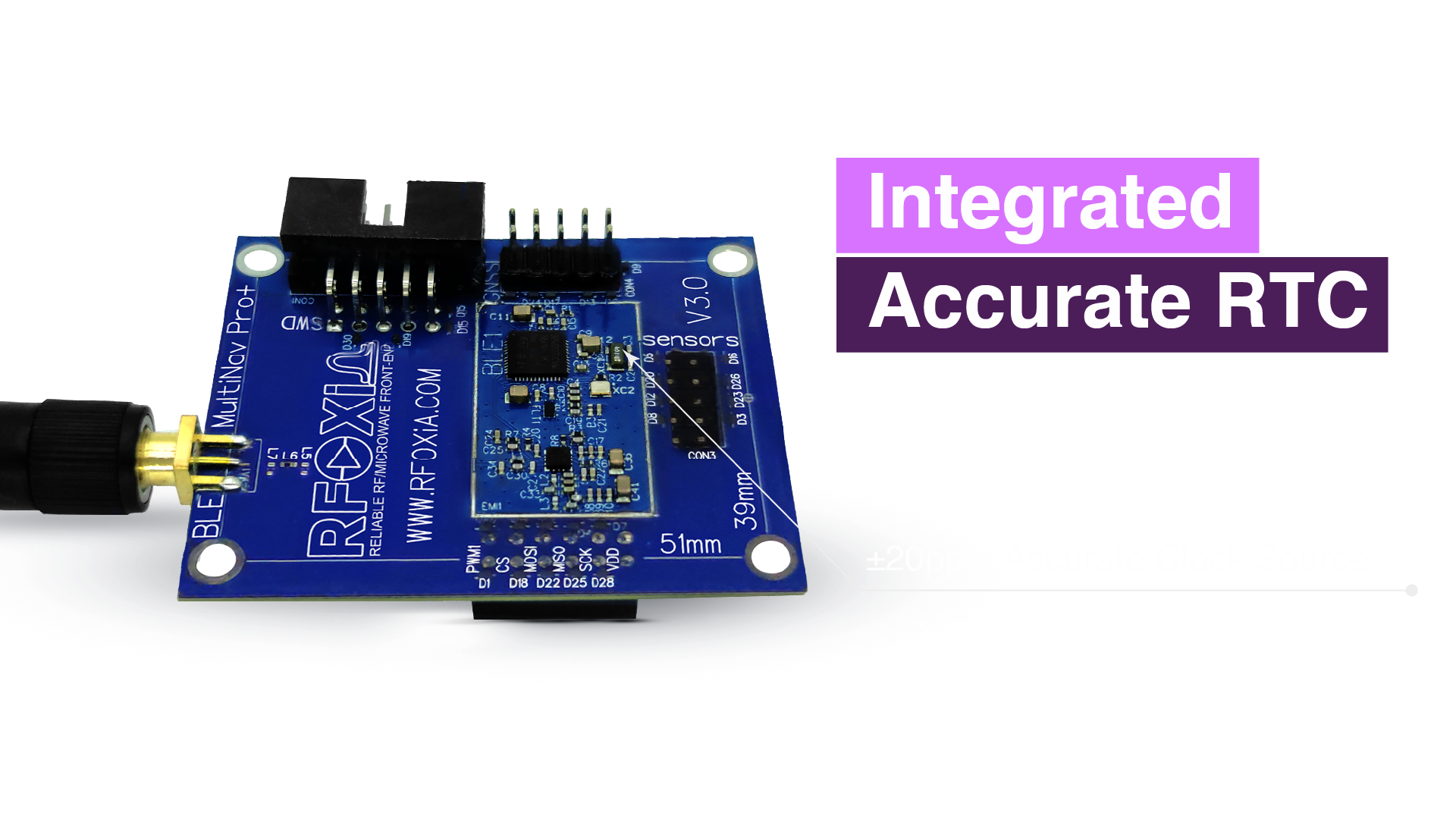
In multi-node networks where data synchronization matters — environmental sensor arrays that timestamp readings to the millisecond, search patterns where timing coordination is operationally critical, or data logging systems where post-mission analysis depends on accurate timestamps — the onboard RTC crystal provides the precise time reference needed without relying on GPS availability or network time synchronization.
Open Source, Fully Programmable, and Built for Customization
Every serious wilderness communication device maker eventually needs to go beyond what off-the-shelf firmware provides. The MultiNav Pro+ BLE Module is fully open source and fully programmable through the SWD interface, with the complete firmware repository available on GitHub.
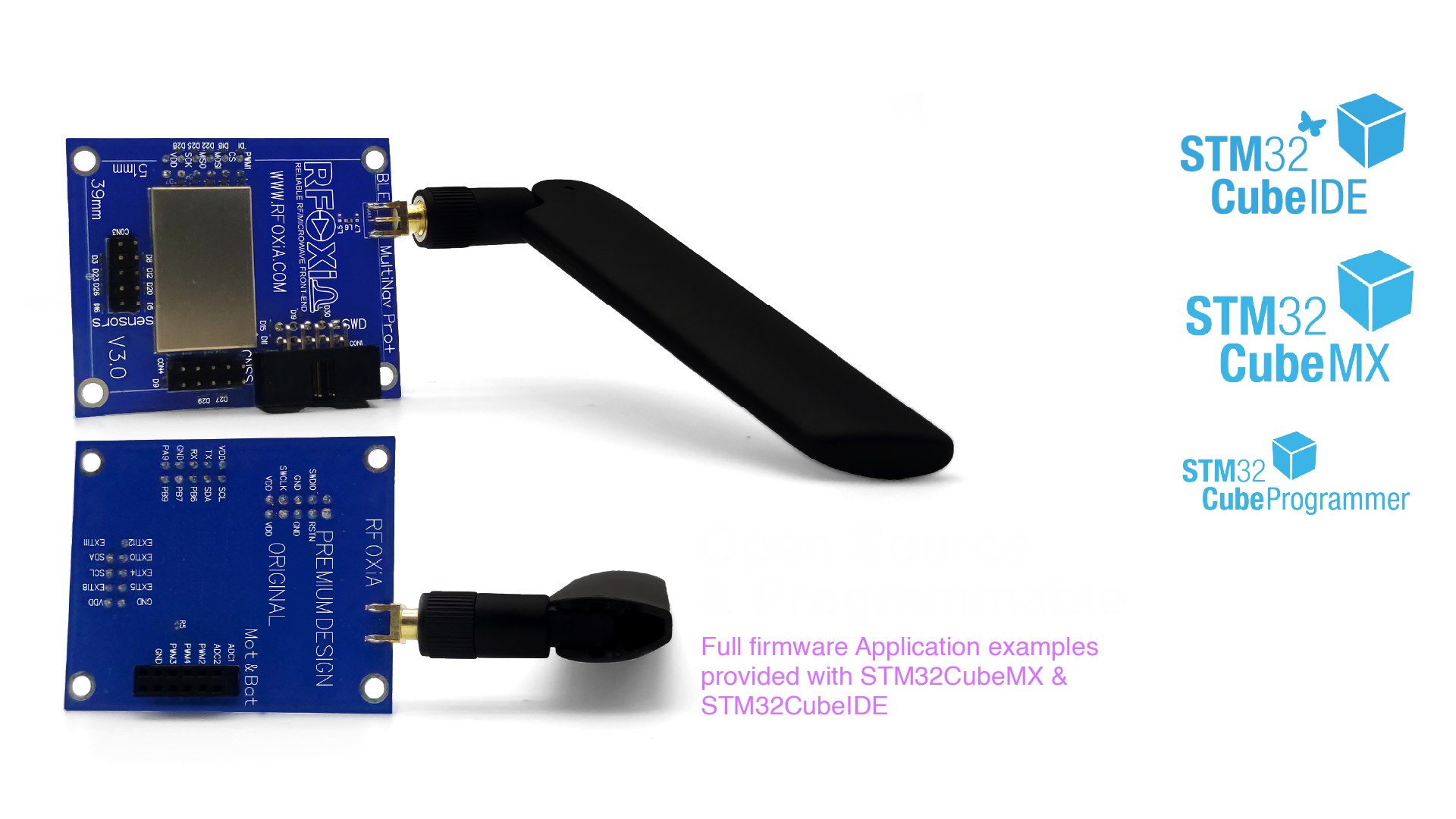
The firmware is built on the STM32WB07 platform using standard ARM toolchains. The complete source code — BLE stack integration, sensor drivers, GNSS parsing, application logic — is available at the RFOXiA GitHub repository. You can fork it, modify it, build custom application layers on top of it, and flash it back to the module in minutes using the SWD programming interface.
For makers who need a starting point without spending weeks on BLE stack integration, RFOXiA Club includes an AI Firmware Builder that generates production-ready custom firmware from a plain-language description of your application. Describe what you want the module to do — "stream GPS and sensor data every 500ms, respond to remote configuration commands, enter low-power mode between transmissions" — and the AI generates complete, compilable firmware that you can review, modify, and deploy.
This combination of full open-source access and AI-assisted firmware generation means the MultiNav Pro+ BLE Module can be adapted to virtually any wilderness communication device maker application in days rather than months.
Who Should Be Building with the MultiNav Pro+ BLE Module
The MultiNav Pro+ is not a general-purpose development board. It is purpose-built for a specific and demanding class of applications. The wilderness communication device maker community represents a natural primary audience, but the module serves anyone who needs reliable, high-bandwidth wireless communication beyond the reach of standard infrastructure.
Drone Builders and FPV Pilots: Long-range drone control with live GPS tracking and sensor telemetry. 20KM man-to-drone range gives FPV pilots a communication link that exceeds the practical range of most platforms. The 2Mbps data rate supports real-time control command streaming with latency low enough for aggressive flight.
Search and Rescue Teams: Mesh communication networks for field teams operating beyond cellular coverage. BLE Chat creates an infrastructure-independent team communication layer. GPS tracking through the Connect app gives team leaders real-time visibility of all deployed members and sensor nodes.
Field Researchers and Environmental Scientists: Long-range sensor network deployments with multi-node coverage across watershed-scale study areas. The Sensors Module integration puts temperature, humidity, pressure, air quality, and motion data on a 50KM wireless backbone.
Robotics Engineers: Long-range autonomous system control with real-time telemetry. The Motors and Battery Management interface creates a complete control link for ground robots, autonomous vehicles, and unmanned surface vessels.
Emergency Communications Preparedness Builders: Resilient communication infrastructure that works when commercial networks fail. The internet-independent mesh architecture of the MultiNav Pro+ ecosystem is specifically suited to emergency preparedness applications where infrastructure failure is the scenario being planned for.
Pricing, Availability, and the Developer Bundle
The MultiNav Pro+ BLE Module is available at $59 for two units — a price point that is genuinely without precedent for a module with these specifications and certifications.
For the wilderness communication device maker who wants the complete platform, the RFOXiA Developer Bundle combines the BLE Module, GNSS Module, Sensors Module, and Power/Program Kit into a single package at $199. The Power/Program Kit adds a supercapacitor-based power system with a 5-minute charge time and 24-hour runtime — eliminating the battery management complexity that complicates most field deployments.
All modules are FCC certified. All modules are in stock and shipping. The entire ecosystem is supported by the RFOXiA Club platform, which includes documentation, the AI Firmware Builder, the developer community, and the live device management dashboard.
New Club members receive a $10 welcome credit on signup — no hardware purchase required to join and start exploring the platform.
Final Assessment: The Definitive Module for Wilderness Communication Makers
There is no other module on the market — at any price in the maker-accessible range — that delivers 50KM of Bluetooth range, 2Mbps data rate, FCC certification, complete ecosystem integration, open-source firmware, and a mobile control application in a 57mm x 47mm package.
For the wilderness communication device maker, the MultiNav Pro+ BLE Module is not a compromise solution between commodity hardware and military systems. It is a professional-grade platform built specifically for the demands of remote, infrastructure-independent, mission-critical wireless applications — and it ships today for $59.
The barriers that have kept long-range wireless technology out of the hands of independent builders for decades are gone. The hardware exists. It is certified. It is affordable. And it is ready to be built into whatever you are imagining.
GitHub Repository: MultiNav Pro+ Long Range BLE Module Firmware
All specifications reflect verified hardware performance. FCC certification documentation available on request. Inventory in stock and shipping from Delaware, USA.
Written by: Moamen Mohamed LinkedIn